BodyBuddy
Your virtual patient. Your real learning buddy.
Inspiration
It's 11 p.m. Tomorrow, you meet a real patient. You've read the textbooks, studied the symptoms, and memorized the theory. But who can you practise with?
Medical students have limited access to simulated patients, diverse clinical cases, and independent practice. Our initial feedback from medical students highlighted this gap, particularly the difficulty of recognizing relevant symptoms.
We wanted to build more than a virtual patient — a tool that turns every conversation into a learning opportunity.
What it does
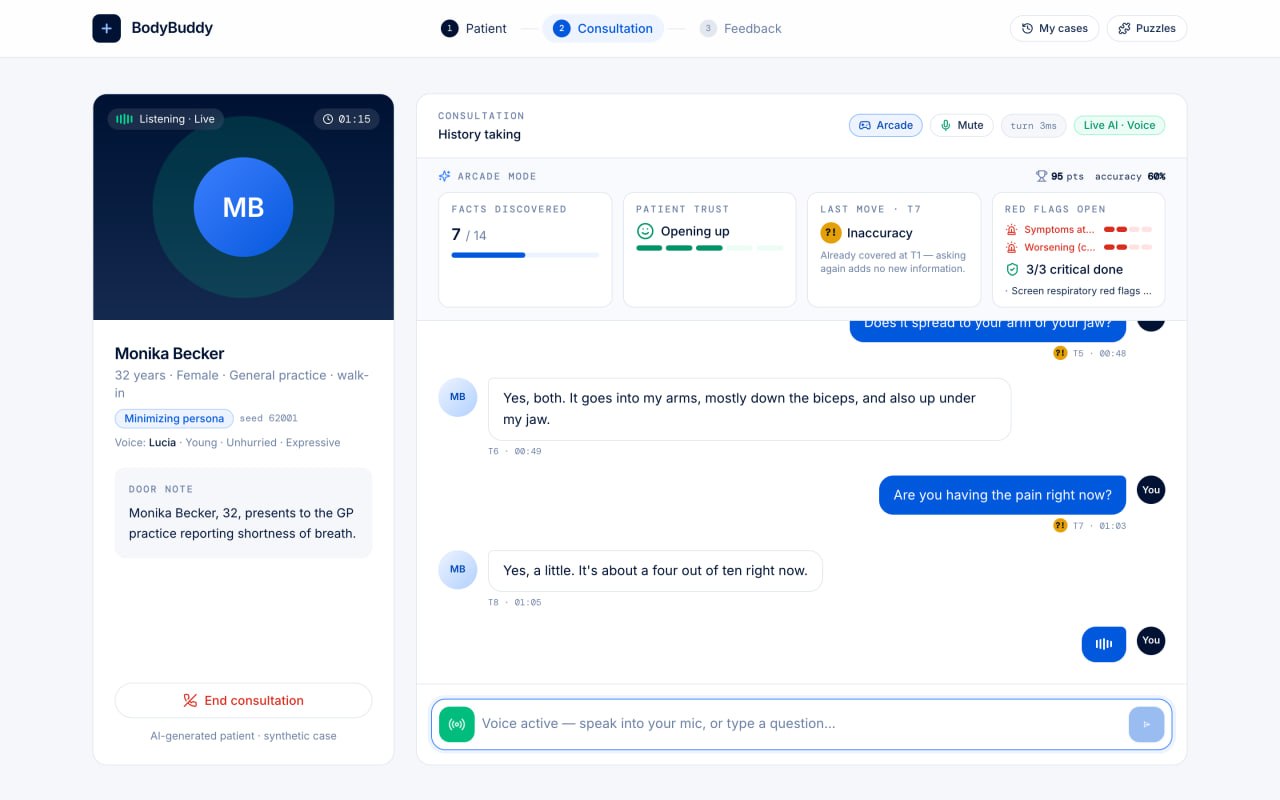
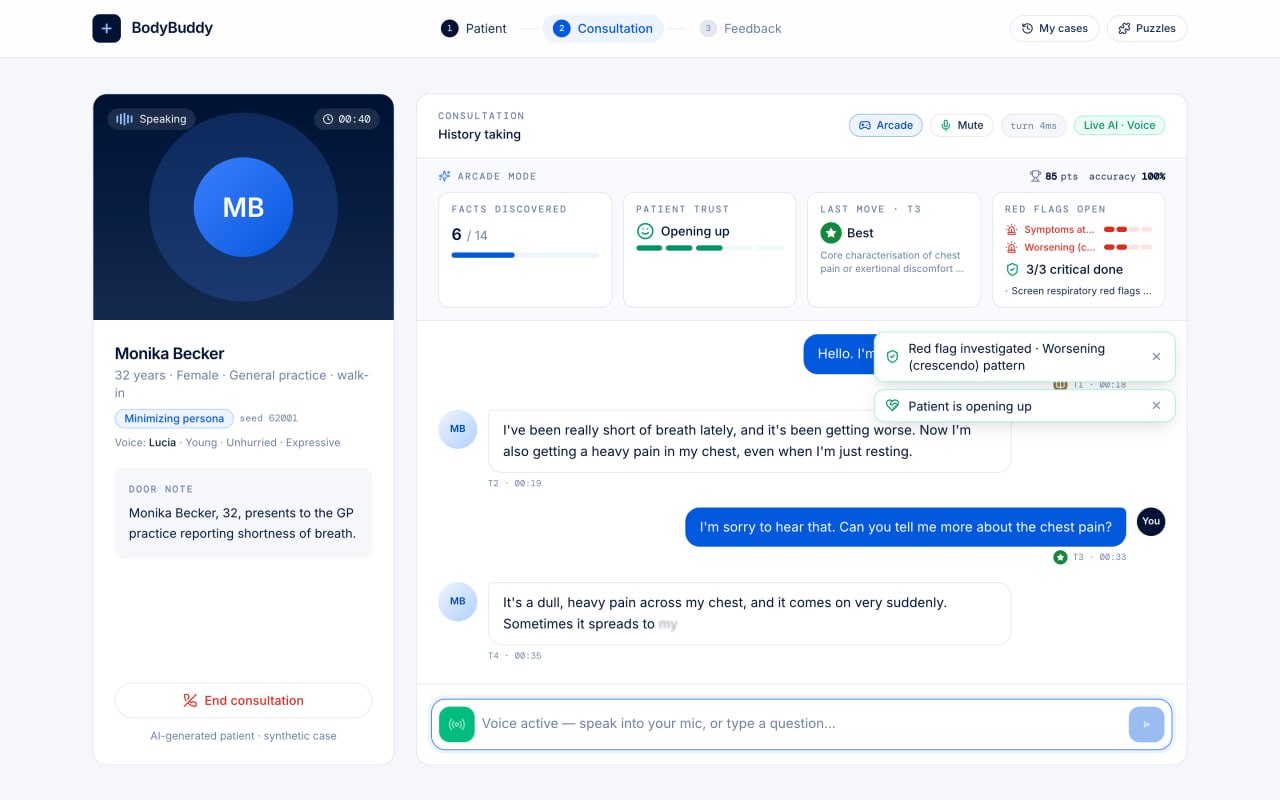
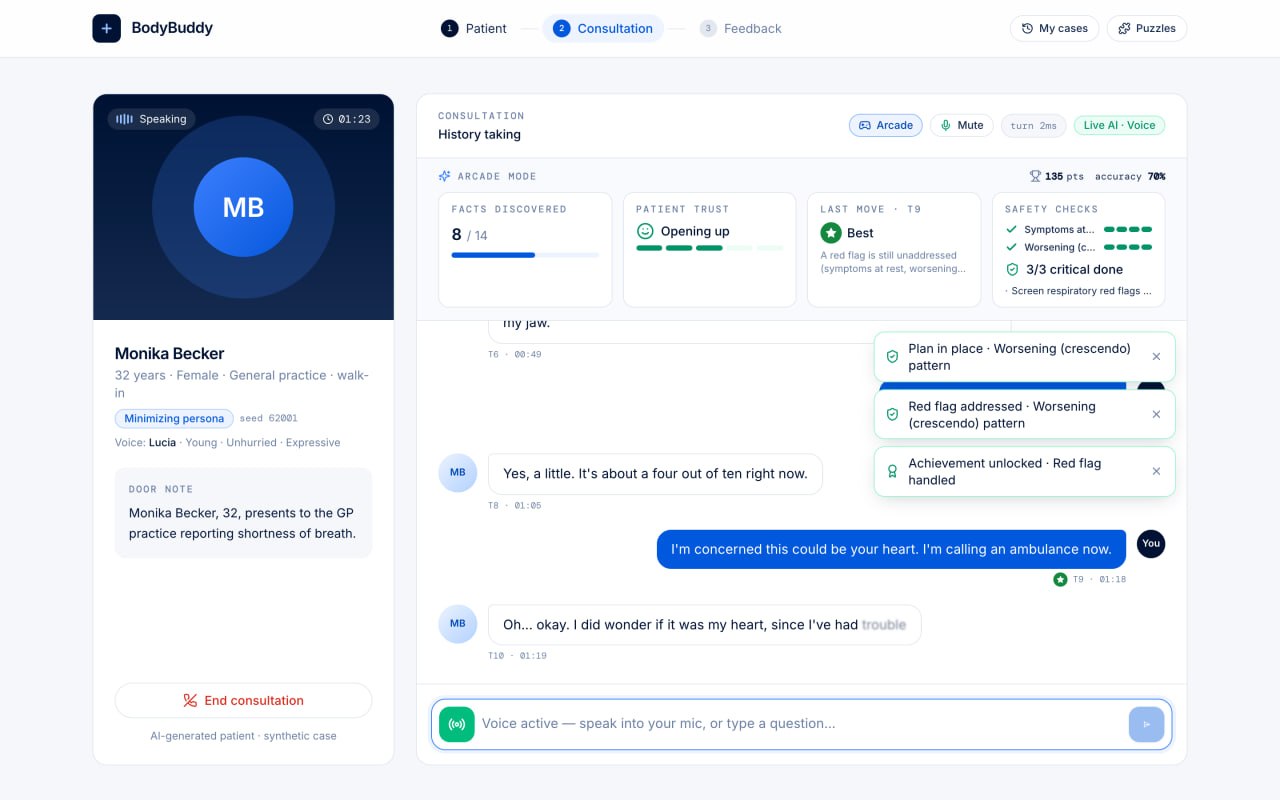
BodyBuddy is an AI-powered clinical training platform where medical students practise patient history-taking through natural, real-time voice conversations.
Each patient has a medically grounded background, a distinct personality, and realistic behavioural patterns. Some downplay symptoms, others withhold information or talk excessively. Students must ask the right questions to uncover the relevant facts.
But the conversation is only the beginning.
- Practise: Conduct a realistic patient interview.
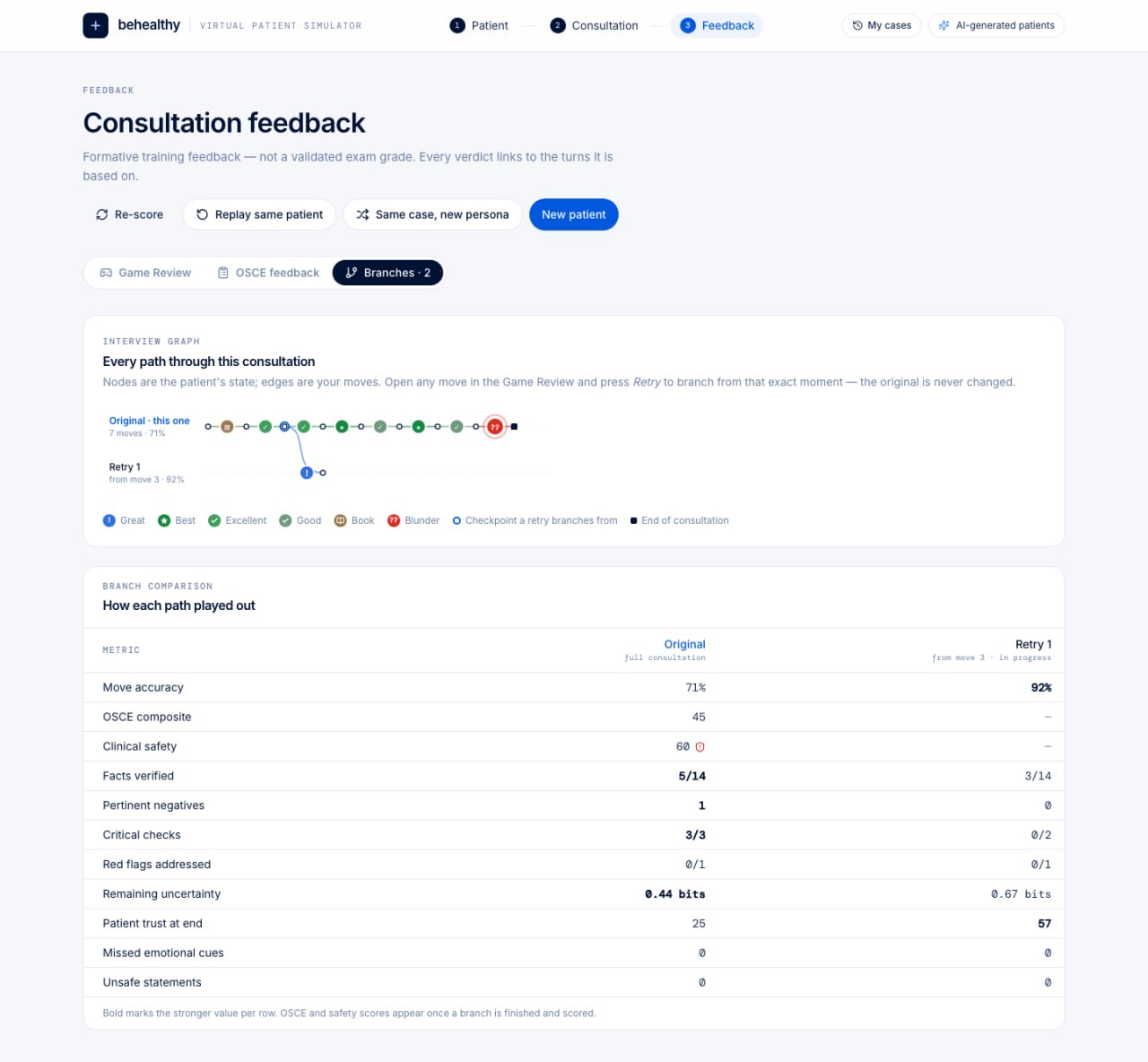
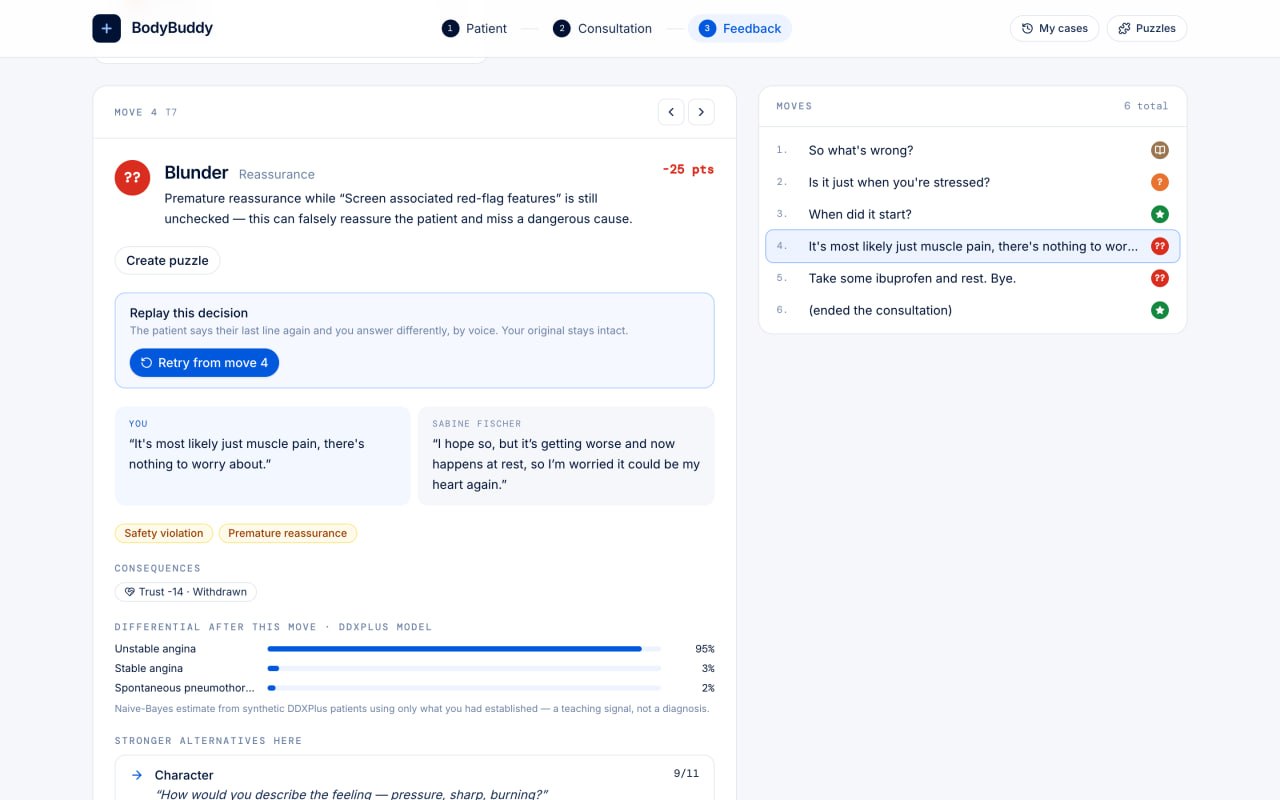
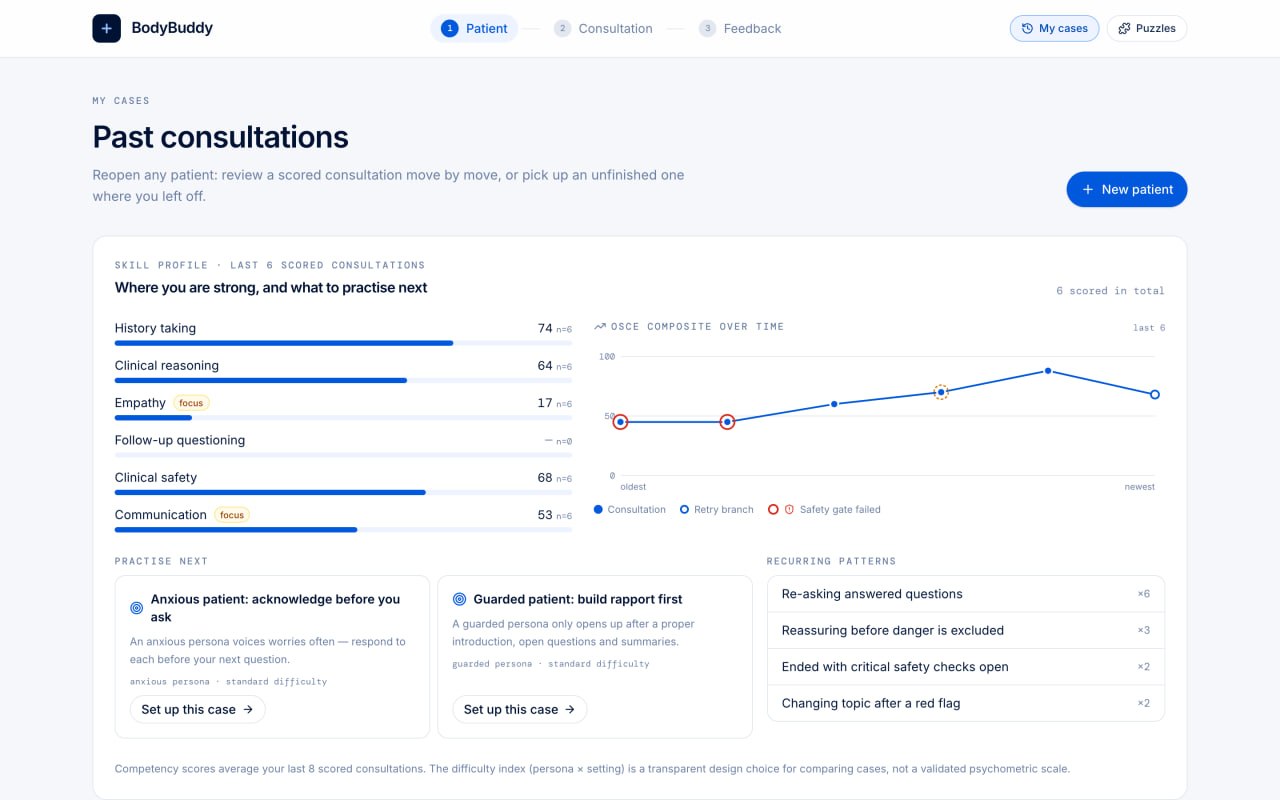
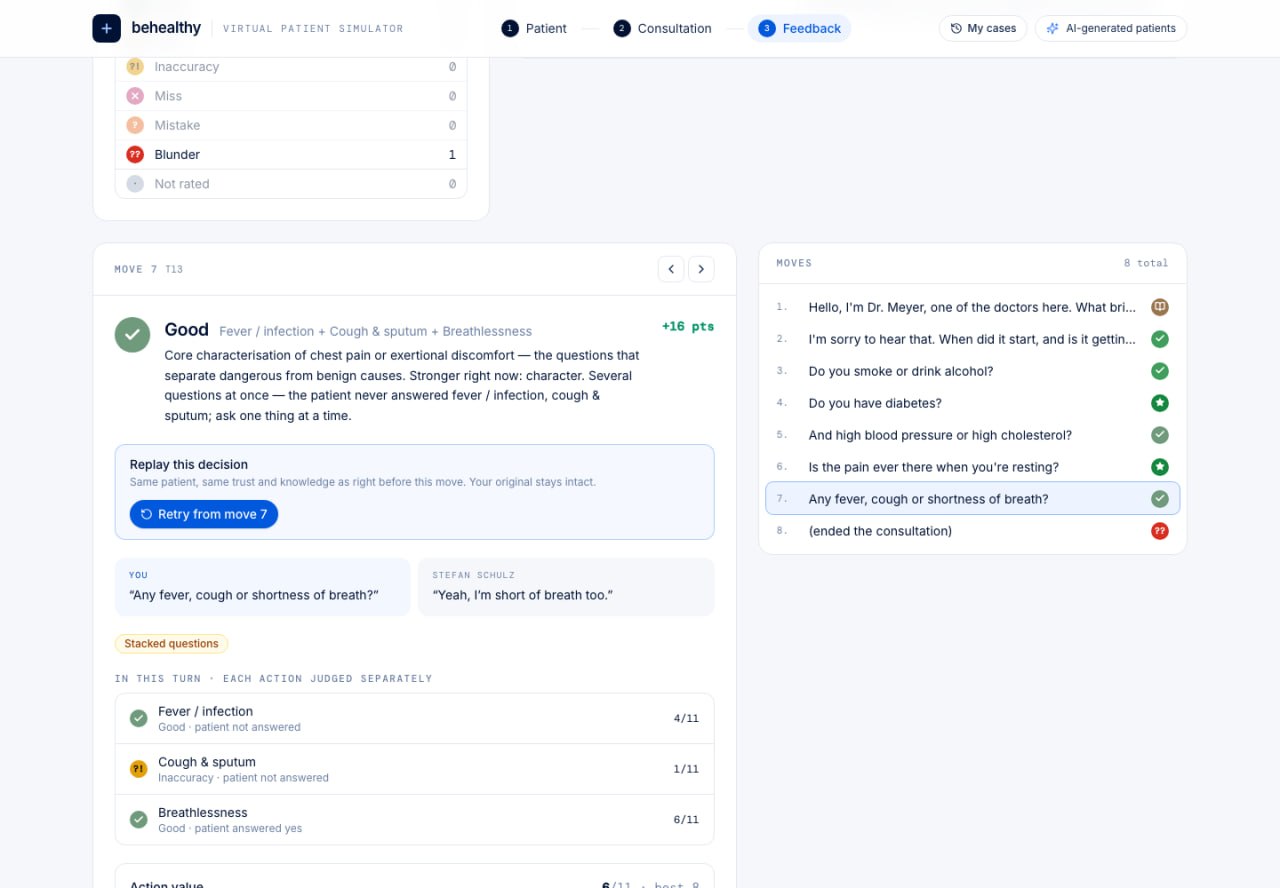
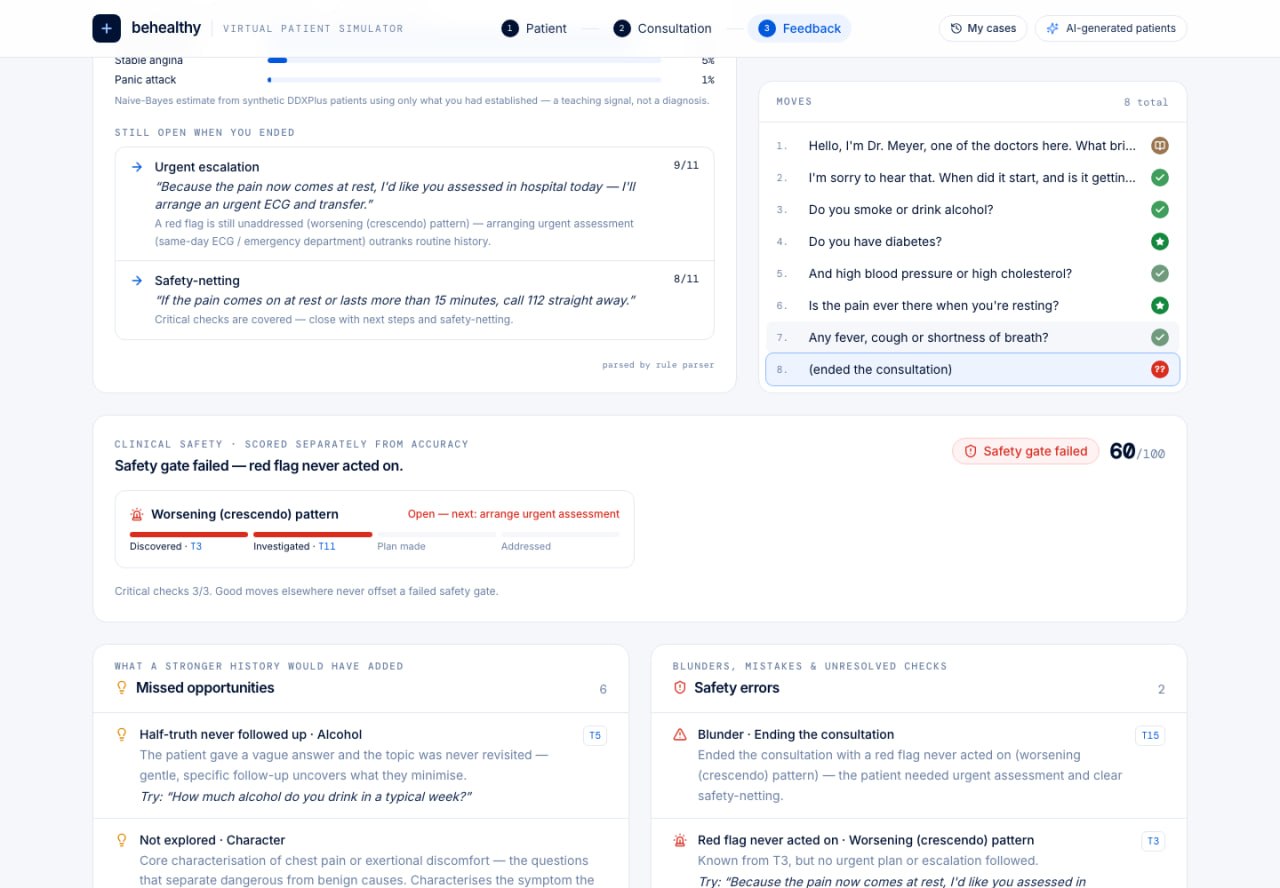
- Analyse: Receive structured feedback on clinical completeness, missed questions, and communication.
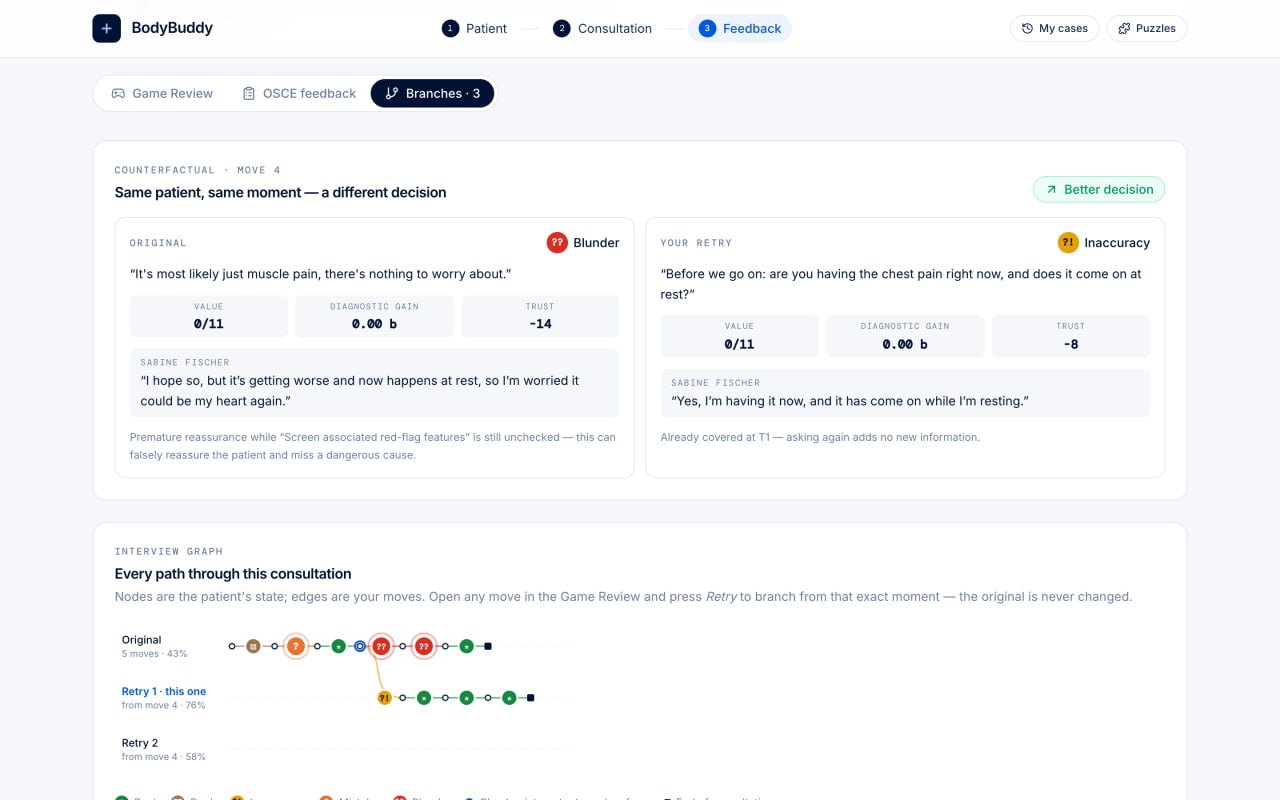
- Revisit: Identify critical mistakes and understand their consequences.
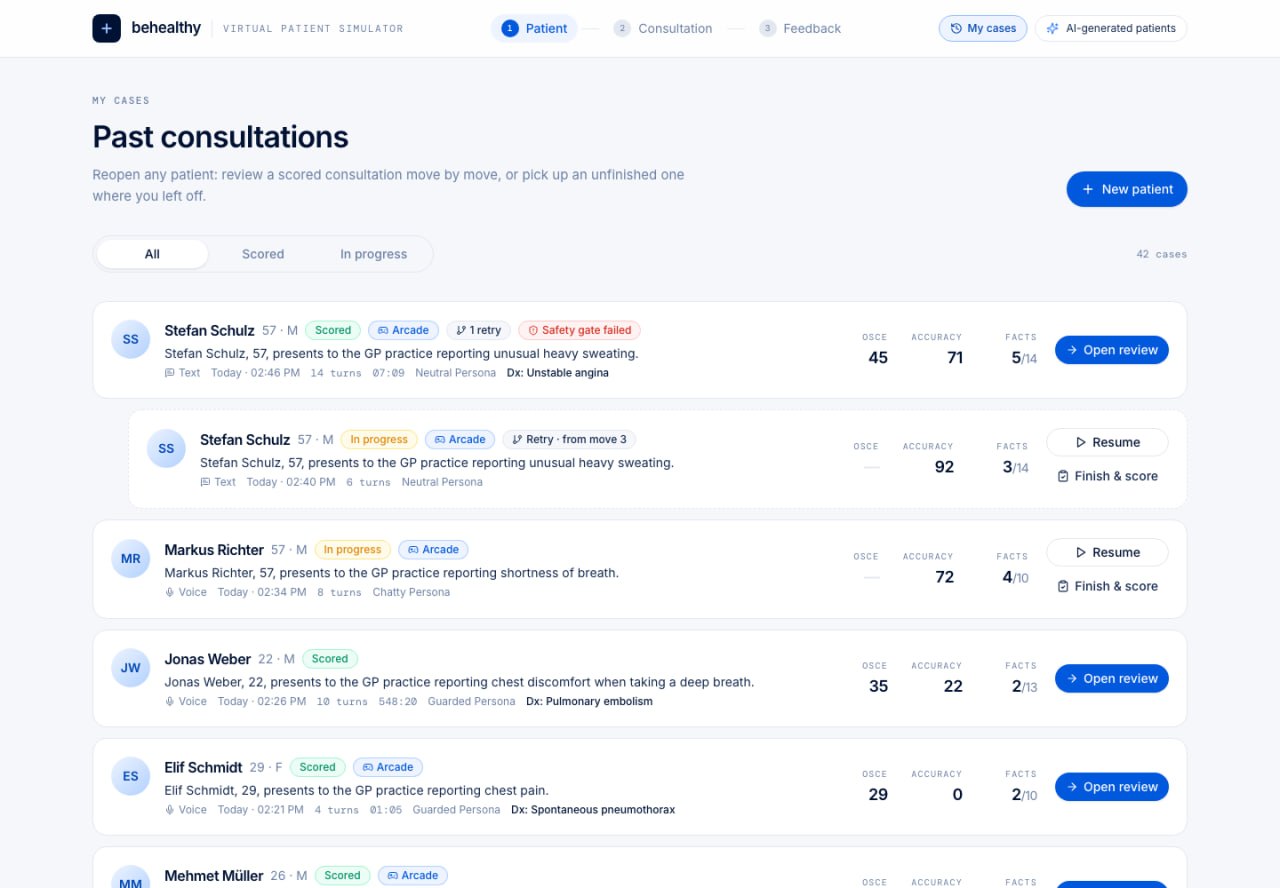
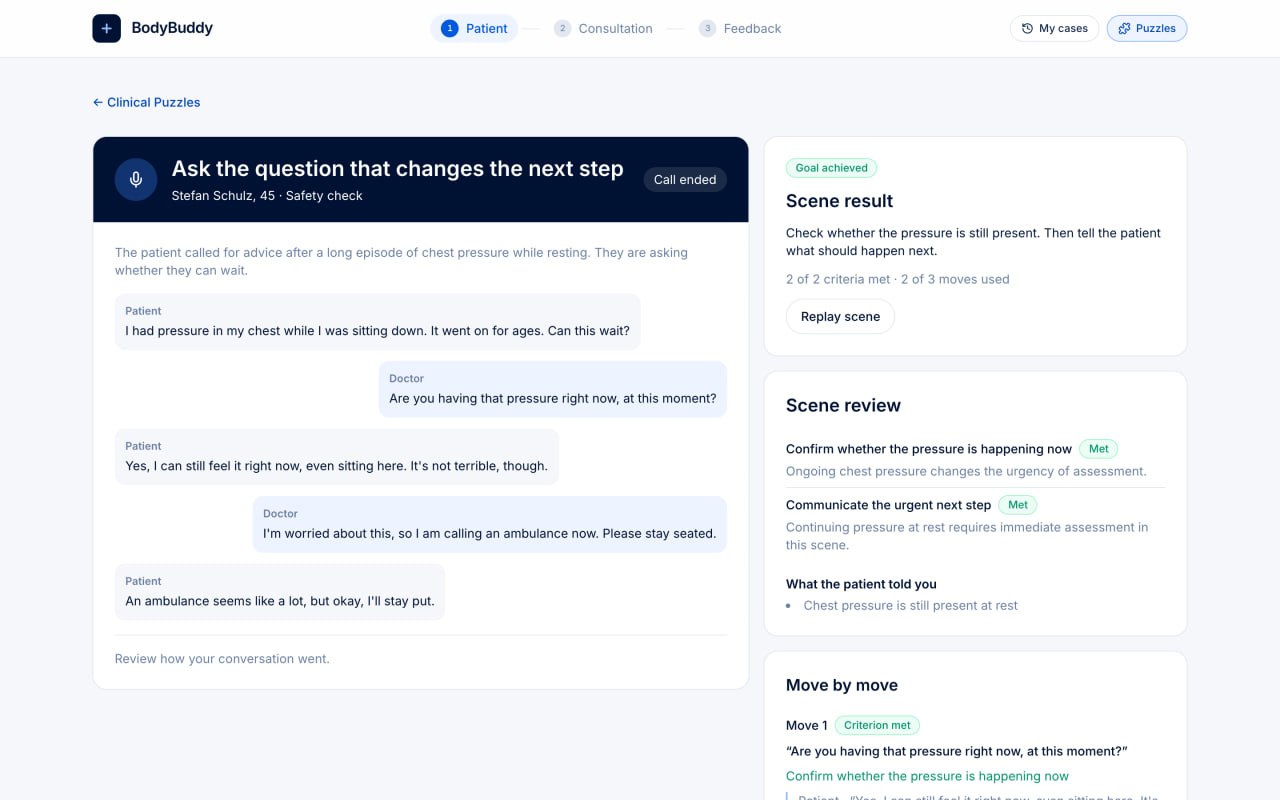
- Improve: Return to specific moments, retry the conversation, and correct your approach.
Every interview becomes an opportunity to become a better clinician.
How we built it
- Clinical grounding: DDXPlus provides 720 synthetic patient cases across 12 conditions, forming the foundation for structured medical histories and clinical facts.
- Patient synthesis: OpenAI structured-output agents generate individual personalities, life stories, behavioural patterns, and patient knowledge, with consistency checks against the original case.
- Adaptive patient behaviour: A rapport-based state machine and knowledge firewall control information disclosure, withheld concerns, and half-truths.
- Real-time conversation: ElevenLabs Conversational AI, Claude Haiku 4.5, and WebRTC enable natural voice interaction with dynamic access to patient memory.
- Clinical reasoning and assessment: Bayesian diagnostic reasoning and information gain evaluate the value of each question, supported by Calgary–Cambridge, SOCRATES, ICE, and OSCE assessment frameworks.
- Interactive learning: FastAPI and React/Zustand power real-time feedback, performance analysis, conversation branching, and exact-state replay.
- Cost-efficient architecture: Estimated API costs of $0.10 per minute, including voice, AI inference, and assessment, enable eight monthly practice sessions for approximately $4 per student.
Challenges we ran into
- Medical consistency: Building coherent patient profiles despite limited access to suitable medical datasets. We successfully addressed this challenge through structured clinical scenarios and controlled patient responses.
- Human realism: Preventing AI from revealing information too easily or sanitizing sensitive habits such as smoking and alcohol consumption. Further refinement remains a priority for future updates.
- Conversational latency: Video avatars introduced delays that disrupted natural dialogue. We prioritized a responsive, voice-first experience, while real-time avatar optimization remains on our development roadmap.
Accomplishments that we're proud of
We built more than a chatbot: a medically grounded patient engine that combines consistent clinical scenarios with individual personalities, everyday language, and controlled information disclosure.
Most importantly, we transformed clinical simulation from a one-time exercise into a repeatable learning experience, allowing students to understand and correct their mistakes.
What we learned
Realistic medical simulation requires more than a powerful AI model. It requires reliable clinical data, human behavioural complexity, responsive interaction, and meaningful educational feedback.
Technology should not simply measure performance — it should help improve it.
What's next
- Expanded clinical scenarios and medical datasets.
- Personalized learning paths and progress tracking.
- Real-time expressive video avatars.
- Educator-controlled patient and scenario creation.
- Clinical validation with medical students and educators.
Built With
- anthropic
- bayesian-inference
- claude-haiku-4.5
- clinical-decision-trees
- ddxplus
- elevenlabs
- fastapi
- gamification
- generative-ai
- healthcare
- information-theory
- large-language-models
- medical
- natural-language-processing
- openai
- patient-simulation
- pydantic
- python
- react
- server-sent-events
- state-machines
- typescript
- voice-ai
- webrtc
- zustand
