
An autonomous ML research agent that writes the code and reports what failed
Track 2: Autonomous ML Research Agent for Recommender Systems
Task: KuaiRand-Pure, within-user ranking of logged impressions. Label long_view.
Metric: primary = mean(GAUC, nDCG@5).
Tagline
A research loop whose actuator is an edit to a source tree, not a choice from a menu of hyperparameters, with a signed, pre-registered ledger that makes every claim in this write-up checkable, including the ones that make the agent look bad.
What it does
Each iteration, the agent:
- proposes six competing hypotheses, one per research lane: architecture, objective, sampling/training, features, optimisation/regularisation and ensembling. A judge ranks them and funds exactly one;
- writes the code for the funded hypothesis, editing any of
config.json,features.py,model.py,train.pyin a mutable workspace; - pre-registers the hypothesis, the resulting tree hash and the harness-computed diff in a signed ledger before the candidate is allowed to run;
- fits and scores it in a sandbox that cannot read held-out labels;
- reflects, updating a structured belief keyed by mechanism, recording whether the mechanism was supported or contradicted and under what condition it should be retried.
The champion is immutable and advances only on a signed validation improvement, so a bad run can spend budget but cannot damage the submission.
How I built it
The actuator is a diff, not a menu. The predecessor exposed 16 typed actions, 14 of which were hyperparameters, which is the definition of a naive baseline tweak. Here the agent returns source files; the harness computes the parent→child diff itself and never trusts a diff supplied by the model.
Content-addressed artifacts. Every candidate tree is stored under its own length-prefixed
hash, so runs/artifacts/<sha256>/source/ holds the exact code that produced every number in
this document. The full source deliberately does not go in the ledger: the signed record cap
(12,288 bytes) is smaller than the legal patch cap (24,000), so a large proposal could not record
itself and the failure would be silent.
Pre-registration, then execution. Entries are HMAC-signed and hash-chained. The ordering is enforced, not conventional: a candidate that fails to register aborts instead of running, which is what stops a result from being written after the fact.
Two seed profiles, to keep an honest distinction. inherited ships with a working pairwise
implementation; minimal is pointwise-only and reproduces the official baseline
byte-identically. On minimal, any ranking objective has to be written by the agent rather
than switched on. This is how I found out what the agent can actually implement (see below).
Multi-seed confirmation, with the seed list pre-registered. A single-seed promotion is a search decision. Only paired multi-seed results are quoted as findings, and the exact seed list is recorded before the first fit so it cannot be chosen after seeing the outcome.
Results
The submitted champion, from a compliant run under the official stopping rule:
| signed validation primary | 0.604074 (GAUC 0.670569, nDCG@5 0.53758) |
| vs published baseline (0.6016) | +0.002474 at the run's seed |
| paired 20-seed confirmation | +0.001888, t = 11.50, wins 20/20 |
| train/dev gap | 0.044325 |
| manual interventions | 0 |
For scale: the seed standard deviation on this task is 0.0008, and a per-user oracle ceiling is 0.8645, so real gains here are small, and a headline number without a paired multi-seed test behind it is not a result.
An independent run reached the same place by a different route. A later compliant run
converged in 3 iterations on a structurally different configuration: no user_hist_len,
neg_per_pos: 1, l2: 1e-05, plus a cosine decay schedule it wrote into train.py itself. It
confirmed at +0.001845, t = 11.12, 20/20. Compared directly against the submitted champion
over the same 20 seeds: −0.0000433, t = −0.31, 13/20 to 7/20. Statistically
indistinguishable, so the frozen champion stands and the rerun is reported as corroboration.
That convergence is the most useful scientific finding here: pairwise ranking is the dominant observed lever, and two materially different surrounding configurations built on the same pairwise implementation land within 0.00005 of each other.
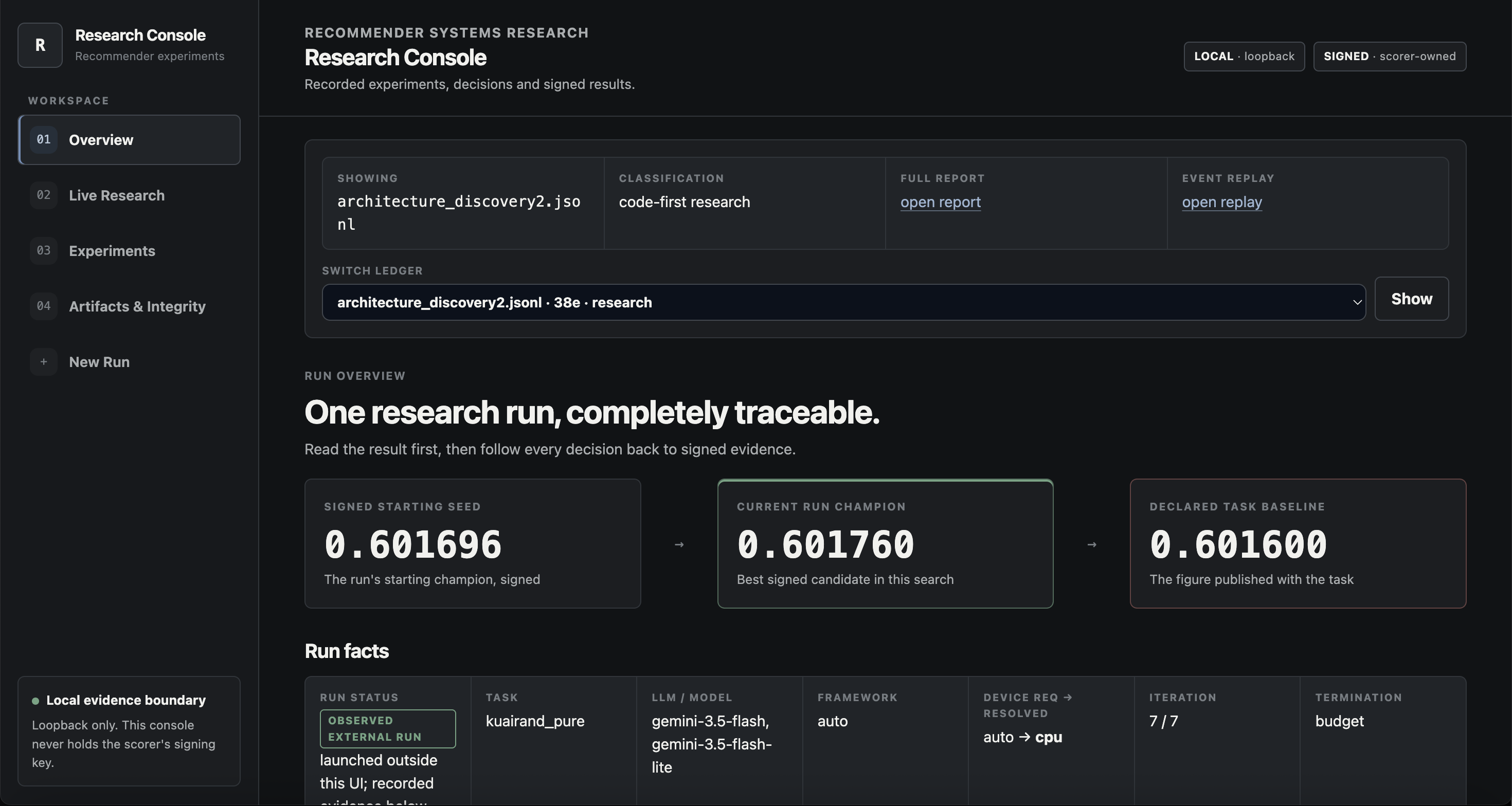
A stronger-tier architecture discovery run did not beat it. Gemini 3.5 Flash planned and
judged a seven-iteration diagnostic run from the pointwise-only minimal seed. It considered 32
signed hypotheses, trained four candidates, and autonomously wrote a PyTorch DeepFM across
model.py, train.py and config.json. DeepFM scored 0.572274 (−0.029422) and widened the
train/dev gap from 0.0852 to 0.1498, so it was rejected. A rank-based checkpoint ensemble was the
only promotion, at +0.000064. This was valid but negligible and still well below the frozen 0.604074
champion. The run used 301,168 tokens and ended with one timeout, one incomplete provider
response and one free-tier quota error; all three failures are retained in the 38-entry signed
ledger.
Resource usage
The final submitted model was produced by the compliant trial_4 run under the official
convergence rule. It converged after 5 iterations, using 103,059 total LLM tokens and 0.07 hours
of agent wall-clock time (approximately 4.2 minutes), with 0 GPU-hours and 0 manual
interventions.
Technology and data
- Development tools: Codex, Claude Code, Git and GitHub
- LLM API: Google Gemini API
- Languages and libraries: Python, NumPy, pandas, PyTorch, HTML, CSS and JavaScript
- Dataset: KuaiRand-Pure, using only the organizer-defined training split and
long_viewlabel - Hardware: MacBook CPU; no GPU was used for the submitted run
Challenges: the parts that failed
This is the section I would most want a judge to read, because the failures are better evidence that the loop is real than the +0.0019 is.
The agent's own BPR implementation was broken, and the harness caught it. On the minimal
profile the agent wrote step_bpr plus per-user negative sampling across model.py and
train.py, creating a genuine multi-file implementation from a pointwise-only start. It scored
−0.206874, far below the 0.5 random floor, with train (0.3156) worse than validation
(0.3948). The defect: the optimiser expects dLoss/dz and descends, but the BPR step passed
+σ(−diff) to positives and −σ(−diff) to negatives, where the true gradients are the
opposite sign. It therefore performed gradient ascent, training the model to rank negatives
above positives. The per-epoch curve confirms it: training loss rose monotonically
0.738 → 11.165 across 30 epochs. The tree and its source are retained in the repository.
The reflector diagnosed it vaguely. It recorded "improper gradient alignment or sampling mismatch" at confidence 0.95. This was directionally near, but it did not identify the sign inversion, and nothing aborted a run whose loss had been climbing since epoch 2.
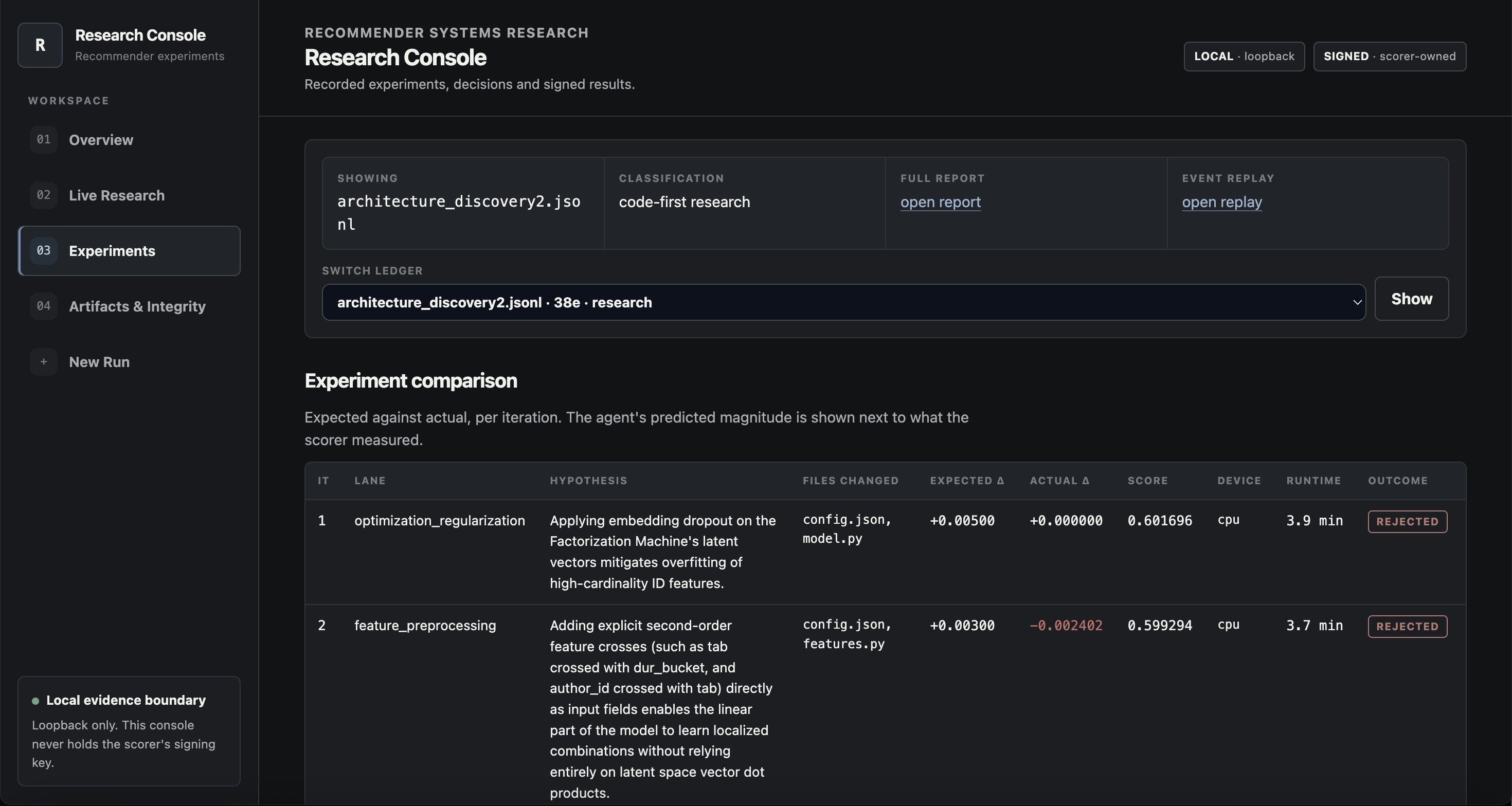
One iteration was silently inert. The agent implemented feature-level dropout properly, with a
constructor parameter, an inverted-scaling binomial mask, training=True correctly threaded into
the training path. However, it never passed the config value into the constructor, so the default 0.0
stood and "dropout": 0.1 was dead code. The result was bit-identical to its parent to 15
significant figures, and deduplication could not see it because the tree hash genuinely
differed. 38,113 tokens re-derived the champion.
The first funded architecture made overfitting worse. The discovery judge selected DeepFM from an eight-candidate tournament and the coder produced a genuine 12,561-byte structural diff. It trained successfully, but extra capacity raised train primary to 0.722080 while validation reached only 0.572274. This is evidence that the architecture actuator works, not evidence that DeepFM is a good model for this task without careful sparse-feature and optimiser tuning.
The DeepFM did not actually use MPS, despite an MPS target. The harness correctly measured
MPS availability and supplied TRACK2_DEVICE=mps; the generated code ignored it and constructed
CPU tensors. That exposed an observability defect: a resolved device is not proof of use. The UI
and execution records now keep “resolved target” and candidate-reported evidence separate, and
future Torch coder instructions require the model and all tensors to move to the supplied device.
The agent over-predicted its own gain on essentially every scored iteration. Predicted and actual are printed side by side rather than hidden.
What I learned
A test that cannot fail is worse than no test. Of 38 defects found in one review sweep, 12 were in tests and 5 could not fail, including the two guarding the invariants I would have defended most confidently. The habit that found them: after fixing a defect, sweep for its class across every module instead of re-reading the file it was found in.
A measurement that confirms what you expect should be verified before it is acted on. Nine
times in this project the measurement was wrong rather than the code. Examples included a filter
that could not display the outcome I was not expecting, a timeout binary that does not exist on
macOS and made 28 passing suites report as failures, and a single successful API probe read as
"the quota reset".
Never let a test-set number justify a protocol decision. I once used a test-derived delta to argue about the convergence threshold. The correct figures were validation-only and smaller. The episode is recorded in the repository rather than quietly deleted.
A wall-clock field that reads 0.0 will be believed. Per-iteration records were written
inside the timing context, where the duration had not yet been assigned, so every iteration
logged wall_seconds: 0.0 against stage sums of 11–18 seconds. The fix ships with a
mutation-tested invariant requiring every ledger record's wall time to be at least its own stage
sum. I confirmed that the invariant fails when the fix is reverted.
Accomplishments I'm proud of
- Every number here is checkable.
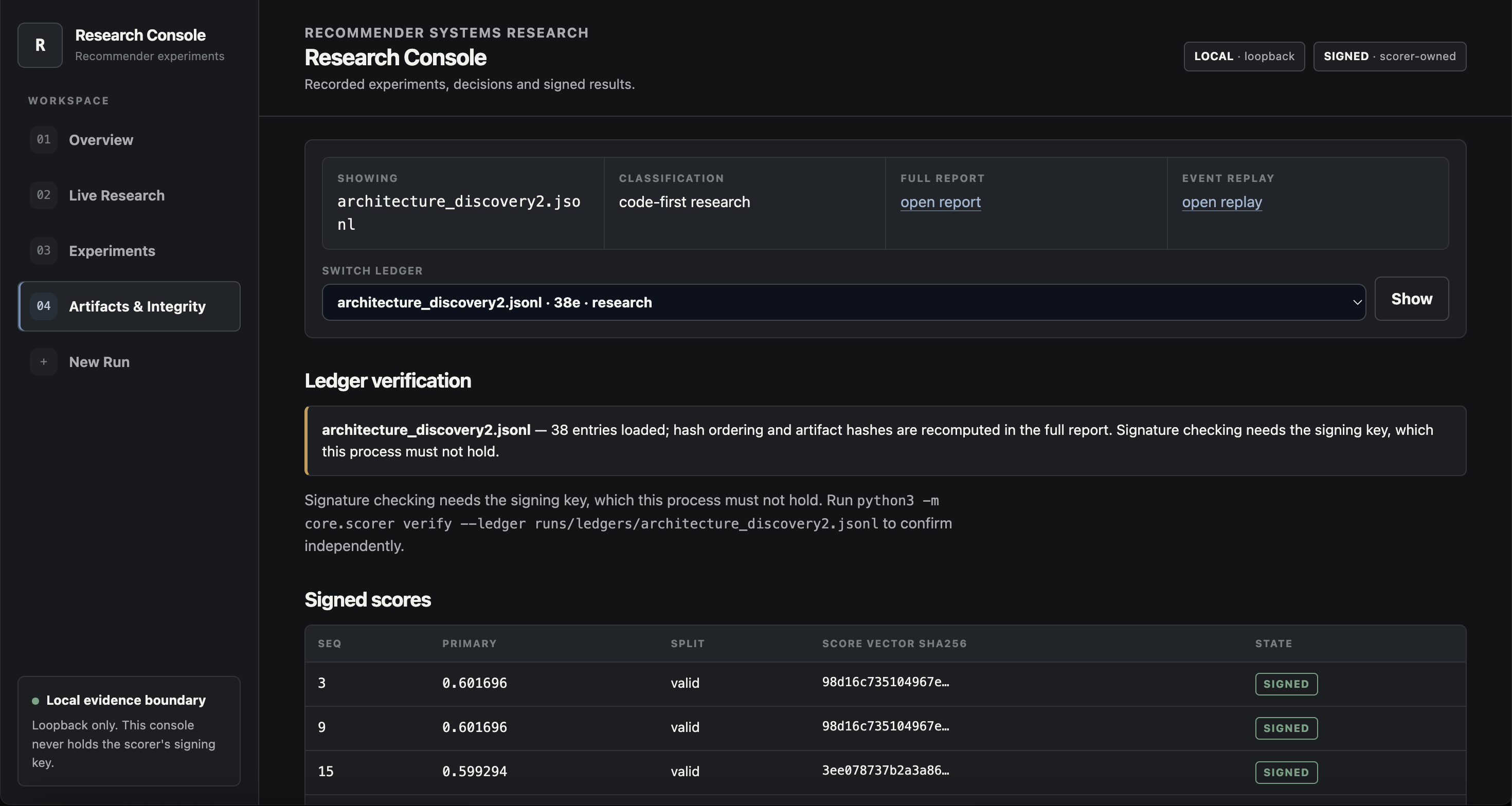
python3 -m core.scorer verify --ledger <path>re-verifies the signed chain; artifact hashes and pre-registration ordering are recomputed by the report itself. - Diagnostic and compliant runs live in separate ledgers. A run with the stopping rule switched off is not evidence about the official protocol and never shares a ledger with a run that is.
- The submission is bound to a promoted artifact, not reconstructed from a config after the fact.
- 35 test suites, including adversarial tournament cases, a sandbox escape attempt via a symlinked dataset, and a scanner that fails the build on stale claims in the documentation.
Limitations
- One stronger-tier diagnostic run is now recorded. It reached for architecture, but the result was worse; better LLM reasoning did not automatically produce a better recommender.
- One
model_architecturecandidate has been selected and executed, but none has been promoted. The first DeepFM attempt is a single negative result, not a general rejection of neural models. - Provider reliability limited the run: three of seven iterations ended before training because of a timeout, incomplete structured response, and a 20-request free-tier quota.
- The secondary effects around the pairwise objective are small or unresolved, not disproved:
the negative-sampling change lost on a single search iteration rather than a 20-seed ablation,
user_hist_lenhelped in the original lineage, and the L2-plus-cosine step was never confirmed against its immediate parent across seeds. No component ablation has been run. - The train/dev gap is a diagnostic: the harness verifies the size of the returned train-subset vector but cannot verify which rows produced it.
- Docker isolation is implemented but unexercised; the measured boundary is the macOS seatbelt sandbox.
What's next
- A divergence guard. A monotonically rising training loss is an unambiguous abort signal from epoch 2, and would have saved ~150 s on the BPR failure while handing the coder a far sharper repair signal than "primary was 0.39".
- An inert-change detector. A delta of exactly zero with an identical train metric means semantically inert. This is cheap to flag, and it recovers an evaluation slot that hash-based deduplication structurally cannot see.
- Component ablations over 20 seeds, to turn the unresolved secondary effects into measurements.
- A controlled neural follow-up, starting by reproducing the NumPy FM in Torch, verifying device use, and only then adding a small deep interaction tower. That separates framework and optimisation errors from the architectural question instead of changing everything at once.
How to verify
python3 -m core.scorer verify --ledger runs/ledgers/research_submission.jsonl   # signed chain
python3 -m agent.research_report --ledger runs/ledgers/research_submission.jsonl # report
for f in tests/test_*.py; do python3 "$f"; done                                  # 28 suites
submission_compliant/MANIFEST.json binds the submitted predictions to the champion tree hash,
the signing sequence number, and the score vector's own SHA-256.

Log in or sign up for Devpost to join the conversation.