-
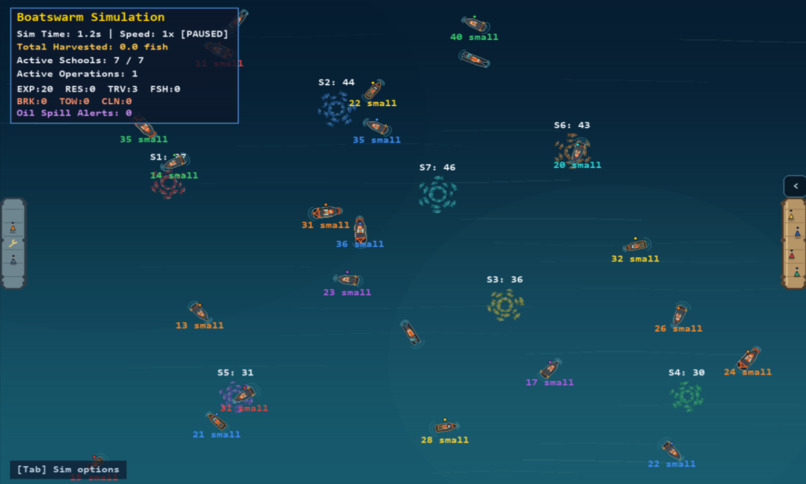
Overview of simulation
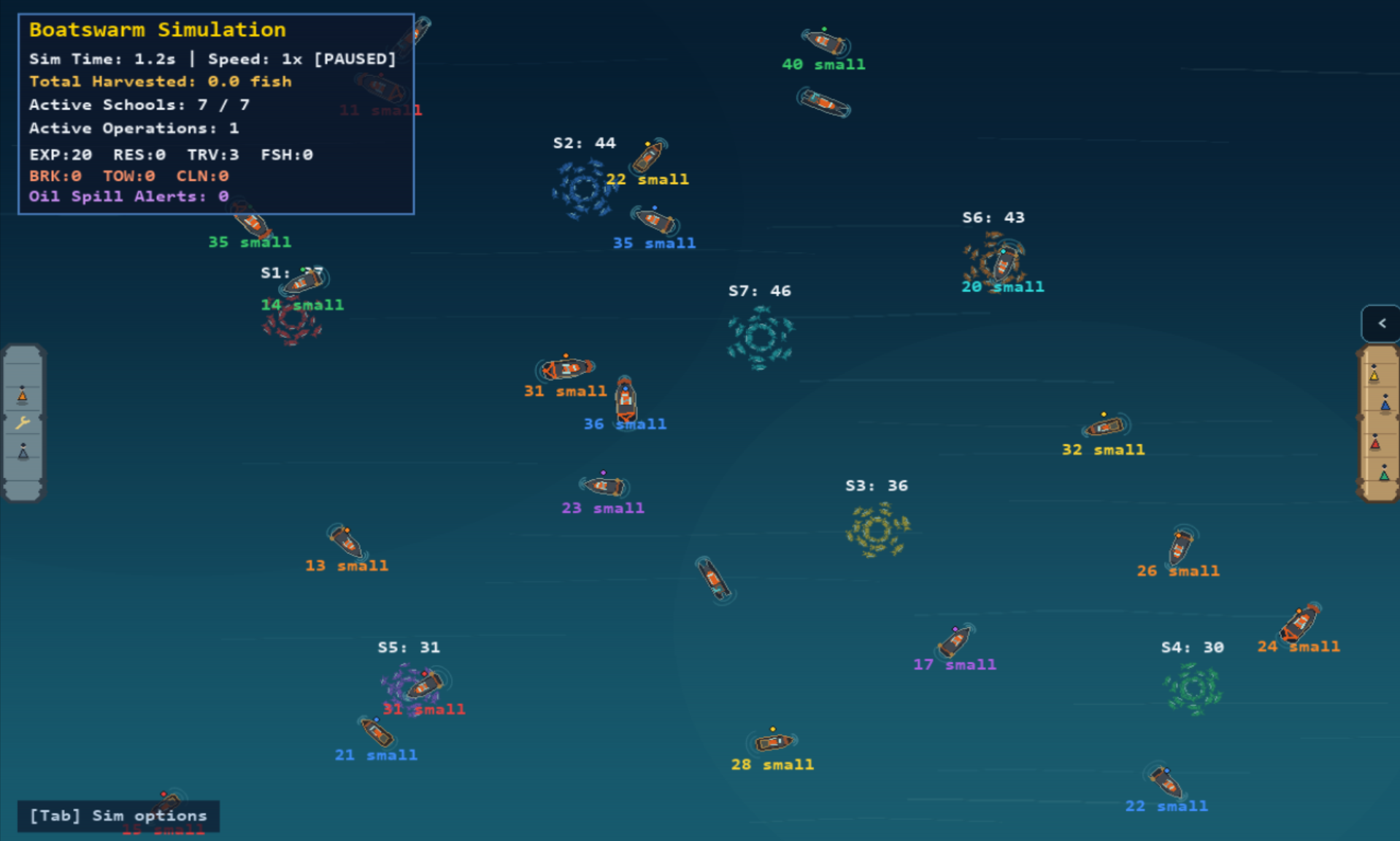
Inspiration
We decided to create a fishing simulator as it was a good opportunity to display communications between objects and create different instances for identifying needs and solving problems within the setting. The concept that the boat as a singular unit seems unable to work by itself makes it all the more satisfying when seeing the different interactions as it seemingly acts with prerequisite knowledge when all the signalling factors are not visible.
What it does
BoatSwarm is an autonomous fishing simulator, which primarily uses different boats to fish whilst indicating to others adjacent, of different environmental elements it comes across such as schools of fish and oil spills, which can then be responded to appropriately.
Featured Boats
- Regular
- Sonar
- Rescue
- Cleaning
Boats can take fishing tasks and fulfill them when they are able to find a source of the required fish, and these are collected again whenever the quota is filled. Oil spills and boats in need of rescue are also primary features of the simulation. Spills can be reported and cleaned with the relevant cleaning boats, and dedicated rescue boats are also featured in order to take away boats for repair. There is a natural waterborne instance in which a typhoon spawns and all boats must work together and adapt to overcome it. As the main task involves fishing, sonar boats are included in order to prevent other boats from fully failing their tasks.
How we built it
We were able to further progress a skeleton using AI(Gemini) along with an initial manual code. This allowed for a basis in which we were able to build on and add different boats as objects, with differing functionality depending on what information they receive. We also used a combination of Codex and Antigravity to adjust the code to our needs, adding more functions through both its generative code and its pointers towards where change could be added.
Challenges we ran into
During our coding, we came across many challenges which arose due to the implementation of tasks and the pier, as previous versions were based off open water. The addition of a pier resulted in unintended object collisions where boats would get stuck on the edge or clammer towards the pier all at once. Getting the independent specialised tasks for the different boats to work together and become cohesive, was challenging as it did result in random consequences such as other boats being dragged along or functions not working together as intended.
Accomplishments that we're proud of
Overall, it is still rewarding to have a project that simulates the tasks successfully, demonstrating a fleet of boats working as a whole unit. We were able to add multiple boats with specialised functions in addition to the default regular.
What we learned
We were able to learn more in terms of how pygame can be used visually as well as how important cohesion and subtle nuances are important in maintaining an adaptive 'swarm'.
