-
-
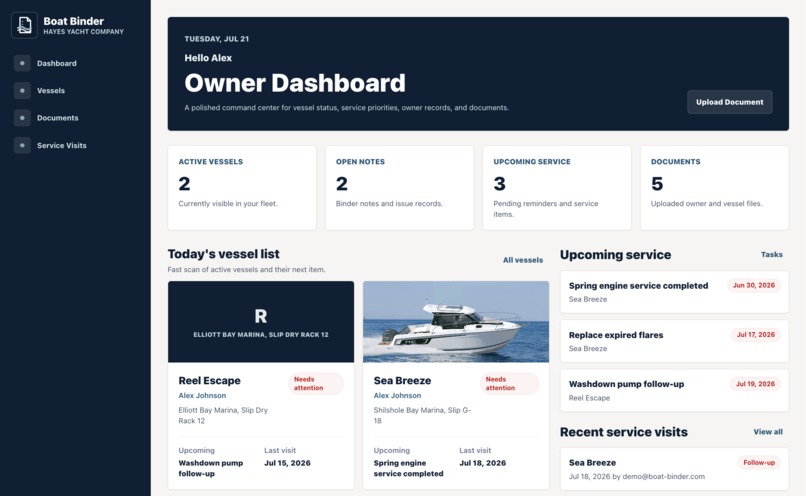
Boat Binder Dashboard
Inspiration
Boat Binder was inspired by a problem my husband, Will, and I kept running into while caring for boats.
Boat owners often have maintenance records, manuals, warranties, receipts, inspection reports, and reminders scattered across filing cabinets, email inboxes, cloud storage, and spreadsheets. Finding the right document at the right time is frustrating, and valuable service history is easily lost over the lifetime of a vessel.
At the same time, we're launching Hayes Yacht Company, a Seattle-based yacht management business. We wanted a professional system that would help us care for customer boats while giving owners complete transparency into the work being performed.
Rather than build separate tools for owners and service providers, we decided to build one platform that could support both.
What it does
Boat Binder is the digital home for boat ownership.
The platform allows boat owners to:
- Organize maintenance records and service history
- Store manuals, warranties, insurance documents, and photos
- Track maintenance reminders
- Receive detailed digital service reports
- Securely manage multiple vessels
- Collaborate with trusted service providers
For professional captains and yacht management companies, Boat Binder provides structured service visit workflows, photo documentation, maintenance tracking, and owner notifications, creating a shared record of everything that happens throughout a boat's life.
How I built it
Boat Binder is built as a Ruby on Rails application with a focus on security, maintainability, and long-term scalability.
Technologies include:
- Ruby on Rails
- PostgreSQL
- Active Storage
- Action Mailer
- Heroku
- GitHub Actions
- Stripe
- GitHub Advanced Security
Throughout development I used both OpenAI Codex and GPT-5.6 as an engineering collaborator rather than simply a code generator.
Codex helped me:
- Implement new features
- Review architecture
- Improve test coverage
- Refactor existing code
- Investigate security findings
- Harden Stripe webhook handling
- Write documentation
- Iterate quickly while maintaining code quality
GPT-5.6 helped me:
- Refine the overall product vision and roadmap
- Prioritize features and define phased implementation plans
- Design the subscription model, trial experience, and pricing strategy
- Evaluate competing boat maintenance platforms and identify differentiating features
- Review pull requests, Copilot findings, and security tradeoffs before implementation
- Design authorization and permission models for owners, crew members, and internal users
- Plan manual QA, release validation, and deployment checklists
- Write product copy, demo scripts, Devpost submission content, and project documentation
Every pull request went through automated CI, RuboCop, Bundler Audit, GitHub Advanced Security, and manual review before deployment.
Challenges
One of the biggest challenges was balancing development speed with building production-quality infrastructure.
Features like subscriptions seem straightforward at first, but quickly involve:
- Secure Stripe webhook verification
- Idempotent event processing
- Configuration management
- Environment isolation
- Logging sensitive data safely
- Automated testing
- Future scalability
Rather than cutting corners, I invested time building a solid billing foundation first so future subscription features can be added confidently.
I also spent significant effort improving authorization, protecting uploaded documents, validating user permissions, and reducing sensitive information written to application logs.
Accomplishments
I'm especially proud that Boat Binder is becoming more than just a maintenance tracker.
Today the application includes:
- Secure authentication and invitations
- Multi-vessel management
- Document storage
- Service visit workflows
- Email notifications
- Photo management
- Subscription infrastructure
- Secure Stripe webhook processing
- Comprehensive automated testing
- Security scanning and dependency auditing
Most importantly, every feature has been designed with a real business workflow in mind rather than being built purely as a technical exercise.
What I learned
This project reinforced that good software isn't just about writing code—it's about making thoughtful product decisions.
I learned the importance of:
- Building strong foundations before adding features
- Treating security as a continuous process
- Separating business rules from implementation details
- Designing for future growth without overengineering
Working alongside AI also changed how I develop software. Instead of replacing engineering judgment, tools like Codex accelerated implementation, surfaced edge cases, and helped me iterate more confidently while remaining responsible for architecture, testing, and final decisions.
What's next for Boat Binder
This party is just getting started.
Our roadmap includes:
- Stripe Checkout and self-service subscriptions
- Customer billing portal
- Boat ownership timeline
- Expense and receipt tracking
- Crew collaboration
- Inventory management
- Trip logging
- Fuel tracking
- Dashboard with "What's Next" recommendations
- AI-powered document search and maintenance insights
Our long-term vision is simple: Boat Binder becomes the digital home for boat ownership.
Whether someone owns one fishing boat or manages an entire fleet, we want every document, maintenance record, service visit, reminder, and milestone to live in one trusted place throughout the life of the vessel.
Built With
- action-mailer
- active-storage
- codeql
- css
- dependabot
- github
- github-actions
- github-advanced-security
- heroku
- heroku-postgres
- html
- javascript
- mailgun
- openai-codex
- postgresql
- ruby
- ruby-on-rails
- sql
- stimulus
- stripe


Log in or sign up for Devpost to join the conversation.