-
-

Banner
-
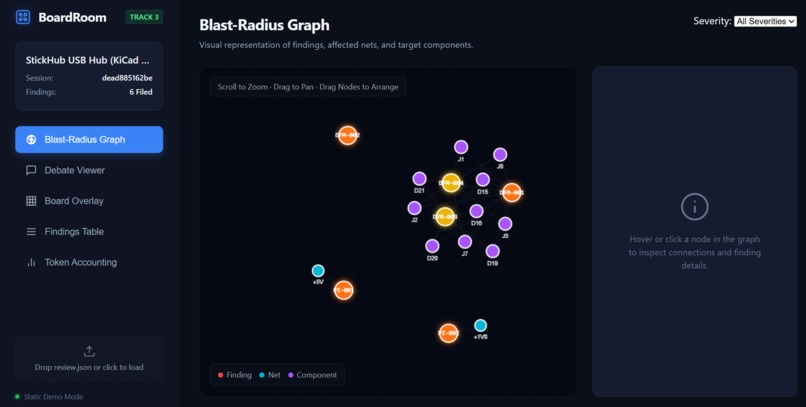
Main tab
-
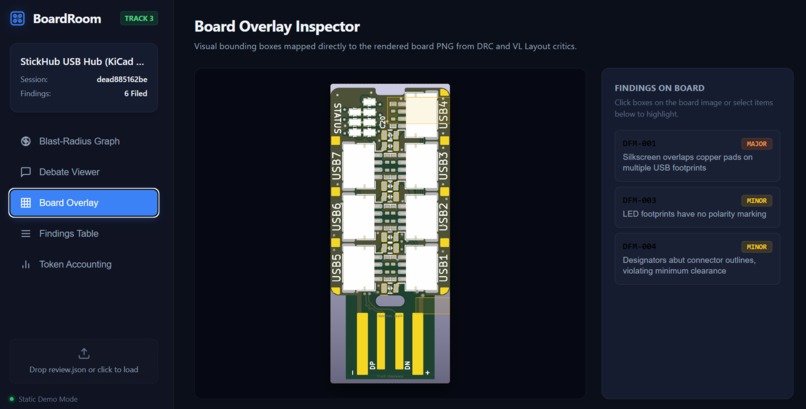
PCB tab
-
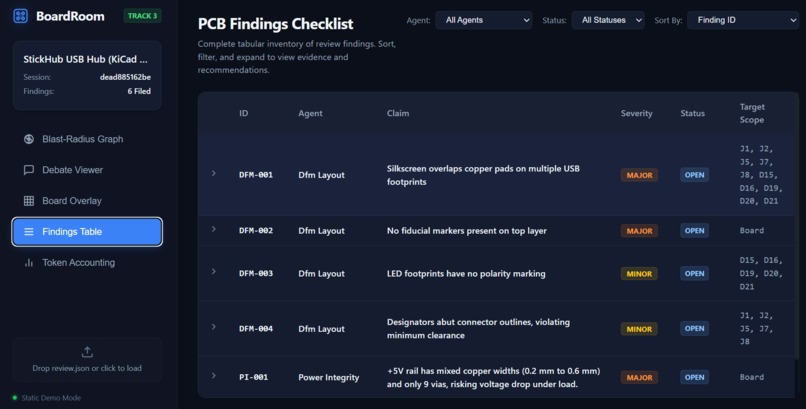
Errors tab
Inspiration
A missed decoupling capacitor or an I²C bus with no pull-ups turns into a three-week board respin and a few hundred euros. Single-LLM "PCB reviewers" miss real defects and invent fake ones with equal confidence.
But a real design review was never one expert. It's a board of specialists who disagree and have to justify themselves. So I built that instead of another chatbot.
What it does
BoardRoom runs a PCB review as a society of agents:
- Five specialists — power integrity, signal integrity, connectivity/ERC, DFM & layout, and firmware bring-up — inspect a real KiCad project through the KiCad MCP server. Each agent can only touch the tools in its own lane, enforced in code, not by prompting.
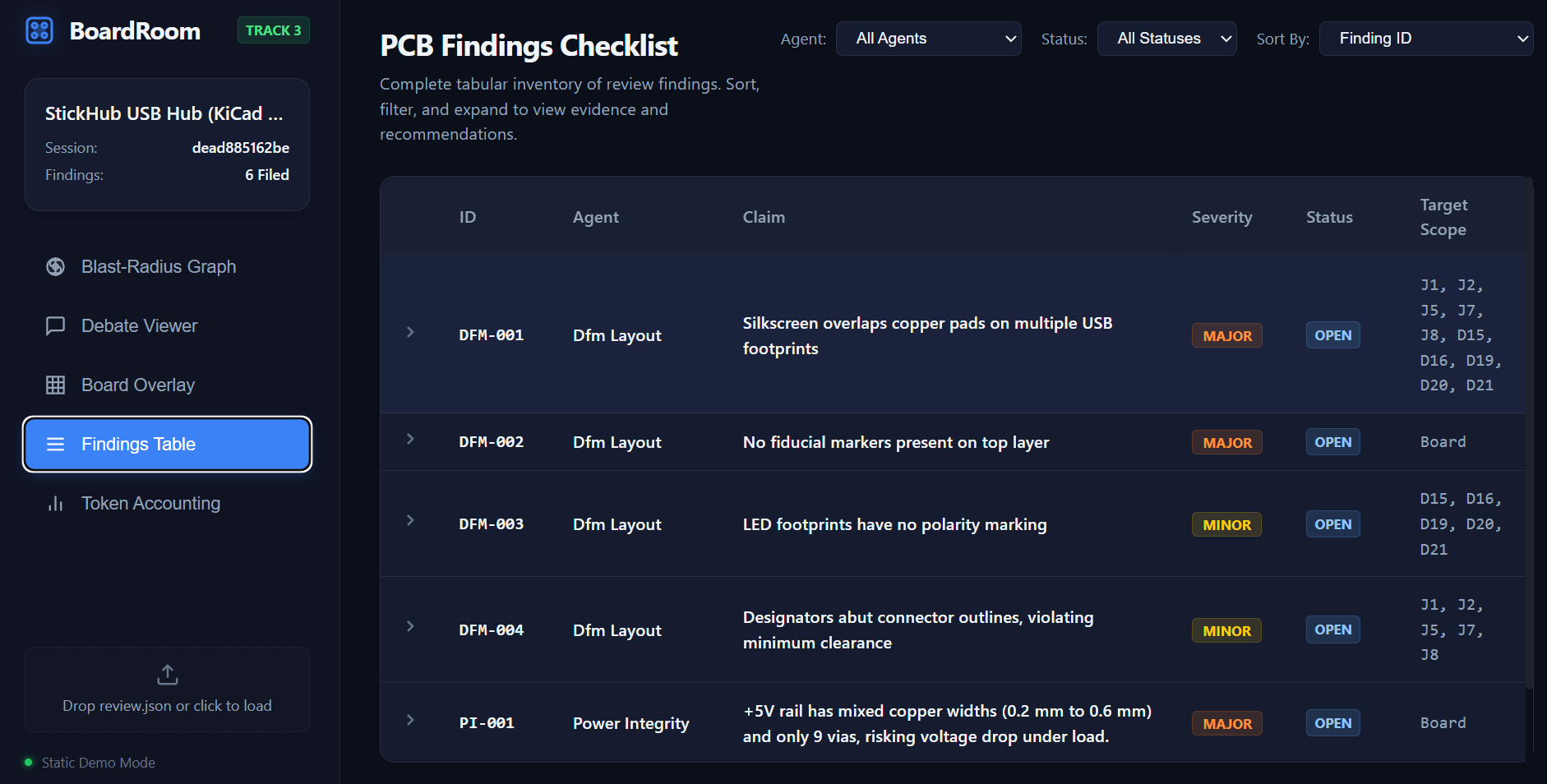
- Every finding must cite a real tool call. Uncited claims are rejected at the schema boundary, so the hallucination guard is architectural rather than a polite request in a prompt.
- A Moderator detects conflicting recommendations and runs a bounded two-round debate — one extra measurement per side — then rules on the evidence, recording which measurement decided it.
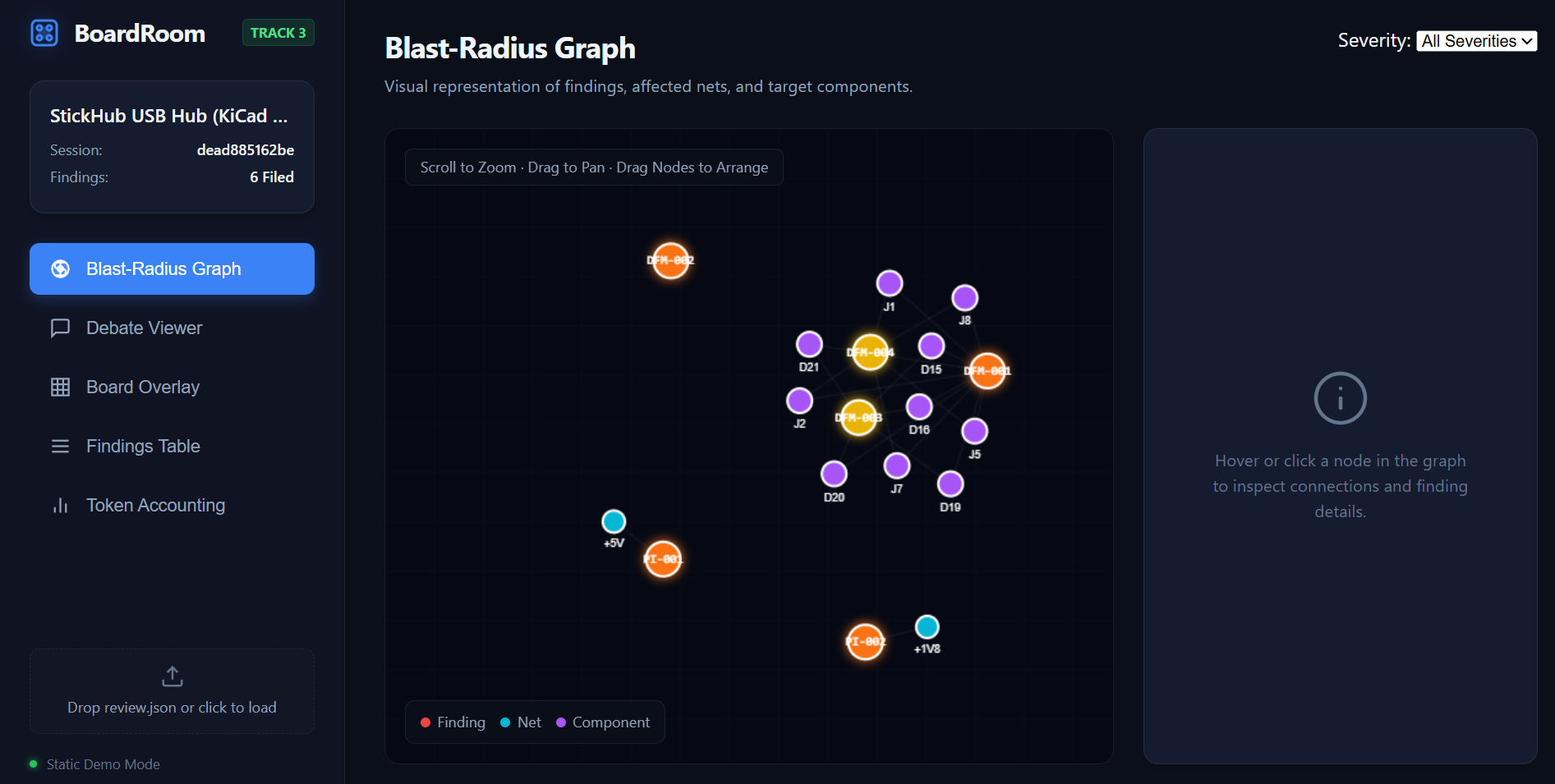
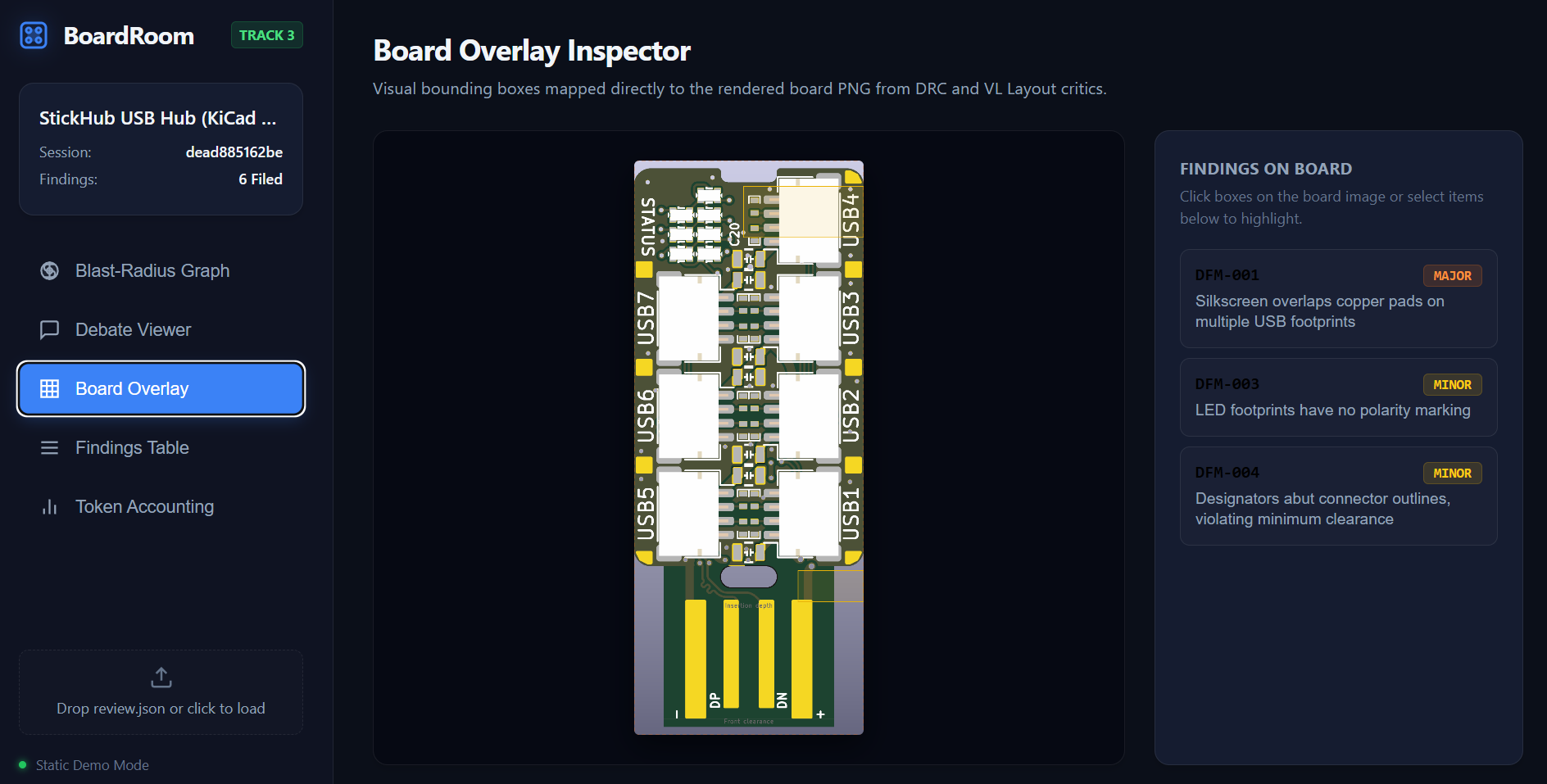
- The report is a blast-radius graph (findings → nets → components), plus board overlays drawn by a multimodal model that actually sees the rendered PCB.
How I built it
- Qwen on Alibaba Cloud Model Studio, routed by role:
qwen3-maxchairs and adjudicates,qwen-flashruns the tool-heavy specialists,qwen3-vlis the multimodal layout critic,qwen3-codergenerates bring-up artifacts. - 26 typed KiCad MCP tool adapters as the specialists' only path to the board, behind per-agent allowlists enforced before any call.
- Evidence cache: every tool result gets a stable ID; findings cite those IDs or they don't exist.
- FastAPI orchestrator, concurrent dispatch with per-specialist crash isolation, JSON-persisted sessions, and a single model-call gateway so token accounting is complete and comparable.
- 228 tests, none requiring network or KiCad.
Results — and what I refuse to claim
6 KiCad boards, 12 reproducibly seeded defects, two independent runs per configuration (LLMs are nondeterministic; one run isn't a measurement).
| society | baseline (1× qwen3-max, all tools) | |
|---|---|---|
| Seeded-defect recall (mean) | 0.29 | 0.21 |
| Cost per corpus | $0.147 | $0.429 |
| Prompt tokens | 792K | 312K |
| Findings surfaced | 49–56 | 6–10 |
| Hallucination rate | 0.00 | 0.00 |
The society burns 2.5× MORE tokens and costs 2.9× LESS. That inversion is the whole thesis: five cheap specialists doing more work cost far less than one expensive generalist doing less. Routing by role beats routing by model size, and it reproduced to within 2% across runs.
I deliberately do not claim a detection win. The society led in both runs — by exactly one defect out of twelve. That's noise, and the README says so.
Challenges I ran into
Proving the society was better turned out to be harder than building it. My benchmark lied in my favour three separate times:
- Agents left
affected_netsempty, naming nets only in prose — so a correct catch scored as a miss. This wasn't just a scoring artifact: my report's headline visualization is built from those fields, so the centerpiece was silently broken. - My baseline was an accidental strawman. I'd named it
moderatorto inherit "all tools", but the registry scopes that agent down to three overview tools. It had been reviewing boards nearly blind. - The baseline was penalized on formatting. It found the defect but emitted
title/descriptioninstead ofclaim/evidence, so every finding was discarded. The specialist prompts each carry a worked JSON example; the baseline's didn't. I was measuring prompt quality and calling it architecture.
All three pointed the same direction — none made the society look worse. That's what motivated reasoning looks like from the inside: you stop debugging when the number agrees with you.
What I learned
The reasoning layer is now ahead of the observability layer. Absolute recall is low for both configurations, and it's mostly the tools' fault: removing a decoupling capacitor creates an absence, and no KiCad tool reports that a part which should exist doesn't. A swapped SDA/SCL is electrically valid, so ERC stays silent. These models can reason about a missing bypass cap — they just have no instrument that reports it.
Also: evidence gating works. 0.00 hallucination rate across every run, both configurations. Make honesty structural and you stop arguing with the model about it.
One honest limitation: the negotiation engine — bounded rounds, evidence-cited rulings, fully unit-tested — never fired on real data. Across the whole corpus, no two specialists ever produced conflicting findings; their scopes are narrow enough that collisions are rare. The repo ships a clearly-labeled synthetic fixture to demonstrate the viewer and says so in the README, because the alternative is faking a debate and calling it a demo.
Alibaba Cloud
backend/app/qwen_client.py— all model calls via Model Studio, with per-agent token accountingdeploy/alibaba/oss_store.py— Alibaba Cloud OSS via the officialoss2SDKdeploy/Dockerfile— backend + KiCad container
What's next
More board classes, a KiCad plugin front-end, and — the interesting one — building the missing instruments: tools that detect absence, so the reviewers can finally see what isn't there.
Links
- Code (MIT): https://github.com/lluisestape-upc/boardroom
- Benchmark method, raw numbers and limitations: https://github.com/lluisestape-upc/boardroom/blob/main/docs/BENCHMARK.md
Built With
- alibaba-cloud
- css
- docker
- fastapi
- html
- javascript
- kicad
- matplotlib
- model-context-protocol
- model-studio
- pydantic
- pytest
- python
- qwen


Log in or sign up for Devpost to join the conversation.