-
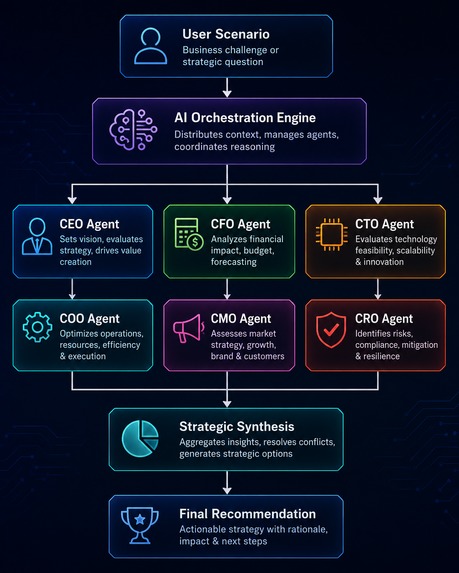
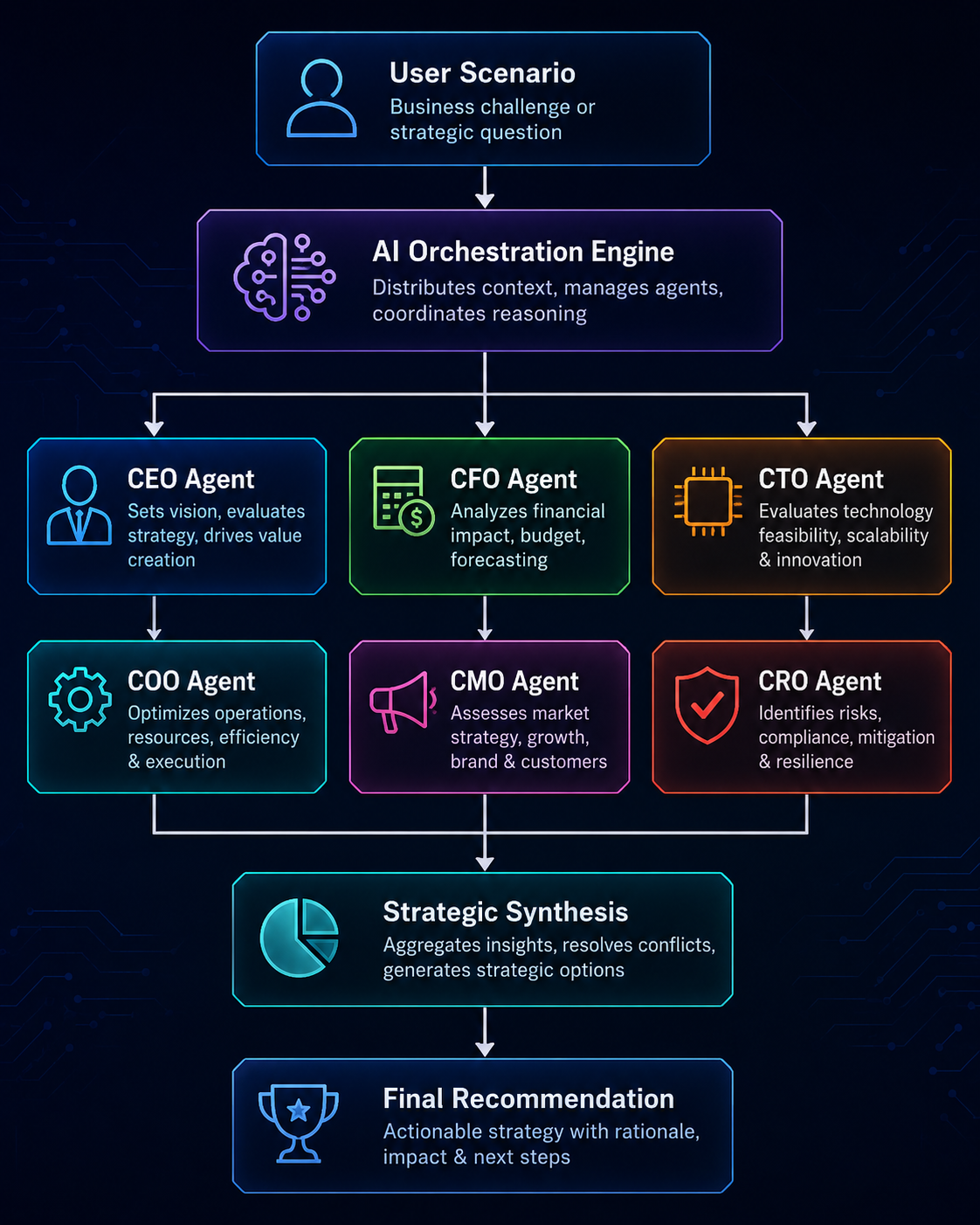
Architecture Diagram
Inspiration
Modern organizations are drowning in dashboards, reports, and fragmented analytics, yet critical decisions are still made through disconnected conversations between departments with competing priorities.
A CFO optimizes for margins. A marketing leader optimizes for growth. Operations teams optimize for efficiency. Risk teams prioritize stability.
The problem is not lack of data — it is lack of synchronized intelligence.
We wanted to explore a future where autonomous AI executives could collaborate like a real boardroom: debating strategy, challenging assumptions, forecasting risk, and synthesizing high-level business decisions in real time.
That vision became Boardroom AI — an autonomous executive intelligence simulator designed to transform raw business signals into strategic decision-making through multi-agent AI collaboration.
What it does
Boardroom AI simulates a fully autonomous executive boardroom powered by specialized AI agents.
Each AI executive represents a different organizational perspective:
- CEO for strategic synthesis
- CFO for financial optimization
- Marketing AI for growth strategy
- Operations AI for efficiency and scalability
- Risk Engine for uncertainty and exposure analysis
When users input a business scenario, the agents independently analyze the situation, debate strategic trade-offs, challenge each other’s assumptions, and collaboratively generate enterprise-level recommendations.
The platform simulates:
- strategic planning
- operational forecasting
- executive conflict resolution
- organizational risk analysis
- multi-agent reasoning workflows
- consensus-driven decision intelligence
Instead of acting like a traditional chatbot, Boardroom AI behaves like a coordinated AI leadership team.
How we built it
We built Boardroom AI as a cinematic multi-agent intelligence system using:
- React
- TypeScript
- Vite
- Google Gemini API
- autonomous prompt orchestration workflows
The platform uses role-based AI cognition where each executive agent operates with:
- specialized objectives,
- independent reasoning behavior,
- contextual memory,
- and strategic priorities.
We designed an orchestration layer that manages:
- executive turn-taking,
- context synchronization,
- debate sequencing,
- consensus generation,
- and final strategic synthesis.
A major focus was creating an immersive executive simulation experience through:
- futuristic boardroom UI design,
- real-time conversation rendering,
- dynamic intelligence dashboards,
- animated strategic metrics,
- and cinematic interaction flows.
The result is an AI-native interface that feels less like software and more like an autonomous executive operating system.
Challenges we ran into
One of the biggest challenges was making the AI executives feel genuinely distinct rather than multiple copies of the same model.
We had to carefully engineer:
- executive personalities,
- reasoning styles,
- communication tone,
- strategic incentives,
- and decision-making priorities.
Another major challenge was maintaining coherent multi-agent discussions while preserving context across several reasoning steps.
Balancing realism with usability was also difficult: we wanted the platform to sound like a real boardroom without becoming incomprehensible or overloaded with corporate jargon.
On the frontend side, synchronizing cinematic UI animations with live AI-generated interactions required significant iteration to maintain responsiveness and immersion.
Accomplishments that we're proud of
We are proud that Boardroom AI feels genuinely alive.
Instead of building another AI chat interface, we created a system where autonomous executive agents:
- debate,
- negotiate,
- challenge assumptions,
- forecast outcomes,
- and synthesize strategic decisions collaboratively.
We successfully combined:
- multi-agent AI orchestration,
- enterprise analytics simulation,
- strategic reasoning,
- and cinematic UX design into a cohesive experience.
We are especially proud of how believable the executive interactions became. Watching AI executives disagree over growth strategy, operational efficiency, and risk exposure created moments that genuinely resembled real boardroom dynamics.
Most importantly, we built a project that explores a larger idea: what the future of organizational intelligence could look like when AI systems evolve from passive assistants into collaborative strategic entities.
What we learned
This project taught us that effective agentic AI systems are not just about model capability — they are about coordination architecture.
We learned how important:
- role specialization,
- memory persistence,
- orchestration design,
- contextual synchronization,
- and incentive-driven reasoning are for creating believable autonomous AI behavior.
We also learned that presentation dramatically affects perceived intelligence. The combination of cinematic UI, structured reasoning, and dynamic interactions made the system feel significantly more advanced and immersive.
Most importantly, we learned that multi-agent AI can simulate organizational thinking in ways that single-agent systems cannot.
What's next for Boardroom AI — Autonomous Executive Simulator
We see Boardroom AI evolving into a full enterprise decision intelligence platform.
Future plans include:
- real-time business data ingestion
- predictive forecasting dashboards
- voice-enabled executive agents
- persistent organizational memory
- strategic scenario simulations
- autonomous meeting generation
- live KPI integrations
- explainable AI decision tracing
- enterprise collaboration systems
- digital twin business simulations
Long term, we believe systems like Boardroom AI could evolve into AI-native executive operating systems that help organizations make faster, smarter, and more coordinated strategic decisions.
Our goal is not to replace executives — it is to augment organizational intelligence through autonomous AI collaboration.

Log in or sign up for Devpost to join the conversation.