Inspiration
Important decisions often happen long before people have access to a real board of advisers. I wanted to explore whether AI could help by providing different perspectives while always keeping the human in control.
Rather than building another chat application, I wanted to build a decision platform where discussions become structured organisational knowledge that can be reviewed, searched and built upon over time.
What it does
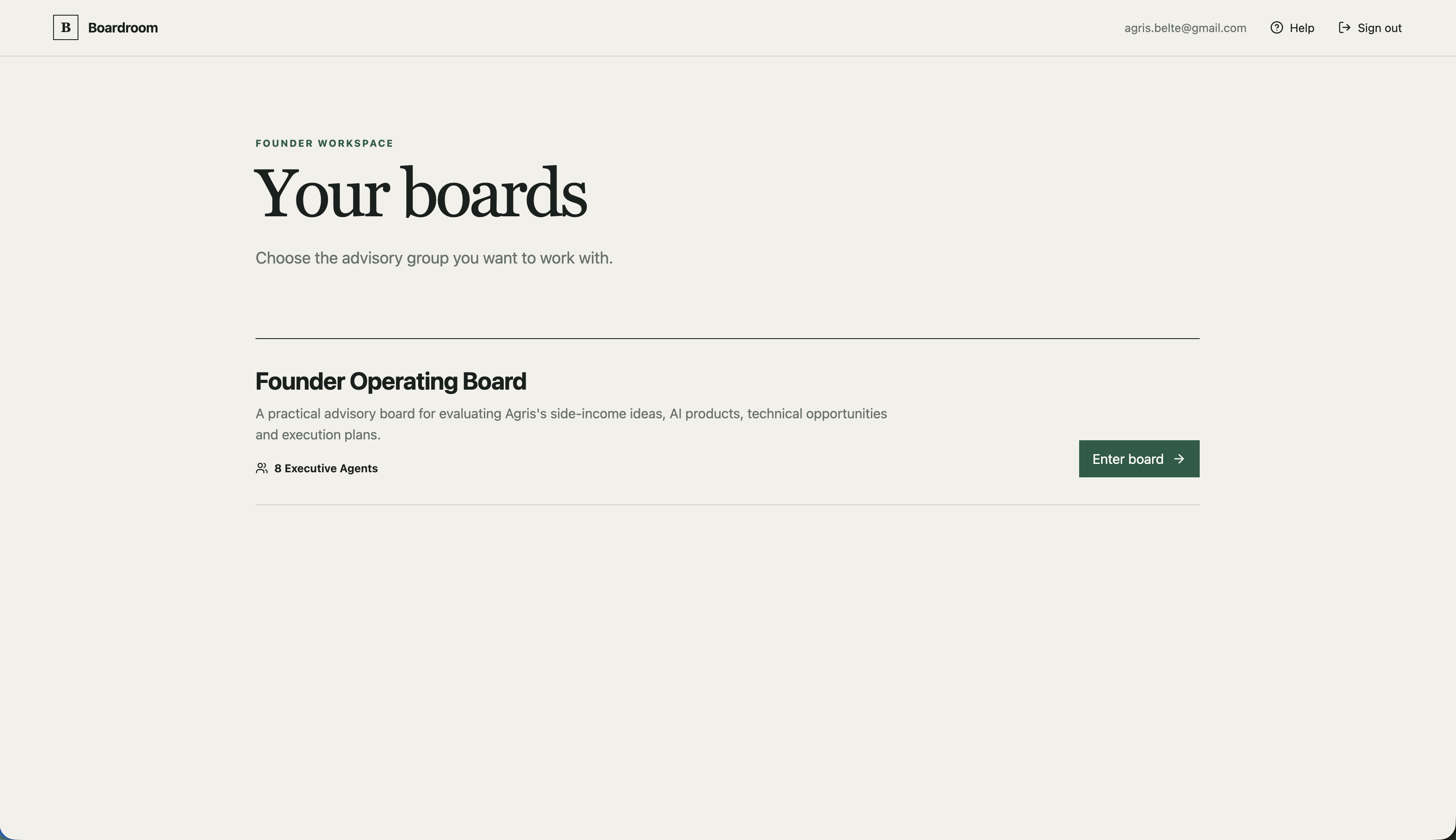
Boardroom allows a user to create Boards made up of AI Executive Agents, each with a different role and responsibility.
Discussions are organised into Meetings where users can ask individual Agents or the whole Board for advice. The Secretary summarises the discussion, and when the Meeting is closed, Boardroom creates a structured record including summaries, decisions, actions, risks and assumptions.
Unlike traditional AI chats, this information is stored as structured data, creating a growing organisational memory instead of isolated conversations.
How we built it
Boardroom Phase 2 already existed as a local Python CLI prototype before Build Week.
During Build Week I designed and built Phase 3 as a hosted web application using React, Python, Cloudflare Workers, Cloudflare D1 and the OpenAI Responses API powered by GPT-5.6.
I used an architecture-first approach, building the application in small numbered implementation batches. Codex became an engineering partner throughout the project, helping review architecture, implement features, improve quality, write documentation and prepare the final submission.
Challenges we ran into
One of the biggest challenges was turning a local proof of concept into a hosted application within the Build Week timeframe.
The project combines user interface design, backend services, AI orchestration, persistent storage and structured data modelling. Designing a system that remained simple for users while producing reliable structured Meeting records required several iterations and continuous refinement.
Accomplishments that we're proud of
I'm proud that Boardroom is more than a conversation interface.
The application delivers a complete end-to-end workflow, from creating a Board and running Meetings through to generating structured decision records that can be reopened and reviewed later.
I'm also proud that the architecture was designed as a platform from the beginning, making it straightforward to extend with future capabilities.
What we learned
This project reinforced that building AI applications is as much about software engineering as it is about prompting models.
Persistent data, clear workflows, deterministic orchestration and good software architecture make AI systems significantly more useful than treating them as isolated chat sessions.
Build Week also demonstrated how productive modern AI-assisted software development can be when the human remains responsible for product vision, architecture and engineering decisions.
What's next for Boardroom
Boardroom is intended to become a platform rather than a single application.
Future work includes multiple Board templates, Worker Agents that execute approved actions, semantic search across organisational knowledge, richer reporting, collaborative Boards with multiple users and integrations with external business systems.
The long-term vision is to help people and organisations build knowledge that grows with every decision they make.
Built With
- cloudflare
- codex
- openai
- python
- react
- typescript
- workers

Log in or sign up for Devpost to join the conversation.