-
-
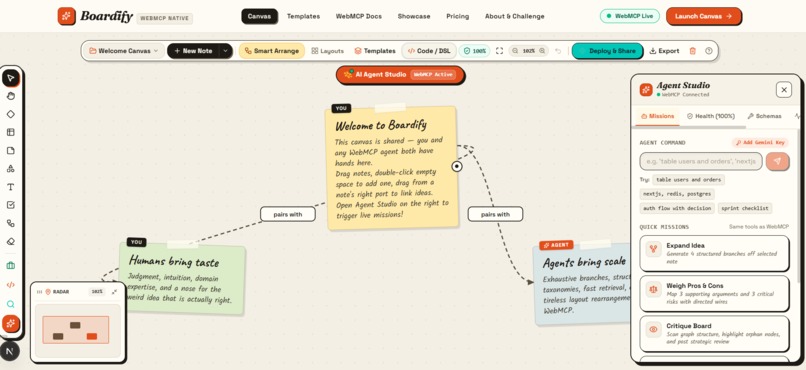
canvas
-
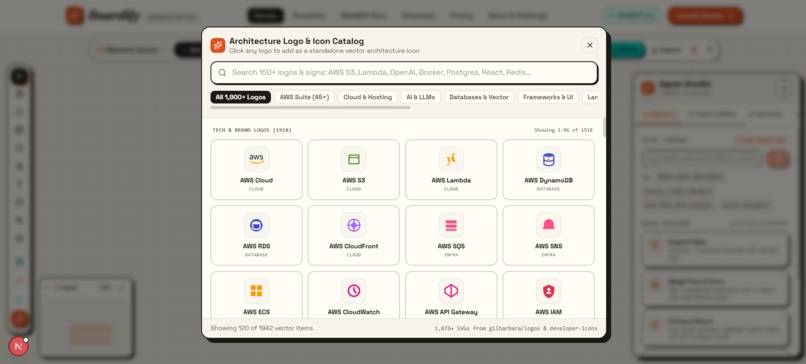
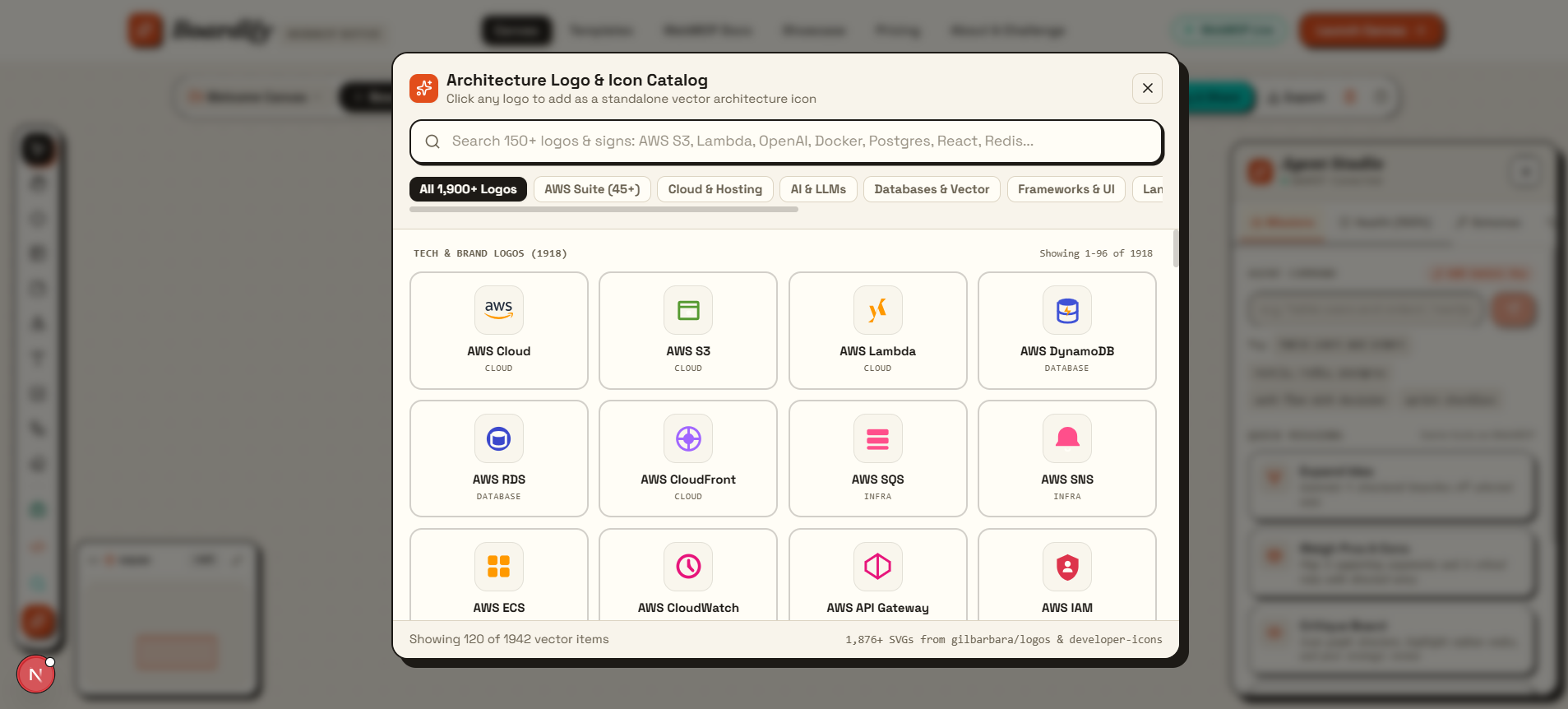
assets library
-
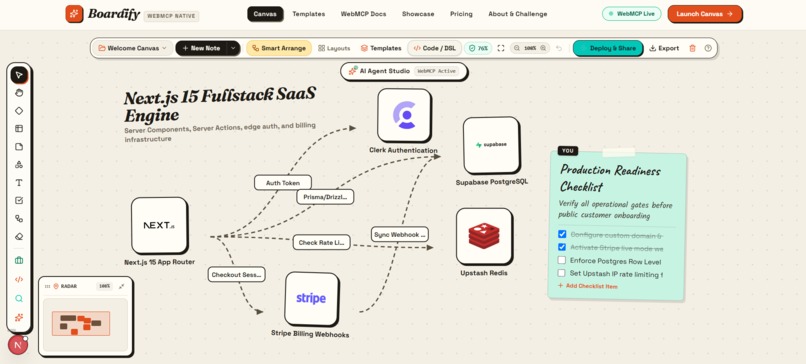
workflow template
-
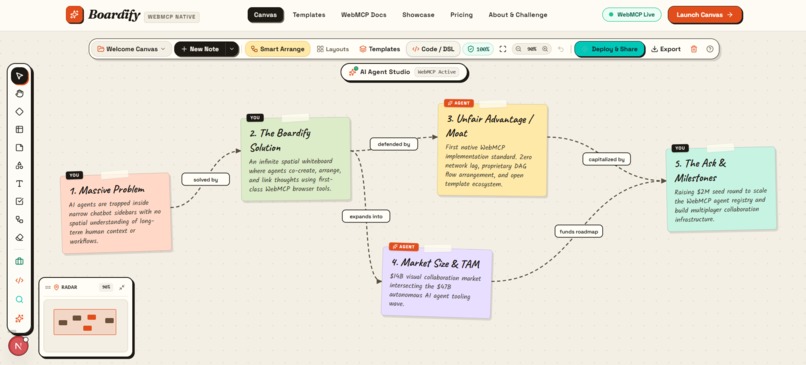
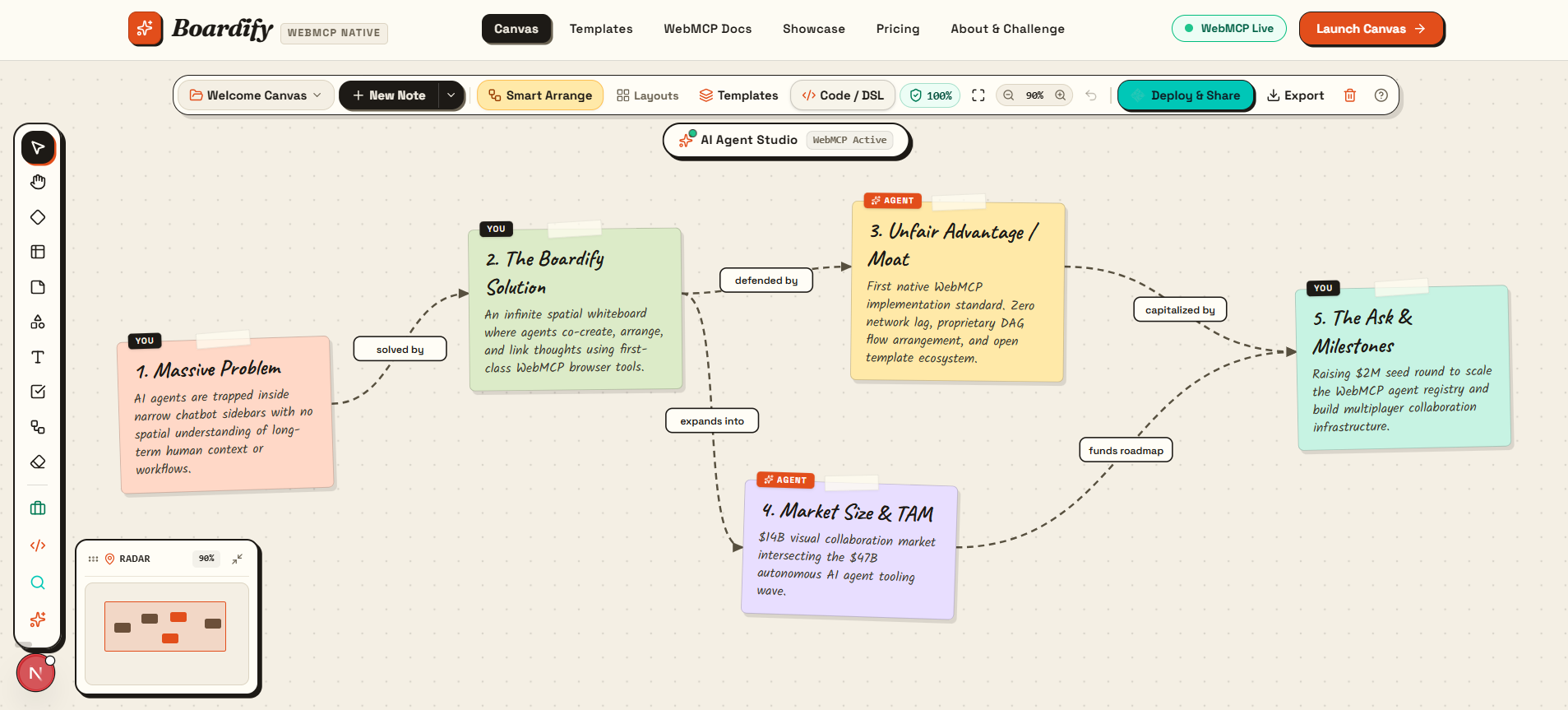
notes template
-
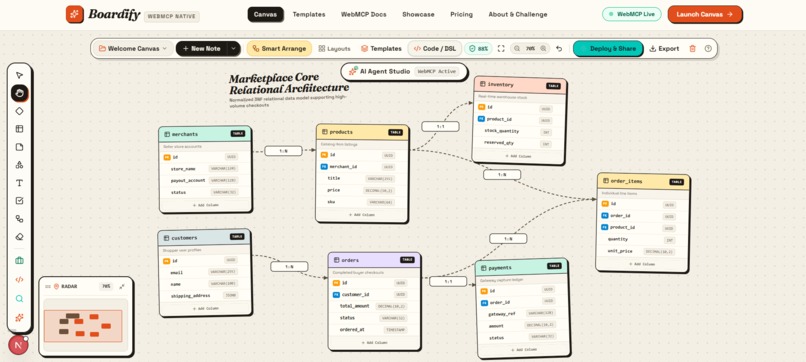
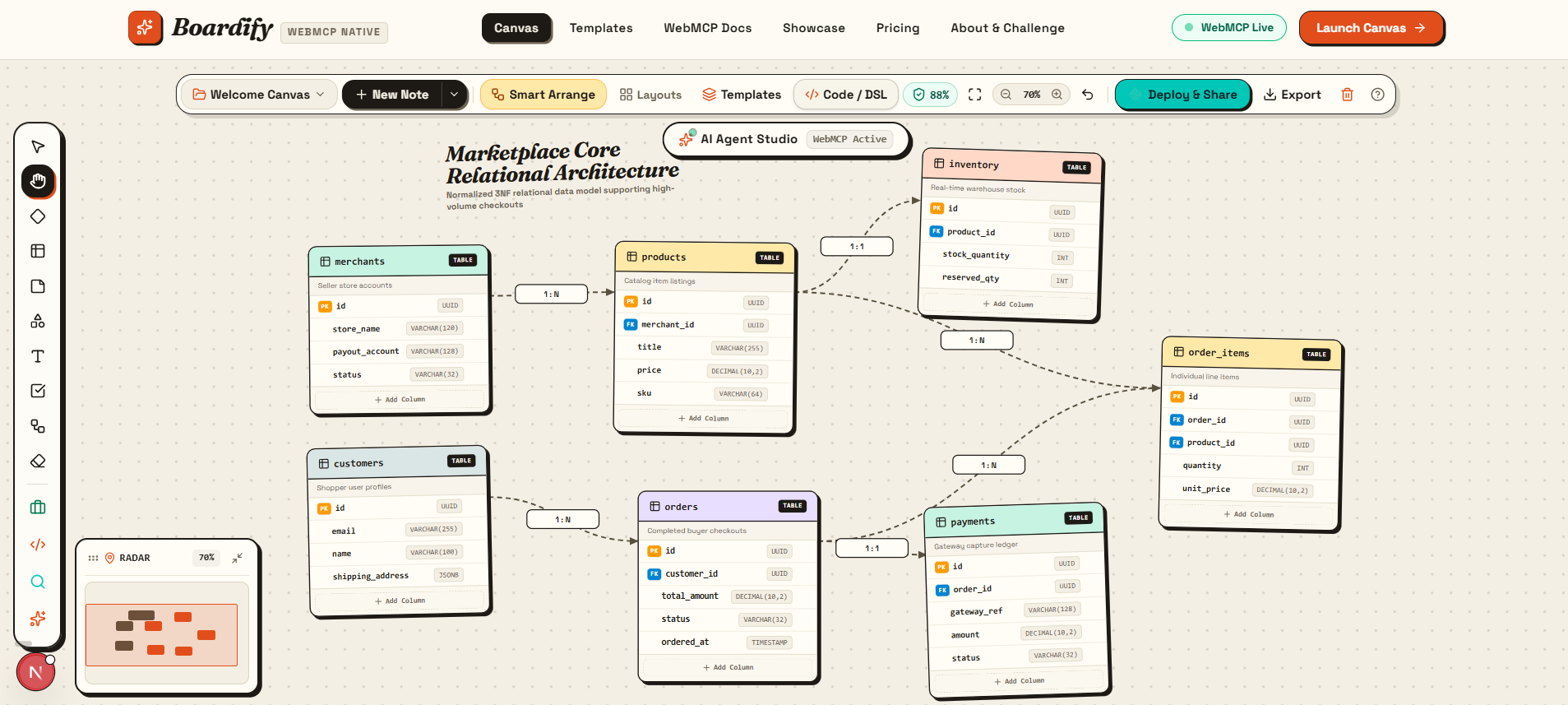
er template
-
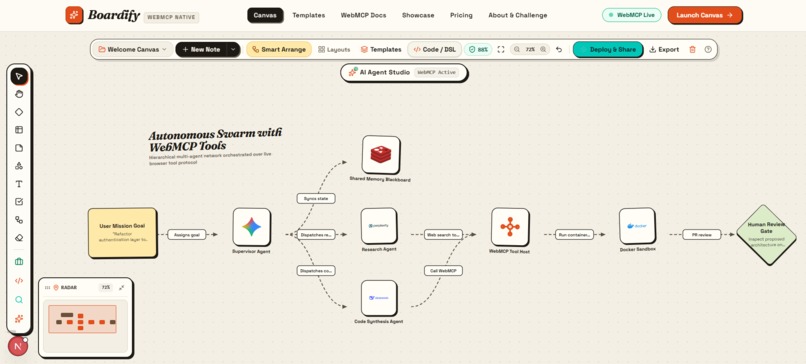
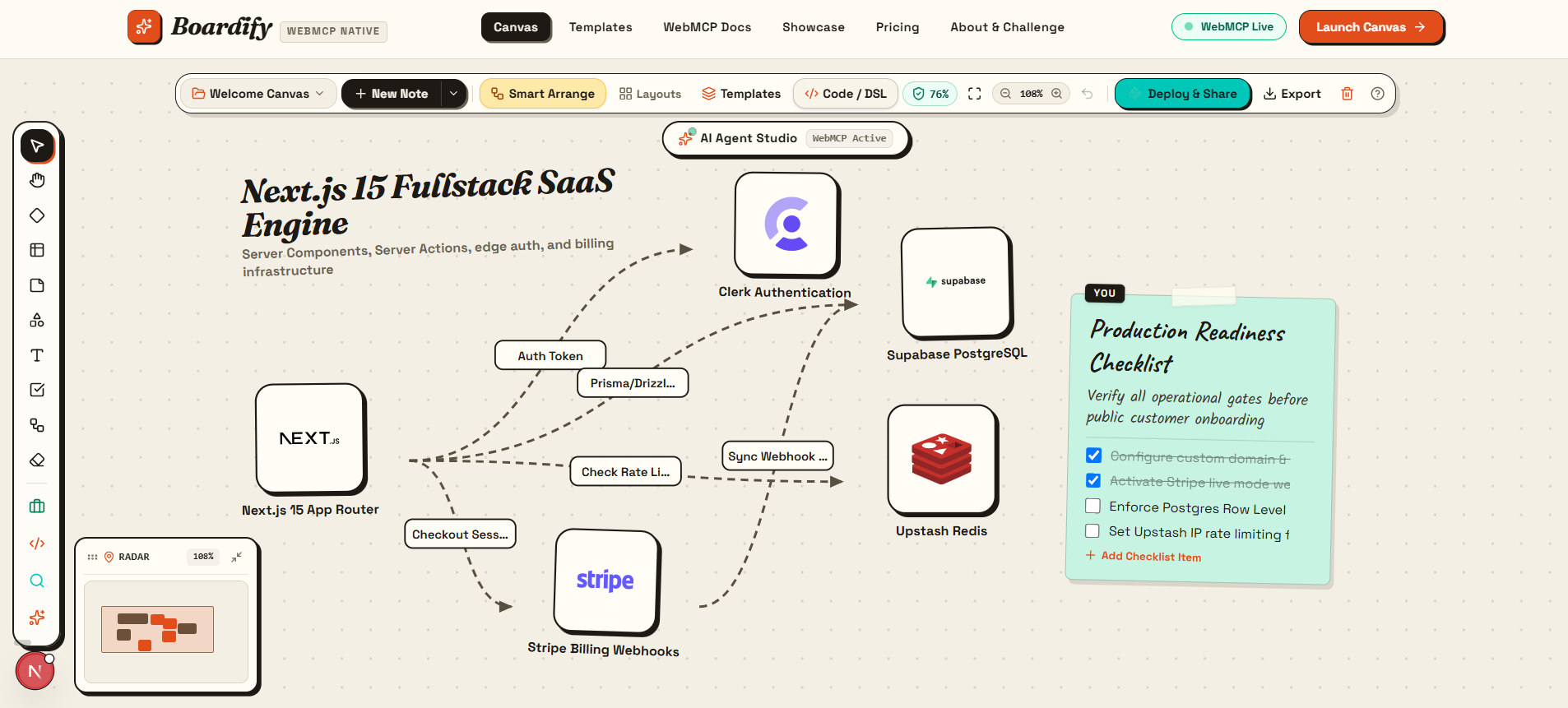
cloud workflow template
-
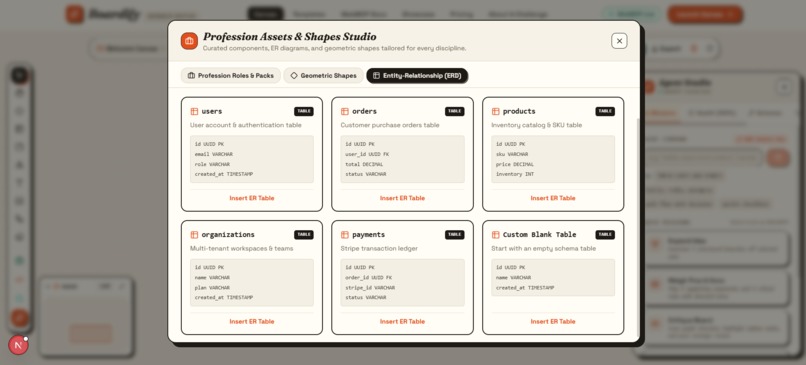
tables
-
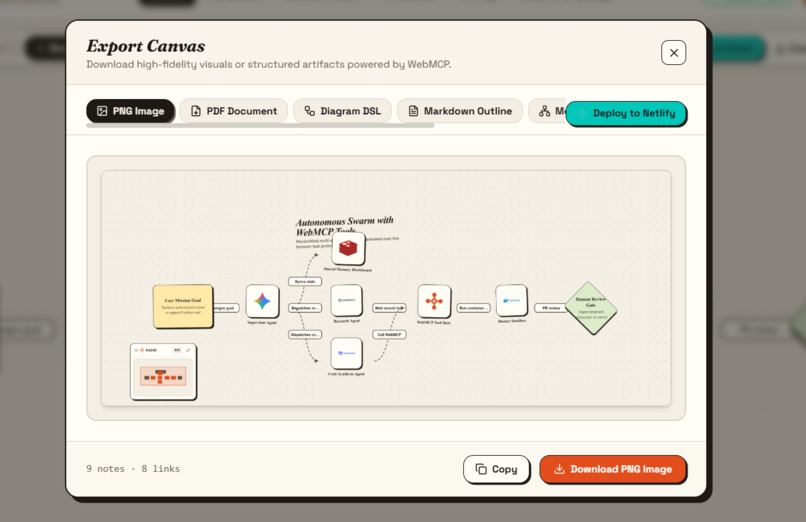
export
-
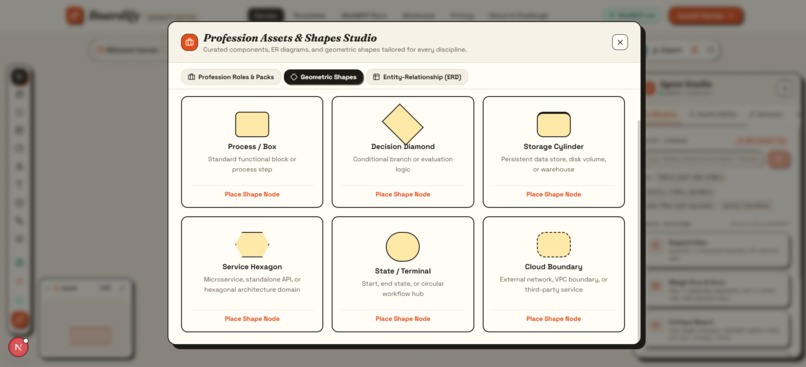
shapes
-
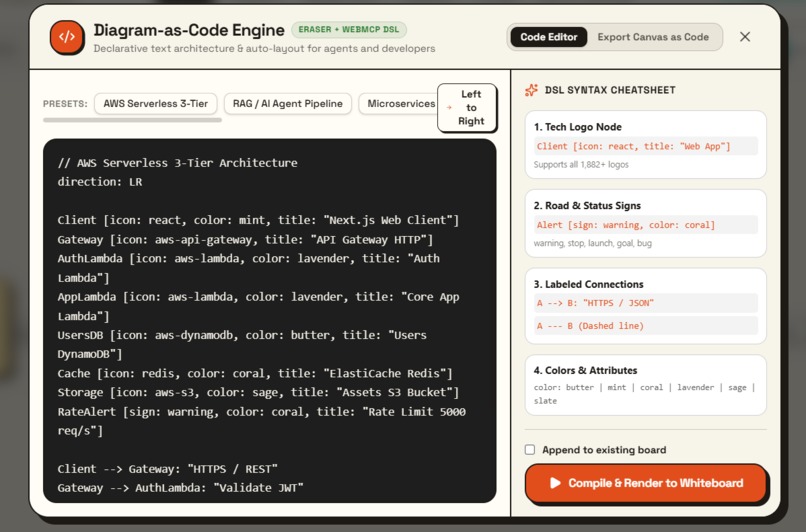
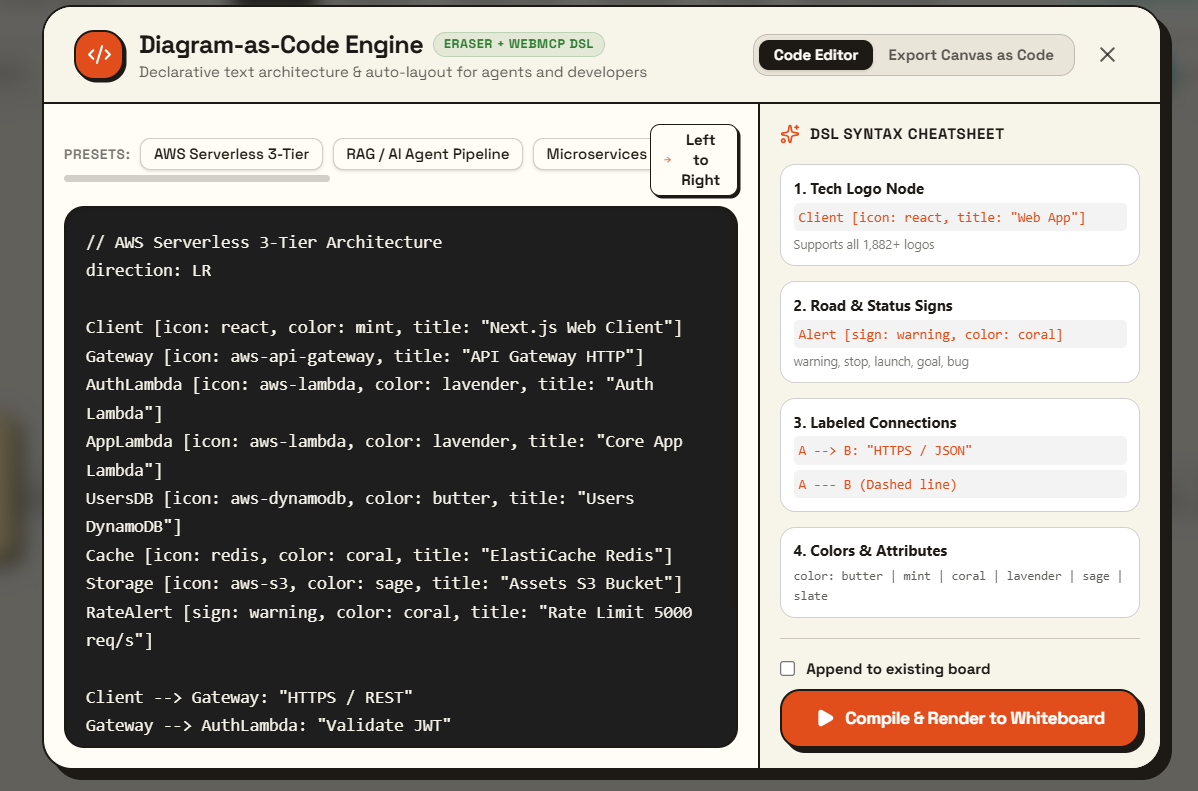
code and dsl
-
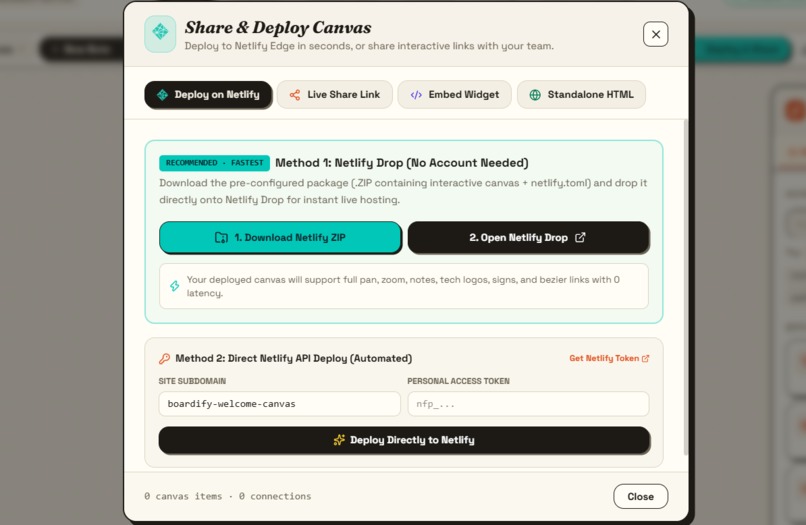
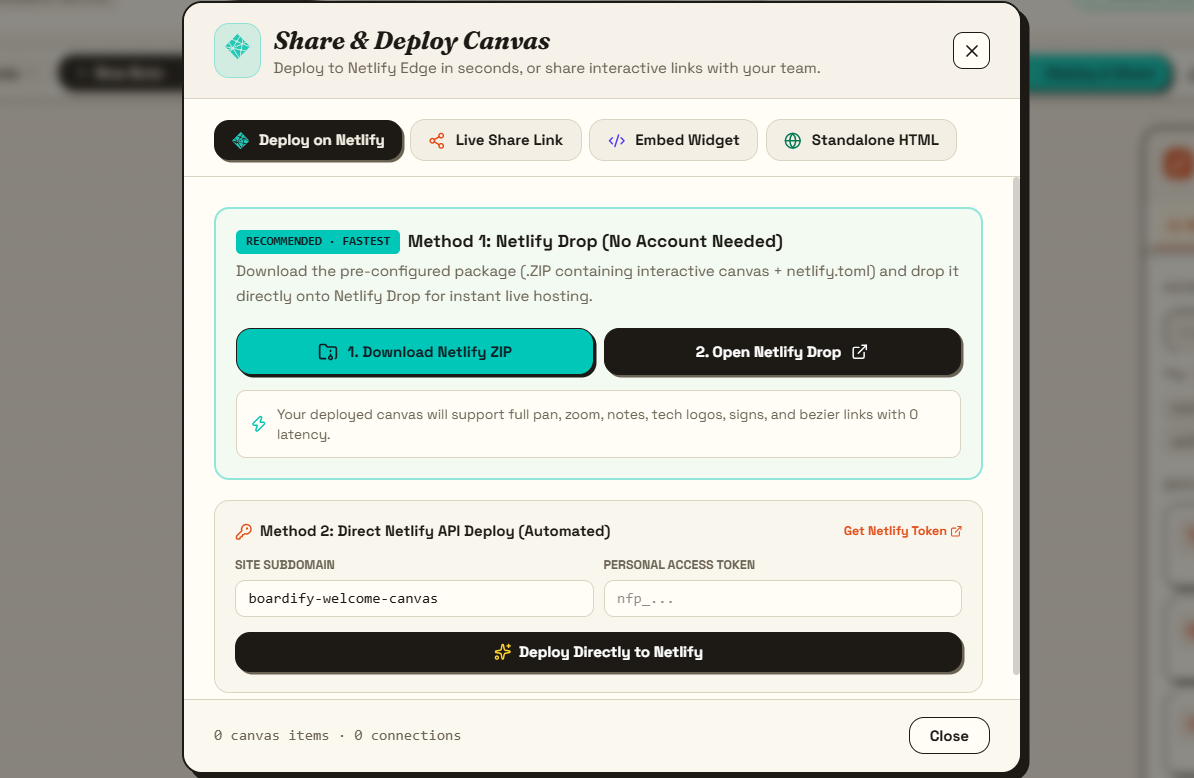
deployment and sharing
Inspiration
We've all experienced the frustration of whiteboarding complex software architecture. You open a spatial tool like Miro or Excalidraw, stare at an empty canvas, and wrestle with "blank canvas paralysis." Meanwhile, your AI assistant is confined to a narrow linear chat sidebar in another window.
To bridge this gap, engineers have spent years copying code snippets, describing layout ideas in prose, switching tabs, manually drawing boxes, pasting brand logos, and routing arrows. Previous attempts to give AI agents spatial capabilities relied on vision screen-scraping: taking a screenshot of the browser, passing it to an LLM to guess $(x, y)$ pixel coordinates, and synthesizing simulated mouse clicks. This approach is fundamentally flawed—it introduces 3,000ms+ roundtrip latency, breaks across different device pixel ratios and monitor resolutions, and frequently causes cards to collide or overlap.
Spatial thinking is inherently non-linear, multi-dimensional, and relational—represented mathematically as a directed graph $G = (V, E)$. Chat interfaces force this multidimensional thought process into a 1-dimensional string of tokens.
When the OpenAI & Google WebMCP Challenge was announced, we realized that browser-native agents no longer need to be blind or clumsy. By establishing window.document.modelContext, browser applications can expose structured, type-safe APIs directly to the host model. We asked ourselves:
"What if an AI didn't just talk to you about your architecture—what if it pulled up a chair directly at your whiteboard, read the graph in sub-20ms, placed typed SQL tables, routed bezier wires, and untangled layout physics alongside you?"
That was the spark for Boardify.
What It Does
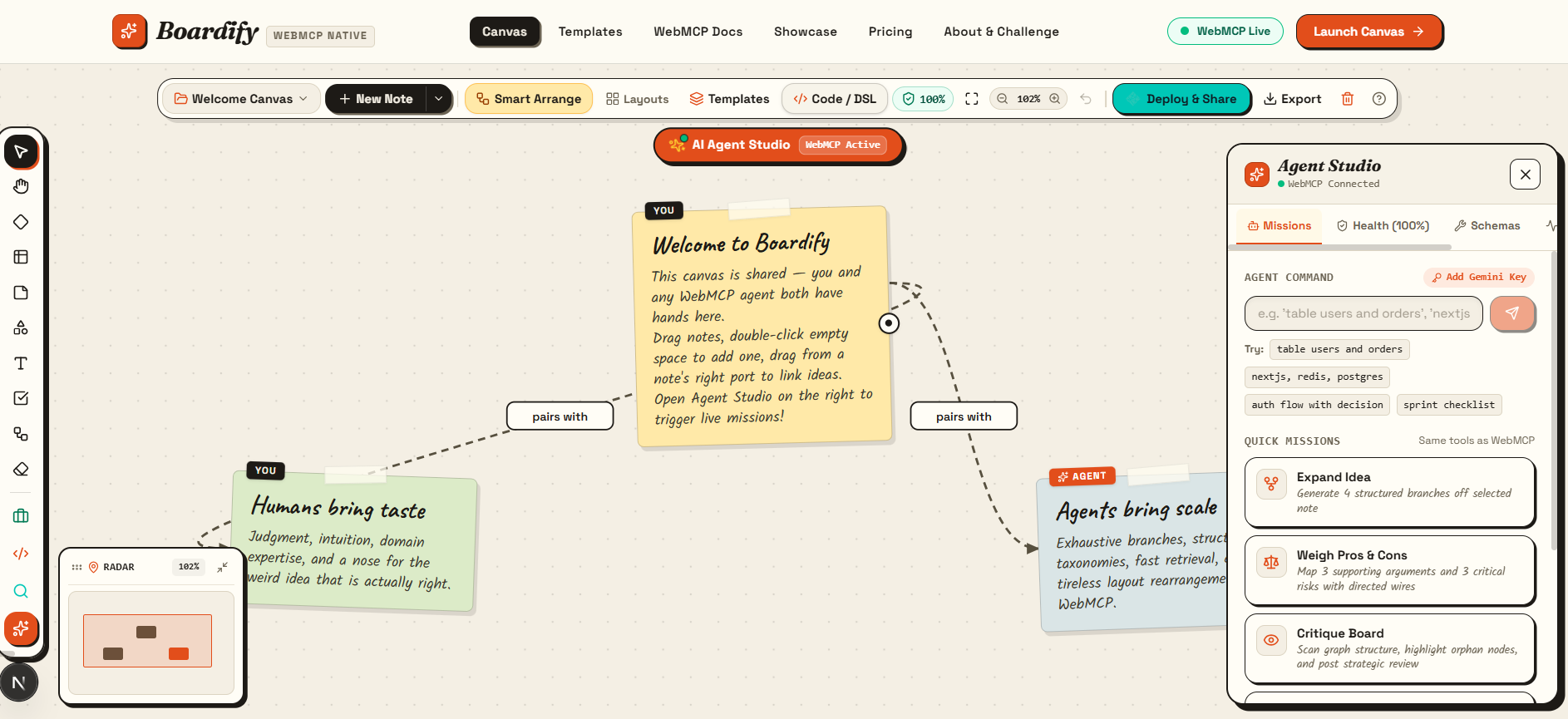
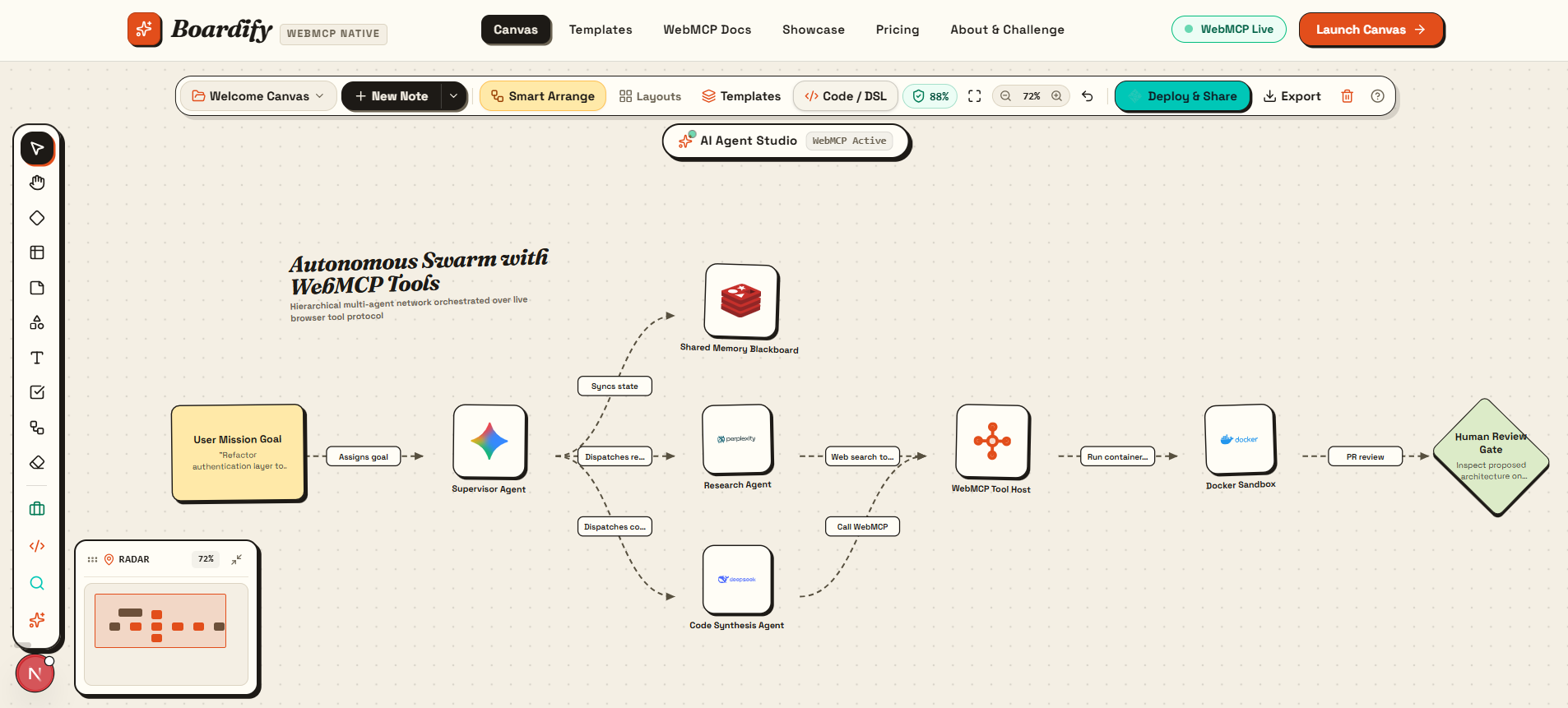
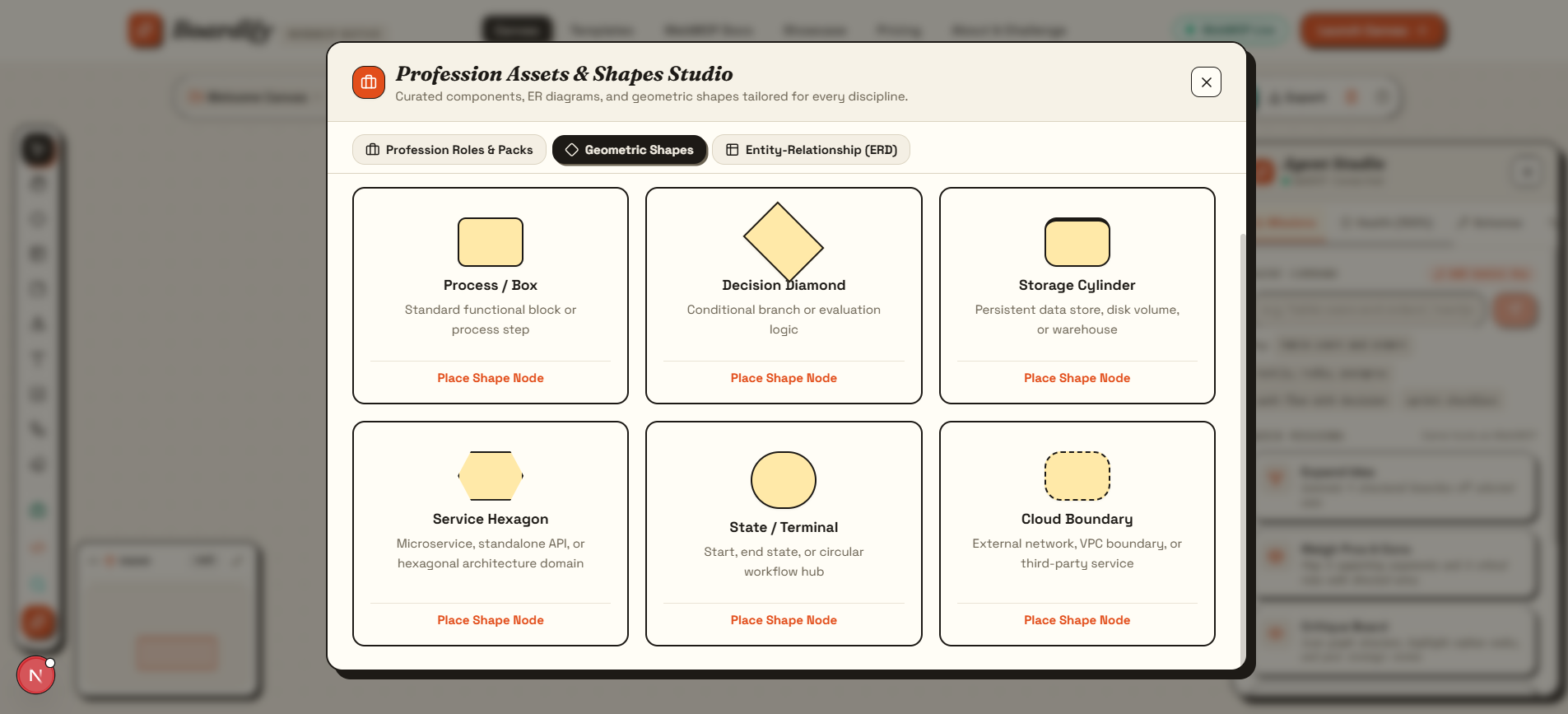
Boardify is the first agent-native spatial whiteboard built from the ground up for the WebMCP standard. It is a shared collaborative workspace where humans bring intuition, taste, and high-level strategy, while browser agents bring speed, scale, and architectural execution.
Key capabilities include:
- 24 First-Class WebMCP Tools: Directly exposed on
document.modelContextwith strict JSON Schema definitions, encompassing node creation, wire connections, SQL schema tables, tech stack logos, checkpoints, and graph layout physics. - Agent Ghost Cursor & Tactile Feedback: Real-time visual agency. When an agent runs a tool, a pulsing Ghost Cursor sweeps across the canvas with an active action badge (e.g.,
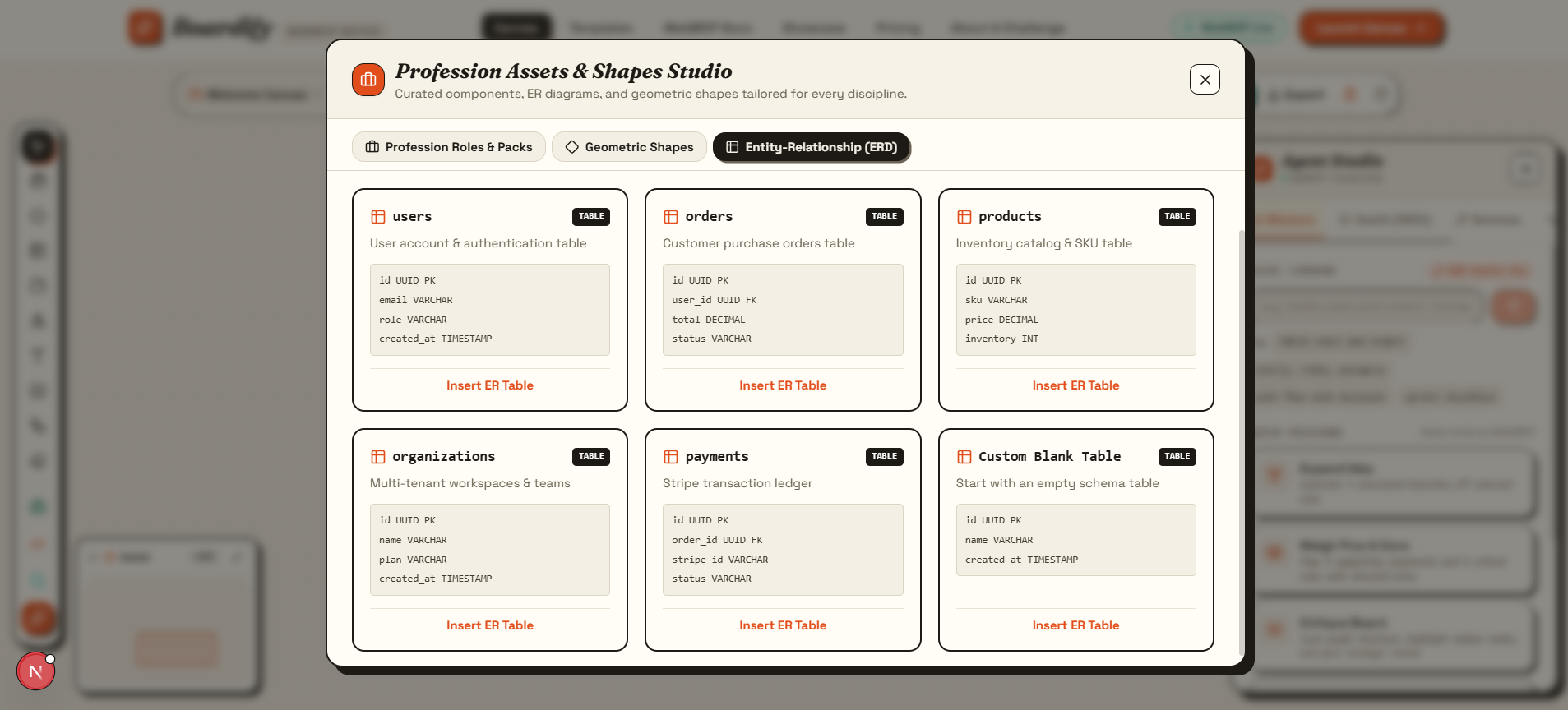
AGENT · tool: add_entity_table), accompanied by mechanical pop animations and sound design. - Instant Relational ERD Generation: Prompt the agent with "table users and orders", and it creates complete SQL database entity cards equipped with primary keys, foreign keys, data types (
UUID,VARCHAR,TIMESTAMP), and relational wire linkages. - Curated Architecture Vector Logo Library: Over 1,800+ tech logos (Next.js, Kafka, Redis, PostgreSQL, Docker, AWS, Stripe, etc.) searchable and spawnable by the agent in milliseconds.
- Physics-Based Auto-Tidy & Smart Flow: Clean algorithms for topological DAG ordering, force-directed untangling, and semantic clustering.
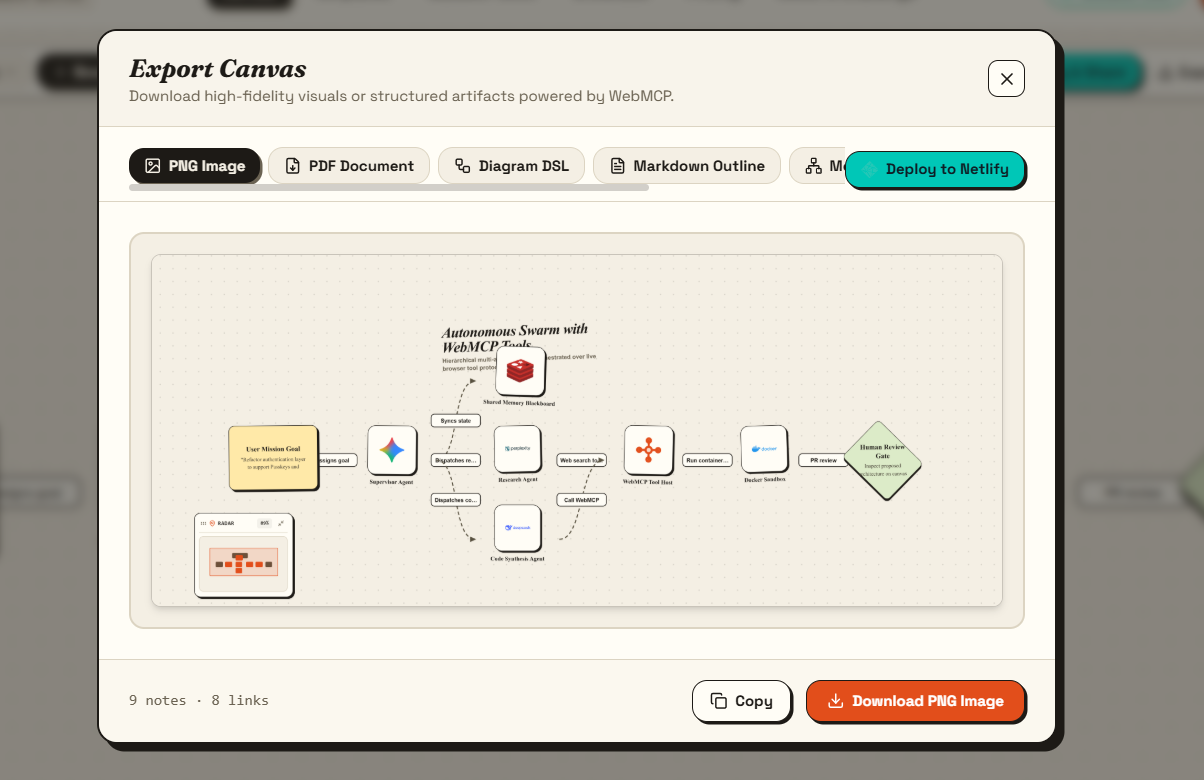
- Zero-Friction Multi-Format Export: 1-click export of visual diagrams to clean Markdown documentation, Mermaid flowchart code, structured JSON state, or high-res PNG.
- Dual-Mode WebMCP Execution: Hooks natively into Chrome Canary (
#enable-webmcp-testing) and ChatGPT in-app browser sessions, while offering an interactive AI Agent Studio and DevTools console polyfill for standard desktop browsers.
How we built it
Boardify was engineered using a high-performance, modern web stack tailored for 60fps spatial manipulation:
- Frontend Core: Next.js 15 (App Router) with React 19, TypeScript, and Tailwind CSS.
- Graphics & Spatial Engine: Infinite zoom-and-pan canvas combining HTML5 viewport transforms with high-efficiency SVG Bezier curve rendering.
- WebMCP Integration Layer (
src/lib/webmcp.ts): Complete implementation of the WebMCP specification. When the canvas mounts, it registers 24 typed tools towindow.document.modelContext.registerTool(...). - Multi-Provider LLM Client: Native client adapters for Google Gemini (
gemini-2.0-flashwith multi-version fallback acrossv1betaandv1), OpenAI (gpt-4o-mini), Anthropic (claude-3.5-sonnet), alongside an offline heuristic synthesis engine. ### The Mathematics of Spatial Whiteboarding (LaTeX)
Camera Projection & Viewport Transforms: To translate between user screen coordinates $(x_s, y_s)$ and the infinite 2D world space $(x_w, y_w)$, we compute affine viewport transformations using scale factor $C_z$ and pan offsets $(C_x, C_y)$: $$\begin{pmatrix} x_s \ y_s \end{pmatrix} = \begin{pmatrix} C_x \ C_y \end{pmatrix} + C_z \begin{pmatrix} x_w \ y_w \end{pmatrix}$$ The inverse projection (Screen-to-World) executed during pointer events and agent cursor positioning is: $$\begin{pmatrix} x_w \ y_w \end{pmatrix} = \begin{pmatrix} \frac{x_s - C_x}{C_z} \ \frac{y_s - C_y}{C_z} \end{pmatrix}$$
Cubic Bézier Dynamic Cable Routing: Every wire connecting two nodes $P_0 = (x_0, y_0)$ and $P_3 = (x_3, y_3)$ is generated as a smooth cubic Bézier spline $B(t)$ parameterized over $t \in [0, 1]$: $$B(t) = (1-t)^3 P_0 + 3(1-t)^2 t P_1 + 3(1-t) t^2 P_2 + t^3 P_3$$ where intermediate control points $P_1 = (x_0 + \Delta x \cdot \kappa, y_0)$ and $P_2 = (x_3 - \Delta x \cdot \kappa, y_3)$ dynamically scale with horizontal separation $\Delta x = x_3 - x_0$ using stiffness coefficient $\kappa = 0.45$.
Force-Directed Physics Layout (Spring-Embedder): Our
tidy_force_directedtool models notes as charged particles exerting repulsive Coulomb forces and edges as Hookean springs with equilibrium length $L$: $$F_{\text{repulsive}}(u, v) = \frac{k^2}{|p_u - p_v|} \cdot \hat{r}{uv}, \quad \text{where } k = \sqrt{\frac{\text{Width} \cdot \text{Height}}{|V|}}$$ $$F{\text{attractive}}(u, v) = \frac{|p_u - p_v|^2}{k} \cdot \hat{r}_{vu}$$ System states are updated over discrete iterations via velocity-Verlet numerical integration: $$p_i^{(t+\Delta t)} = p_i^{(t)} + v_i^{(t)}\Delta t + \frac{1}{2}a_i^{(t)}\Delta t^2$$ converging in $O(|V|^2 + |E|)$ time to a minimum-energy, crossing-minimized diagram.Directional DAG Smart Flow: Hierarchical diagrams are arranged using topological level sorting. We compute the longest path for each vertex $v \in V$ in $O(|V| + |E|)$: $$\text{Level}(v) = \begin{cases} 0 & \text{if } \text{in-degree}(v) = 0 \ 1 + \max_{(u, v) \in E} \text{Level}(u) & \text{otherwise} \end{cases}$$ Vertices are partitioned into horizontal columns $C_\ell = {v \in V \mid \text{Level}(v) = \ell}$ and laid out left-to-right to preserve intuitive cause-and-effect flow.
Challenges we ran into
Spatial Collision & Viewport Bleed: When agents spawn multiple cards, placing them blindly resulted in cards overlapping existing notes or landing far below the fold on compact laptop viewports. We solved this by developing an outward radial spiral search in
findFreeSpot()paired with synchronous bounding-box camera framing (fitView(true, allNodes)), guaranteeing that generated items appear immediately within the user's active viewport without disrupting existing work.React 19 State Batching vs. Real-Time Tool Execution: When an agent called multiple tools in rapid succession (e.g. creating 4 nodes and 3 links), unbatched state updates caused intermediate render passes where references to newly created nodes were not yet committed to
nodesRef.current. We re-architected tool execution into atomic batch commits, accumulating additions in memory and applying them in a single cohesive render cycle.Passive Event Listener Constraints on Infinite Canvas: Modern browsers treat wheel events as passive by default to optimize scrolling performance. However, an infinite canvas must intercept
wheelto implement pinch-to-zoom and multi-directional trackpad panning withe.preventDefault(). We resolved this by binding native non-passive DOM event listeners directly to the container ref with{ passive: false }, completely eliminating browser console errors.Multi-Model API Evolution: During development, the legacy
gemini-proendpoint was retired in Google'sv1betaAPI. We built a resilient multi-version client adapter insrc/lib/llm-client.tsthat auto-migrates stored keys togemini-2.0-flash, sanitizes quotation marks and whitespace, and provides automatic fallback acrossv1betaandv1REST endpoints.
What we learned
- WebMCP Eliminates the Prompt Engineering Tax: Instead of writing 500-word system prompts telling an LLM "format your output as JSON with x, y, width, and height", WebMCP provides typed JSON Schemas directly through the browser. The agent interacts with our app through clean function calls rather than text parsing.
- Deterministic APIs Beat Vision Scraping Every Time:
Watching a browser agent execute 5 tools in under 50 milliseconds via
document.modelContextcompared to waiting 5 seconds for a vision-based agent to take a screenshot and guess a coordinate was an absolute epiphany. WebMCP is to the web browser what SQL was to relational databases. - The Power of Shared Canvas State: When human and AI operate on the exact same data model, collaboration feels completely natural. The human can sketch an idea, the agent can expand it, the human can edit the agent's typos, and the agent can tidy the result. It's truly pair-programming for system architecture.
What's next for Boardify
- Multi-Agent Spatial Collaboration: Allowing multiple specialized agents (e.g., a Database DBA Agent, a Security Architect Agent, and a UX Flow Agent) to inspect the whiteboard simultaneously and leave contextual review stamps and suggestions.
- WebRTC Multiplayer Rooms: Combining human-to-human real-time presence (live multiplayer cursors and voice) with autonomous WebMCP agents in the same shared canvas room.
- Two-Way Git & Issue Tracker Synchronization: Bi-directional sync where clicking a "Sync with GitHub" button converts diagram nodes directly into GitHub Issues, PR milestones, or Jira epics.
Build with
webmcp, nextjs, react, typescript, tailwindcss, google-gemini, openai, anthropic-claude, html5-canvas, svg, playwright, firebase, firestore, netlify, vercel
Built With
- anthropic-claude
- chrome
- firebase
- firestore
- google-gemini
- html5
- netlify
- nextjs
- openai
- playwright
- react
- svg
- tailwindcss
- typescript
- vercel
- webmcp


Log in or sign up for Devpost to join the conversation.