Live on AWS: https://m5fd6rcr67gfrvw3elkxctbcvu0xseam.lambda-url.us-east-1.on.aws/ (AWS Lambda + Function URL, S3, CloudWatch; open System to see the runtime). Mirror: https://boardguard-three.vercel.app. Code: https://github.com/bilal-feroz/BoardGuard
Inspiration
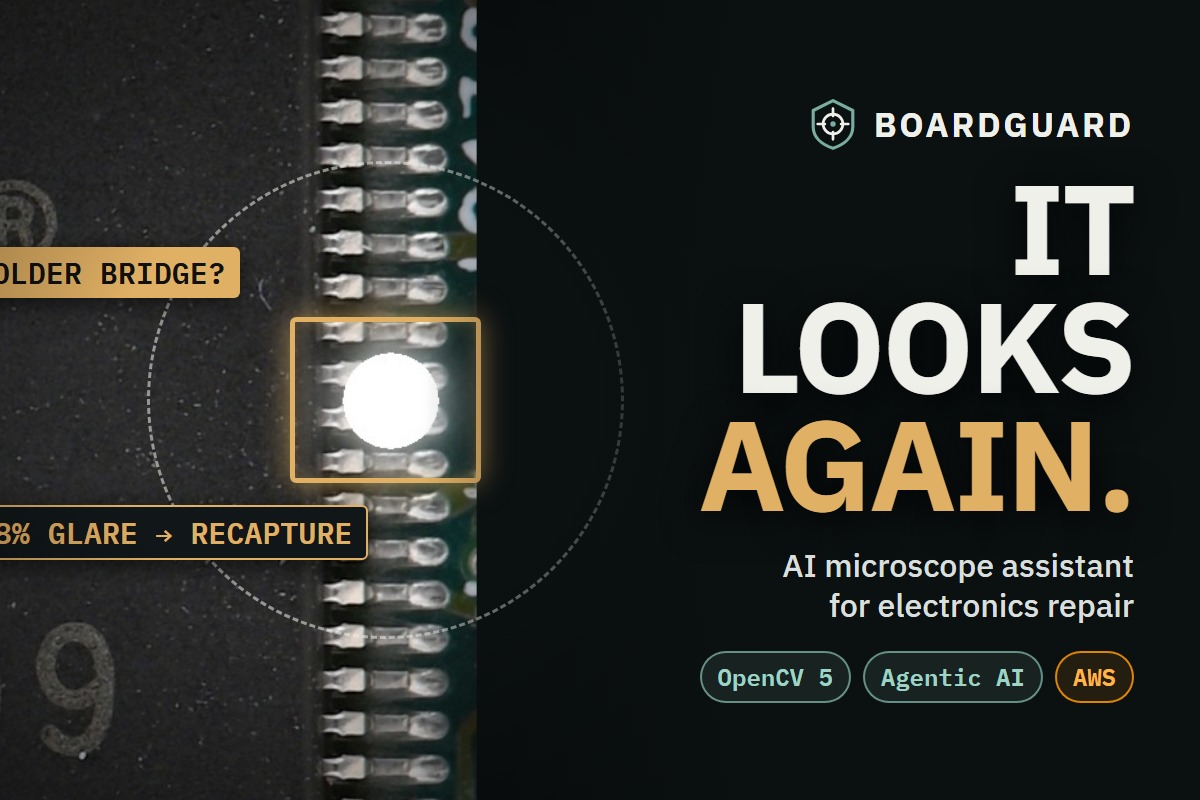
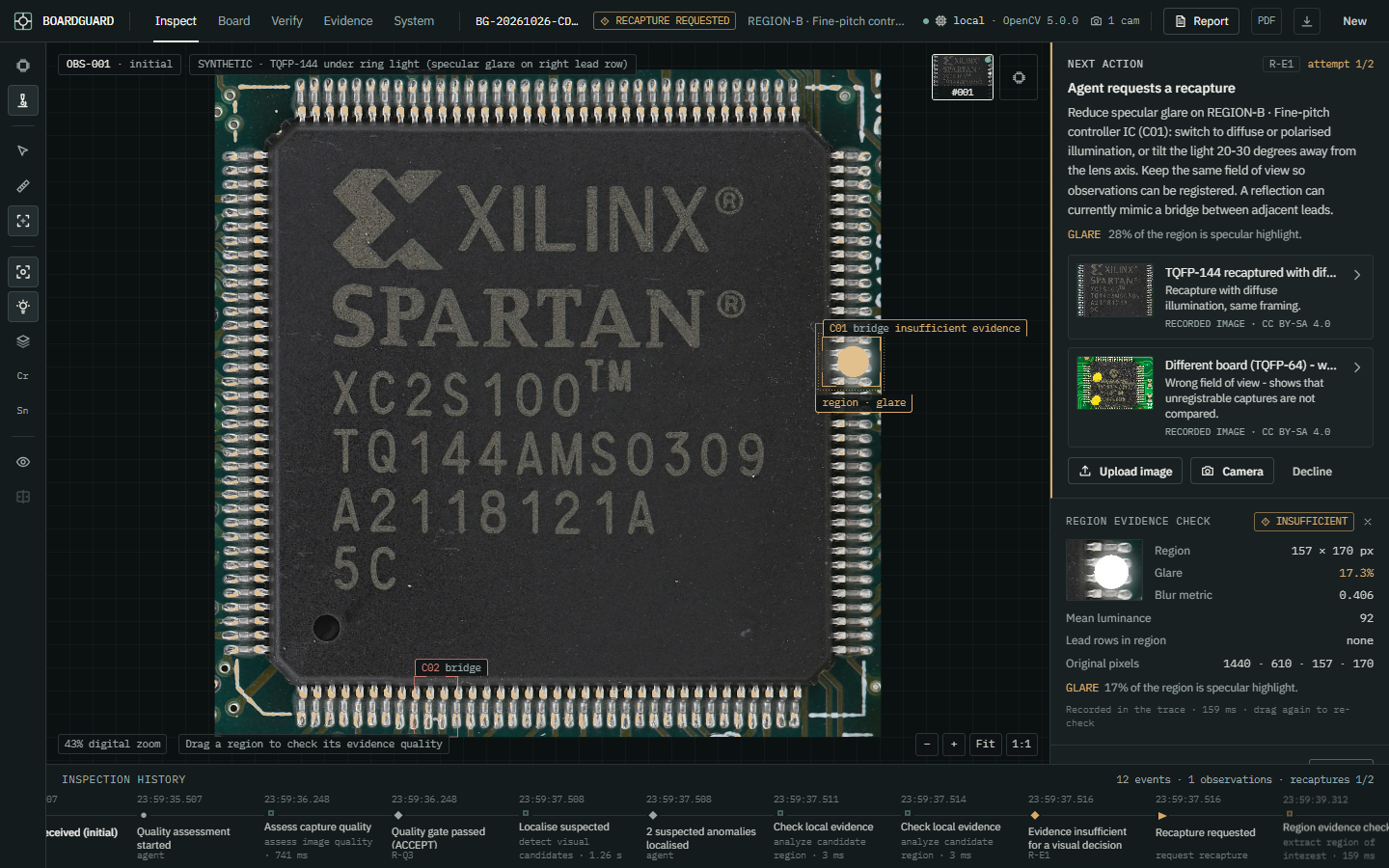
Repair technicians spend hours under digital microscopes hunting for corrosion and solder bridges on boards they have never seen before. The hardest moments are not the clear defects. They are the ambiguous ones, like a ring-light reflection that looks exactly like a bridge between two 0.5 mm leads. A good technician's answer is "let me look again with different light", not "probably a short". We wanted software that behaves the same way.
What it does
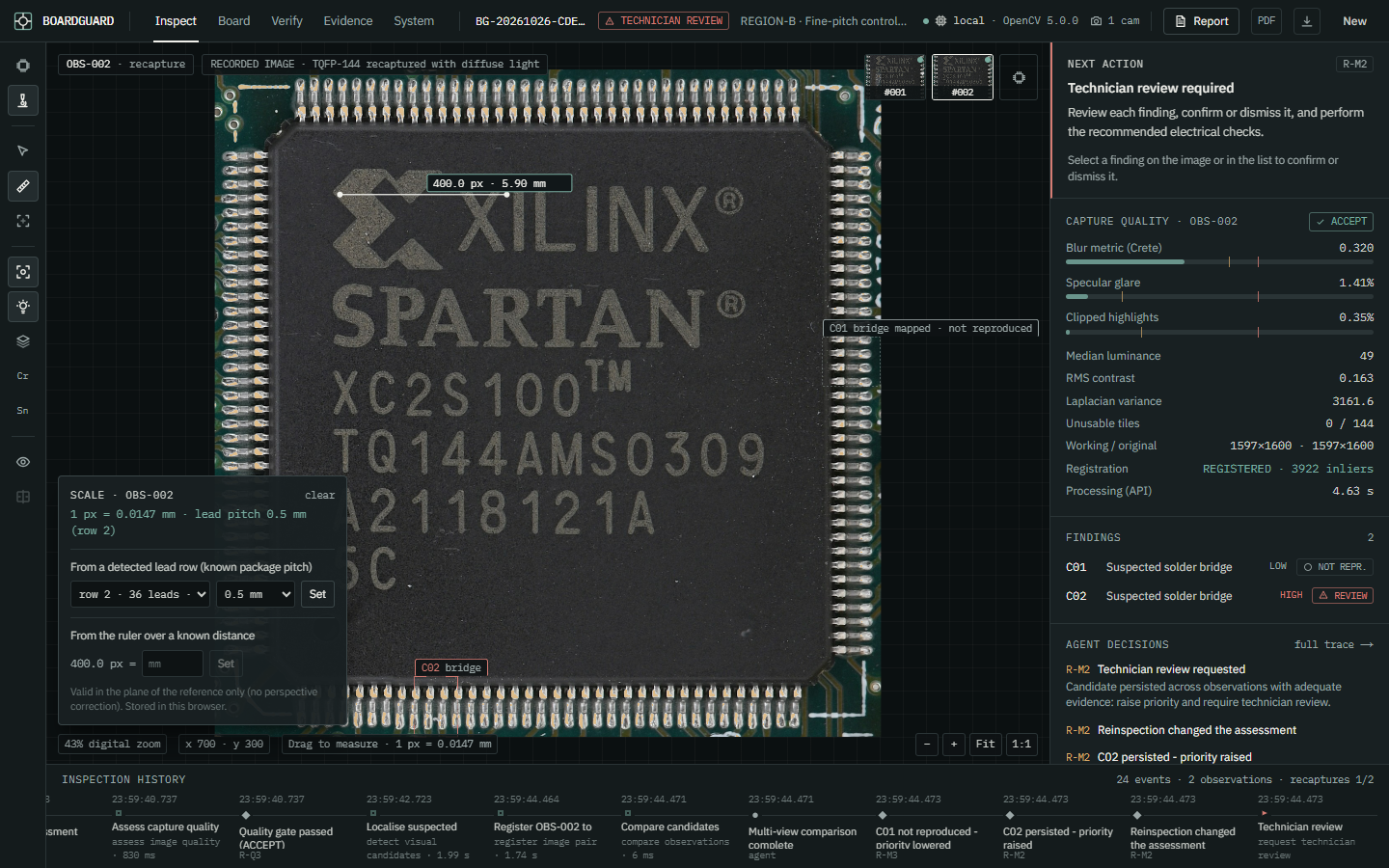
- Measures each capture (focus, glare, exposure, contrast, unusable tiles) and refuses to analyse unusable evidence.
- Localises suspected corrosion and solder bridges with OpenCV, and checks whether the local evidence around each one is good enough to support a decision.
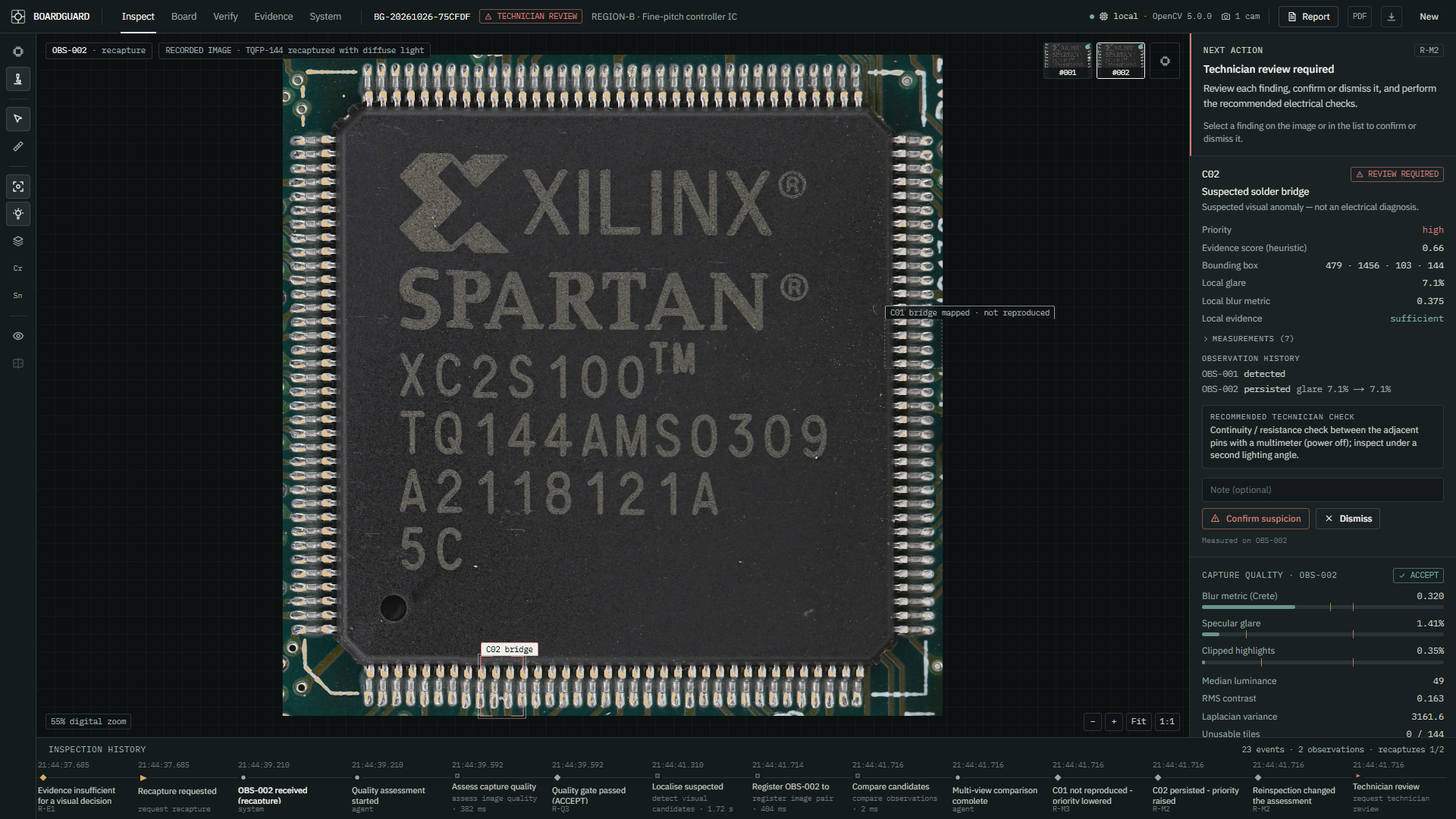
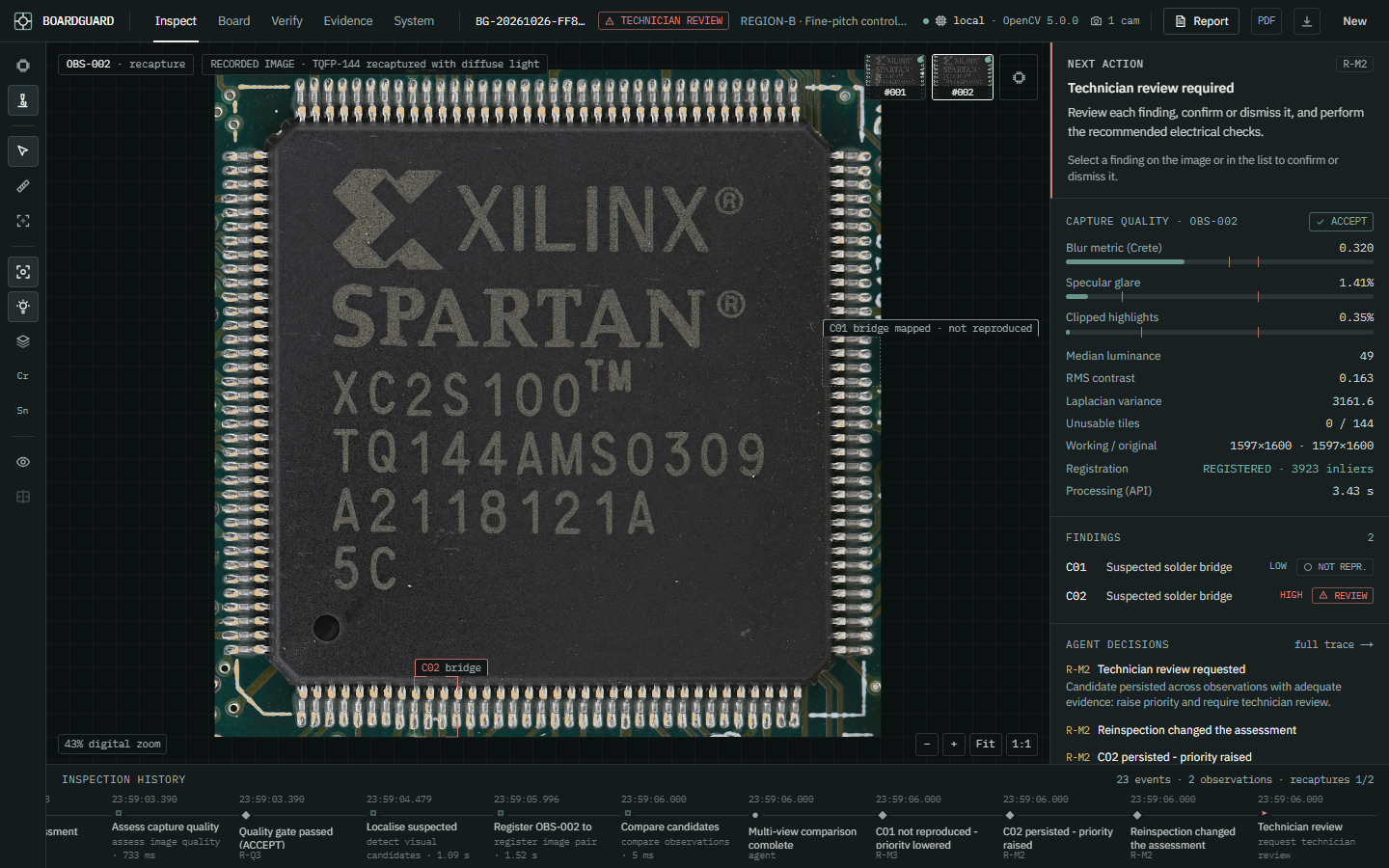
- When it is not, the agent requests a specific new observation: diffuse light, refocus, more magnification, same framing. It then registers the new capture to the old one and records whether each finding persisted, was not reproduced, or is still inconclusive.
- Hands every finding to the technician with a recommended electrical check. It never auto-clears anything and never claims continuity.
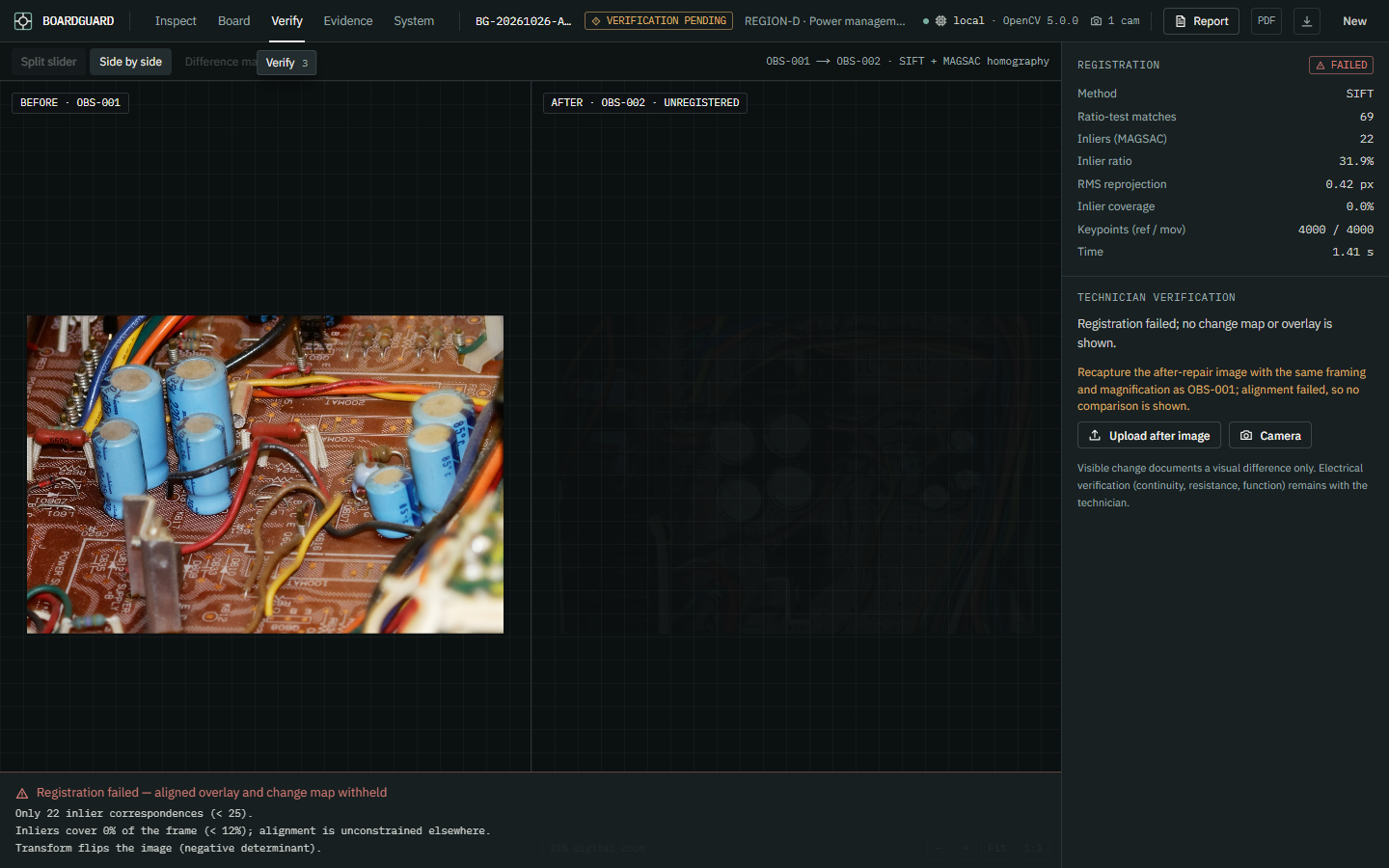
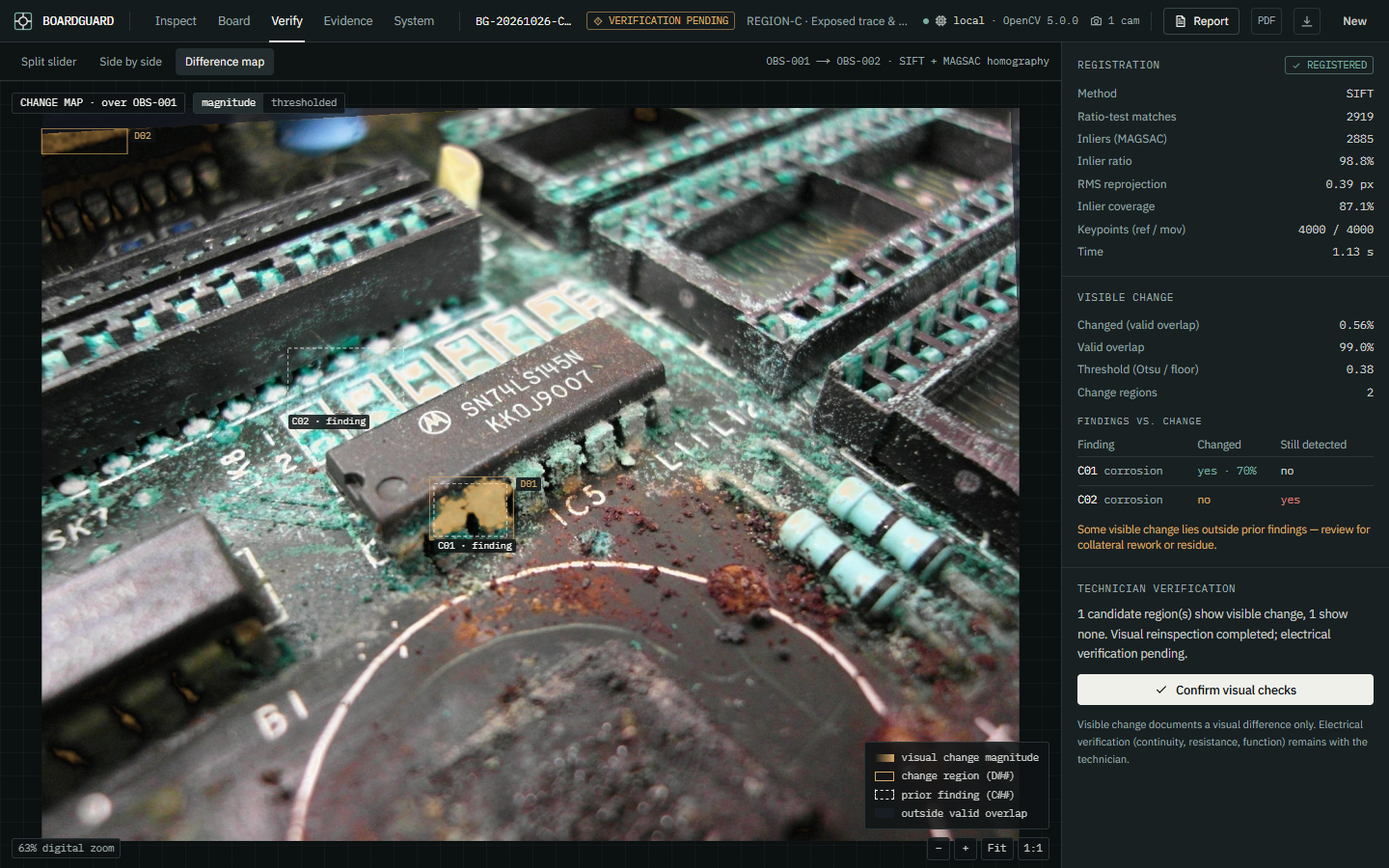
- Registers before/after-repair captures, shows a split slider, synced views and a difference map, maps visible change onto findings, and withholds overlays when alignment is unreliable.
- Records a full evidence trace and produces a printable report.
- Lets you navigate a detailed 3D logic board and fly into a region to open its microscope view.
- Gives the technician their own tools: drag any area to check its evidence quality (glare, focus, exposure, lead resolution), measure in millimetres after calibrating from a known IC lead pitch, and undo a confirm/dismiss while the review is still open. Every step lands in the trace.
How we built it
- OpenCV 5.0.0 (
opencv-python-headless) for everything visual:- Crete blur metric, Laplacian and Tenengrad measures
- specular masks and connected components
- Lab/HSV colour cues, difference-of-Gaussians texture energy and structure-tensor coherence
- lead-row geometry with
minAreaRect - SIFT/ORB features with USAC MAGSAC homographies
- shift-tolerant ΔE + SSIM change maps
cv2.inpaintfor a labelled synthetic fixture
- Agent: a policy-driven state machine in Python. Its tools have explicit contracts and its rule-cited decisions are unit-tested.
- FastAPI service; Next.js 16 + React Three Fiber workstation UI.
- AWS (live): the workstation and every OpenCV 5 analysis run on AWS Lambda (Python 3.12 zip,
3008 MB) behind a Function URL, with a private S3 evidence store (7-day expiry) so any instance
continues any inspection, and per-request CloudWatch logs. One CloudFormation template, a one-command
deploy and a verification script (
infrastructure/aws); a container path (ECR + Lambda Web Adapter) is included too. Runtime proof:docs/evaluation/aws-proof.md. - Mirror on Vercel: the static UI on the CDN and the FastAPI/OpenCV 5 service as one Python Function; inspections are shared between function instances through Vercel's Runtime Cache.
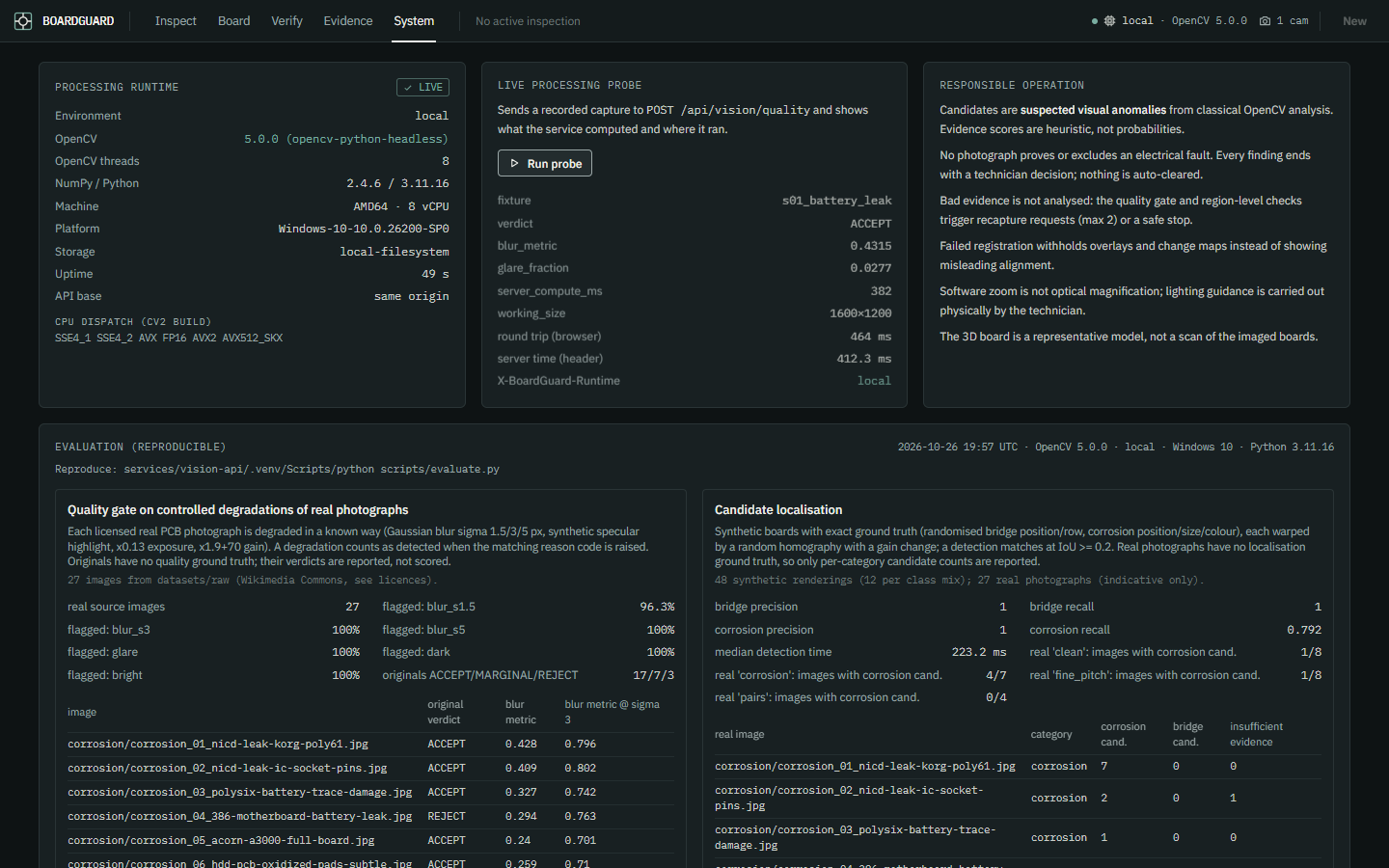
- 27 licence-checked Wikimedia Commons photographs plus a reproducible evaluation script.
Challenges we ran into
- Real data. No licensed dataset of real repair damage exists. The public PCB defect sets are factory defects with restrictive or conflicting licences. We documented every image's licence and never invented ground truth.
- Calibrating on real photos. The first corrosion detector fired on nearly every real board: brown phenolic laminate, tin-plated capacitor terminations, IC leads. Fixing that took texture-interior checks, metallic-surface suppression, and dropping a cue that could not be made reliable.
- Honest registration. Our genuine before/after rework pair is shot from different angles. The right behaviour is to refuse to overlay it, and BoardGuard does.
Accomplishments that we're proud of
- An actual perception → decision → action loop:
- vision outputs choose the next tool call or request;
- a second observation is genuinely processed;
- the decision changes for measured reasons, with the rule cited in the trace.
- Zero unsafe automatic conclusions across the evaluation scenarios (9/9 scripted agent scenarios pass).
- Registration accurate to 0.09 px median corner error on 81 known warps of real photos; 23/23 unrelated pairs correctly rejected.
- On 10 synthetic glare cases a single image got 5 wrong; after one targeted recapture all 10 were right.
What we learned
The most valuable output of a vision system in a repair shop is often "this evidence is not good enough, here is how to get better evidence". Making uncertainty actionable matters more than adding classes.
What's next
- Collect a consented, annotated corpus of real repair imagery with partner shops and train a small learned detector behind the same agent.
- Stage-micrometer calibration and perspective correction (today the scale comes from a known lead pitch or a ruler over a known distance).
- Local (non-planar) registration refinement.
- Integration with USB microscope controls (focus, illumination) so the agent's requests can be carried out by the instrument.
Team
Bilal Feroz, Fuad Ahamed and Muhammed Umar.
Built With
- amazon-cloudwatch
- amazon-web-services
- aws-cloudformation
- aws-lambda
- fastapi
- next.js
- numpy
- opencv
- playwright
- python
- react
- tailwindcss
- three.js
- typescript
- vercel

Log in or sign up for Devpost to join the conversation.