Inspiration
BoardForge began with my own family.
Two years ago, I moved away from my home country for work. Since then, my brothers and sisters have also settled in different countries. Social media and video calls allow us to stay in touch, but I kept missing something more specific: the family game nights we used to share.
I remembered the laughter and friendly competition, but also how much time it took to prepare everything; choosing the games, explaining the rules, forming teams, managing turns, and keeping score. Recreating that experience became even more difficult once we were no longer in the same place.
The internet already allows us to see and hear one another. I wanted it to help us recreate the joy, energy, and closeness of those evenings too.
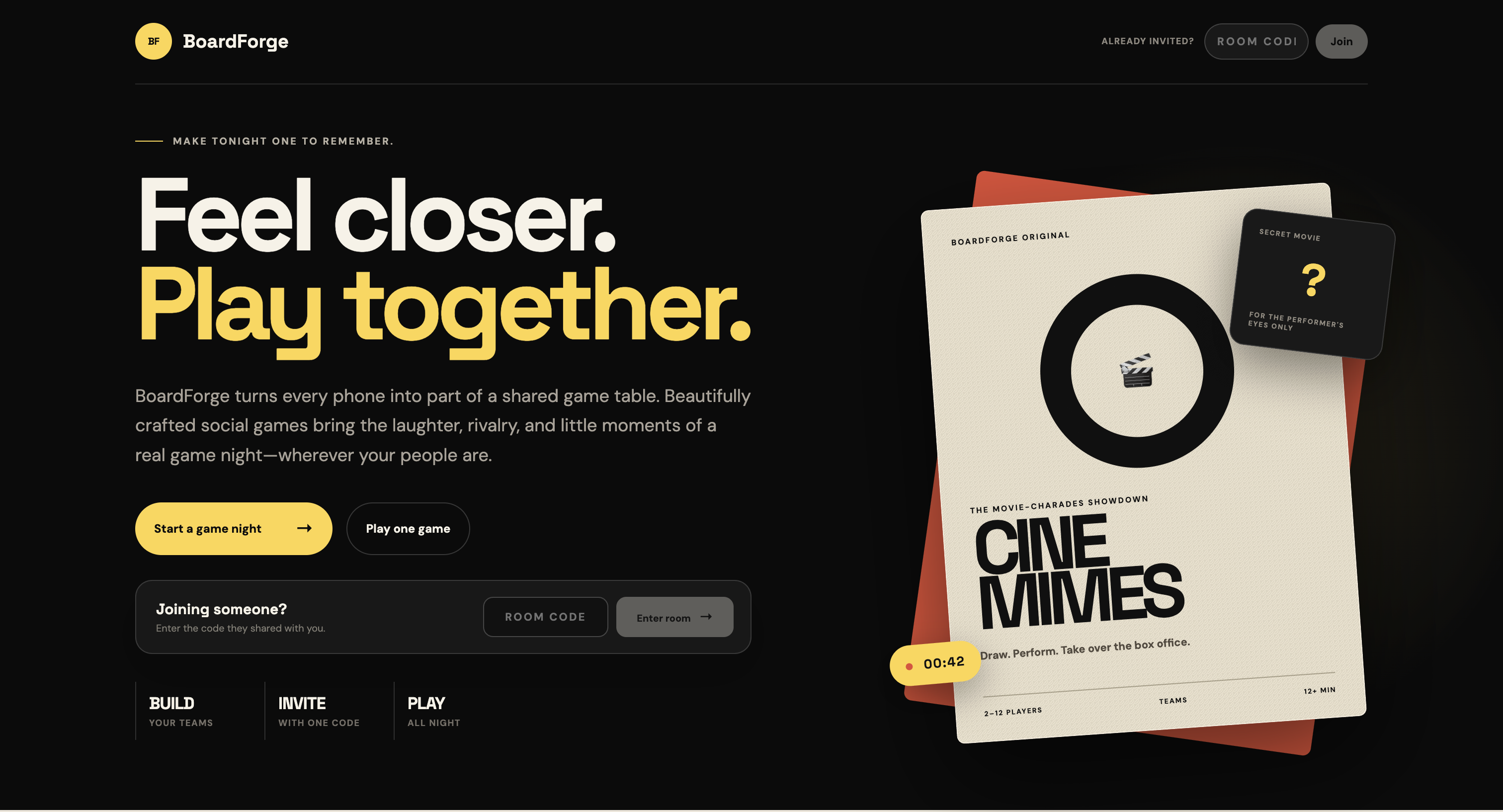
That is why I created BoardForge: a platform that handles the setup and management of group games while everyone remains free to use their preferred video-calling app.
BoardForge was designed to make those magical shared moments possible again, wherever each member of the family happens to be.
What it does
Players can use BoardForge in two ways:
- Play one game by selecting a game, customizing it, and immediately sharing a room code.
- Start a Game Night by creating two to four persistent teams and playing several games during the same session.
During a Game Night, players can:
- Join from their own phone or computer without creating an account.
- Choose their team.
- Select team captains.
- Launch and configure different games.
- Keep the same teams throughout the evening.
- View completed games and the global score.
- Finish the session with a final podium.
BoardForge currently includes seven games:
- Movie Mime - one player receives a secret movie and acts it out while their team races against the timer to identify it.
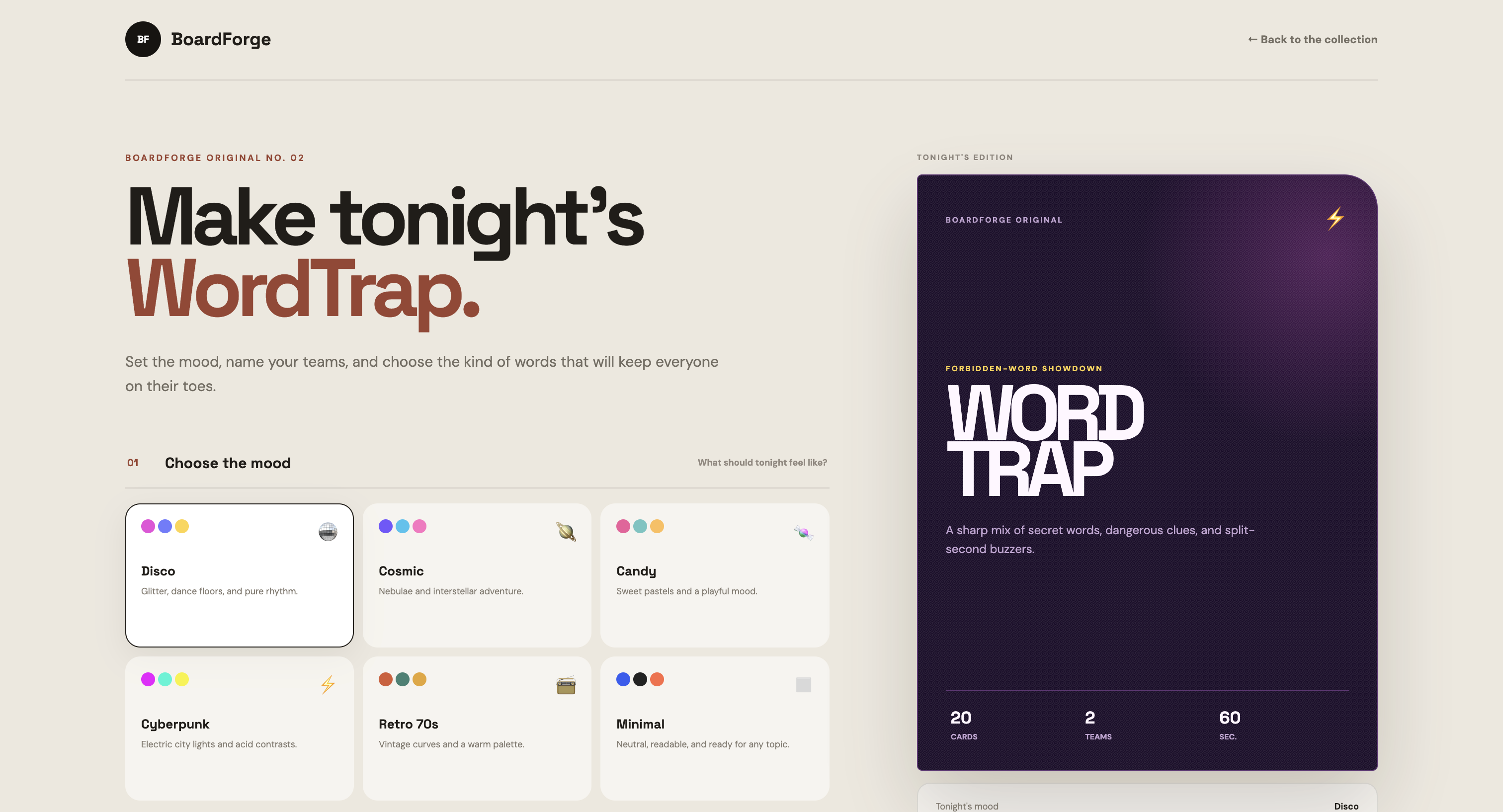
- WordTrap - describe a secret word without using any of its forbidden clues while the opposing team watches for mistakes.
- DrawBattle - turn a secret prompt into a drawing and help your team guess it before time runs out.
- SoundCheck - recreate a sound using only your voice and hope your teammates recognize it.
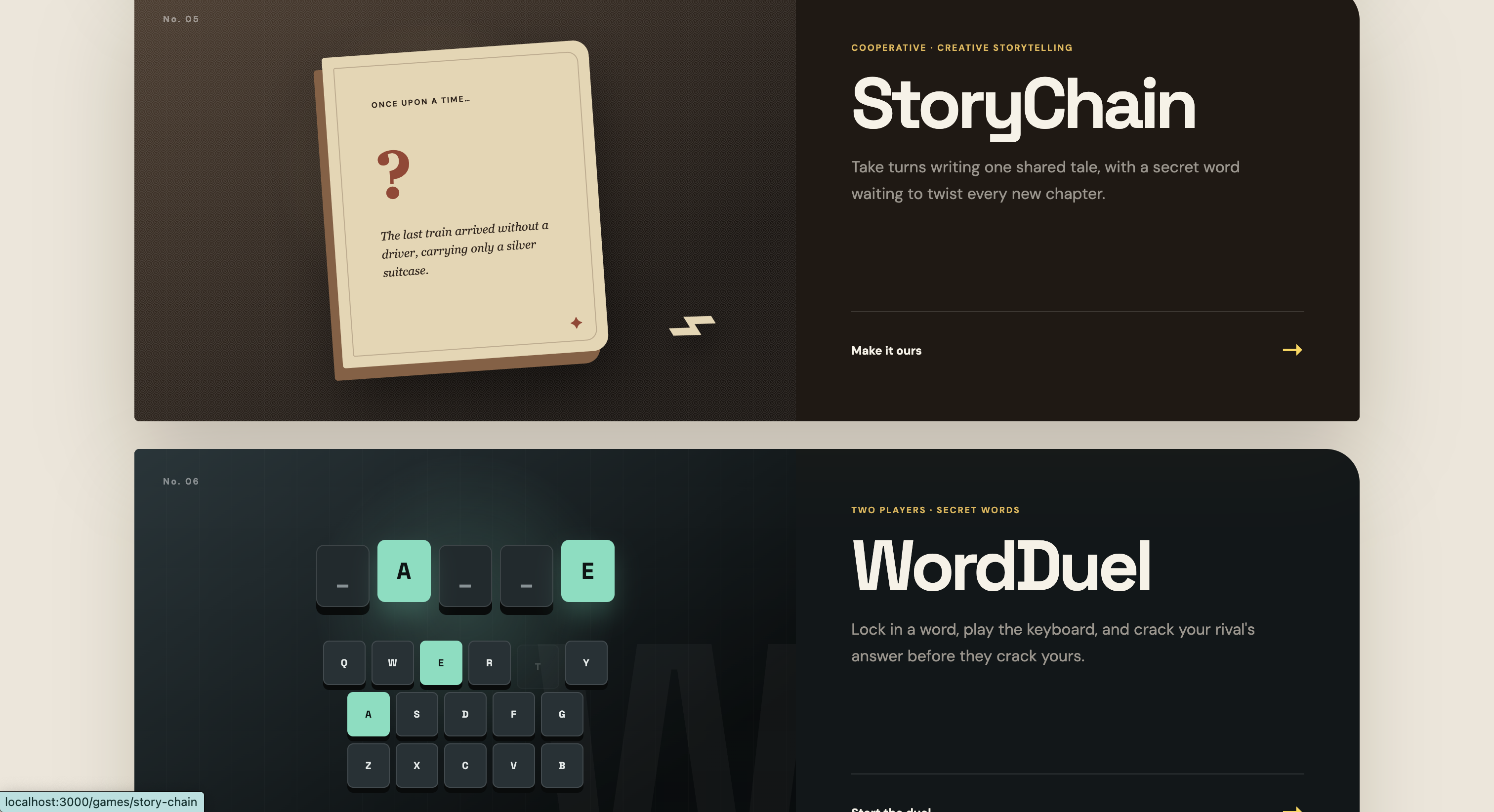
- StoryChain - write a collaborative story one contribution at a time, then let OpenAI transform the finished adventure into a polished digital book.
- WordDuel - two players secretly choose a word and propose letters until one discovers the opponent’s complete word.
- Second Sense - stop an invisible timer as close as possible to a changing target; the least accurate players are eliminated until only one remains.
Each game has its own rules, interactions, visual identity, and player-specific screens. Twenty themes allow the same experience to feel playful, cinematic, nostalgic, or completely chaotic.
The objective is to progressively expand BoardForge with new games and increasingly immersive experiences. Future games will explore more ways of using each player’s device through sound, touch, movement, drawing, private information, and synchronized interactions—turning every phone into a meaningful part of the shared game.
How I built it
I built BoardForge as a solo project using a TypeScript monorepo:
- Next.js for the mobile-first interface.
- Fastify for the HTTP API.
- Socket.IO for real-time multiplayer communication.
- PostgreSQL for rooms, sessions, events, and game history.
- Zod for strict input and AI-output validation.
- GPT-5.6 through the OpenAI Responses API for structured game-content generation.
- Docker Compose for reproducible local and production environments.
- GitHub Actions, AWS EC2, and Caddy for deployment and HTTPS.
Every game mechanic is authored and tested inside BoardForge’s deterministic TypeScript engine. GPT-5.6 does not create rules or executable logic. Instead, it generates or selects bounded creative assets such as movie decks, secret-word cards, drawing prompts, sound challenges, story twists, and finished StoryChain books.
When players describe the experience they want, the backend sends GPT-5.6 a restricted request with a strict output schema. The returned content is validated before it can enter a game.
The server remains authoritative throughout the session. It controls every turn, timer, score, team assignment, and win condition. Clients receive only the information they are allowed to see. A player holding a secret movie or word can see it, while opponents receive a safe public view.
Every accepted action is validated against the player, current phase, legal action set, and state revision. Game events are append-only, while explicit seeds make sessions deterministic and reproducible.
OpenAI image generation was also used to create the fictional remote players featured in the demonstration video. This allowed me to present BoardForge’s real-world use case without relying on personal family footage.
Challenges I ran into
Knowing when to pivot
An early version of BoardForge attempted to generate complete games from a prompt. That experiment revealed an important limitation: generating rules is easy, but guaranteeing that an arbitrary generated game is balanced, secure, understandable, and consistently playable is much harder.
I therefore made a deliberate pivot.
BoardForge now uses authored and tested game mechanics. GPT-5.6 is responsible for bounded creative tasks where AI provides the most value:
- Selecting movie and word content around the group’s preferences.
- Personalizing creative content around a chosen mood or topic.
- Reviewing deterministic playtest evidence.
- Transforming a completed StoryChain session into a polished storybook.
AI never generates or executes game logic. It returns structured data that is strictly validated before being persisted or used.
Accomplishments that I am proud of
What I am most proud of is that BoardForge has already become something my family and I genuinely enjoy using.
It began as a personal response to the distance between us, and seeing it turn into a real experience that brings us together is incredibly rewarding.
Building BoardForge with Codex was also an amazing experience. Codex supported the entire journey—from brainstorming and challenging the original concept to rapid prototyping, architecture, implementation, multiplayer testing, debugging, deployment, and release.
It did more than help me write code. It allowed me to explore ideas quickly, recognize when the first approach was too complex, pivot toward a stronger product, and continuously test each decision against the experience I wanted to create.
As a solo developer, that collaboration dramatically shortened the distance between an idea and a working product. Going from a personal problem to an application my family already loves using is what makes me proudest of BoardForge.
What I learned
The biggest lesson was to remain user-obsessed, not technology-obsessed.
My first approach focused on an ambitious technical idea: allowing AI to generate complete games from a prompt. It was exciting, but testing revealed that generated rules were difficult to guarantee as balanced, secure, understandable, and consistently playable.
The people using BoardForge did not need the most technically impressive game generator. They needed a simple and reliable way to enjoy meaningful game nights together.
That realization led me to pivot toward carefully designed games, premium experiences, and AI-generated creative content within safe boundaries. Technology became a way to remove setup, personalize each session, and protect the flow of the evening, not the product’s main attraction.
I learned that the best technology often becomes invisible. Players should remember the laughter, competition, and time shared with the people they love, not the system operating behind it.
What’s next for BoardForge
The next step is to improve the Game Night experience with more compatible games, richer session customization, accessibility features, and even smoother transitions between the video call and each player’s game screen.
BoardForge will progressively introduce games that use mobile devices in more immersive ways through sound, touch, movement, drawing, synchronized actions, and private information.
The long-term vision remains simple: make playing together feel natural, wherever together happens to be.
Built With
- amazon-ec2
- amazon-web-services
- caddy
- docker
- fastify
- github
- github-actions
- gpt-5.6-terra
- javascript
- next.js
- openapi
- postgresql
- socket.io
- typescript
- zod

Log in or sign up for Devpost to join the conversation.