-
-
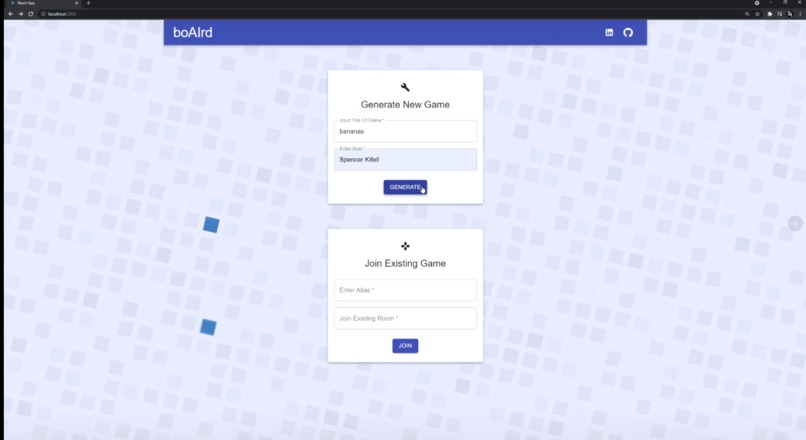
The main menu
-
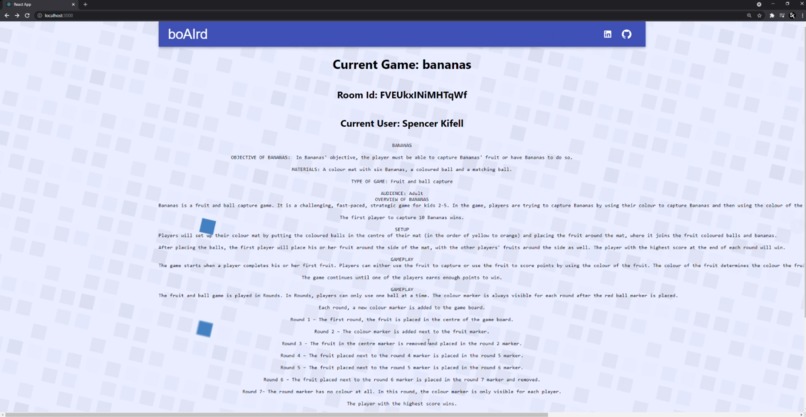
An example of a generated game


Inspiration
Our team was inspired by the many board games we've always enjoyed playing. We were curious if an AI would be able to generate its own custom games.
What it does
Our program uses a GPT-2 trained model to generate board game rules based on a dataset of many rule books. It also is able to connects users to the same board game give a join code.
How we built it
Front-end developed using React.js and Material-UI. Back-end API developed using Express.js and Socket.Io. We used sockets so that multiple rooms can be created at the same time and so that these rooms were joinable by the user’s friends. Dataset scraped from many publicly available board game rules. Trained through GPT-2 (by OpenAI) implemented through the Tensorflow library in Python Outputs instructions faithful to the style of a board game rule booklet.
Challenges we ran into
We were mostly having trouble with making the application work with multiple users connected to the same game. Eventually we managed to make sockets work, but unfortunately did not have enough time to implement the features we wanted to use with it.
Accomplishments that we're proud of
We are proud that we created a model that can properly generate legible board game rules that can actually be played to an extent.
What we learned
We learned about GPT-2, and sockets. For most of us it was our first time creating this type of program.
What's next for boAIrd
We had planned on making a chat system and had all the sockets working effectively, however due to the lack of time, we weren’t able to finish the chat. We also planned on making a game board on site with movable tokens that all connected users would be able to see. We also need to implement a proper loading mechanism with all programs ran from an online server instead of locally.
Built With
- fastapi
- gpt-2
- javascript
- node.js
- python
- react
- tensorflow


Log in or sign up for Devpost to join the conversation.