-
-
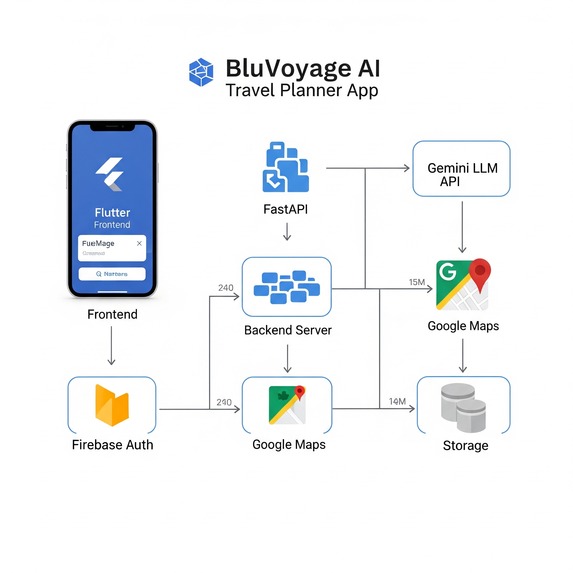
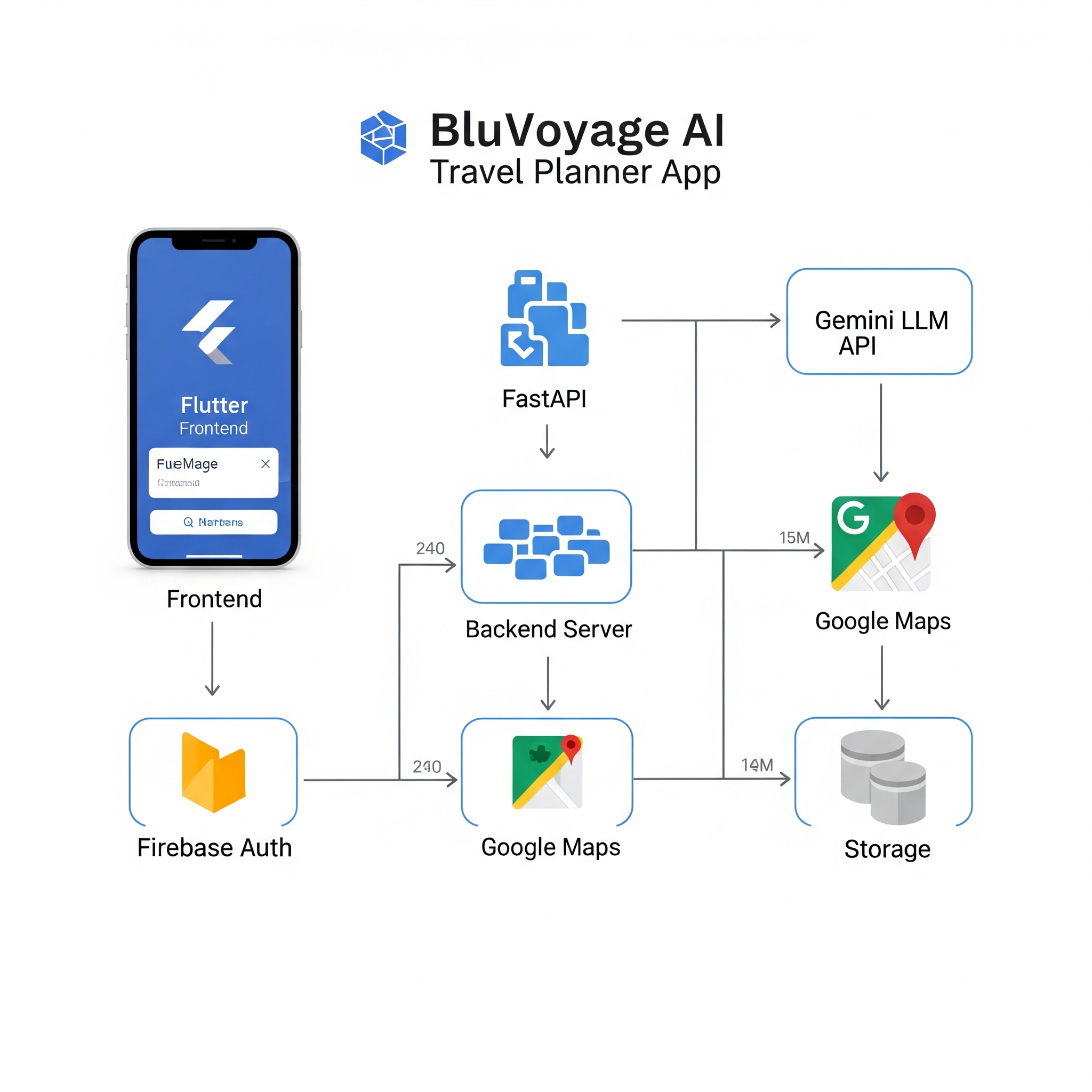
Architecture Diagram
Inspiration
Travel planning can be overwhelming and time-consuming, especially when trying to find personalized recommendations that fit your interests, budget, and schedule. We wanted to create an intelligent travel assistant that simplifies this process by leveraging AI to customize trips effortlessly.
What it does
BluVoyage is an AI-powered travel planner app that helps users design personalized itineraries based on their preferences. By integrating Gemini AI with location data from Google Maps, users receive optimized travel routes, activity suggestions, accommodation options, and real-time updates—all in one seamless mobile experience.
How we built it
- Frontend: Built with Flutter for a cross-platform mobile experience.
- Backend: Developed using FastAPI with Python to create fast, scalable APIs.
- AI Integration: Gemini AI powers the intelligent itinerary planning and recommendations.
- Maps & Location: Google Maps API is integrated for geolocation, route optimization, and map visualizations.
We connected the AI backend with the Flutter app through RESTful APIs to provide dynamic and personalized travel plans.
Challenges we ran into
- Integrating Gemini AI with our backend required extensive fine-tuning to deliver relevant and diverse travel suggestions.
- Handling real-time updates and dynamic route recalculations demanded optimization to maintain app responsiveness.
- Synchronizing data between Flutter frontend and Python backend required careful API design and testing.
- Managing rate limits and data quotas from Google Maps API posed constraints on heavy usage scenarios.
Accomplishments that we're proud of
- Successfully implemented an end-to-end AI-powered personalized travel planning experience.
- Created intuitive UI/UX that simplifies complex itinerary management for users.
- Achieved smooth integration between multiple technologies: Flutter, FastAPI, Gemini AI, and Google Maps.
- Deployed a scalable backend that can handle multiple concurrent user requests efficiently.
What we learned
- The importance of modular architecture to manage integrations of AI, maps, and mobile frontend.
- Fine-tuning AI-generated content is crucial for quality and personalization.
- The challenges of real-time data synchronization between backend and frontend in travel apps.
- Handling external API limitations and gracefully managing errors improves user experience.
What's next for BluVoyage
- Expand AI capabilities to include multi-modal travel suggestions (flights, car rentals, public transit).
- Add social sharing features to let users share their travel plans with friends.
- Implement offline mode with cached maps and itineraries.
- Explore partnerships with travel service providers for in-app bookings.
- Continuously improve AI recommendation accuracy through user feedback and machine learning.


Log in or sign up for Devpost to join the conversation.