Bluum
Private market intelligence for everyone — not just the top 1% of firms
video link: https://www.loom.com/share/196d722840504a8c8fec9d40a53d89ea
The Problem
Private market research has always been gated behind billion-dollar institutions. Bloomberg terminals cost $24,000 per year. Investment banks charge six-figure retainers. Proprietary deal networks are built on relationships that take decades to form.
The result: independent advisors, boutique M&A firms, and small family offices make high-stakes decisions with a fraction of the information available to the institutions they compete against. Talent is universal. Access isn't. This is a form of economic exclusion, and as private markets open up to more people globally, this gap is only getting worse.
Bluum changes that.
Track
Track 3: Economic Empowerment & Education
Bluum directly addresses the information asymmetry in private markets — one of the most consequential and least discussed forms of economic gatekeeping. As private markets are revolutionised to give individuals greater access (SEC's amendments to accredited investor, EU's ELTIF) this will become all the more exacerbated. Bluum is forward-looking in this way. Accessibility to private markets will scale and become more important with time By giving small firms and a potential new class of retail traders access to institutional-grade M&A intelligence, we empower informed decision-making where it has historically been impossible.
What Bluum Does
Bluum is an AI-powered private market intelligence platform designed to make institutional-grade deal insight accessible to anyone.
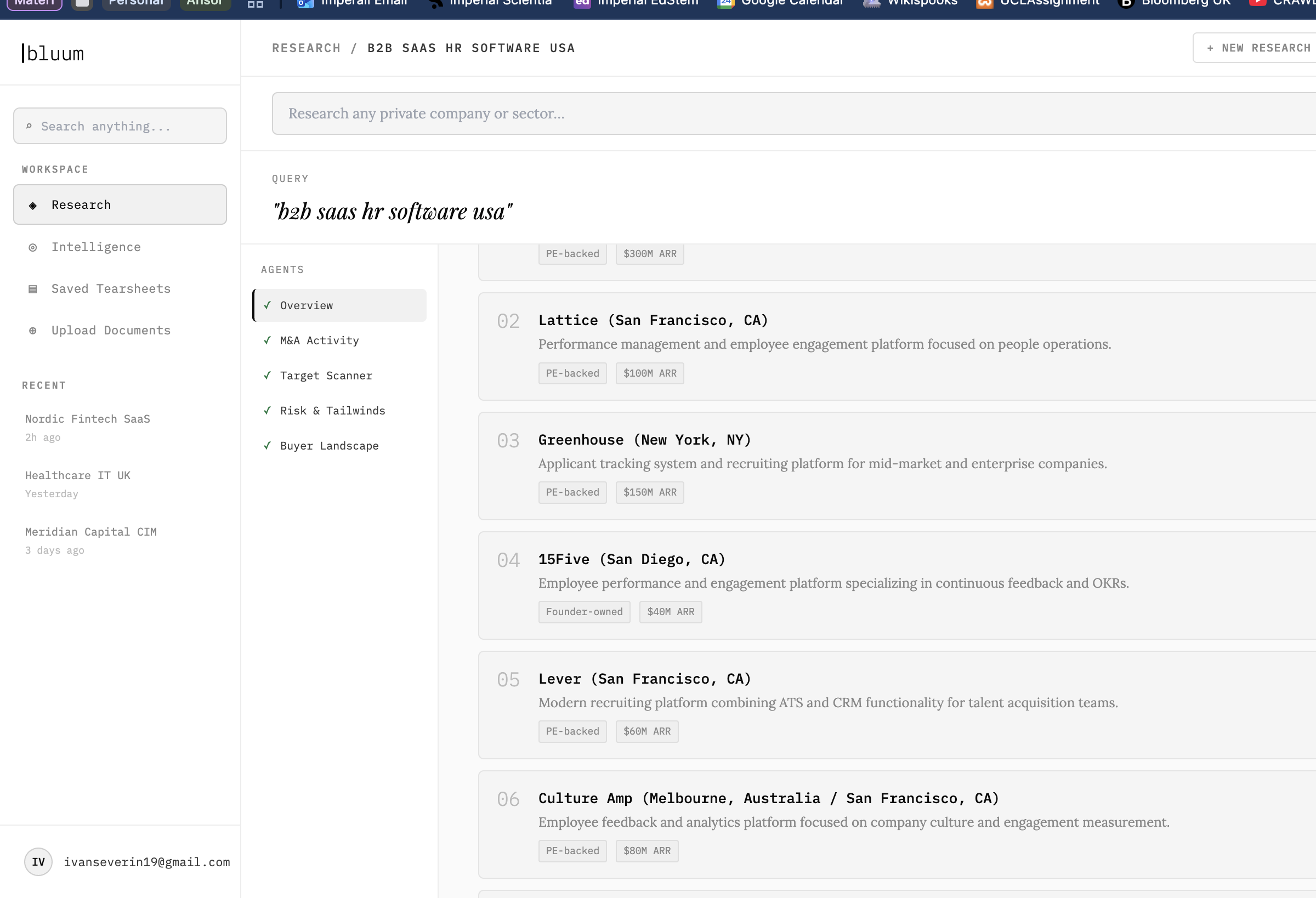
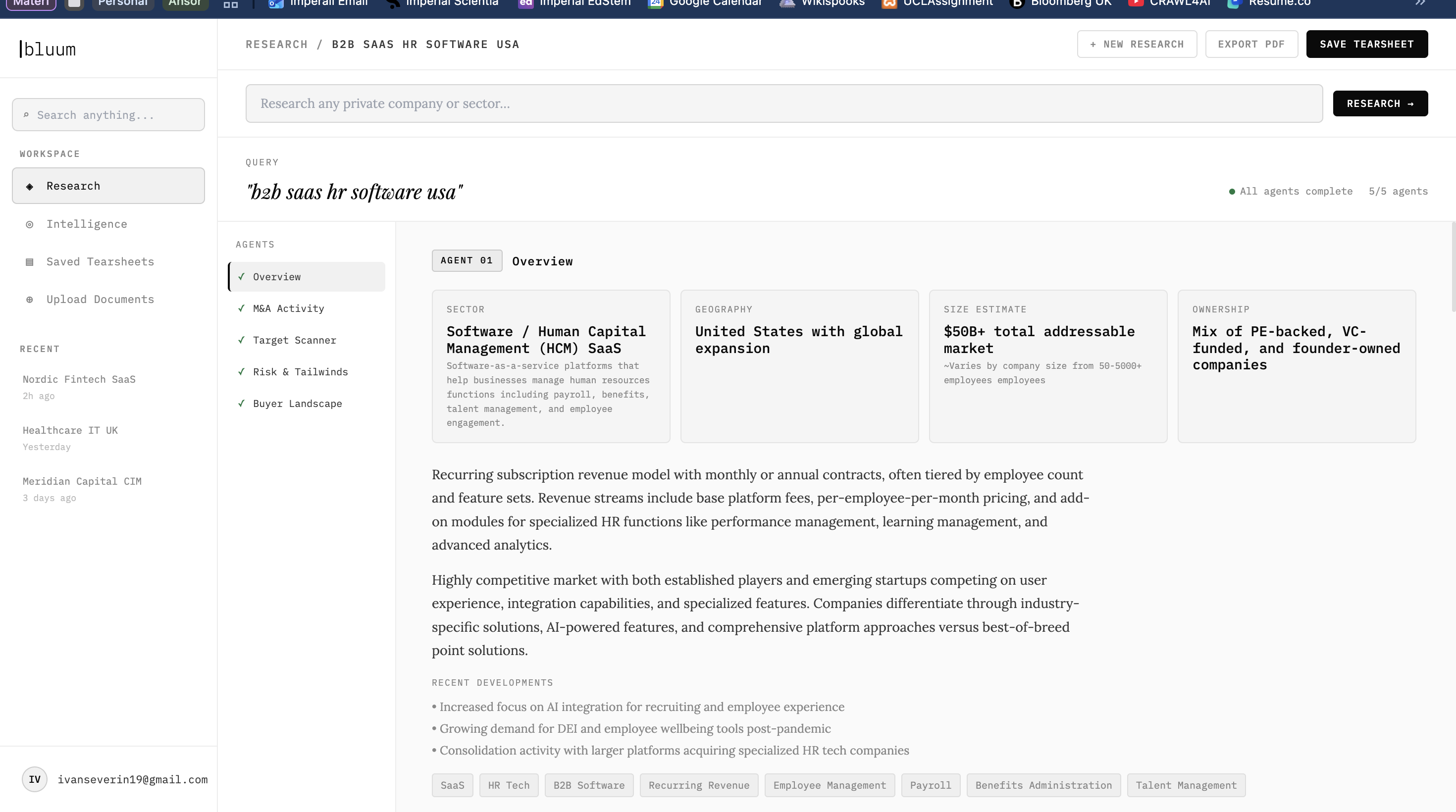
In its current form, Bluum enables fast, structured research on private companies and sectors through a multi-agent AI system that pulls and organises real-time information into clear, actionable tearsheets.
Beyond the MVP, Bluum is designed to evolve into a full intelligence layer for private markets — combining live research, real transaction precedent from SEC filings, and a user’s own deal history into a single queryable system.
The vision is not just to help users understand markets, but to help them understand how deals actually happen — and eventually, how their own portfolio and experience fit within that landscape.
Mode 1 — Research
"Research any private company or sector in seconds"
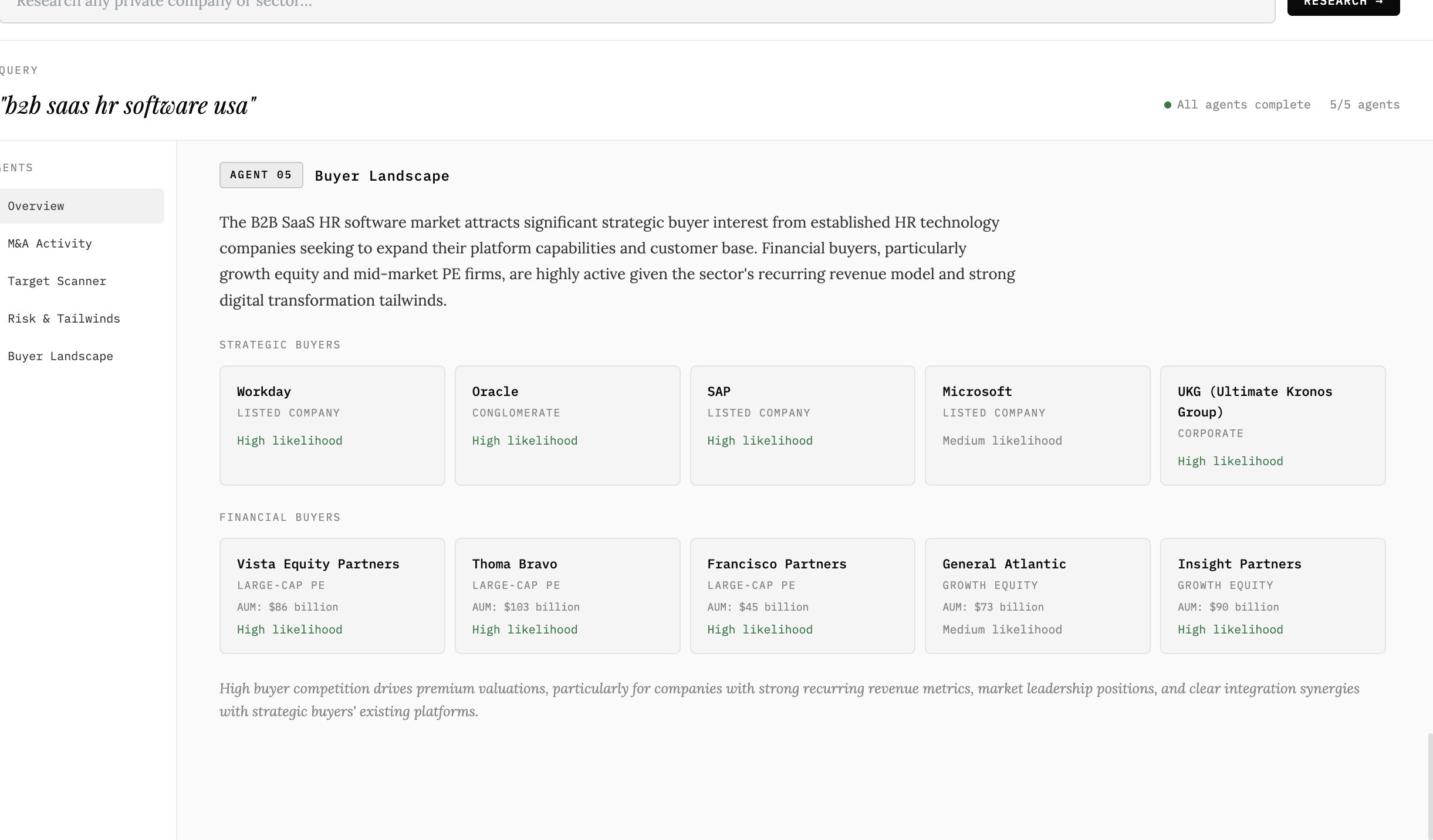
The user types a company name, sector, or deal thesis. A multi-agent AI system fires in parallel, each agent focused on one dimension of the research:
| Agent | Output |
|---|---|
| Overview Agent | Company summary, sector positioning, founding story, key people |
| M&A Activity Agent | Announced deals, PE-backed exits, rumoured transactions, deal rationale |
| Target Scanner Agent | Ranked list of private acquisition targets with scoring and rationale |
| Risk & Tailwinds Agent | Macro risks, regulatory headwinds, growth drivers, sector dynamics |
| Buyer Landscape Agent | Active PE firms and strategic acquirers in the space |
Orchestrator: a lightweight orchestrator agent sits above the five, enriching the raw user query with inferred sector, geography, and deal type before dispatching to each subagent in parallel via Promise.all. Results are written to Supabase as each agent completes.
Each agent uses live web search to pull current, real-world data. Results render progressively — the tearsheet fills in section by section as each agent completes, so users see value immediately.
Every tearsheet is saved to the user's personal corpus and explained in plain English with inline jargon definitions — so a first-time independent advisor gets the same clarity as a seasoned analyst.
Mode 2 — Intelligence (planned, not yet implemented in the MVP)
"Real deal precedent and transaction intelligence for live opportunities"
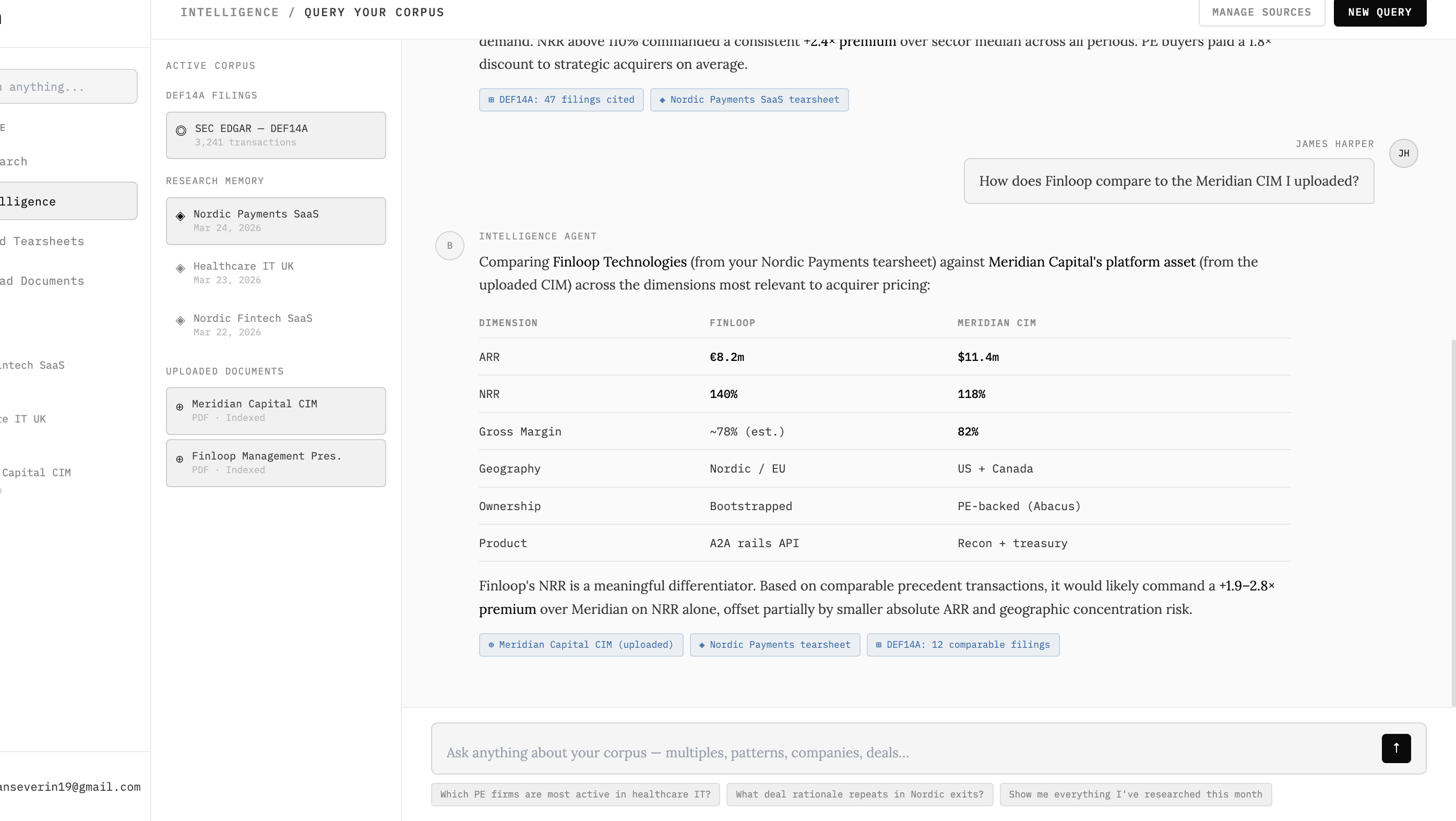
Mode 2 is the layer that sits above basic research. It is designed for the moment when a user is no longer asking, "Tell me about this company or sector," but instead asking, "How do I evaluate, position, buy, or sell this business?"
This mode is intended to help users work on real transaction questions using grounded precedent data. Rather than broad market lookup, Intelligence is about surfacing the most relevant historical deals, comparable transactions, buyer patterns, valuation context, and recurring deal rationales from real-world M&A activity.
In other words:
- Mode 1 helps you understand a company or market
- Mode 2 helps you understand how similar deals have actually happened before
Intended data sources
| Data source | What it contains |
|---|---|
| DEF14A filings corpus | Real M&A transaction data, including deal rationale, target descriptions, merger consideration, buyer identity, and transaction structure |
| Research memory | Tearsheets previously generated by the user in Mode 1 |
| User uploads | CIMs, teasers, management presentations, deal memos, and other transaction materials |
Intended user outcomes
Mode 2 is designed to answer questions such as:
- What are the most comparable deals to this business?
- What valuation multiples have been paid for similar companies?
- Which buyers have been active in this category?
- What deal rationales keep recurring in similar transactions?
- What precedent transactions can I cite in a process or discussion?
Intended system design
Unlike Mode 1, which uses multiple live research agents in parallel, Mode 2 is envisioned as a dedicated Intelligence Agent focused on retrieval, comparison, and synthesis over a transaction corpus.
User Query
    │
    ▼
Intelligence Agent
    │
    ├── retrieves relevant precedent deals, tearsheets, and uploaded materials
    ├── ranks results by semantic and numerical relevance
    ├── compares transaction patterns across sources
    └── returns structured answers with citations, comparable deals, and real figures
The goal is not open-ended generation. The goal is to give the user referenceable market intelligence grounded in real precedent — especially for live buy-side and sell-side decision support.
Important note
Mode 2 is a core part of Bluum's vision, but it is not yet implemented in the current MVP due to hackathon time constraints.
Mode 3 — Corpus (planned, not yet implemented in the MVP)
"A strategic intelligence layer over your own body of work"
Mode 3 extends Bluum from deal and market intelligence into portfolio and corpus intelligence.
This mode is designed for users who want Bluum to reason over their own accumulated work: their portfolio, deal history, prior research, uploaded materials, investment themes, and internal knowledge base. Instead of answering a single research or precedent question, Corpus is intended to help the user understand their broader positioning over time.
Intended use cases
Mode 3 is designed to answer questions such as:
- Where am I overexposed across my portfolio or pipeline?
- Where am I underweight or missing opportunities?
- What sectors or themes keep appearing in my work?
- How could I diversify based on what I already own or track?
- What are my current concentration risks?
How it differs from Mode 2
- Mode 2 is about external transaction precedent: what happened in the market
- Mode 3 is about internal strategic context: what your own body of work says about your exposures, patterns, and opportunities
If Mode 2 is a deal intelligence engine, Mode 3 is intended to become a personal strategic advisor layer over everything the user has collected and done.
Important note
Mode 3 is part of the longer-term product roadmap and has not been implemented in the MVP due to time constraints. It is the most ambitious mode conceptually, because it requires Bluum to reason not just over market data, but over the user's entire corpus as a connected system.
Tech Stack
| Layer | Technology |
|---|---|
| Frontend | React + TypeScript (Vite), TailwindCSS |
| Backend | Node.js + Express + TypeScript |
| Auth + DB | Supabase (auth, user profiles, research history) |
| Multi-agent LLM | Anthropic API (Claude) with web search tool |
| Vector store | ChromaDB |
| Data source | SEC EDGAR DEF14A merger proxy filings |
Data Schema
users           — id, email, full_name, organisation, role, created_at
researches      — id, user_id, query, enriched_query, status, created_at
sections        — id, research_id, section_name, content (jsonb), created_at
tearsheets      — id, research_id, user_id, title, saved_at
Ethical Commitments
Bluum is built for people who have historically been locked out of private market intelligence. We take that responsibility seriously.
| Risk | How Bluum addresses it |
|---|---|
| Tech exclusion | Mobile-first, low-bandwidth friendly, no unnecessary complexity |
| Bad advice impact | Every output shows its source — Bluum surfaces information, never makes decisions for the user |
| Cultural assumptions | Users define their own investment criteria — the tool does not impose a single definition of success |
| Data transparency | Confidence indicators on every data point so users know what to trust and what to verify |
Some barriers still exist in terms of multilingual output and also in terms of simplifying jargon. In a hypothetical future retail investor use-case, the user would still need some fundamental financial knowledge to use our product. A jargon simplification mode and multilingual mode could be potential improvements in this regard.
The Vision
The institutions that dominate private markets didn't get there because they were smarter. They got there because they had more information, earlier, and better organised. Bluum gives that same advantage to anyone with an internet connection and a deal to find.
Institutional-grade private market intelligence. For the rest of us.
Built With
- anthropic-claude-api-(claude-sonnet-4)
- axios
- express.js
- framer-motion
- lucide
- node.js
- promise.all
- react-18
- react-router
- supabase
- tailwindcss
- typescript
- vite
- zustand

Log in or sign up for Devpost to join the conversation.