Inspiration
As students, we are particularly vulnerable to burnout, and it is challenging to find time and energy to prioritize our well-being over our work. Personal experience feeling mentally and physically burnt out because of excessive and uncontrolled screen usage.
What it does
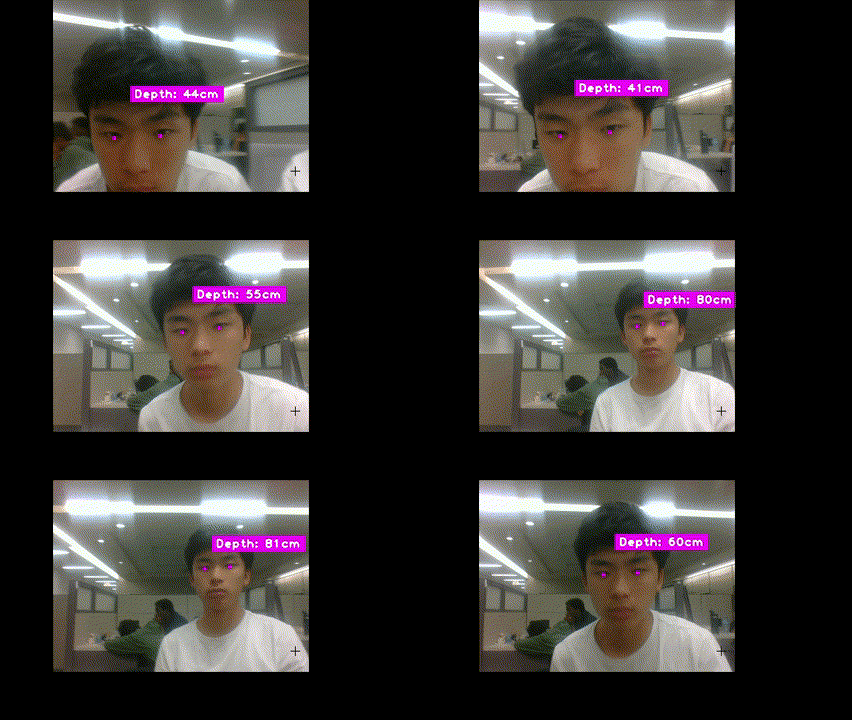
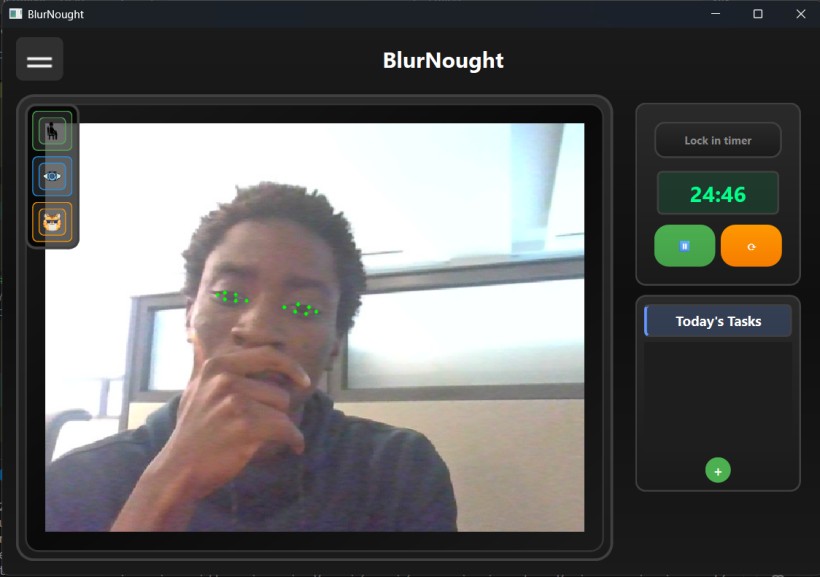
The Hack is an app that monitors a student or white-collar worker's eye strain (quantified through blink rate, room brightness, sclera color, and distance between the eyes and the screen), body posture, and level, and sitting time. The goal is to reduce digital burnout by empowering users with real-time awareness and habits for better screen etiquette and well-being. The application additionally has tools related to productivity and sustainability, such as a pomodoro timer, a to-do checklist, and soon a calendar.
How we built it
The app uses an inbuilt desktop webcam to stream live video footage of the person working. We used OpenCV and MediaPipe on this footage to detect eye strain. Additionally, DeepFace was used to classify emotions like stress, further helping recognize burnout. Eye strain was calculated using three separate approaches including identifying the distance between the webcam and the face, calculating the blinking rate, and figuring the brightness of the room. Good or bad posture was initially classified using OpenCV, however due to accuracy hurdles we used Gemini’s API at the cost of speed. OpenCV, MediaPipe, and DeepFace are all libraries built using CNN and other deep learning frameworks. We then made a front end app using PyQT6 and added productivity and sustainability related features like a pomodoro timer and a to-do checklist.
Challenges we ran into
Initially, we planned to train a deep learning model to create the real-time good/bad posture classifier. However, due to limited time and access to GPUs, we pivoted to using ratio-based conditional logic for classification. Since we typically only had a frontal camera angle, the posture detection lacked accuracy. To improve this, we simply used the Gemini API to analyze images and determine posture quality. However, this introduced disruptions to the live stream. We attempted to mitigate these issues using Python’s async library. Still, we’re excited to pivot once more and continue solving this challenge beyond the hackathon to create the most effective solution possible!
Accomplishments that we're proud of
-Being able to quickly learn skills that were required to complete this hack. For example, we had to learn to use PyQt6 to complete the front end of our project without prior experience. -Being resilient, even though we encountered a problem where we lost a section of our working code due to a github commit issue, we were able to quickly move past this and replace the code.
What we learned
We learn how to effectively use AI in conjunction with our programming knowledge, in the end being able to work cohesively as a team with AI as a member of our group.
What's next for Blurnout
As next steps, we are looking to incorporate some of the following features -Allow for growth and progress tracking through the implementation of a calendar -Ability to share personal stats with friends and colleagues, promoting friendly competition -Replicate this technology for other industries(ie drivers, pilots, healthcare workers), making compatible with other devices(not just computers)

Log in or sign up for Devpost to join the conversation.