Inspiration
Live event tickets are expensive, and the night can still go wrong: your team gets blown out, the star you paid to see sits, or a cold snap hits the outdoor show. Ticket "insurance" today only covers you if you can't attend. Nothing covers a bad night. Prediction markets already price these exact outcomes, so we asked: what if a ticket seller could offer a refund on a bad outcome and offload all of the risk to a market?
What it does
Bluff is ticket protection that pays fans back automatically when the night goes wrong.
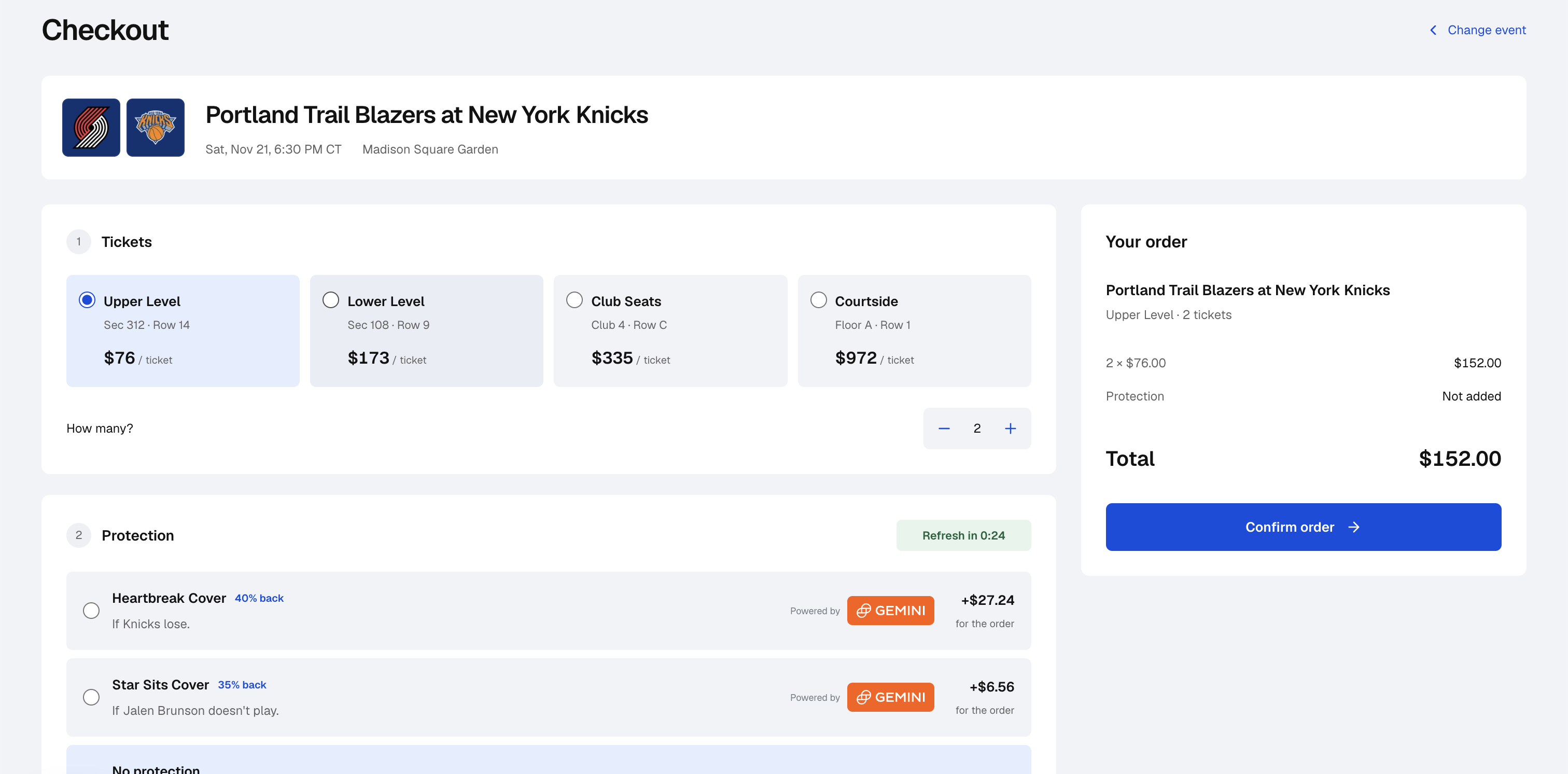
- Fans add protection at checkout. Example: "Knicks lose, get 15% of your $346 back" for a few dollars. They never touch crypto.
- Every policy is hedged on Gemini prediction markets. Bluff buys the contract that pays $1 exactly when the covered outcome happens, one contract per $1 of payout, so the book stays matched and Bluff never carries the risk.
- Payouts settle in USDC on Arc. The premium is escrowed in our
BluffProtectionVaultcontract. When the Gemini market settles, the oracle callssettleMarket()and the vault refunds the fan.
Coverage catalog, each mapped to a real Gemini market:
- Heartbreak: your team loses (opponent moneyline YES)
- Blowout: lose by 13+ NBA / 14+ NFL (spread YES)
- Snoozer: combined score under a threshold (total NO)
- Star Sits: a named star doesn't play (proxy hedge on opponent moneyline)
- Weather: city daily high below/above a threshold for outdoor concerts (NWS daily-high bucket YES)
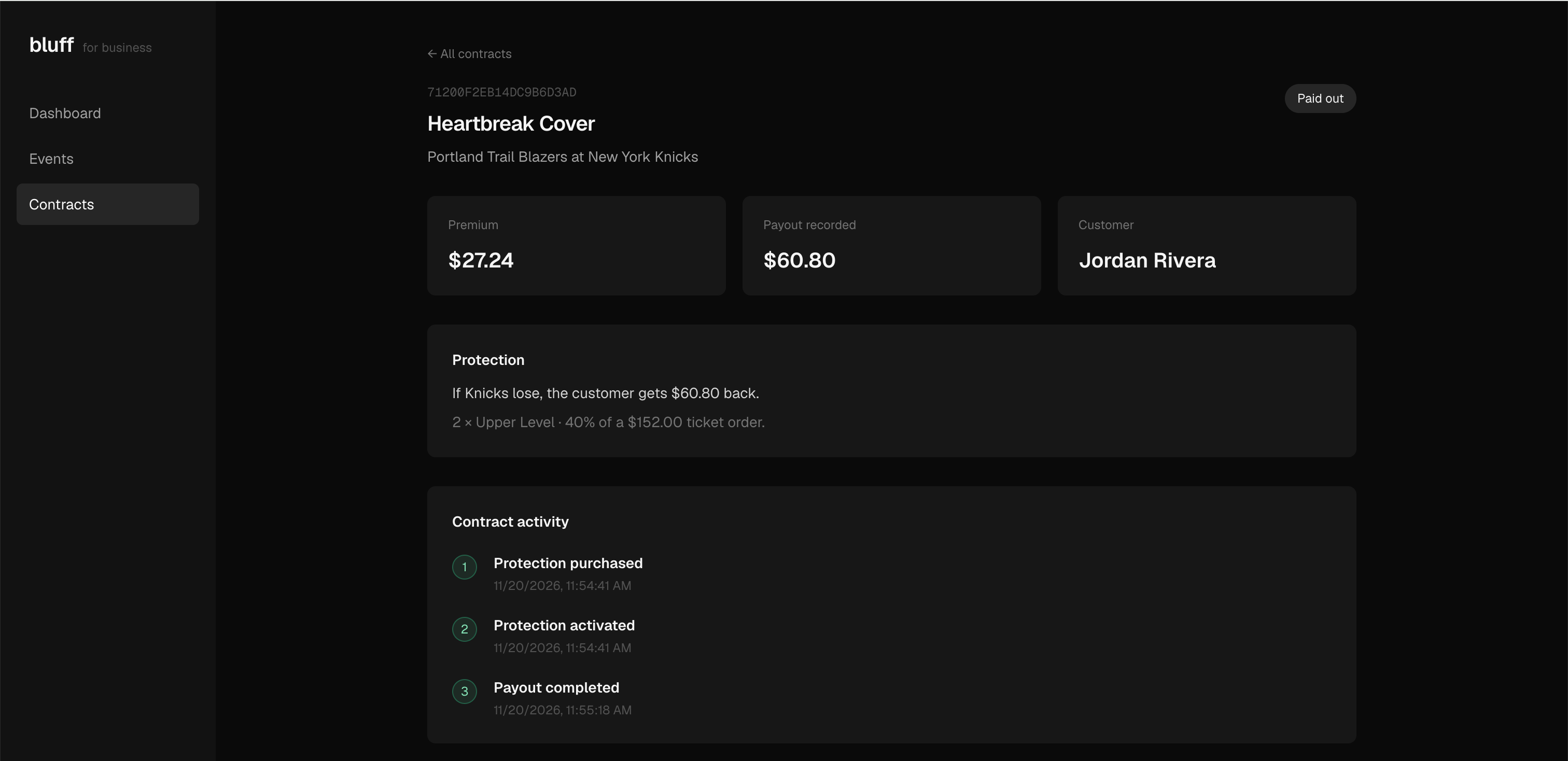
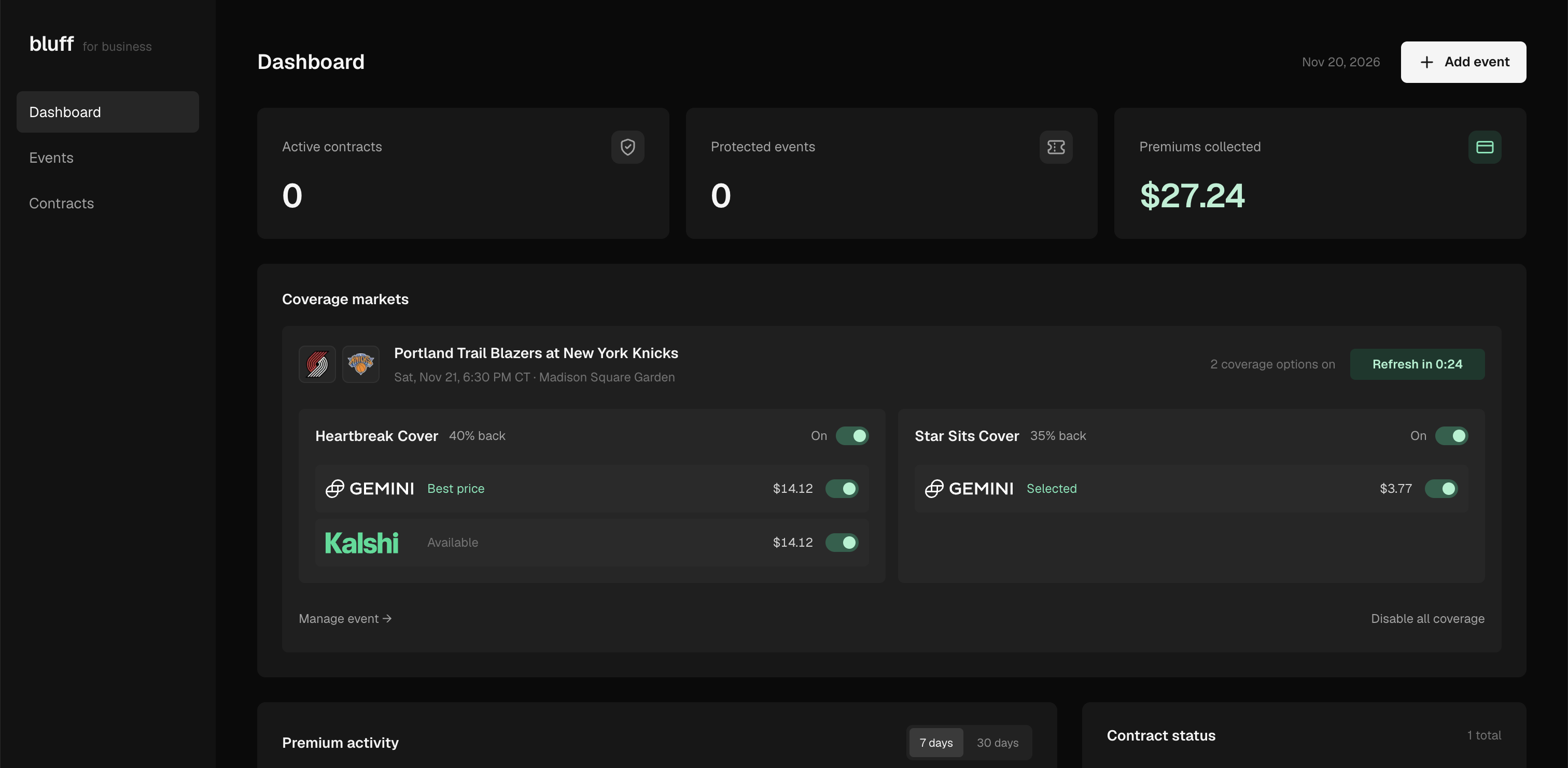
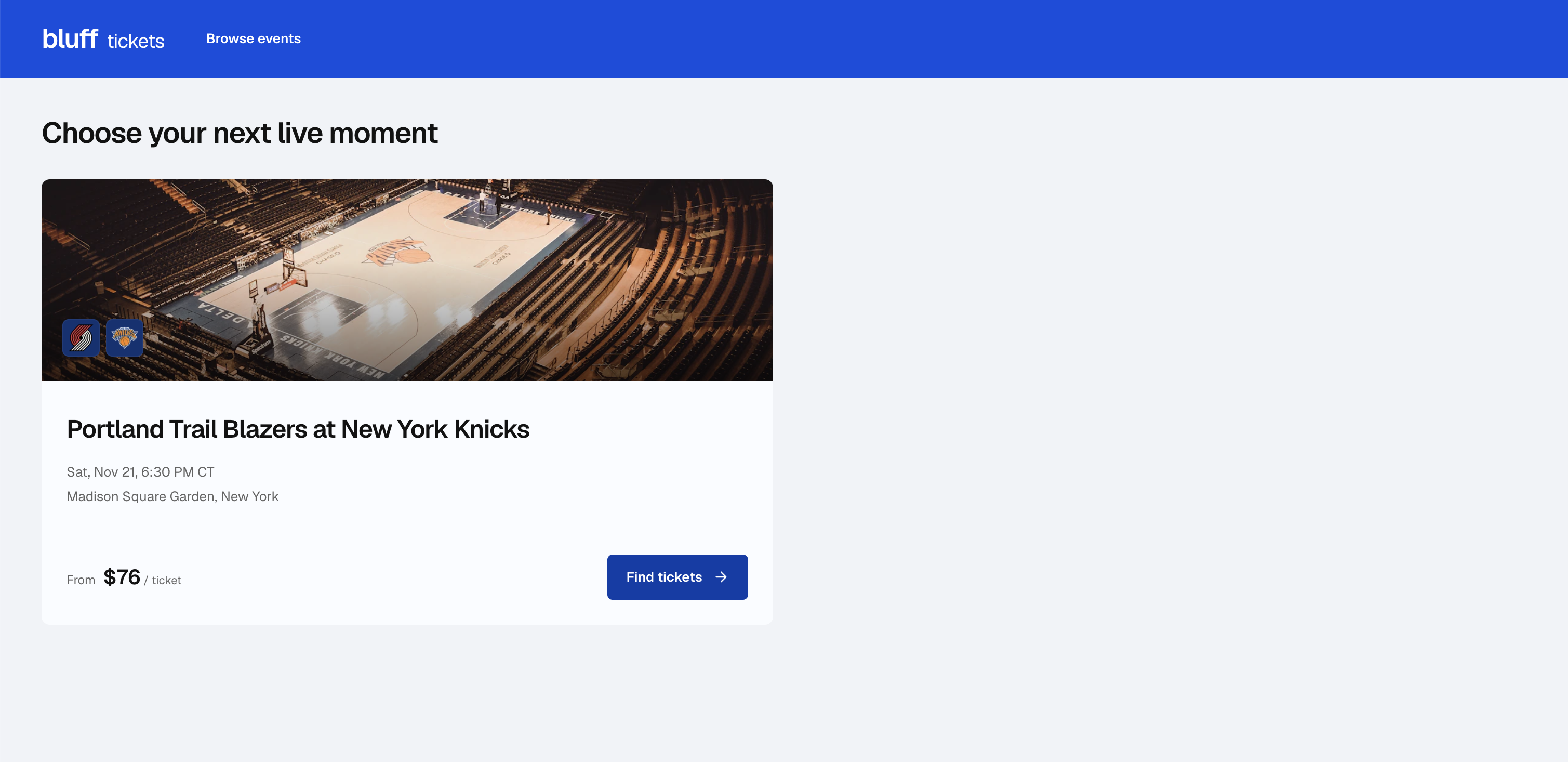
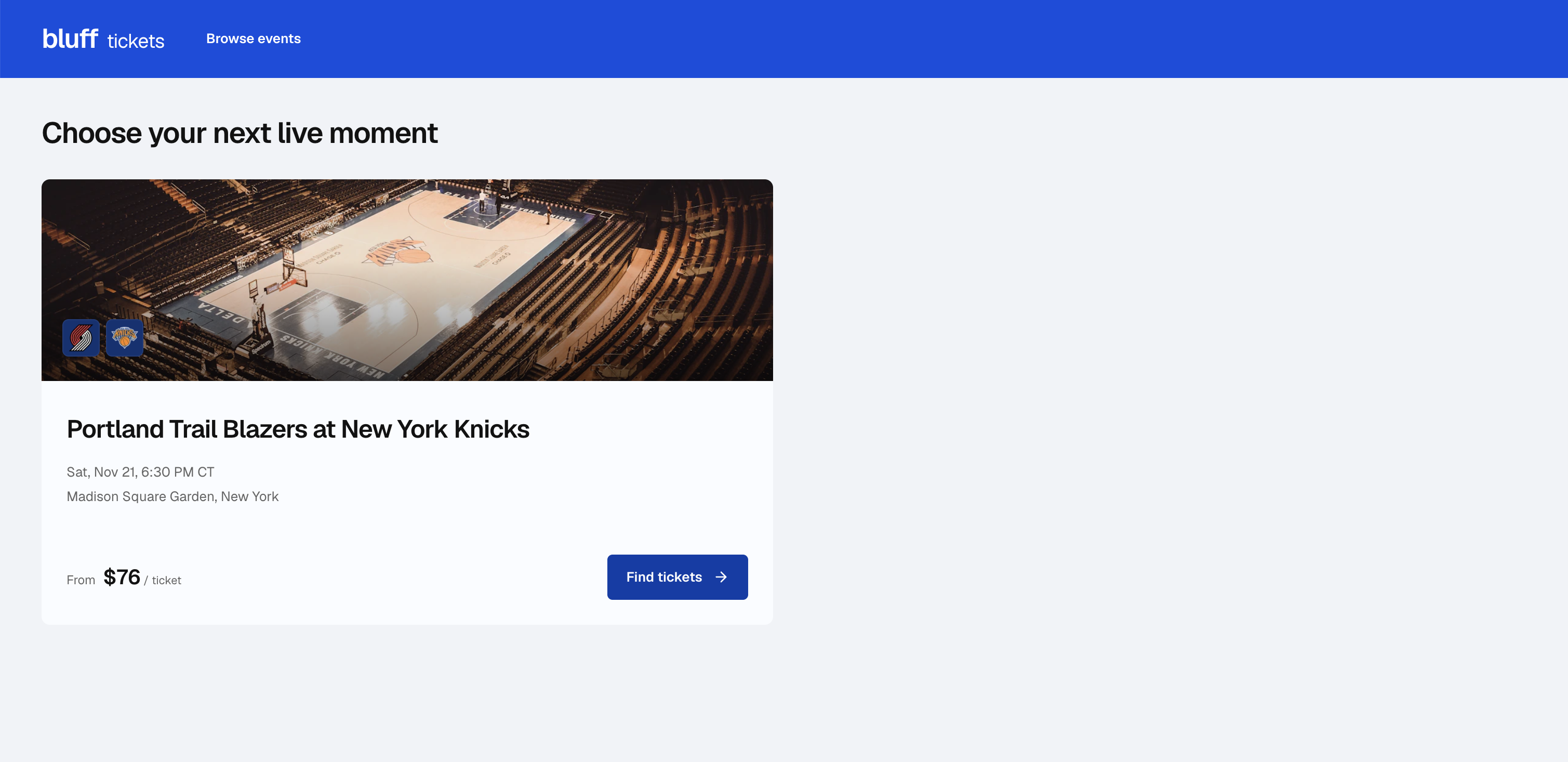
There are two interfaces. The business console lets a ticket seller add an event, scan matching markets, choose covers and refund percentages, publish protection, and track contracts. The customer storefront lets fans browse events, pick tickets and protection, and check out.
How we built it
- Next.js 15 + React 19 + TypeScript + Tailwind for both the business console and the customer storefront, served as two independent interfaces from one codebase with a shared SQLite (WAL) store for orders, offers, and a canonical event journal.
- Gemini Prediction Markets API: a client over the public events API (~1000 markets, 60s cache, offline snapshot fallback), a matcher that maps an event to its markets and covers, and a hedge executor that sends HMAC-signed orders (simulated fills when no keys are set).
- Pricing engine: premium = hedge cost × 1.18 + $0.99, with a $1.99 minimum. Margin is premium minus hedge cost. Checkout uses 30-second server quotes bound to the event, tier, quantity, and offer version, consumed atomically so a price can't silently change.
- Arc:
BluffProtectionVault.sol(purchasePolicy, depositHedgeProceeds, settleMarket, withdrawSurplus) deployed on Arc testnet at0xfab42bf0ea82413d078af58712ef31a43b7ccec8, called from the server with viem. Tested with Hardhat. - QuickNode Streams: vault events flow through a signed webhook into the journal, giving independent purchase and payout confirmations with signature verification, retry deduplication, and reorg reconciliation.
Challenges we ran into
- "Star Sits" has no clean hedge. Gemini player props settle at the last fair price on a DNP, so no contract pays directly when a player sits. We hedge with opponent-win contracts, which reprice when the star is ruled out, sized as a delta hedge, and the Bluff reserve backs the remaining risk. The console states this next to the cover.
- Matching real events to real markets. Spreads and totals are only quoted at certain strikes, so the matcher has to pick the nearest quoted strike and price the cover from it.
- Testnet faucet limits. On-chain amounts are recorded at 1/100 of the USD figures so real transactions fit within Arc testnet faucet limits.
- Honest price quotes. Order books move, so we built expiring quotes and idempotent retries so a fan always pays the price they saw.
Accomplishments that we're proud of
- An end-to-end flow: publish protection, buy at checkout, hedge on Gemini, escrow and pay out through a live vault on Arc testnet.
- A book that stays matched: Bluff earns a margin on every policy without carrying outcome risk.
- Being upfront in the product about what is fully hedged versus partially hedged, and what is live versus simulated.
What we learned
Prediction markets work as a reinsurance layer for consumer products. The hard part is not the smart contract, it is mapping messy real-world coverage ("the star sat") to the contracts that actually exist and being clear about the basis risk that is left over.
What's next for Bluff
- Integrating with real ticketing checkouts so protection is a one-click add-on.
- More cover types as more markets list: concerts, festivals, and player-specific outcomes.
- A production execution and reserve policy so quoted prices can be guaranteed against live fills.
