-
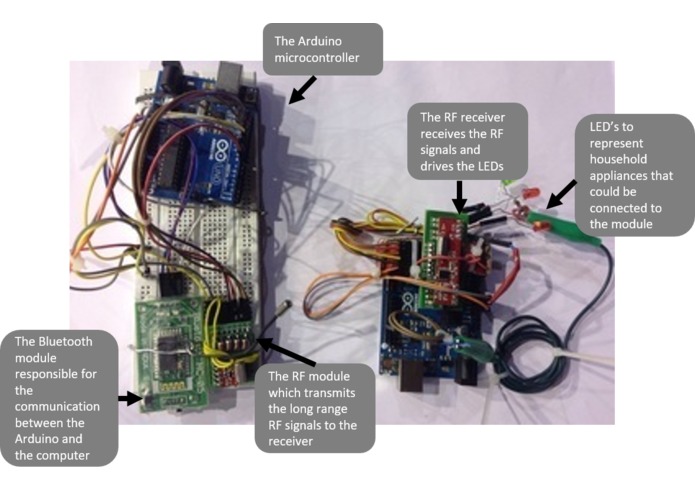
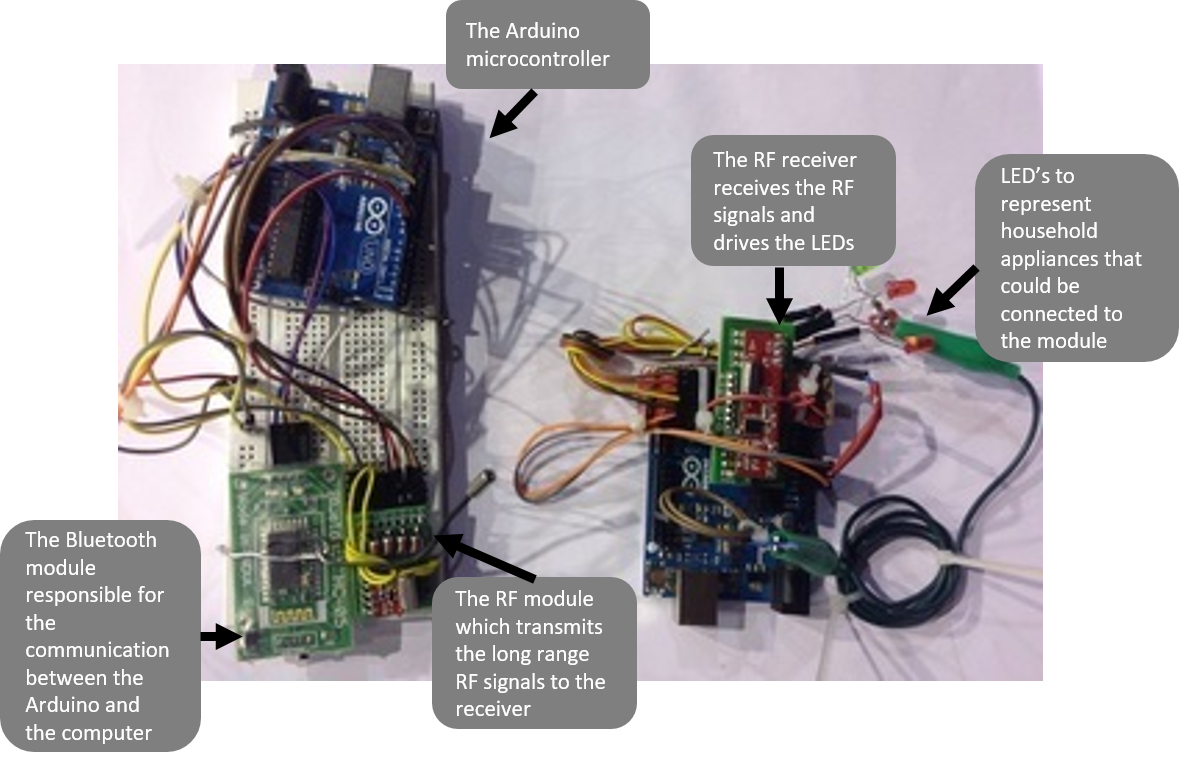
A description of the various components of the Home Automation System
Inspiration
My younger brother Mihir has always loved engineering. He loves to build things and equally loves taking things apart. He has worked on many such projects and his inspiration for these projects, he says, is simply curiosity. I have always been a passionate coder. Software fascinates me and problem solving really excites me.I love picking up small challenges and finding efficient solutions to them and so, Mihir and I decided to pair up our strengths and use our opportunity at the HackIndia Hackathon to build this simple home automation system.
How it works
Our home automation system currently uses the Bluetooth Terminal android application to take input from the user. After the Hackathon, we plan to develop a specialized application to carry out this task. This input is then sent to the Arduino Uno through the HC-05 bluetooth module where the input is processed. It is then transmitted using a radio transmitter to another Arduino Uno where the signal activates and deactivates pins which turn LEDs on and off. The LEDs are representative of electrical devices which will be connected to our set up through relays.
The cool thing about this device, is that it uses both bluetooth and RF. We use bluetooth to obtain input from the user making it easy for the user to connect their phone to our device. Next, we use RF to trasnmit the signal wirelessly to the next Arduino Uno to control the electrical devices on the other end. RF has a much larger range than bluetooth and allows users to effortlessly control the devices in their houses from anywhere, without worrying about range.
Challenges we ran into
We ran into many challenges, mainly bugs in the bluetooth module, making us unable to connect our phone to the module and bugs in the Arduino Uno causing random values to be passed from one Arduino Uno to the next causing the wrong LEDs to light up. We also had to find a way to make our setup as compact and durable as possible using only the equipment available at the Hackathon. We actually used the cardboard from a pizza box as a base for one Arduino along with its receiver! We attached the other Arduino along with its transmitter and bluetooth module to a bread board.
Accomplishments that I'm proud of
I am very proud that Mihir and I were able to work so well together as a team and were able to pull this project together in 24 hours. I am impressed with Mihir for being able to come up with this idea and designing the device. It is satisfying for us to see a final product in front of us. I am also proud of myself for coming up with a very concise and efficient code as well as for being able to help Mihir troubleshoot the hardware problems.
What I learned
We learned a lot from this project. We gained an in-depth knowledge of Serial communication and the glitches associated with data transfer via bluetooth and RF. I learned a lot from Mihir about using the Arduino and the various components used to transmit data through bluetooth and RF. Mihir also learnt a lot from me by watching me brainstorming methods to make the code as efficient and concise as possible. I also taught him how to effectively troubleshoot problems by using a systematic and thorough approach.
What's next for Bluetooth-RF Home Automation System
While home automation is very cool for anyone to use, we have focused our model to especially help those with disabilities. There are many men and women out there who are struggling with the smallest things like turning their lights or fans on and off, locating their air conditioner and television remotes and so on, due to disabilities like paralysis, Parkinson's Disease or Mutilated Body Parts. Since our input is taken through the mobile phone and the input controls arduino pins, the potential number of devices that we can connect to a single phone is infinite. Thus, the user, after the initial installation, can control potentially all the electrical devices in their house using their mobile phone. We all have a habit of carrying our mobile phones and so, this provides a very practical and convenient solution to aid the disabled.
We feel another point that sets our project apart from others is that it is extremely feasible, practical and economical. Installation is easy and a 9V battery can be used to power each Arduino which can be easily replaced periodically. In simplicity lies elegance- our users will not need to spend any time learning how to use our system because we have kept it extremely simple. While some less important features are not included, this design makes our device a lot easier to use, install and maintain. It is also cheaper than any home automation system out there. This helps us to help as many disabled people as possible and also helps home automation enthusiasts enjoy this facility for a negligible price. We hope to change lives through our invention.
Built With
- apl
- arduino-uno
- hc-05-bluetooth-module
- rf-shield

Log in or sign up for Devpost to join the conversation.