-
-
BlueReportAI Decision Agent - AI Financial Analyst
-
BlueReportAI Decision Agent - AI Financial Analyst
## Inspiration
Financial analysis tools often present large volumes of ratios, dashboards, and market data without helping users understand what matters most or how the different signals relate to one another.
BlueReportAI.com Decision Agent was created to turn structured financial information into clear, traceable analysis. The objective is not to replace professional judgment, but to help users identify risks, understand ratios, test assumptions, and explore simple scenarios through a focused AI workspace.
What it does
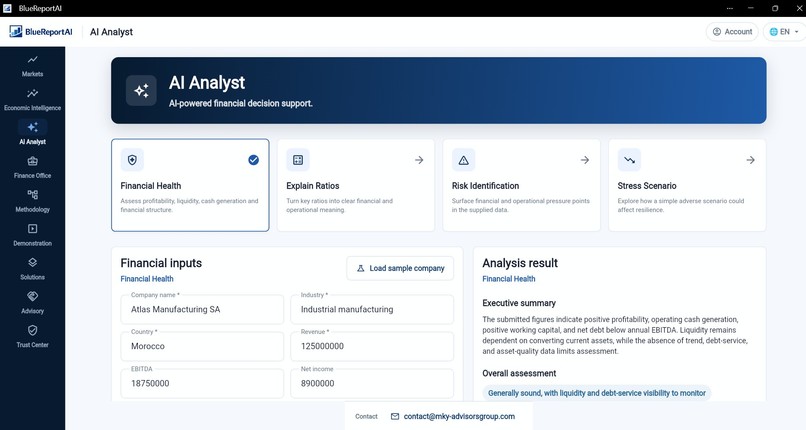
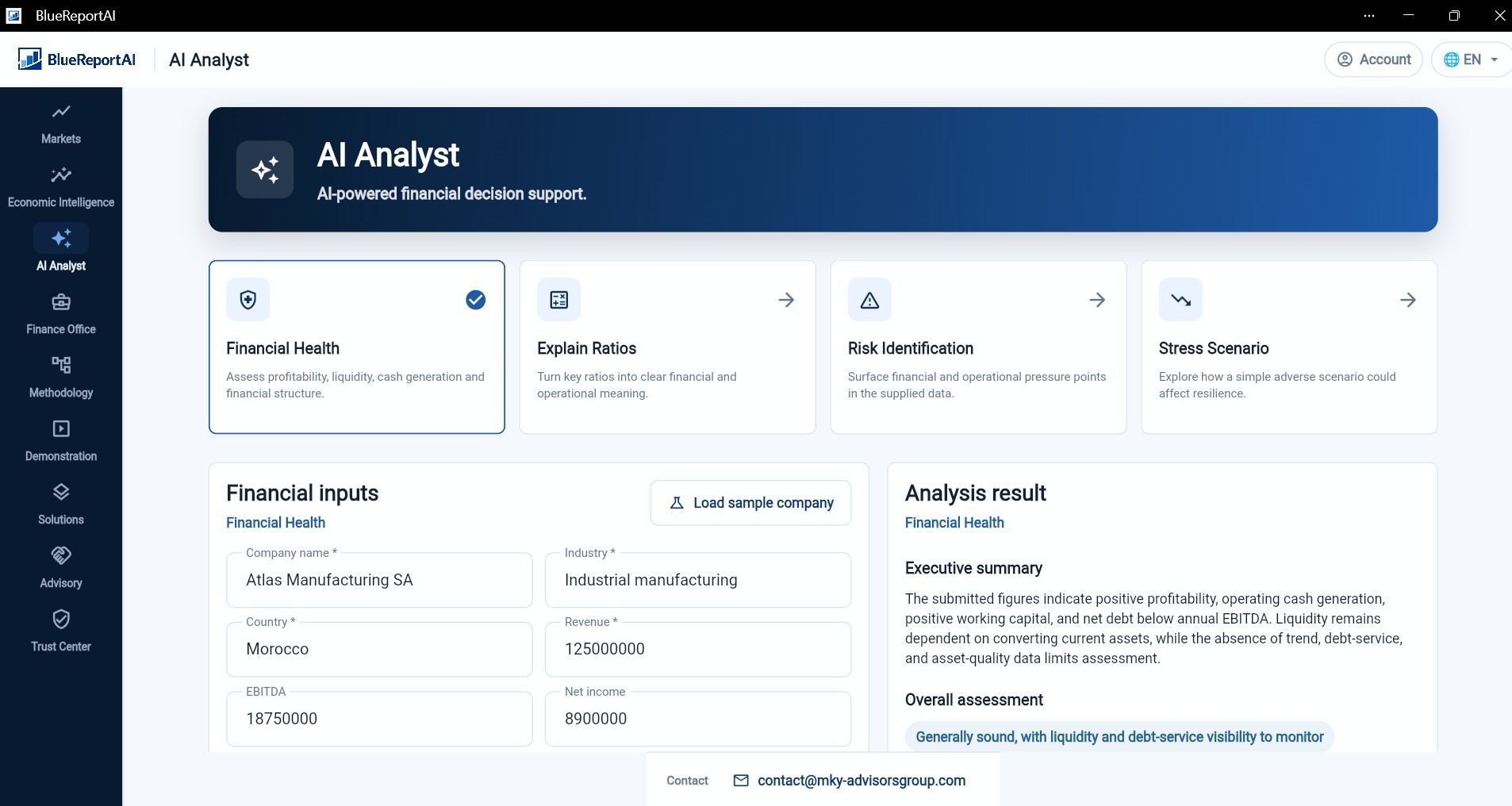
The Decision Agent allows users to interact with financial and market information in natural language.
It is designed to support four core workflows:
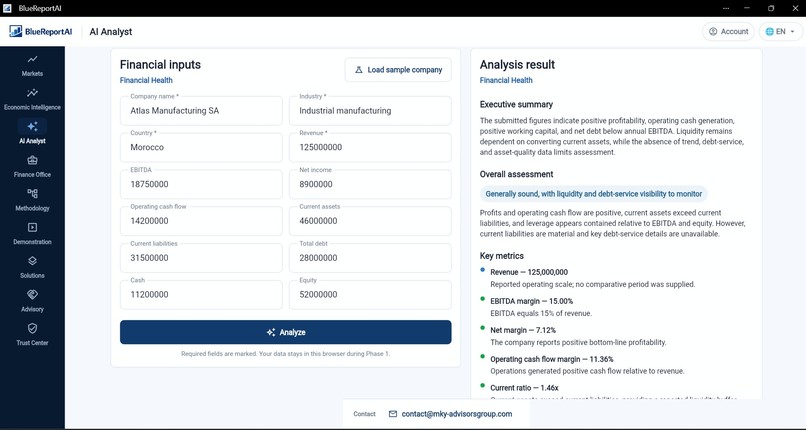
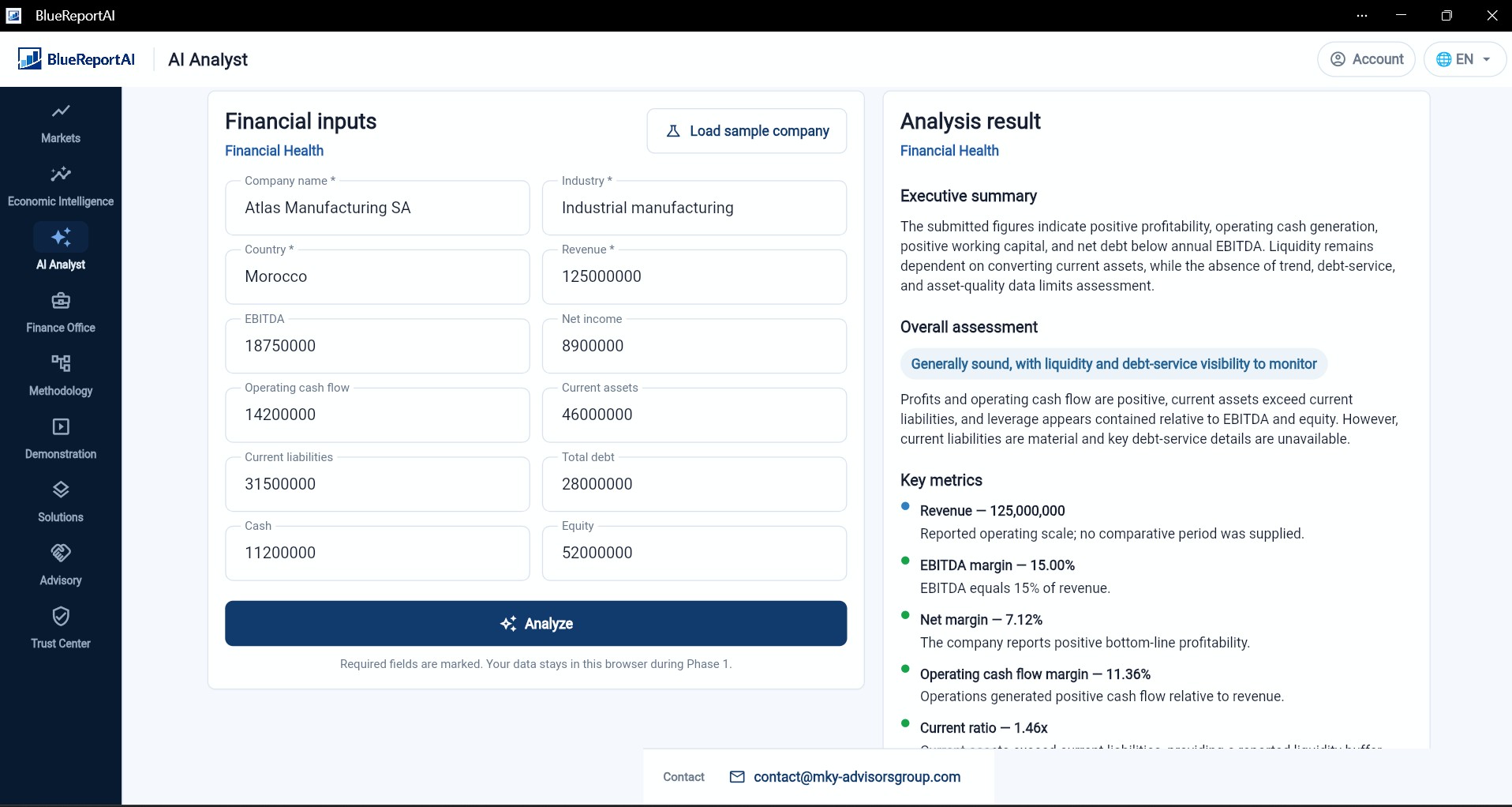
- assess financial health;
- explain financial ratios;
- identify financial and operational risks;
- explore simple stress scenarios.
The agent structures its responses around the available data, separates observations from assumptions, and highlights missing information when a reliable conclusion cannot be reached.
How we built it
The project is integrated into the existing BlueReportAI.com platform as a new public AI analysis workspace.
The front end is built with Flutter Web. The application uses Cloudflare Pages and Cloudflare Workers, with server-side processing designed to protect secrets and isolate model access from the browser. Existing BlueReportAI market, macroeconomic, and financial-analysis components provide the foundation for the agent experience.
Codex with GPT-5.6 was used throughout the Build Week development process to inspect the repository, plan the architecture, implement the feature, write tests, and reduce regression risk across an existing production application.
Challenges
The main challenge was introducing an AI agent into an established financial platform within a very short development window, while preserving existing navigation, localization, responsive behavior, and production stability.
Another challenge was ensuring that the feature behaves as a financial-analysis tool rather than a generic chatbot. The interface and response structure therefore emphasize data provenance, uncertainty, missing inputs, and the distinction between calculated observations and model-generated interpretation.
What we learned
Building an effective financial agent requires more than connecting a language model to a chat interface. The quality of the result depends on how financial data is structured, how context is constrained, how assumptions are disclosed, and how the analysis is presented to the user.
The project also demonstrated how Codex can accelerate feature development inside a mature codebase by combining repository-level understanding, implementation support, testing, and iterative debugging.
What’s next
The next steps are to extend the agent to additional financial workflows, improve scenario modelling, connect more structured market signals, and introduce richer traceability for every conclusion generated.
Built With
- ai
- analysis
- cloudflare
- codex
- d1
- dart
- financial
- flutter
- github
- gpt-5.6
- javascript
- openai
- pages
- restapi
- typescript
- workers


Log in or sign up for Devpost to join the conversation.