-
-
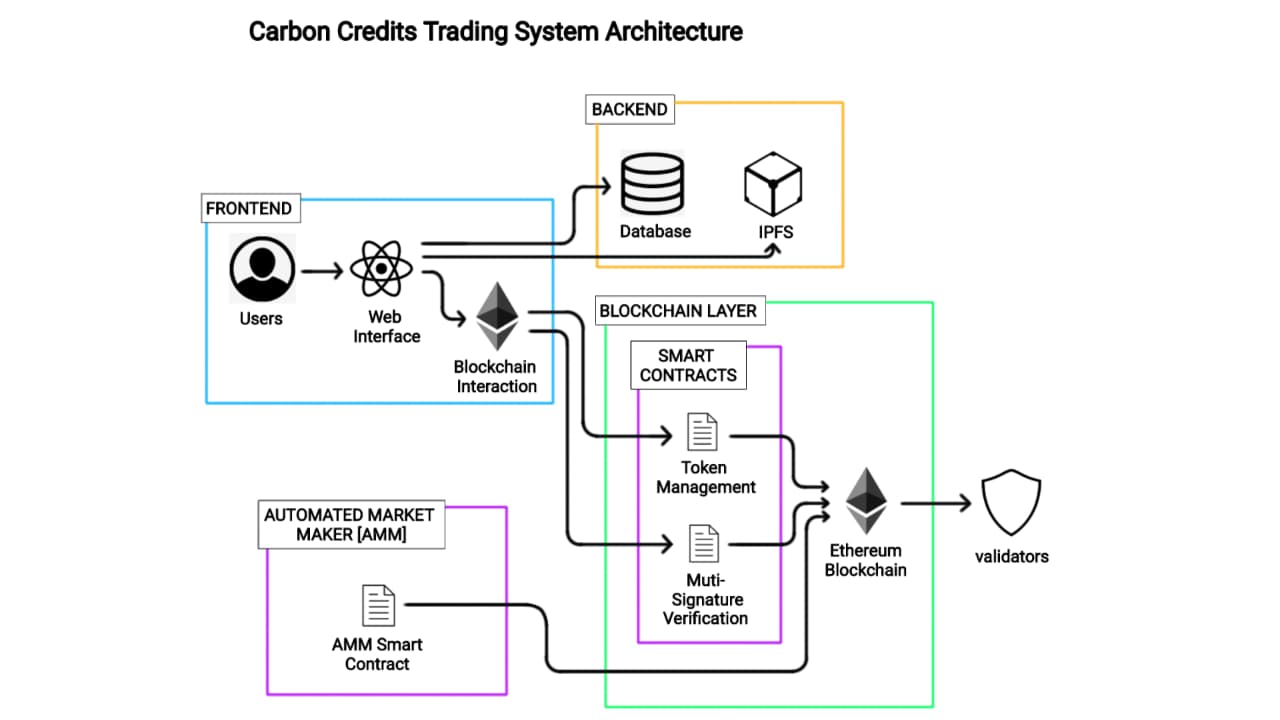
Project Architechure
-
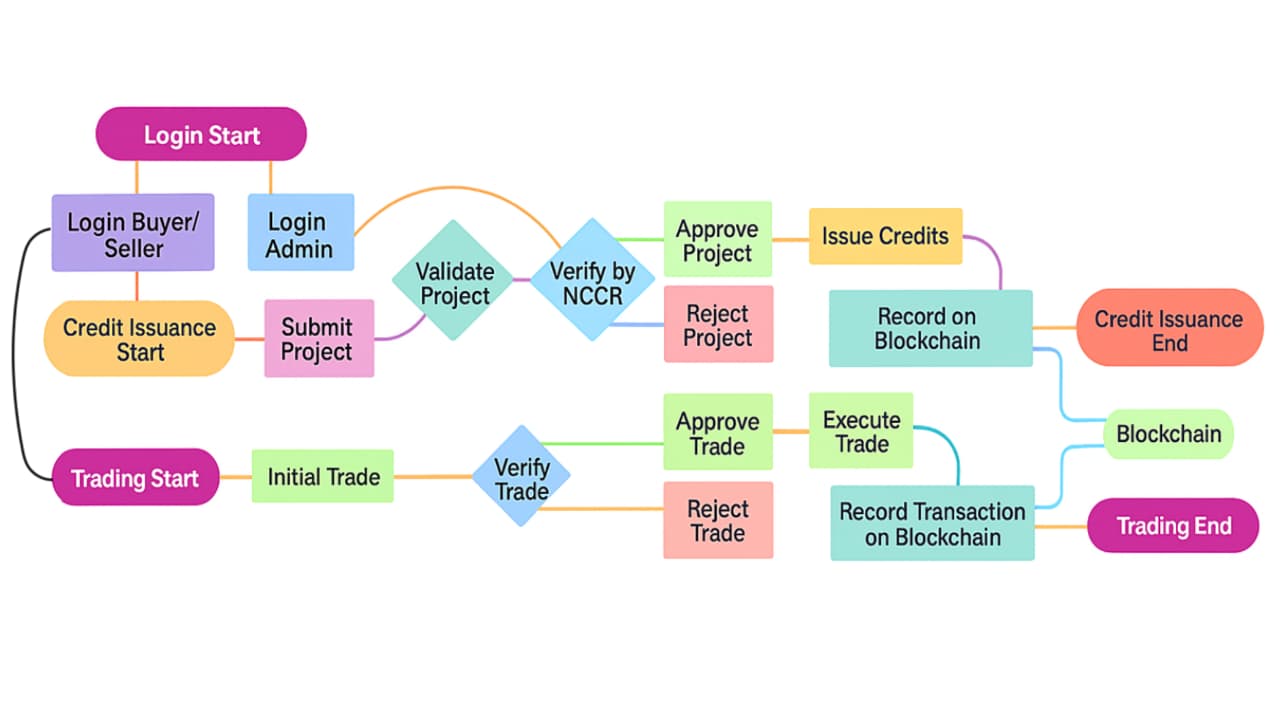
Project Workflow
-
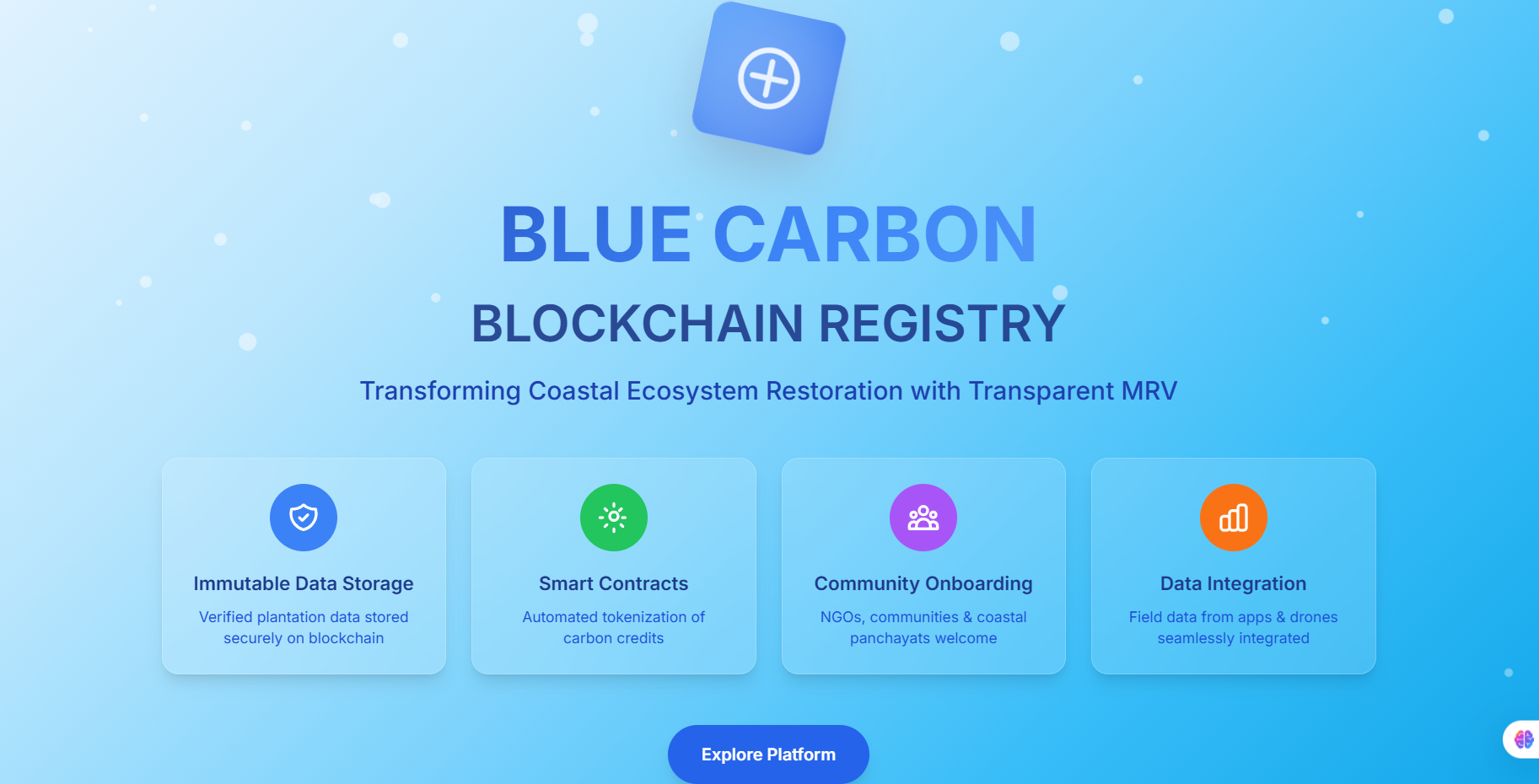
first page
-
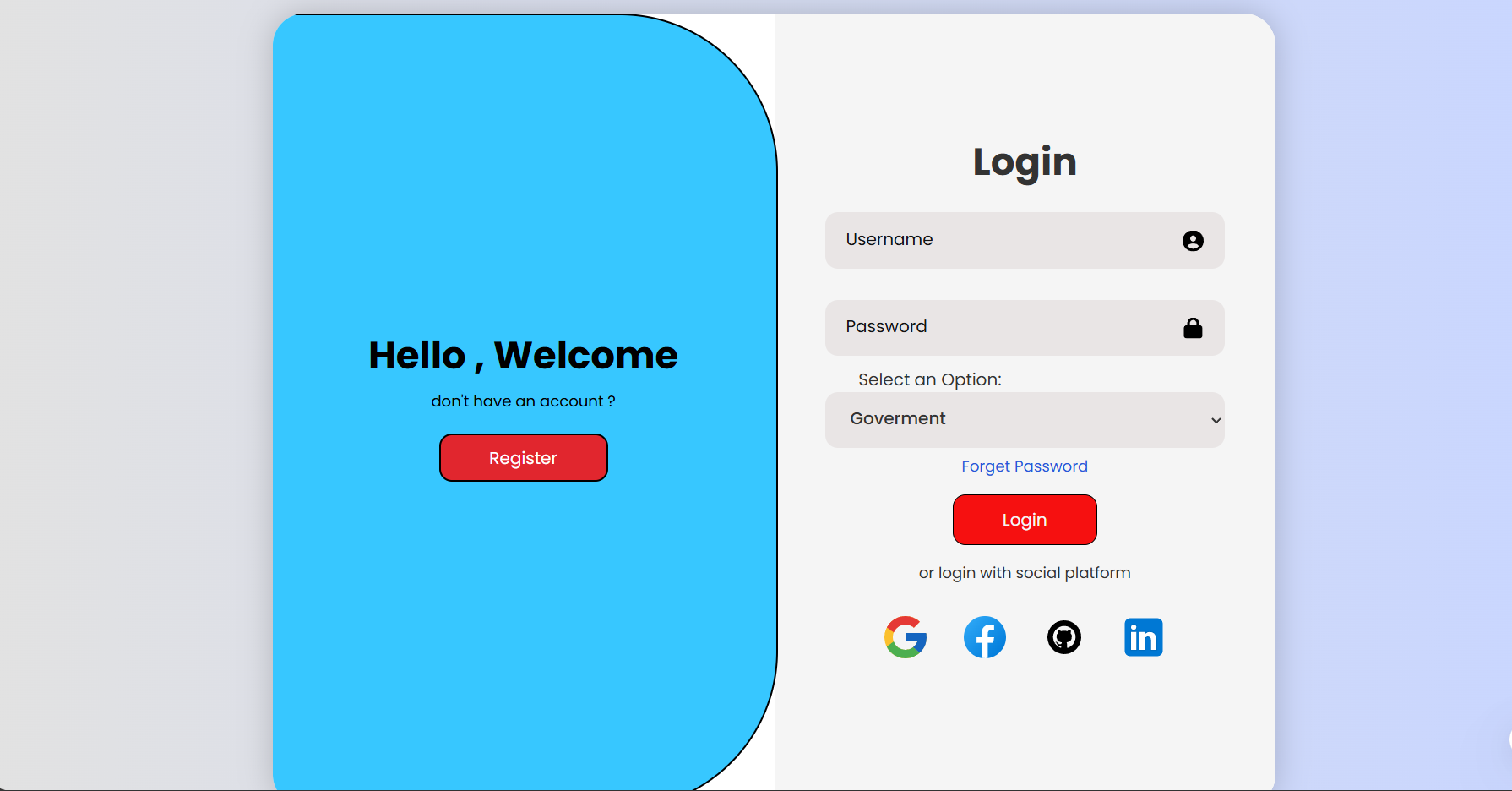
Login
-
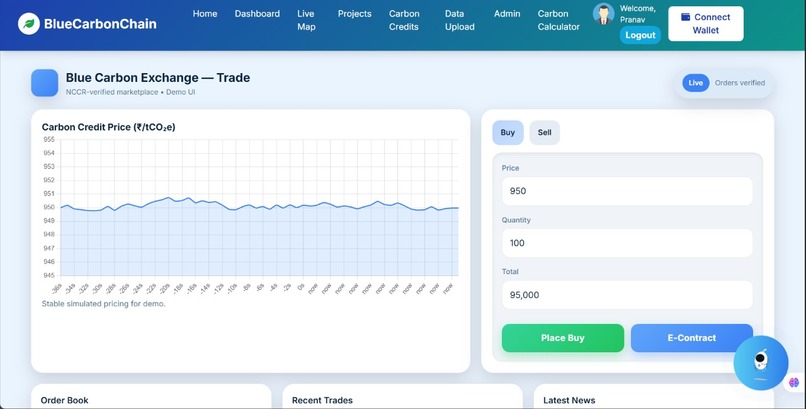
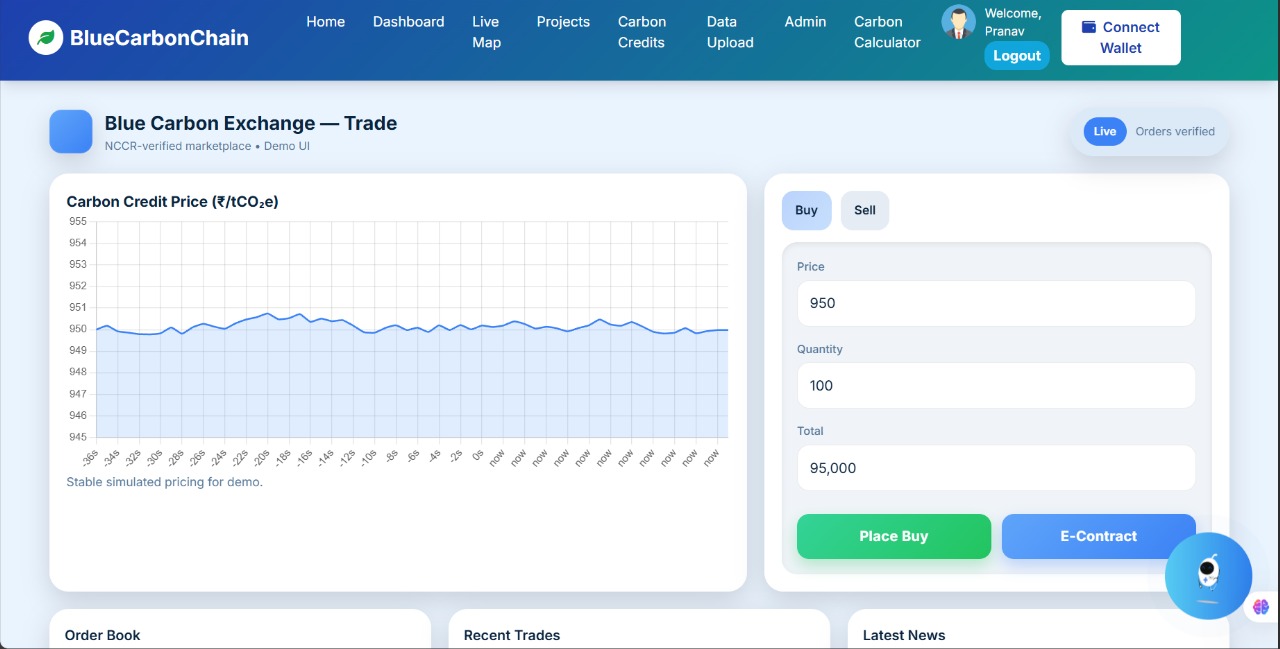
home and trading page
-
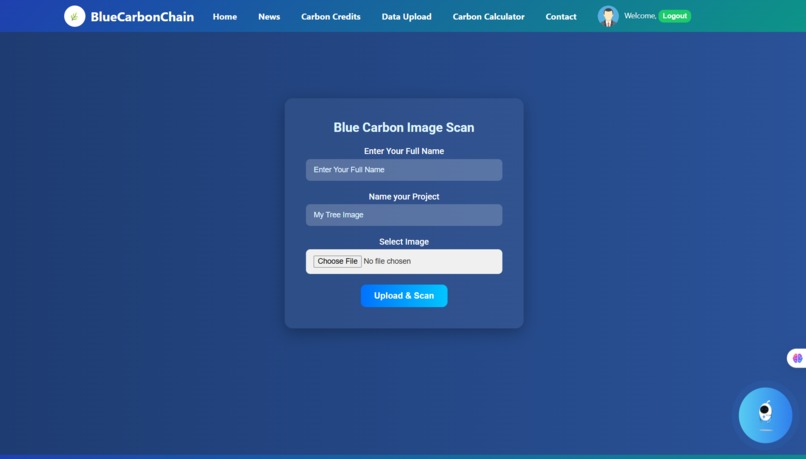
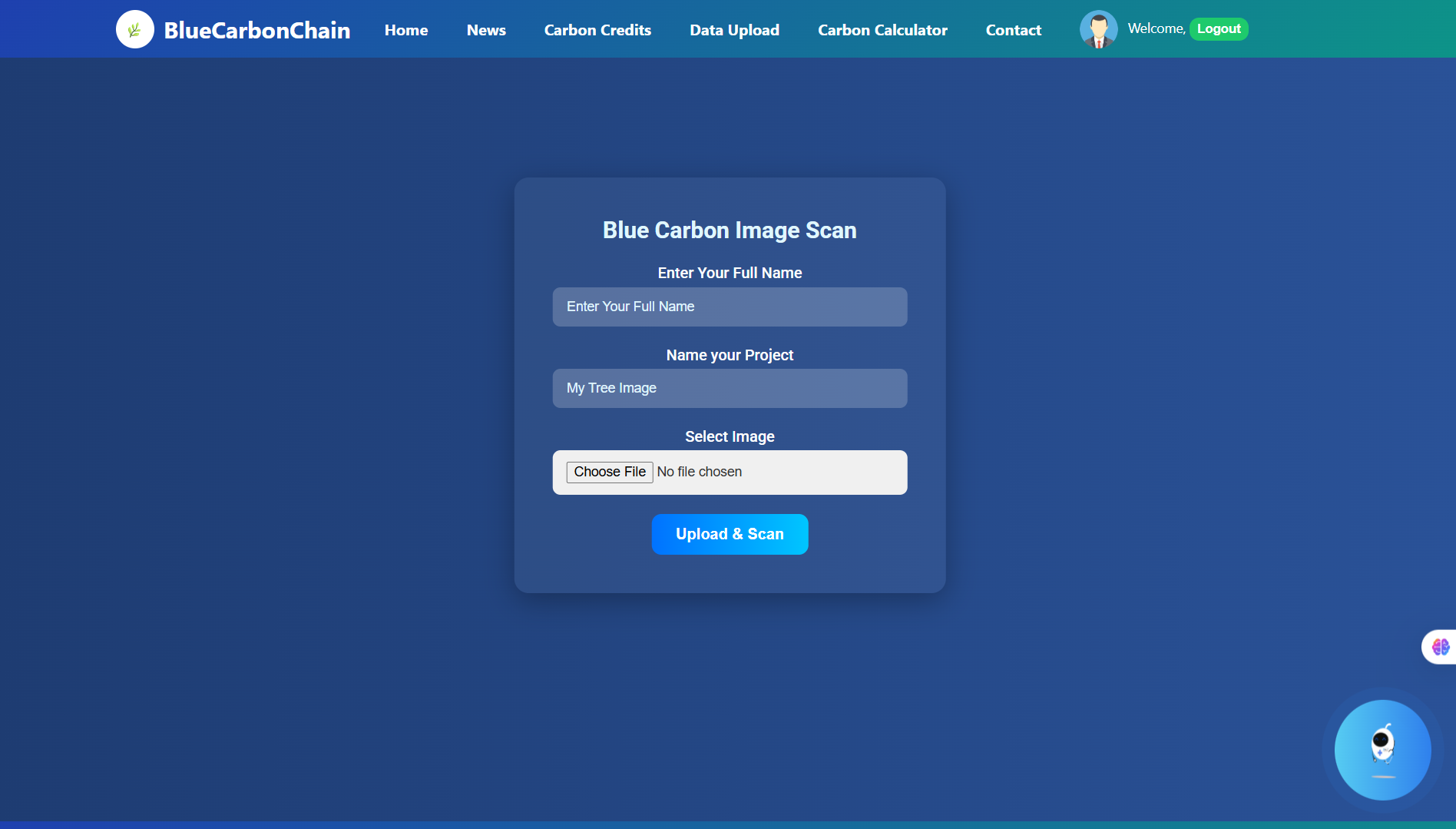
Project Upload Page
-
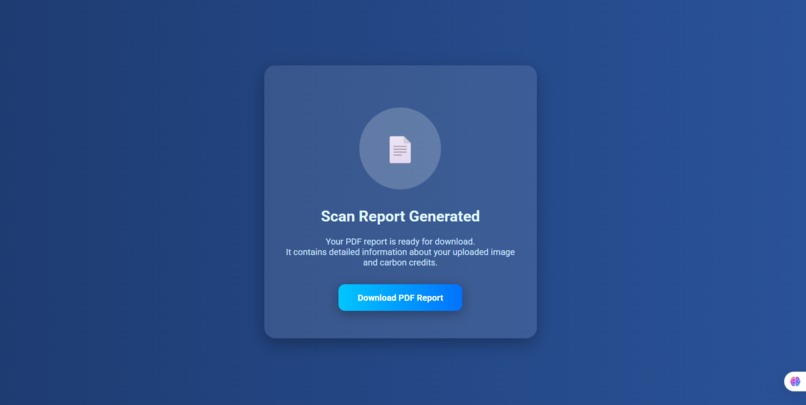
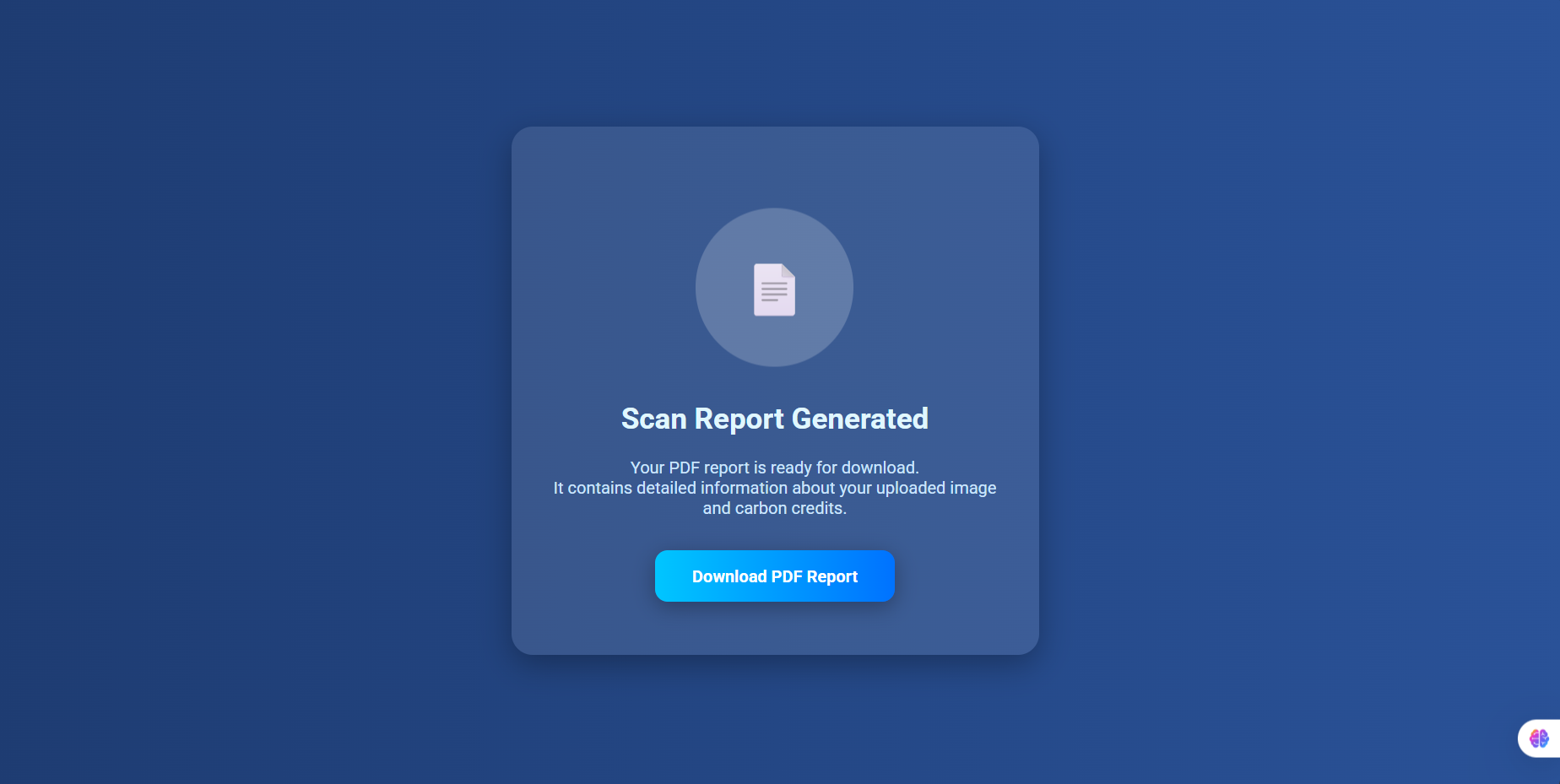
Project Report Page
-
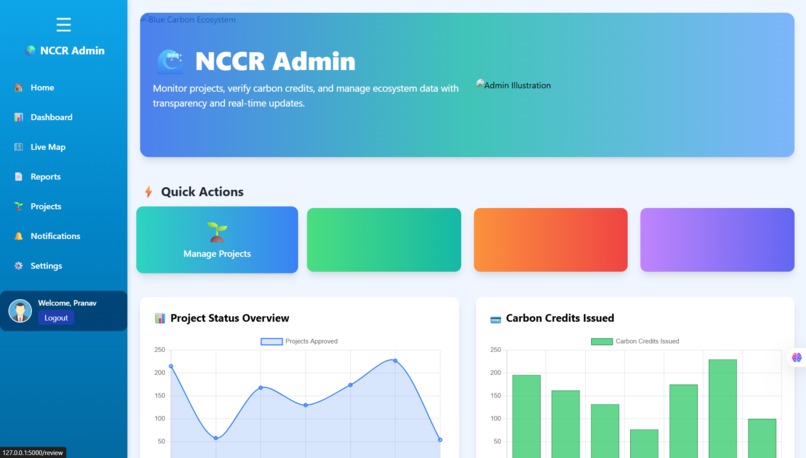
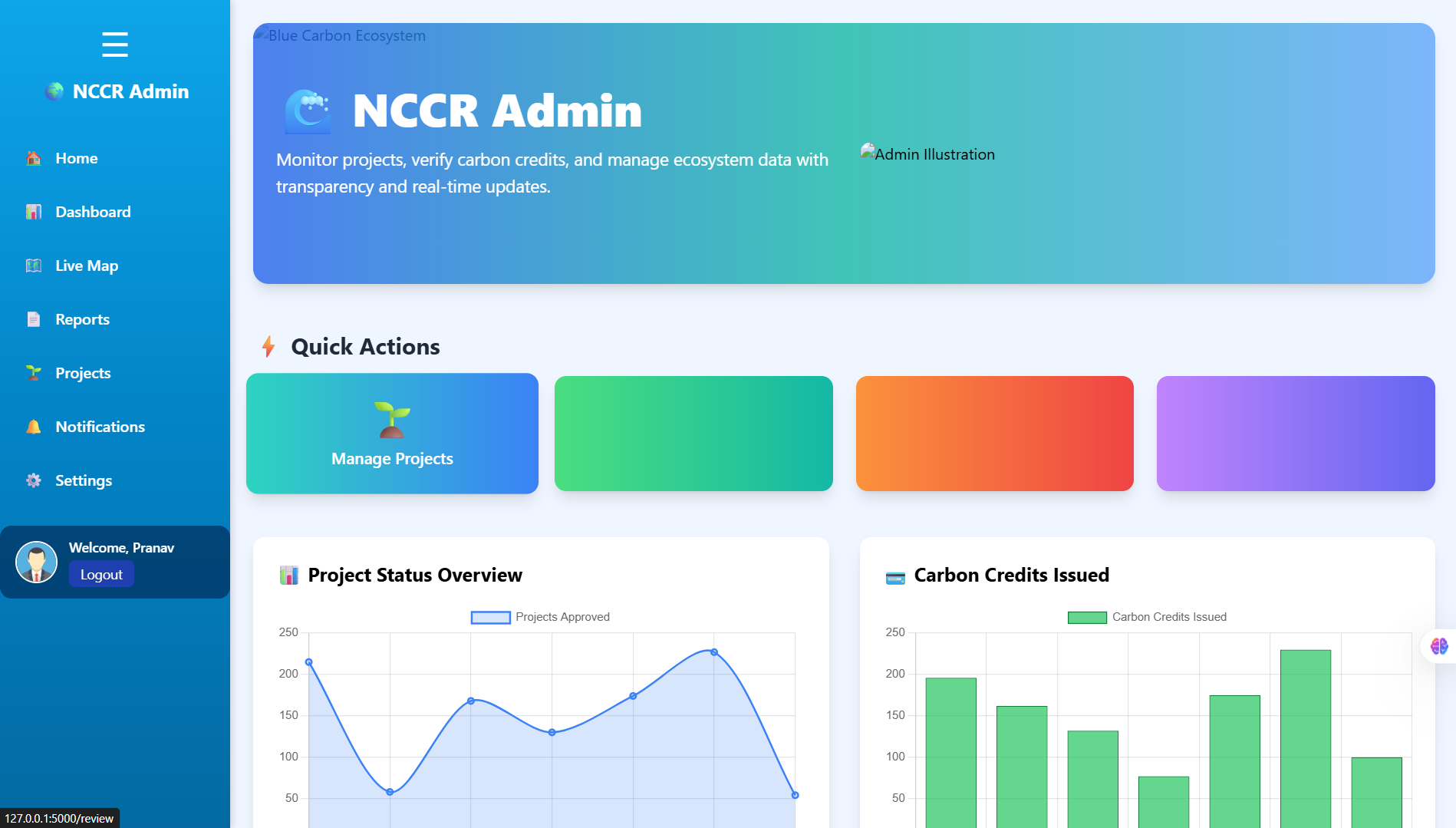
admin home page
-
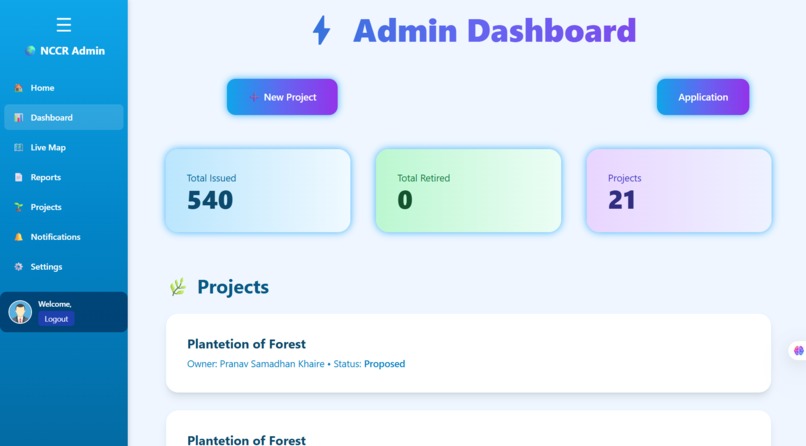
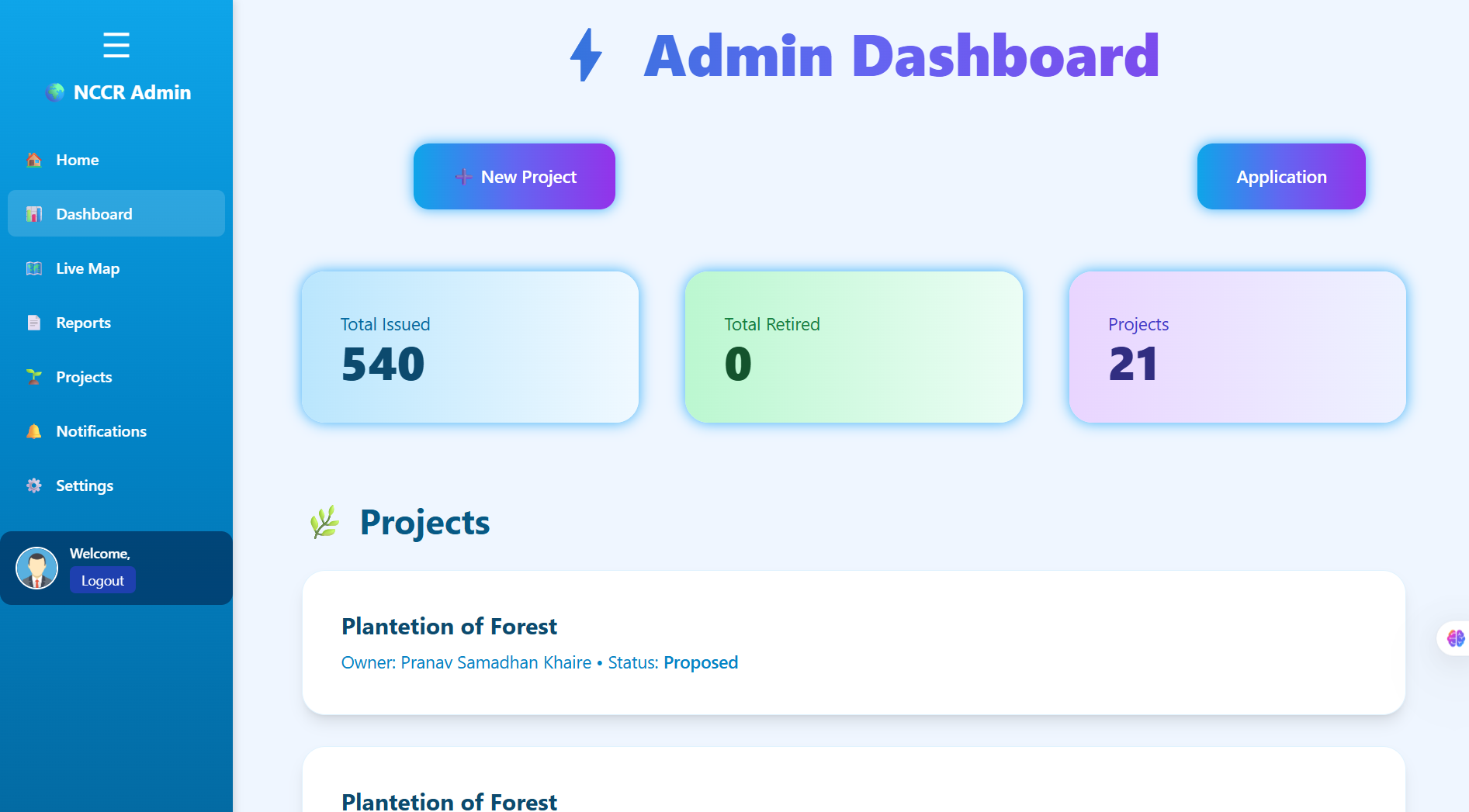
admin dashboard
-
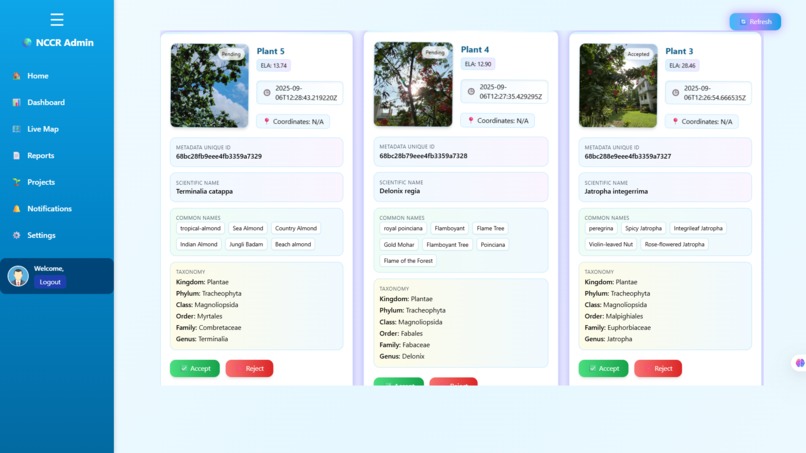
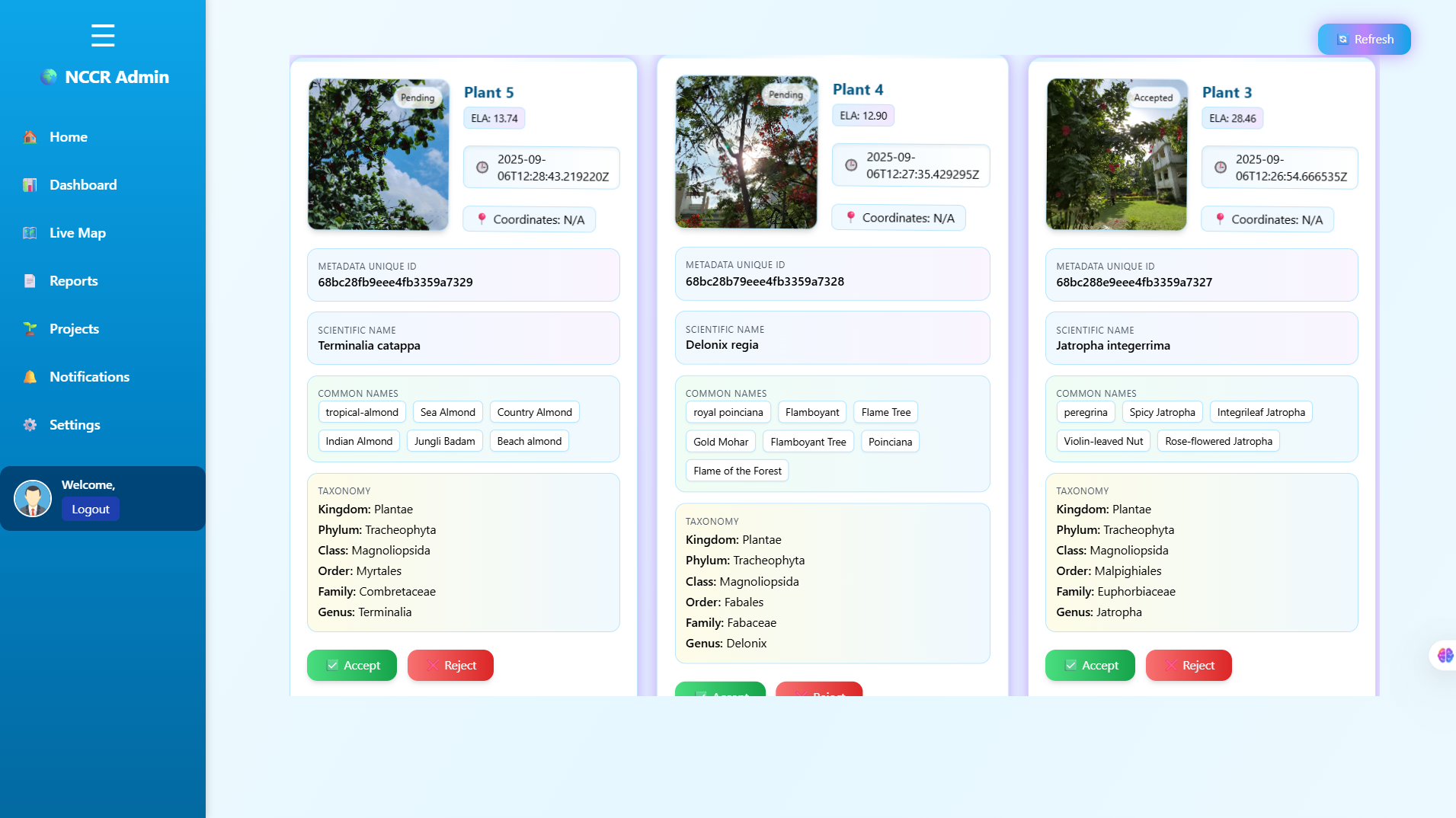
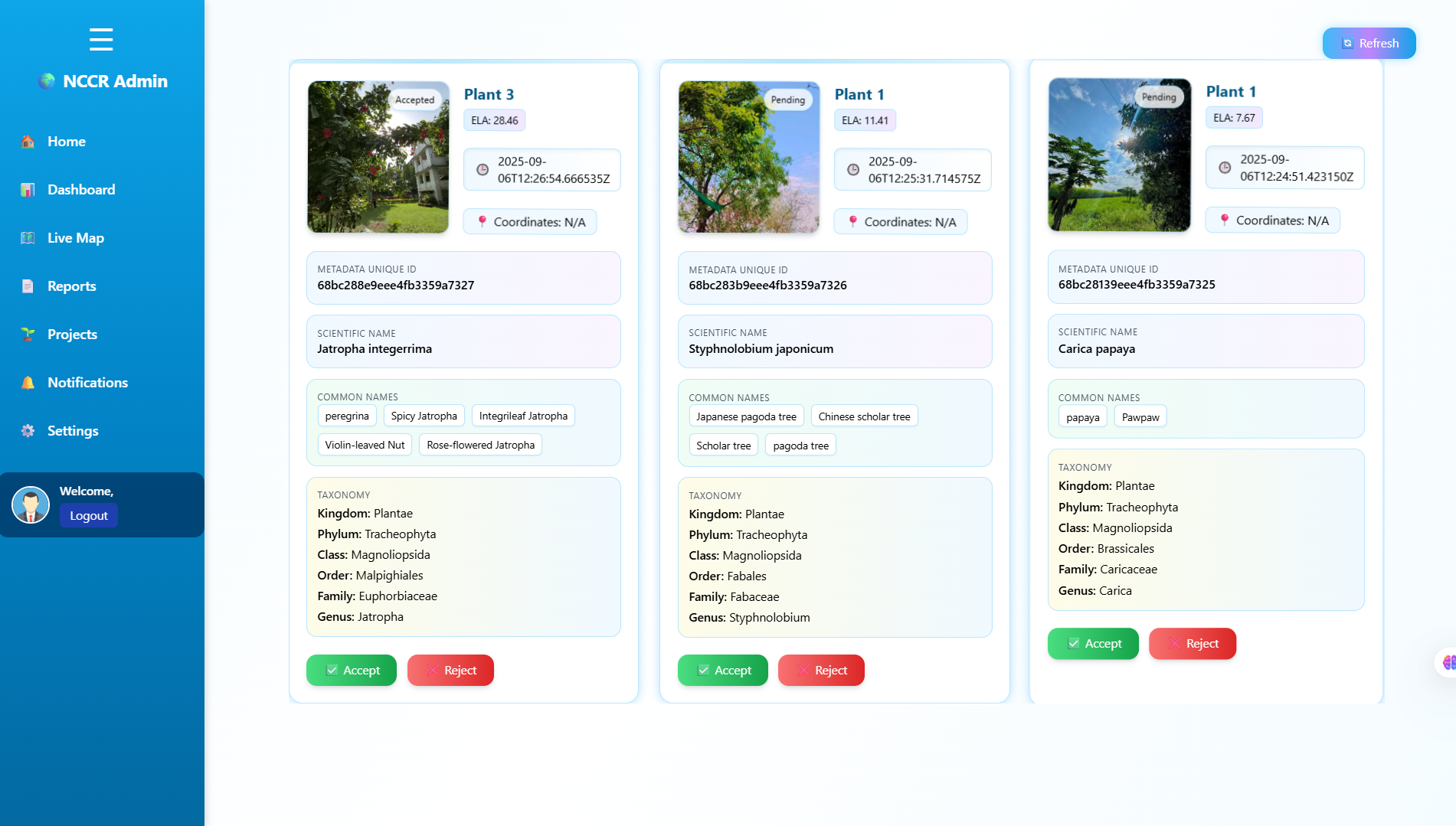
application
-
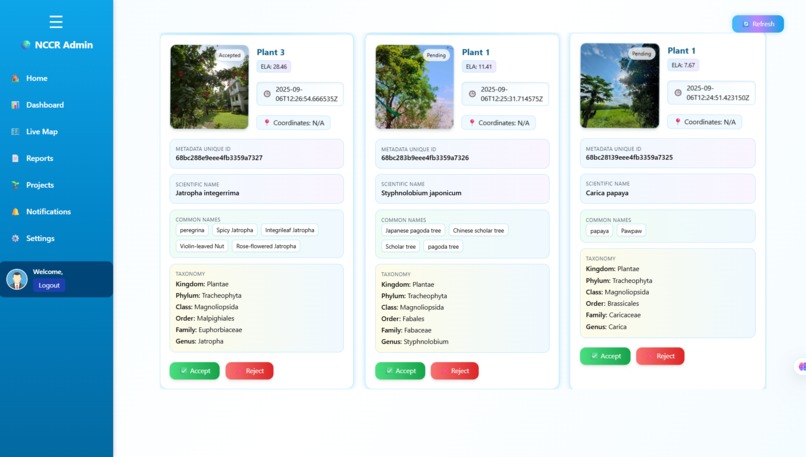
application
-
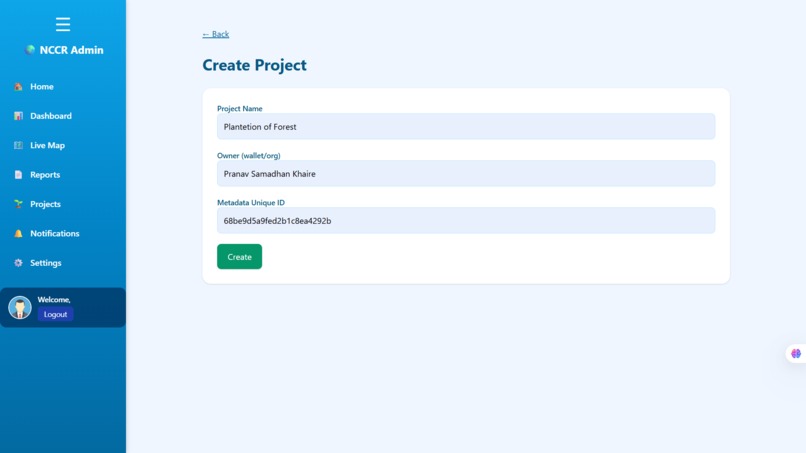
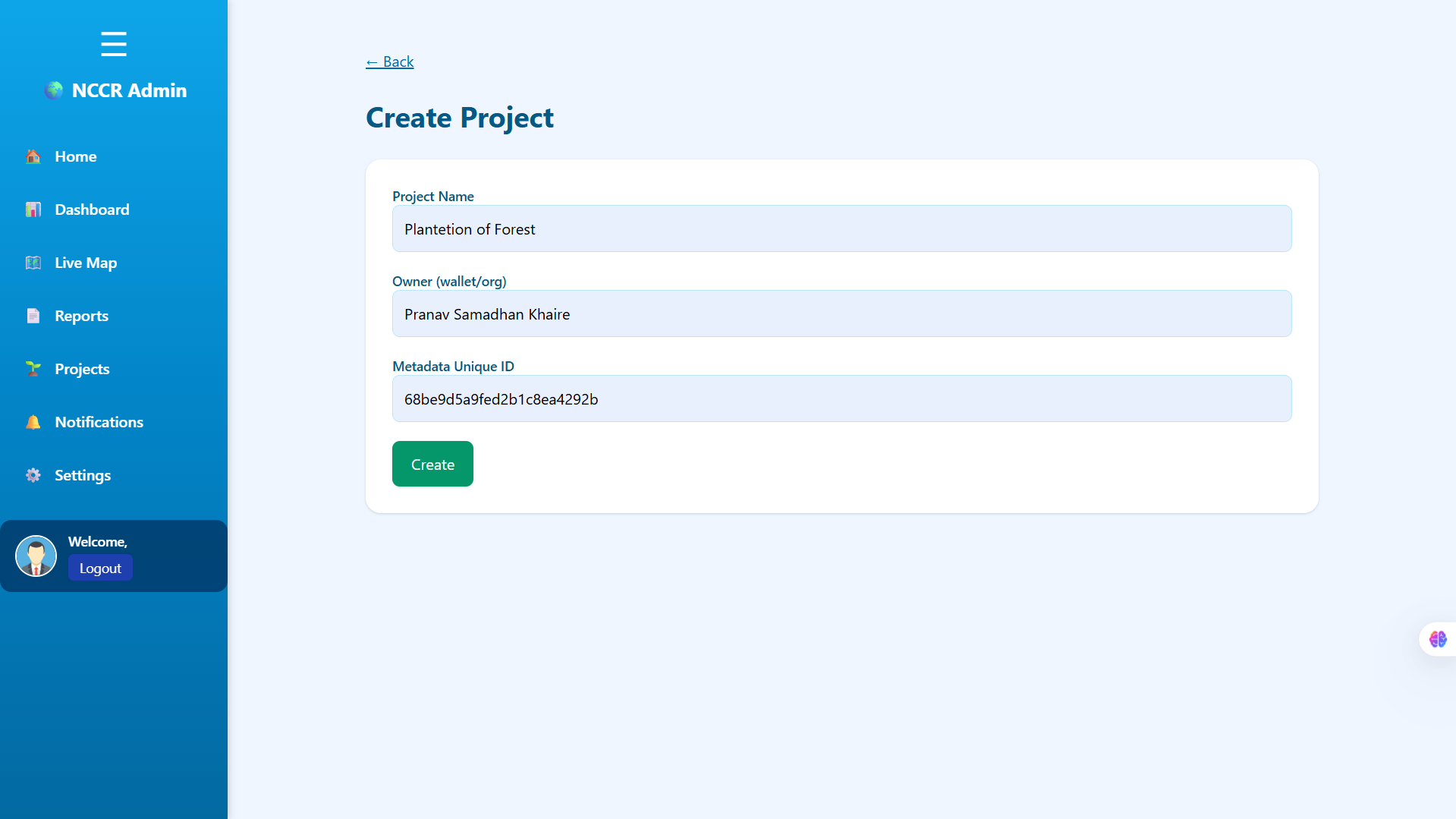
create project for co2 allotment
-
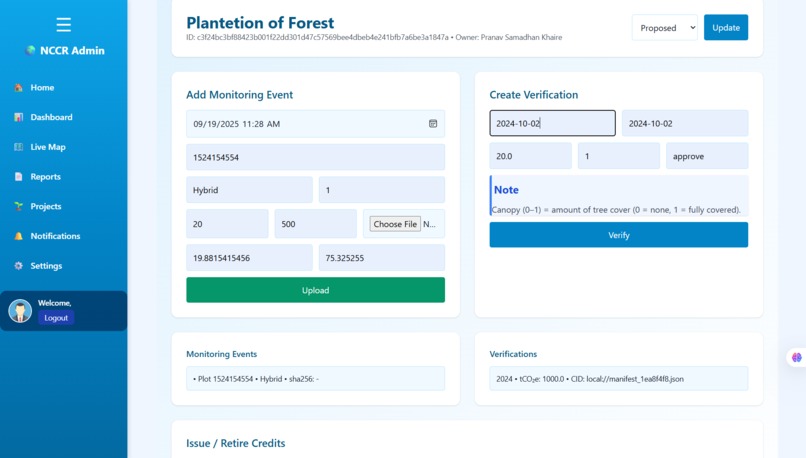
Mange Project
-
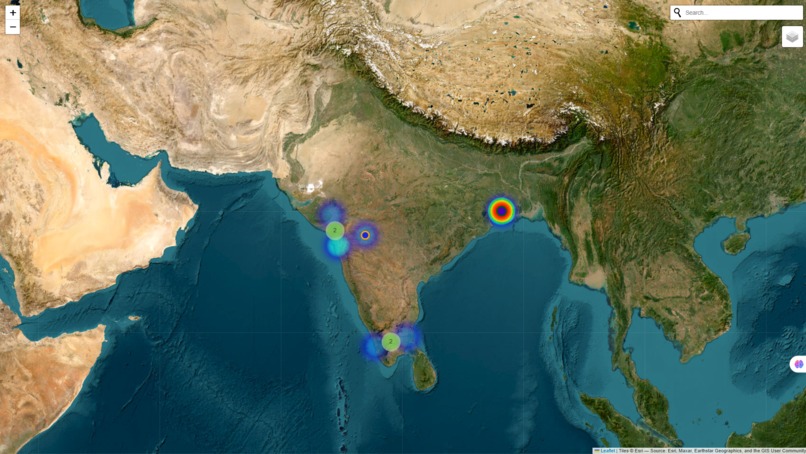
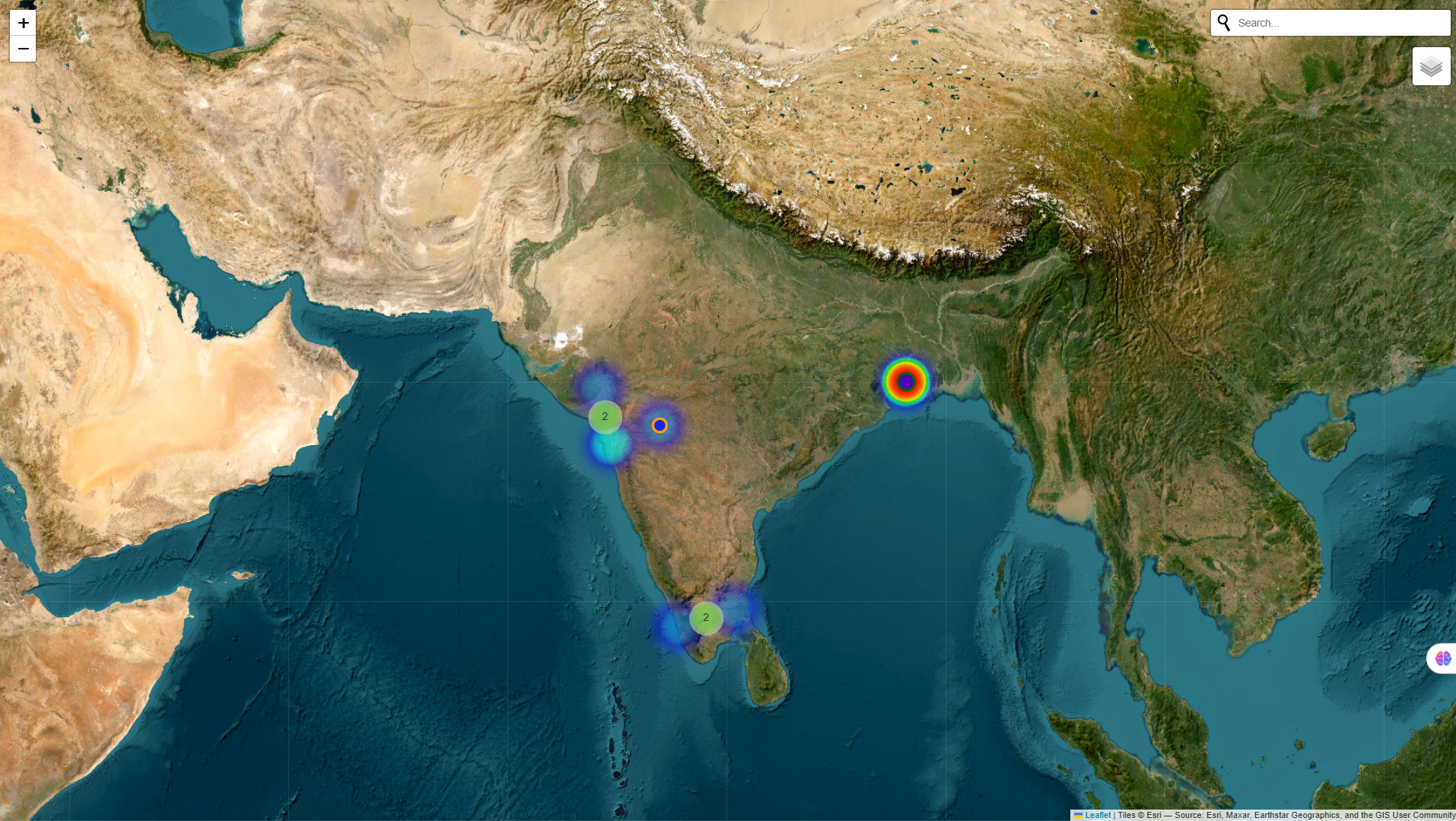
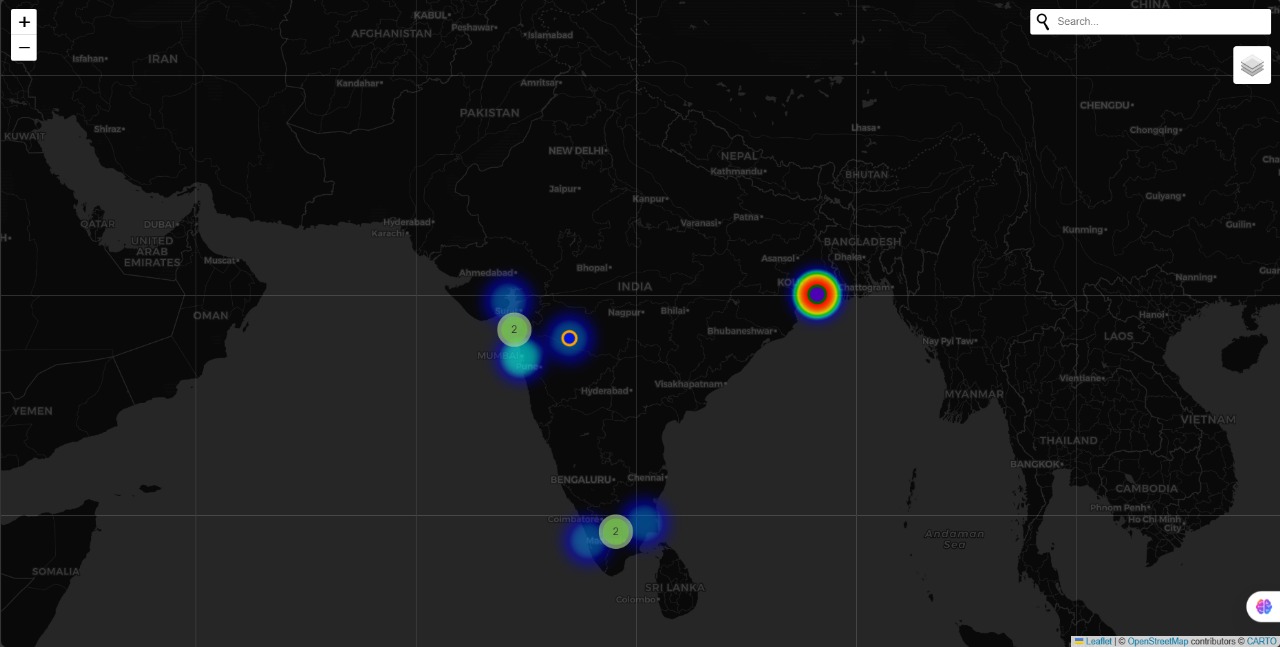
map visualization
-
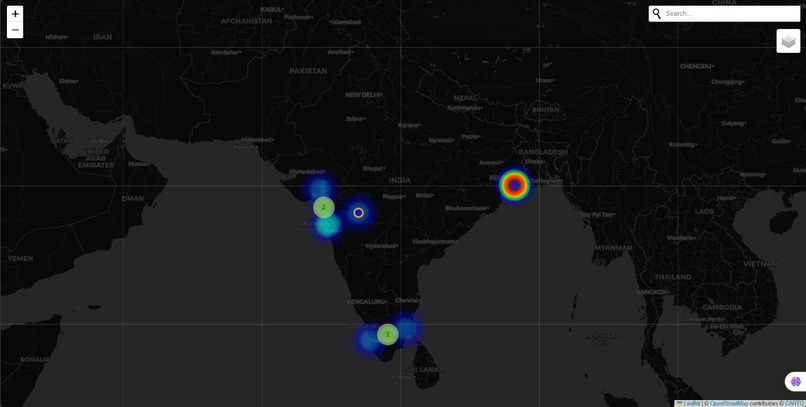
map visualization
-
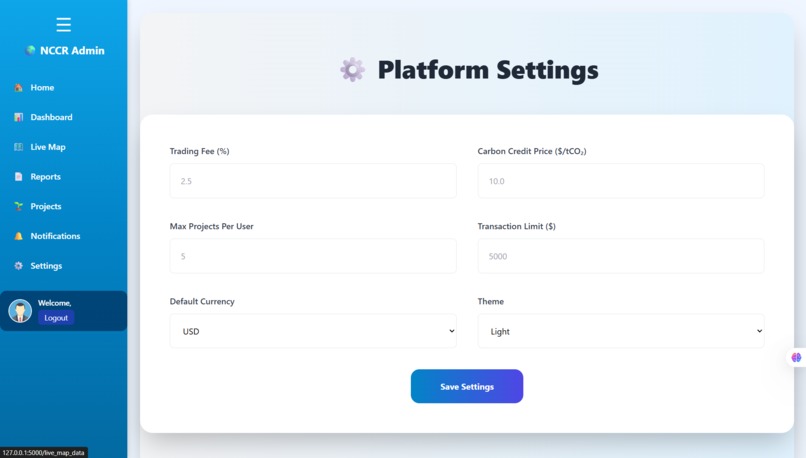
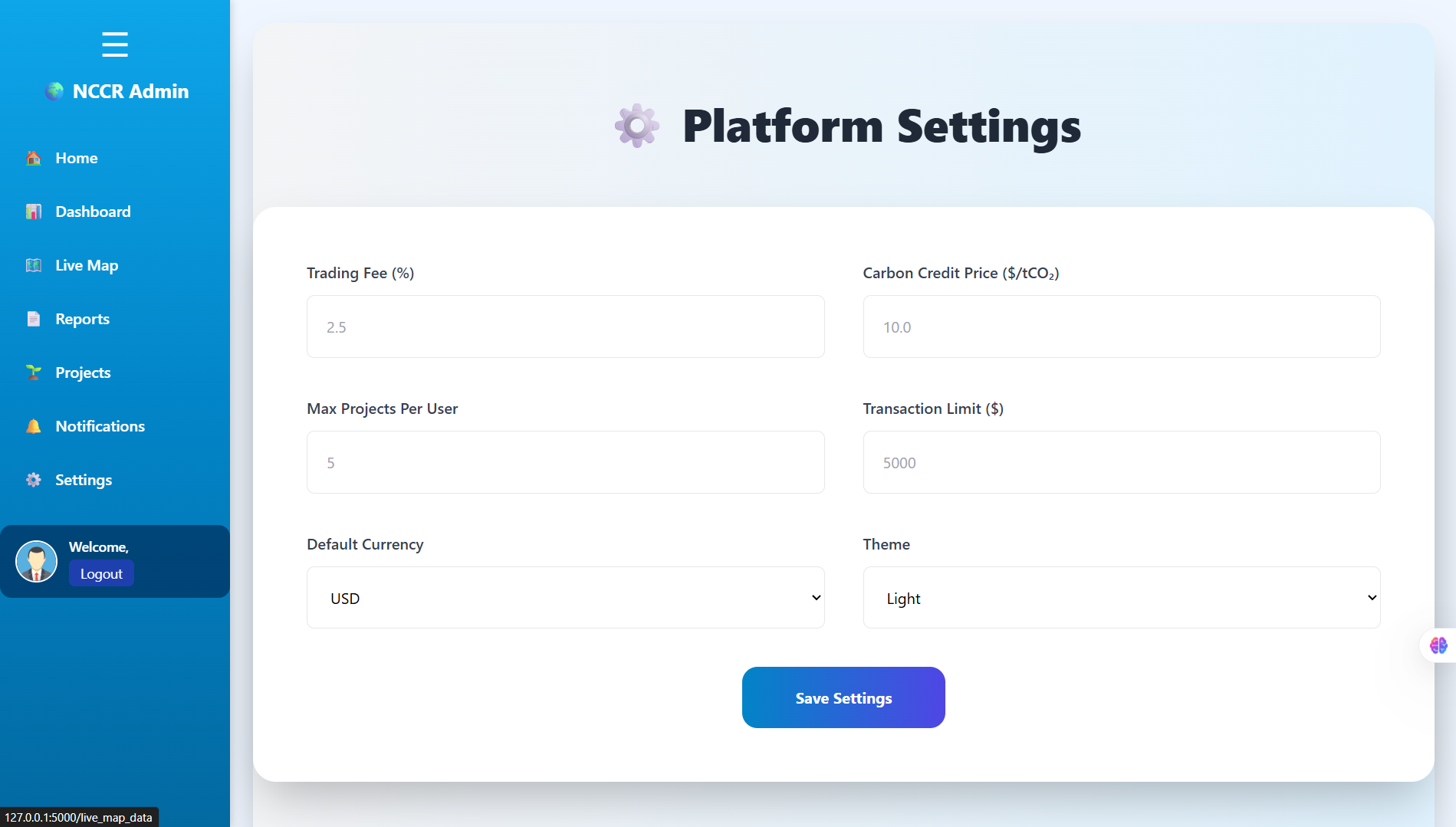
setting
INDEX PAGE NO.
CHAPTER 1: INTRODUCTION 1
1.1 Introduction on to Project and Problem Statement 1
1.2 Necessity of the Platform 1
1.3 Problem Statement 2
1.4 Scope and Limitations 3
CHAPTER 2: LITERATURE SURVEY 4
2.1 Review of Blue Carbon Ecosystems 4
2.2 Existing Carbon Credit Mechanisms
2.3 Blockchain Applications in Carbon and
Environmental Monitoring 4
2.4 Need for Decentralized MRV 4
2.5 Technological Components of Blue Carbon Registry 4
2.6 Challenges in Implementation 5
CHAPTER 3: SYSTEM DEVELOPMENT 6
3.1 Proposed System 6
3.2 System Architecture 6
3.3 Algorithms and Workflow 7
CHAPTER 4: IMPLEMENTATION 11 4.1 Login / Registration Page 11 4.2 Dashboard / Home Page 11 4.3 Data Submission Page 12 4.4 Verification & Approval Module 13 4.5 Blockchain Storage & Tokenization 13 4.6 Contact / Support Page 13
7
CHAPTER 5: PERFORMANCE ANALYSIS 14
5.1 Accuracy and Efficiency 14
5.2 User Experience and Feedback 14
CHAPTER 6: CONCLUSION 15 Conclusion 15 Future Scope 15 REFERENCES 16
LIST OF FIGURES
FIGURE NO.
Figure 3.1
Figure 4.1
Figure 4.2
Figure 4.3
Figure 4.4
Figure 4.5
Figure 4.7
TITLE
workflow Diagram
Login / Registration Page
Dashboard / Home Page Layout
Data Submission Page
Verification & Approval Module
Blockchain Storage & Tokenization
PAGE NO.
9
11
12
12
13
14
Plant Database & Scientific Information 15
8
CHAPTER 1: INTRODUCTION
1.1 Introduction to Project and Problem Statement
Climate change poses a severe global threat, and one of the most effective
nature-based solutions is the restoration of blue carbon ecosystems such as
mangroves, seagrasses, and salt marshes. These ecosystems absorb and store--
large amounts of atmospheric carbon, often at rates higher than terrestrial
forests.
In India, blue carbon restoration is gaining importance as part of its climate
strategy. However, a major challenge lies in the lack of a decentralized,
transparent, and verifiable Monitoring, Reporting, and Verification (MRV)
system. Current systems are fragmented, prone to inaccuracies, and fail to build
trust among stakeholders.
The problem statement highlights the urgent need for a Blockchain-Based Blue
Carbon Registry and MRV System that ensures:
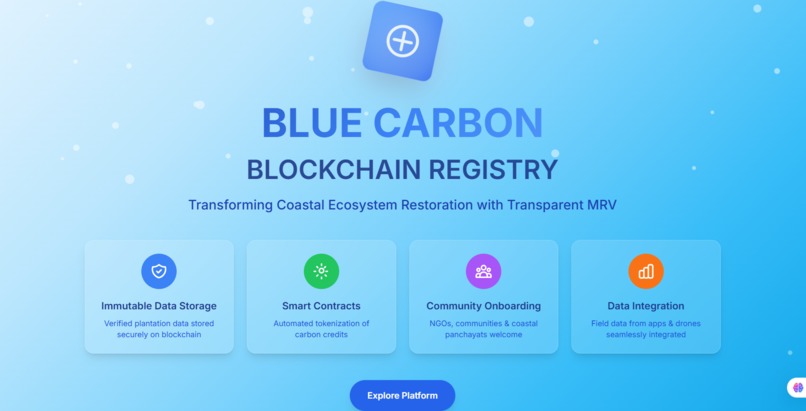
Immutable storage of verified plantation and restoration data.
Tokenization of carbon credits through smart contracts.
Easy participation of NGOs, communities, and coastal panchayats.
Integration of field data from apps, drones, and remote sensing
technologies.
Thus, the project aims to design a blockchain-powered platform that not only
enhances trust, transparency, and accountability but also enables local
communities to access carbon markets fairly.
1.2 Necessity of the Platform
The necessity of this platform arises due to the following reasons:
Transparency Issues: Current reporting mechanisms for carbon credits
lack reliability and are often centralized, making them prone to
manipulation.
Verification Gaps: Manual reporting systems do not ensure accurate
measurement and verification of carbon sequestration.
9
Community Empowerment: Coastal communities and NGOs working on
restoration projects often cannot claim the benefits of their work due to
lack of verifiable proof.
Global Climate Goals: India, under the Paris Agreement and Net-Zero
commitments, needs reliable systems to account for carbon reduction
efforts.
Carbon Credit Market Access: By tokenizing credits on blockchain,
communities can directly access national and international carbon
markets.
Hence, this platform becomes a necessity for sustainable climate action,
economic empowerment, and global credibility.
1.3 Problem Statement
Importance of Blue Carbon Ecosystems
o Mangroves, seagrasses, and salt marshes capture and store
significant amounts of CO₂.
o Essential for India’s climate mitigation strategy.
Lack of Decentralized MRV System
o No reliable framework for Monitoring, Reporting, and Verification
(MRV).
o Existing methods are manual, fragmented, and prone to
manipulation.
Challenges for Stakeholders
o Farmers, NGOs, and communities lack transparent proof of their
restoration contributions.
o Industries face difficulties in accessing authentic carbon credits
for offsetting.
Financial & Trust Gap
o Absence of reliable records prevents fair financial returns to local
stakeholders.
o Lack of transparency reduces confidence in carbon credit markets.
Need for Blockchain Solution
o Blockchain provides immutability, transparency, and trust.
o Smart contracts enable automatic tokenization of carbon credits.
10
o Drones and IoT devices allow verifiable validation of plantation
data.
1.4 Scope and Limitations
Scope:
Development of a blockchain-powered registry for blue carbon
ecosystems.
Smart contracts for automatic issuance and transfer of carbon credits.
Mobile/web interfaces for plantation data submission and drone-based
verification.
Dashboard for NCCR (National Centre for Coastal Research) to monitor
and validate projects.
Potential scaling to other natural carbon sinks (forests, wetlands) in the
future.
Limitations:
Technical Barriers: Blockchain and drone integration may require
advanced infrastructure and training.
Initial Costs: Deployment of drones, sensors, and blockchain
infrastructure could be expensive.
Adoption Challenges: Local communities may face difficulty in adopting
new technology without adequate training.
Regulatory Uncertainty: Carbon credit regulations in India are still
evolving, which may delay large-scale adoption.
Connectivity Issues: Remote coastal areas may face internet and power
challenges, affecting real-time data uploads.
11
CHAPTER 2: LITERATURE SURVEY
2.1 Review of Blue Carbon Ecosystems
Role of mangroves, seagrasses, and salt marshes in carbon storage.
Reports by UNEP, IPCC, and NCCR highlighting restoration importance.
2.2 Existing Carbon Credit Mechanisms
Voluntary carbon markets (Verra, Gold Standard).
Problems: double-counting, high certification costs, lack of transparency.
2.3 Blockchain Applications in Carbon and Environmental Monitoring
Case studies (Toucan Protocol, KlimaDAO, Regen Network).
Blockchain benefits: immutability, decentralization, trust-building.
2.4 Need for Decentralized MRV (Monitoring, Reporting & Verification)
Weakness of centralized MRV.
Integration of drones, IoT sensors, and satellite data for reliable
verification.
2.5 Technological Components of Blue Carbon Registry
Blockchain layer (data storage).
Smart contracts (tokenized carbon credits).
Data collection tools (apps, drones, remote sensing).
Dashboards for NCCR and community use.
2.6 Challenges in Implementation
Technical complexity.
Community adoption and digital literacy issues.
High initial setup costs.
Regulatory uncertainty in India’s carbon markets.
12
CHAPTER 3: SYSTEM DEVELOPMENT
3.1 Proposed System
The proposed system is a Blockchain-Based Blue Carbon Registry and MRV
(Monitoring, Reporting, Verification) System designed to ensure
transparency, accountability, and efficiency in carbon credit generation from
blue carbon ecosystems such as mangroves and seagrasses.
The system provides:
Decentralized storage of verified plantation and restoration data.
Smart contracts to tokenize and automate carbon credit issuance.
Integration of field data from mobile apps, drones, and IoT sensors.
Role-based access for NCCR, NGOs, local communities, and buyers.
Marketplace support for trading tokenized carbon credits.
This system overcomes the limitations of existing centralized registries, where
data tampering, verification delays, and lack of transparency create trust
issues.
3.2 System Architecture
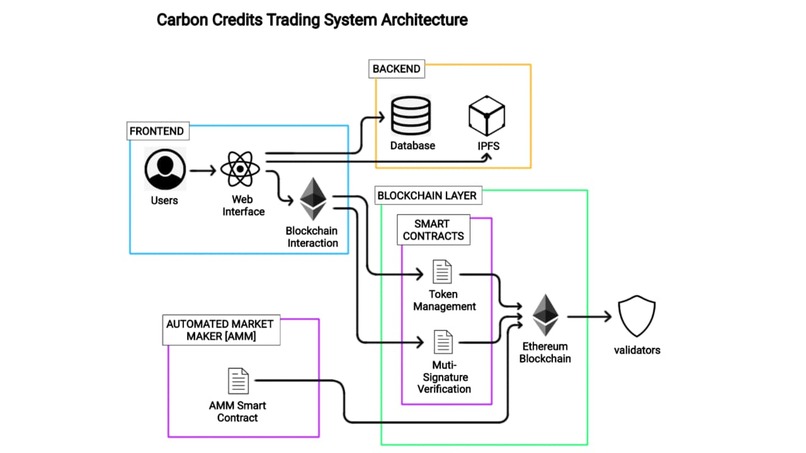
The architecture of the proposed system consists of five main layers:
User Interface Layer
Web portal and mobile app for farmers, NGOs, and communities
to upload plantation data.
Dashboard for NCCR and administrators.
Data Collection Layer
Integration of drones, IoT sensors, and satellite data for
verification.
Mobile-based reporting for on-ground activities.
Blockchain Layer
Smart contracts for immutability, transparency, and tokenization
of carbon credits.
Distributed ledger ensuring no single entity can manipulate
records.
13
Application Layer
Verification engine for MRV compliance.
Carbon credit marketplace for trading credits with industries.
Database Layer
Secure storage of metadata, user profiles, and non-blockchain
data.
3.3 Algorithms and Workflow
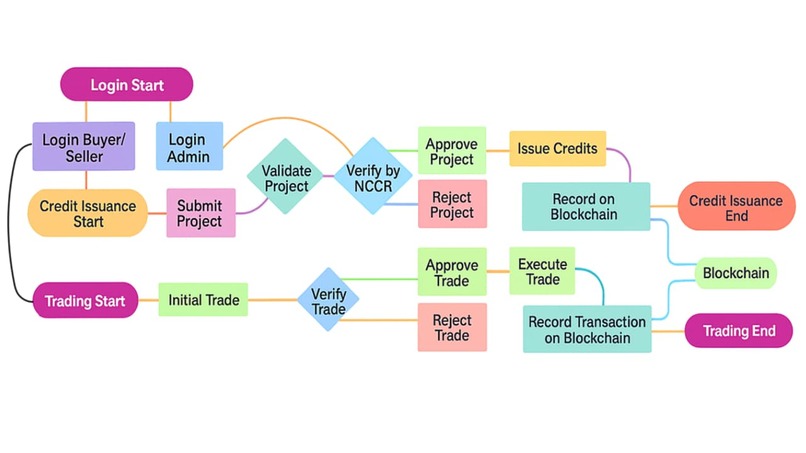
Data Entry: Farmers/NGOs upload plantation and restoration details
(species, area, date, geotag).
Verification: Drones and IoT devices validate growth, health, and
survival rate of plants.
Blockchain Record: Verified data is stored immutably in the blockchain.
Tokenization: Smart contracts calculate equivalent carbon credits and
generate tokens.
Approval: NCCR validates and approves credits.
Marketplace: Tokenized credits are made available for trading with
industries seeking carbon offsets.
Fig : 3.2(A) Flowchart of Blockchain-Based Blue Carbon Registry and MRV
System
14
Fig :3.3(B) Flowchart of Blockchain-Based Blue Carbon Registry and MRV
System
Fig:3.1 Workflow Diagram
15
3.4 Module Description
User Module
Farmers, NGOs, and Panchayats register and submit data.
Provides easy mobile interface for updates.
Verification Module
Integrates drone imagery and IoT sensors.
Ensures accurate measurement of plantation survival and growth.
Blockchain Module
Stores all verified data immutably.
Executes smart contracts for tokenization.
Marketplace Module
Connects carbon credit buyers (corporates) with sellers
(farmers/NGOs).
Ensures fair pricing and transparency.
3.5 Tools and Technologies Used
Blockchain Platform: Ethereum / Polygon for decentralized registry.
Smart Contracts: Solidity for credit tokenization.
Backend: Flask (Python) for API handling.
Frontend: HTML, CSS, JavaScript for user interaction.
Database: PostgreSQL or MongoDB for user and metadata.
Integration Tools: Drone APIs, IoT sensor data pipelines.
Hosting: Cloud deployment (AWS/Azure/GCP).
16
CHAPTER 4: IMPLEMENTATION
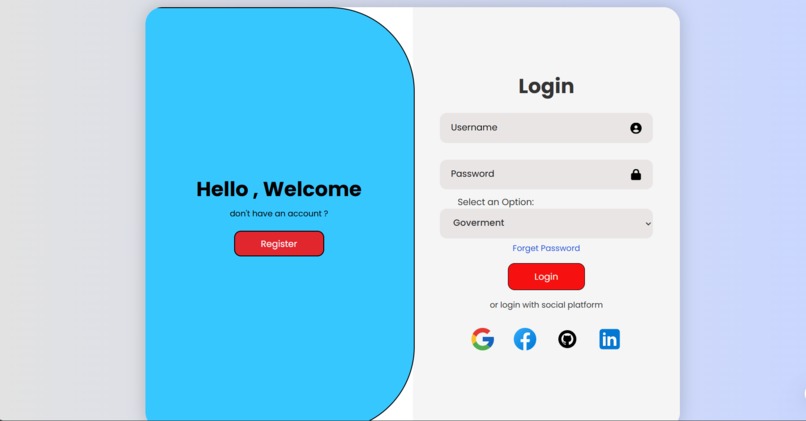
4.1 Login / Registration Page
Role-based login (Buyer/Seller,/Admin/NCCR)
Authentication & authorization
Security measures (password hashing, OTP verification)
Farmer/NGO registration with details like region, type of
plantation
Buyer/Seller,Admin/NCCR registration
Fig: 4.1 Login / Registration Page
17
4.2 Dashboard / Home Page
Overview of plantations submitted, verified, pending approval
Quick stats (CO₂ absorbed, carbon credits earned)
Fig: 4.2 Dashboard / Home Page
4.3 Data Submission Page
Form for uploading plantation/restoration details (species, area,
date, geotag)
Option to attach drone/IoT sensor data
Fig: 4.3 Data Submission Page
18
4.4 Verification & Approval Module
Display pending submissions for verification
Admin/NCCR actions: Approve / Reject / Request re-verification
Fig: 4.4 Verification & Approval Module
Fig:4.5 (A) Blockchain Storage & Tokenization
19
4.5 Blockchain Storage & Tokenization
Smart contracts generate tokenized carbon credits for approved
entries
Display of token balance for farmers/NGOs
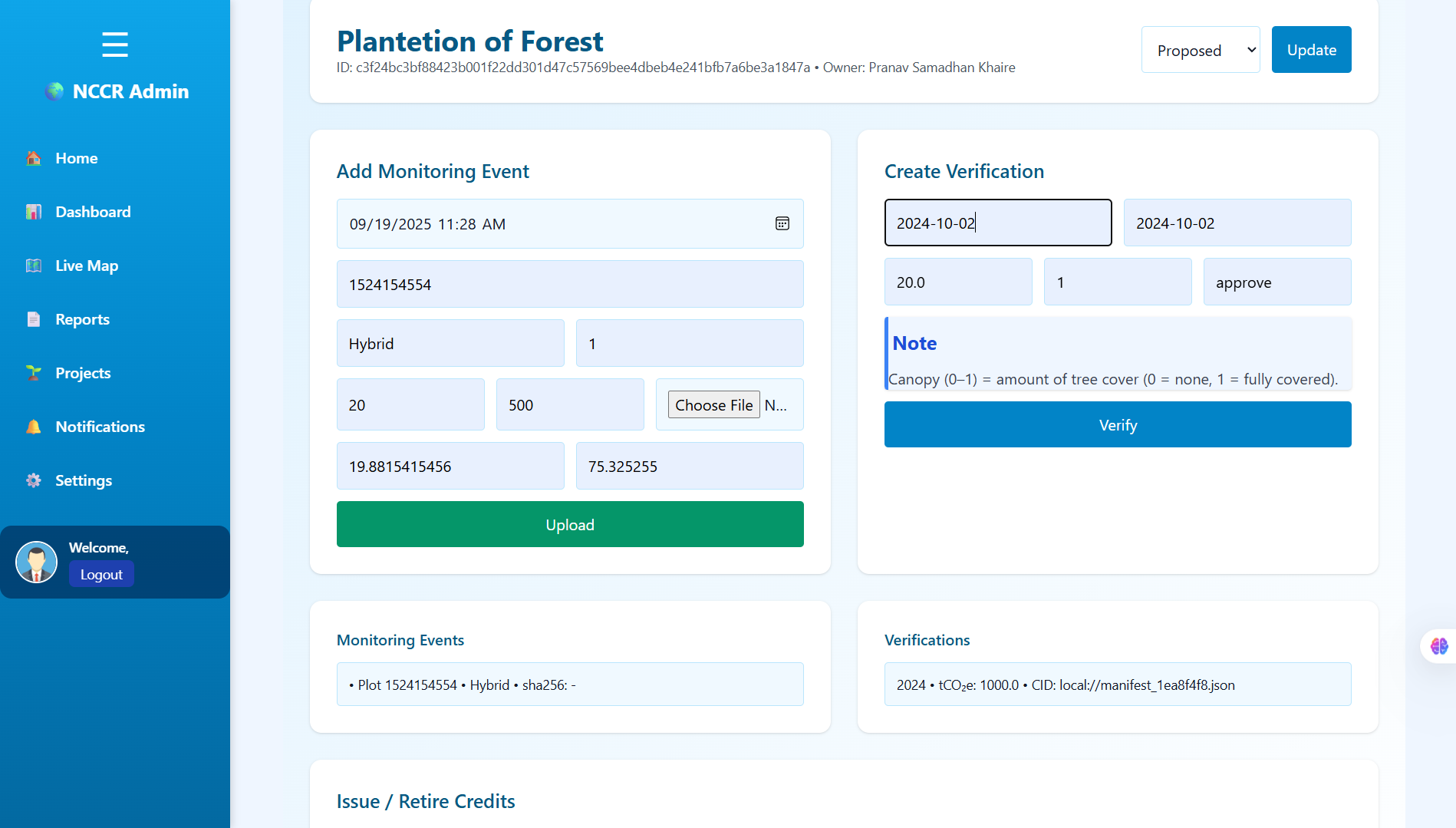
Add Monitoring Event: Collect real-world data (species, location, size)
from carbon projects.
Create Verification: This data verified to ensure its accuracy and
integrity.
Issue / Retire Credits: Once verified, mint a new digital token that
represents a carbon credit. This is the core of our tokenization process.
Fig:4.5 (B) Blockchain Storage & Tokenization
4.6 Contact / Support Page
For farmers/NGOs to get technical support
FAQs or chat support
20
4.7 Project Details (Cordinate,Project name ) With Accept OR Reject Option
The admin dashboard not only verifies plants but also provides scientific
taxonomy, common names, and growth details of each species.
This acts as a knowledge base for admins, NGOs, and researchers to
ensure correct identification and reporting.
Fig: 4.7 Plant Database & Scientific Information
21
CHAPTER 5: PERFORMANCE ANALYSIS
5.1 Accuracy and Efficiency
Accuracy of plantation verification (drone/IoT validation vs. manual
reporting).
Efficiency of smart contracts in generating carbon credits.
Speed of blockchain transactions (storage + tokenization).
5.2 Security and Transparency
How blockchain ensures immutability of data.
Prevention of fraud in carbon credit claims.
Transparency of credits for industries, NGOs, and government.
5.3 User Experience and Feedback
Ease of use of the mobile/web app for farmers/NGOs.
Feedback from sample users on interface simplicity.
Trust gained by transparent credit generation.
22
CHAPTER 6: CONCLUSION
6.1 Conclusion
The Blockchain-Based Blue Carbon Registry and MRV System provides a
transparent, secure, and decentralized way to monitor and record
plantation and restoration efforts.
It ensures accuracy through drone/IoT verification, immutability
through blockchain, and trust through tokenized carbon credits.
By linking farmers, NGOs, coastal communities, and industries, the
platform creates a sustainable carbon trading ecosystem.
Overall, the system contributes directly to climate change mitigation,
environmental sustainability, and local livelihood improvement.
6.2 Future Scope
Integration with AI/ML for predictive analysis of carbon sequestration.
Expansion to Global Carbon Markets, allowing international trading of
credits.
Multilingual Support to include farmers across different regions.
IoT Automation for real-time monitoring of plantations and mangroves.
Mobile Wallet Integration for easy transactions and direct farmer
benefits.
Potential to scale into a National/Global Green Credit Registry.
23
24
REFERENCES
United Nations Environment Programme (UNEP). (2020). Blue Carbon
Ecosystems and their Role in Climate Change Mitigation. Retrieved from
https://www.unep.org
KlimaDAO. (2021). Decentralized Carbon Credit Market
Ministry of Environment, Forest and Climate Change (MoEFCC),
Government of India .Retrieved from https://moef.gov.in
Smart India Hackathon (SIH) – Problem Statement 2025: Blockchain
Based Blue Carbon.
Registry and MRV System. Retrieved from https://www.sih.gov.

Log in or sign up for Devpost to join the conversation.