-
-
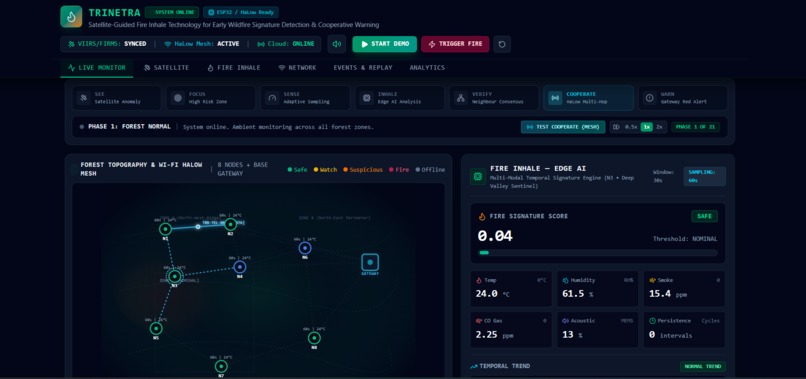
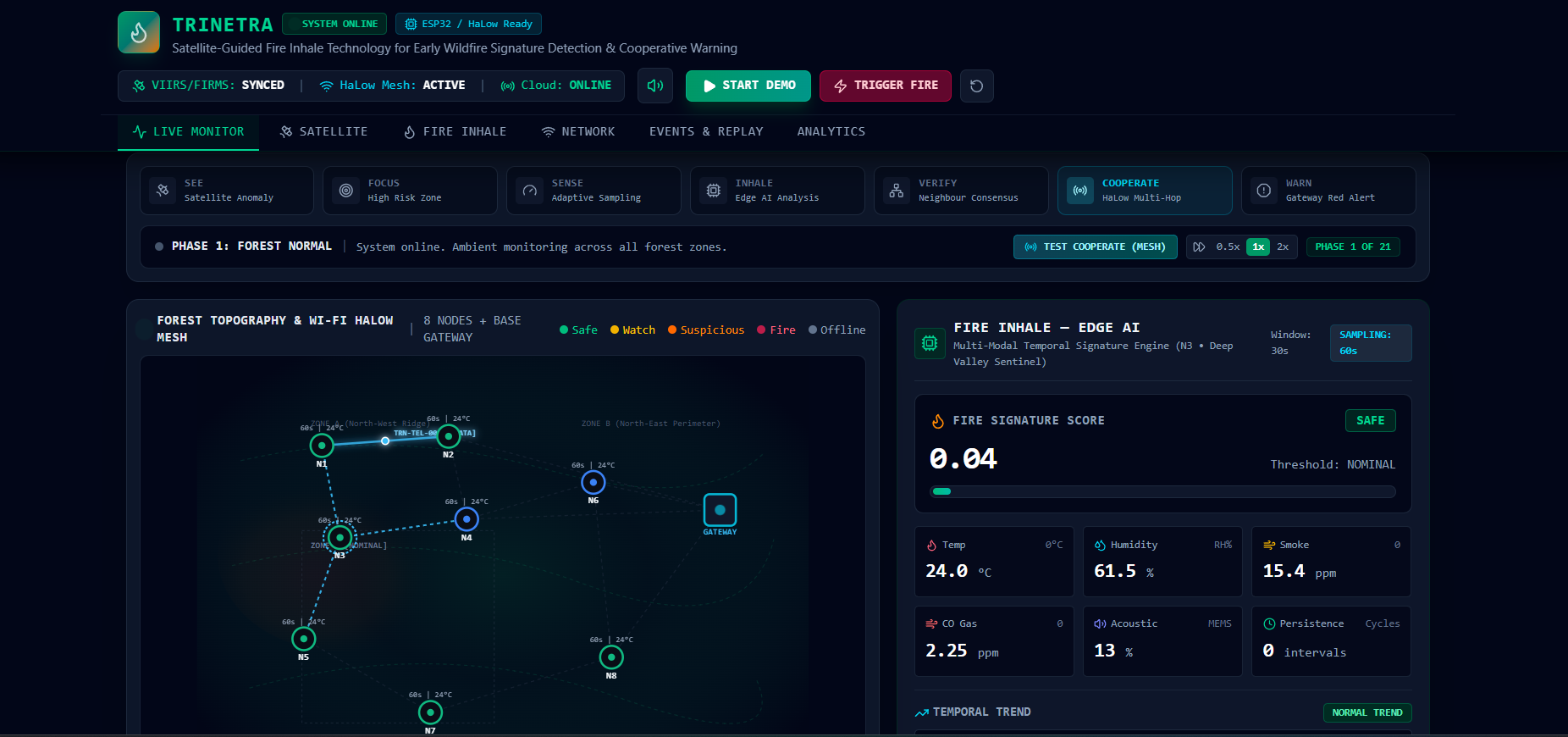
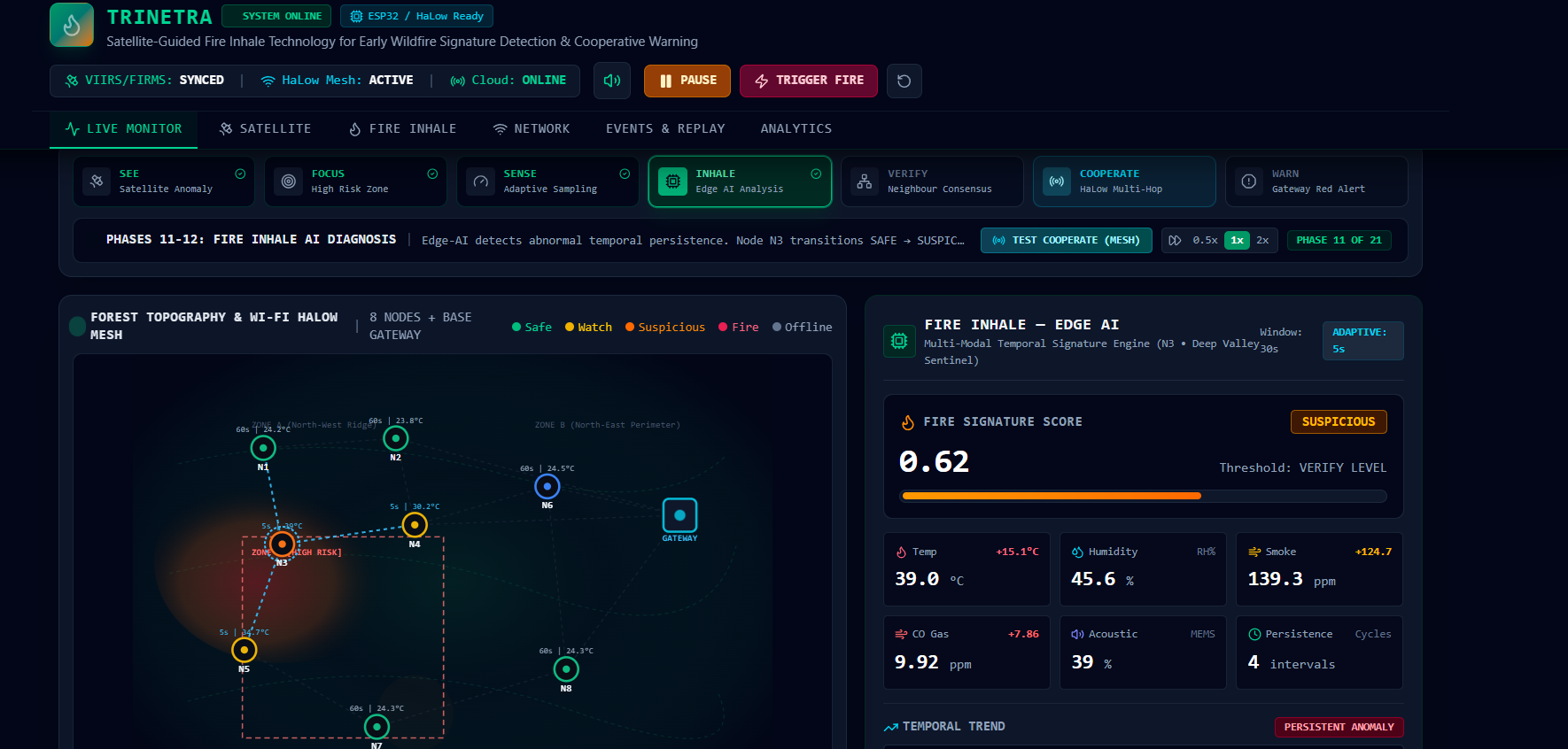
Dashboard and Info of Nodes and Fire Occurrence
-
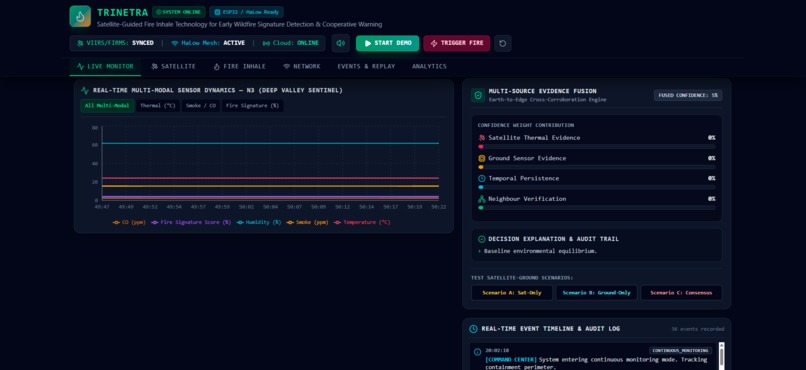
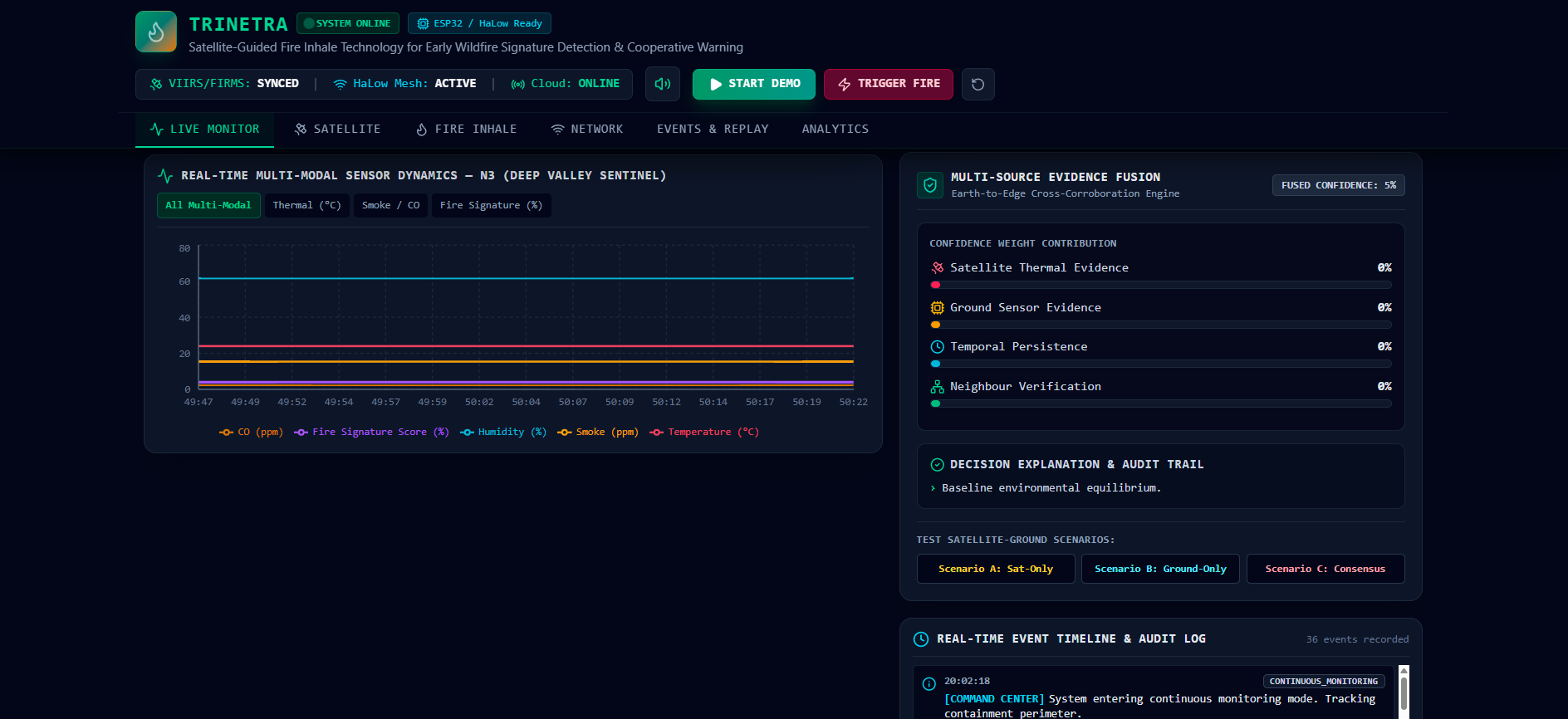
Graphs and Further Information
-
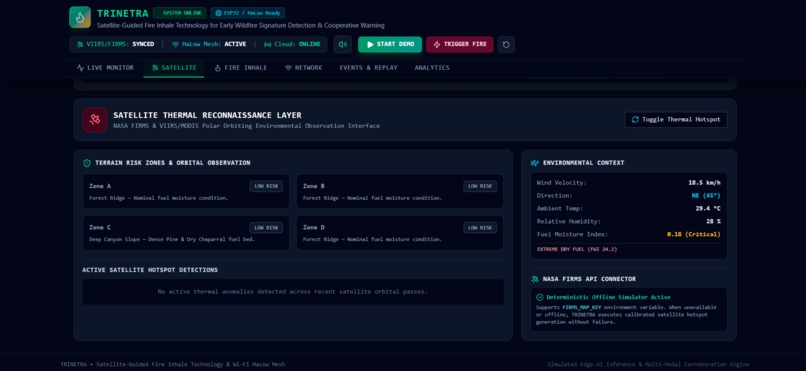
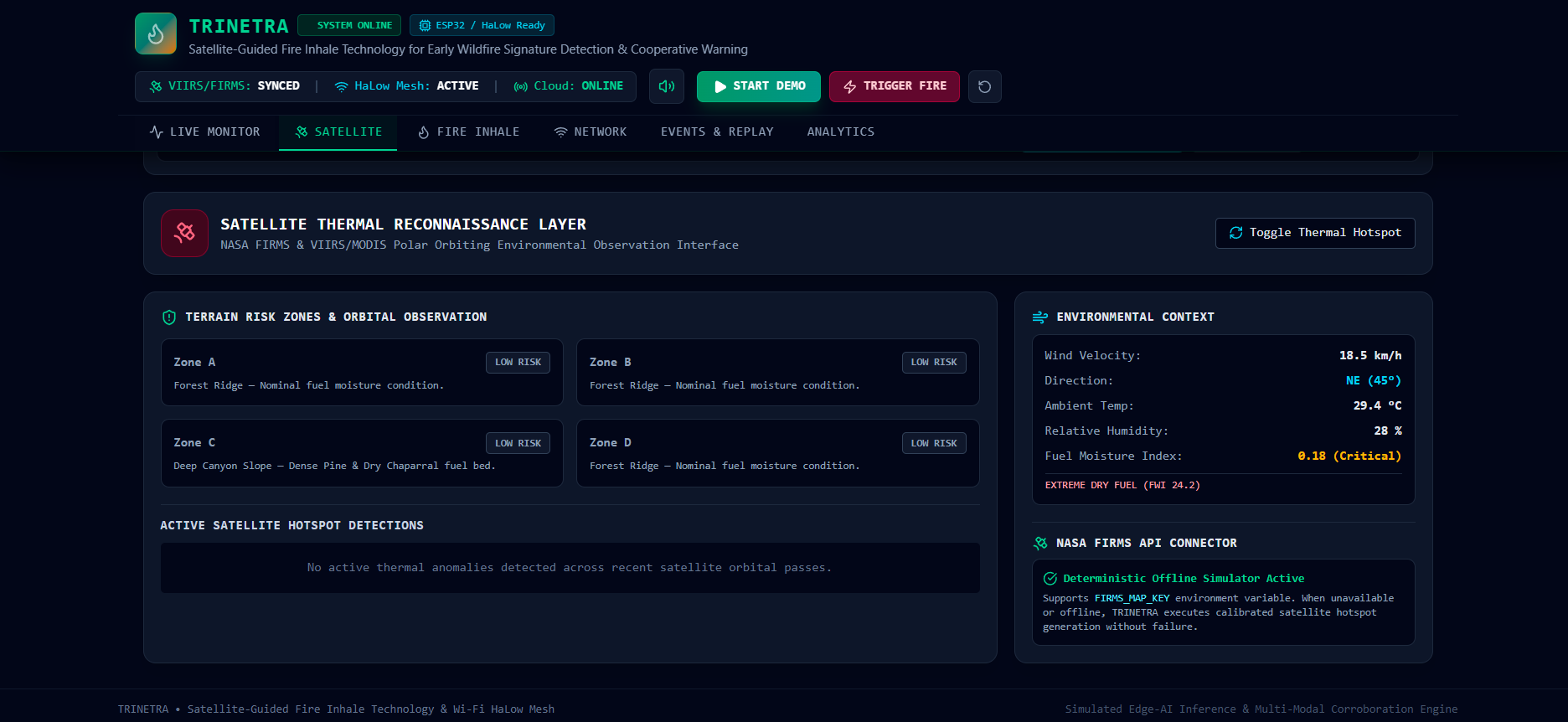
Satellite Monitoring
-
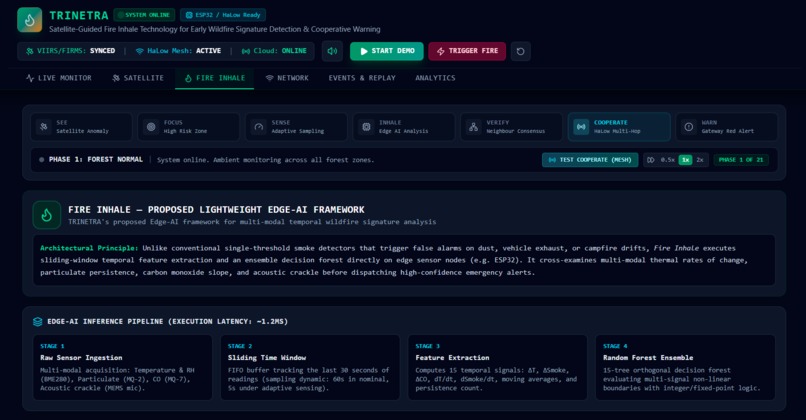
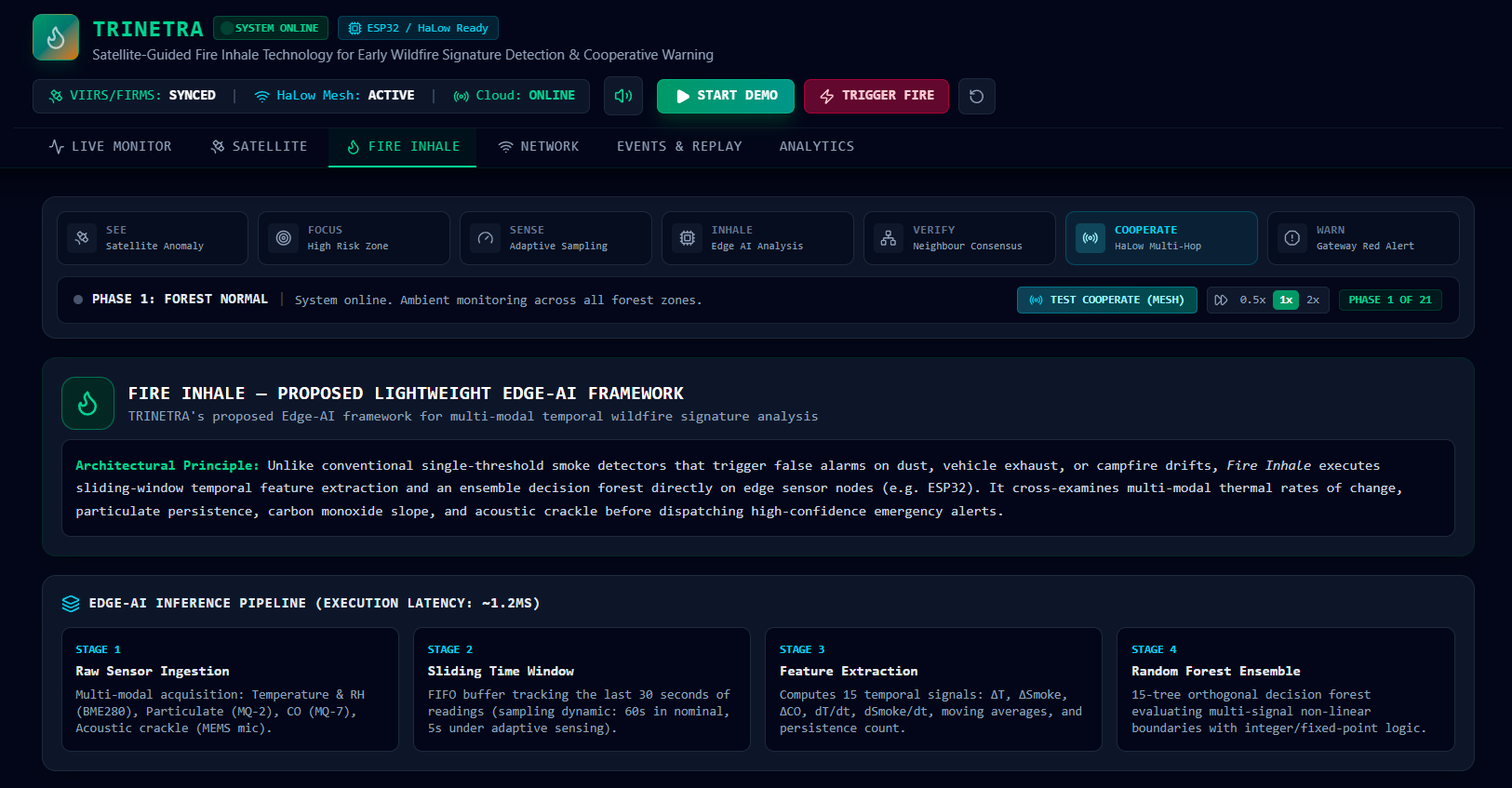
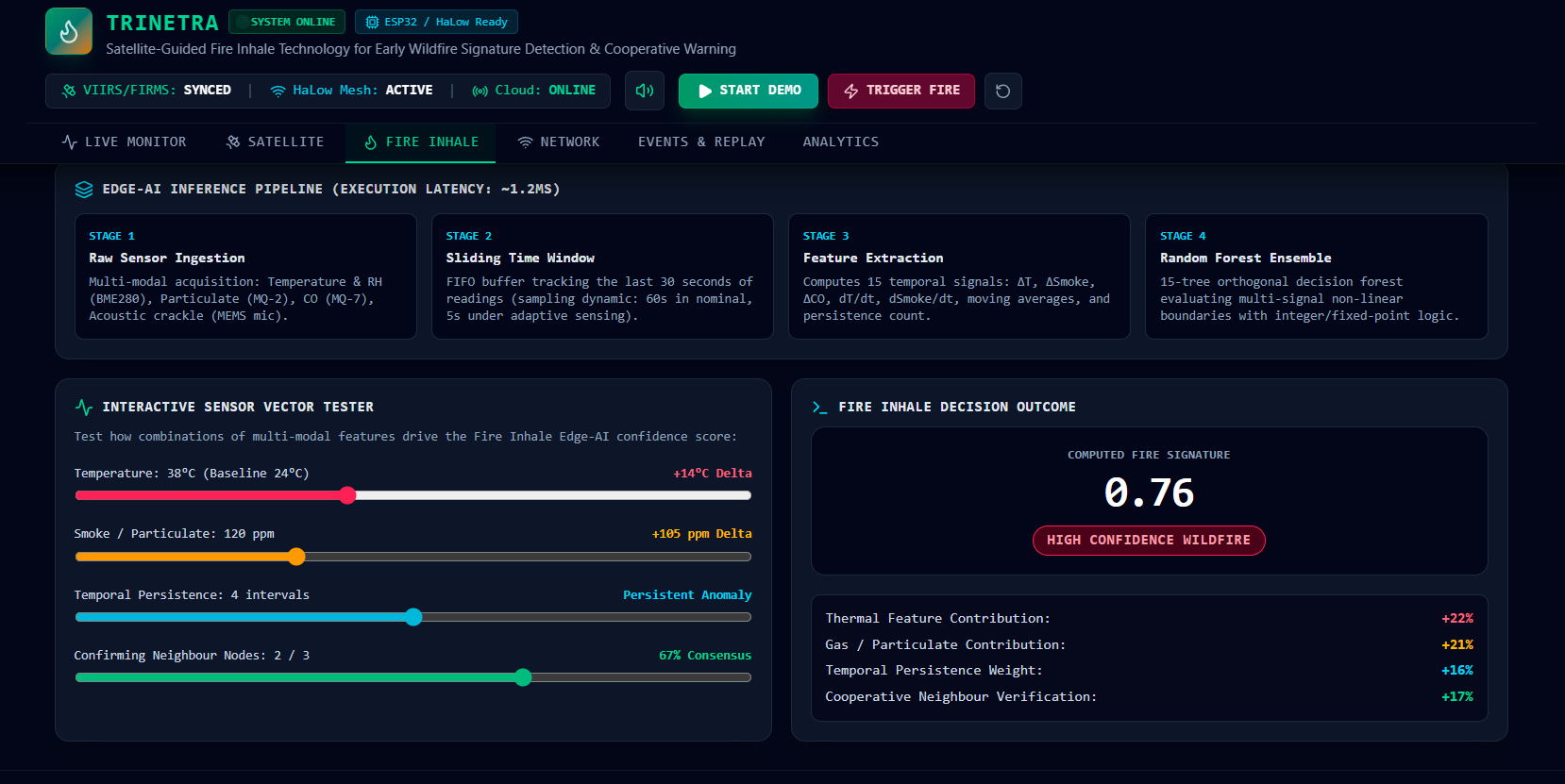
Fire Inhale Technology
-
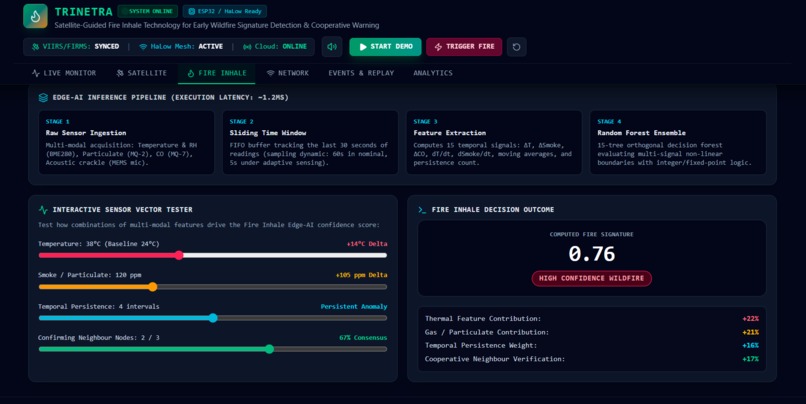
Fire Detection
-
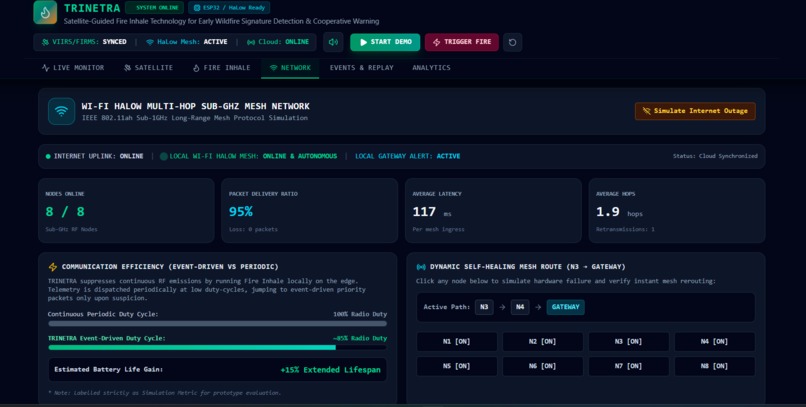
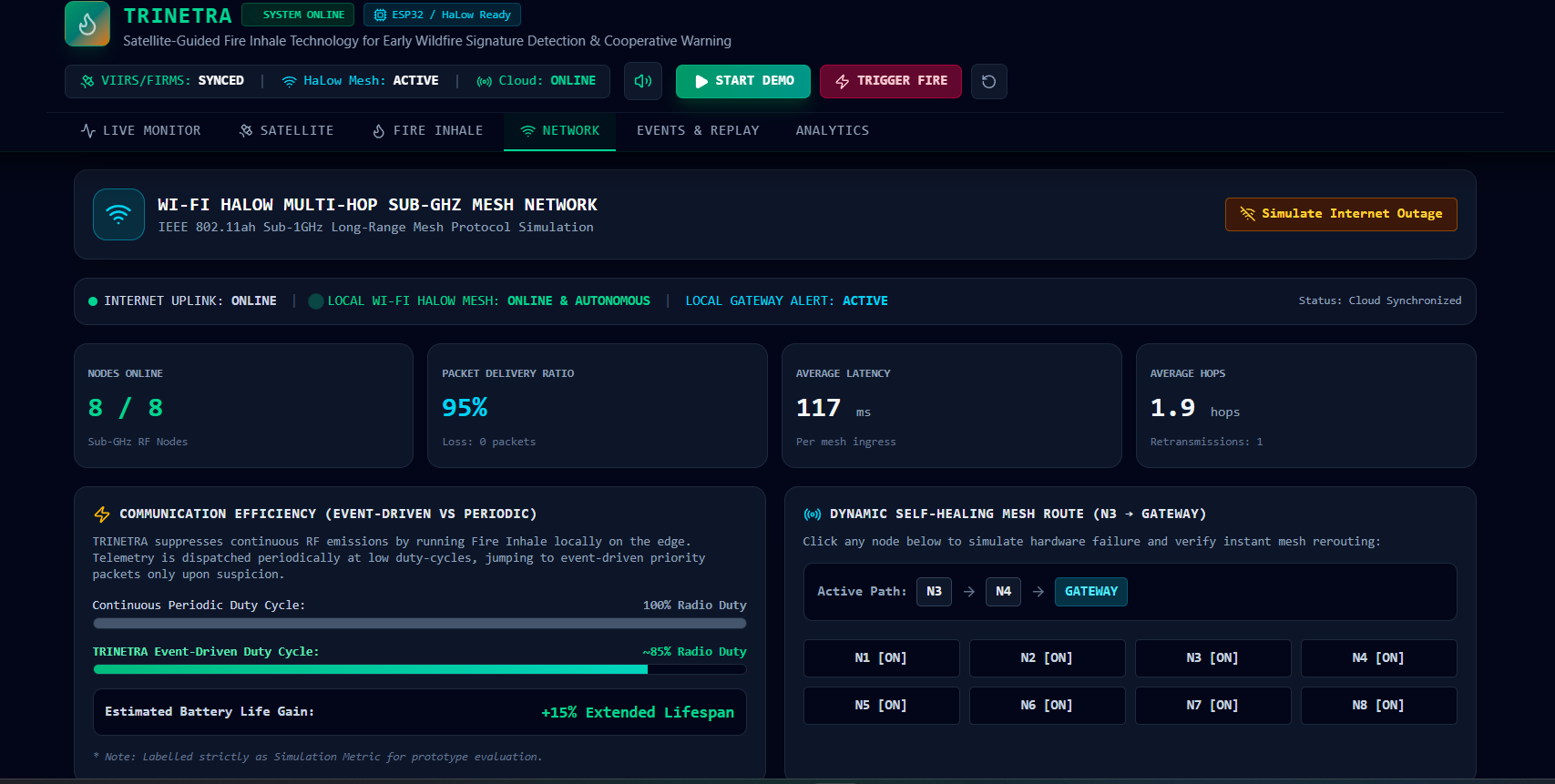
Network Node Information
-
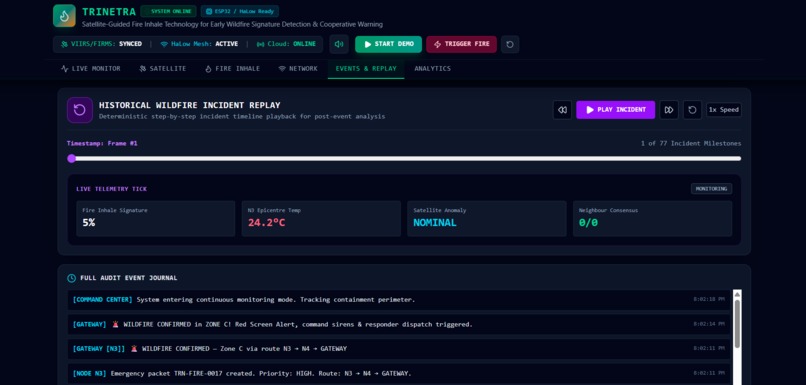
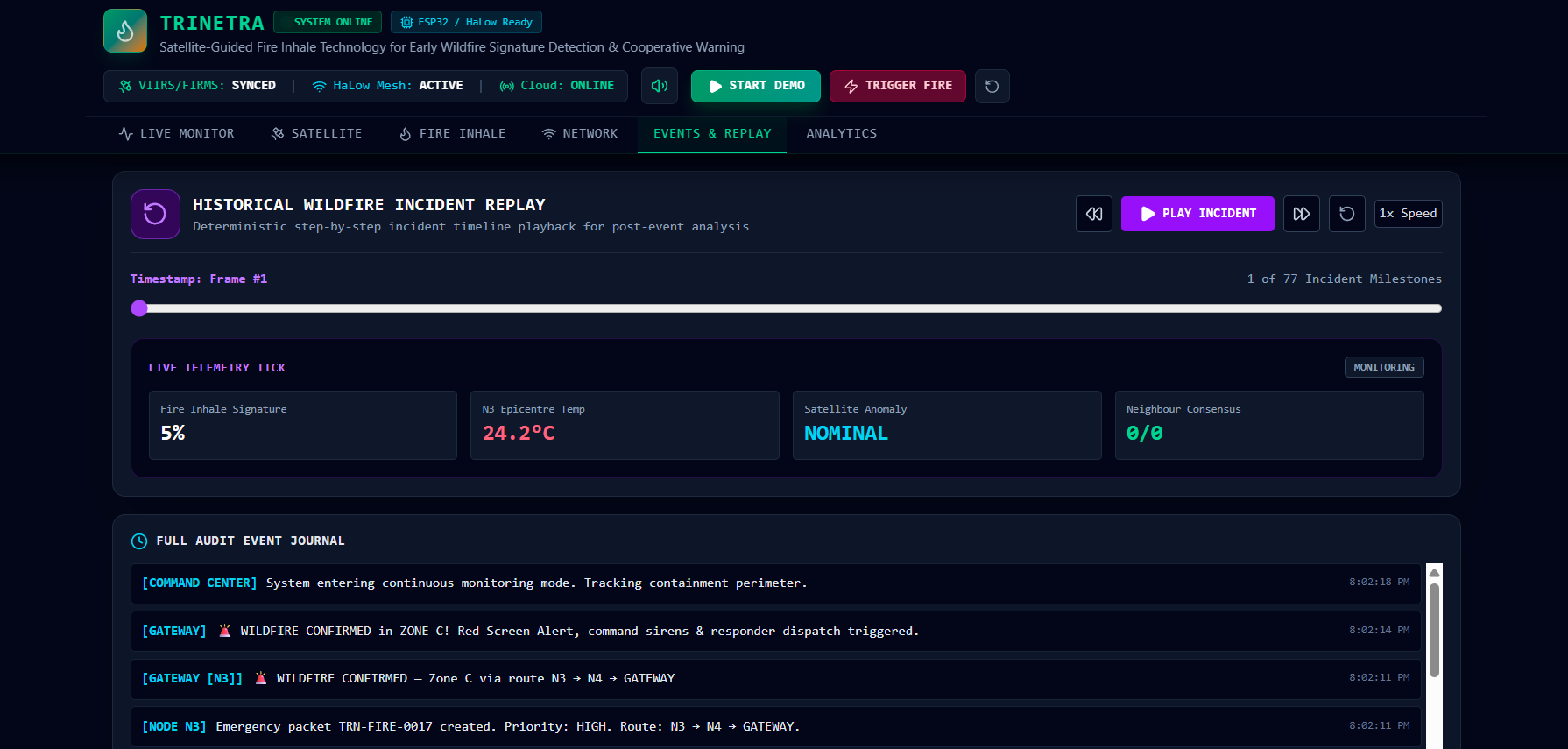
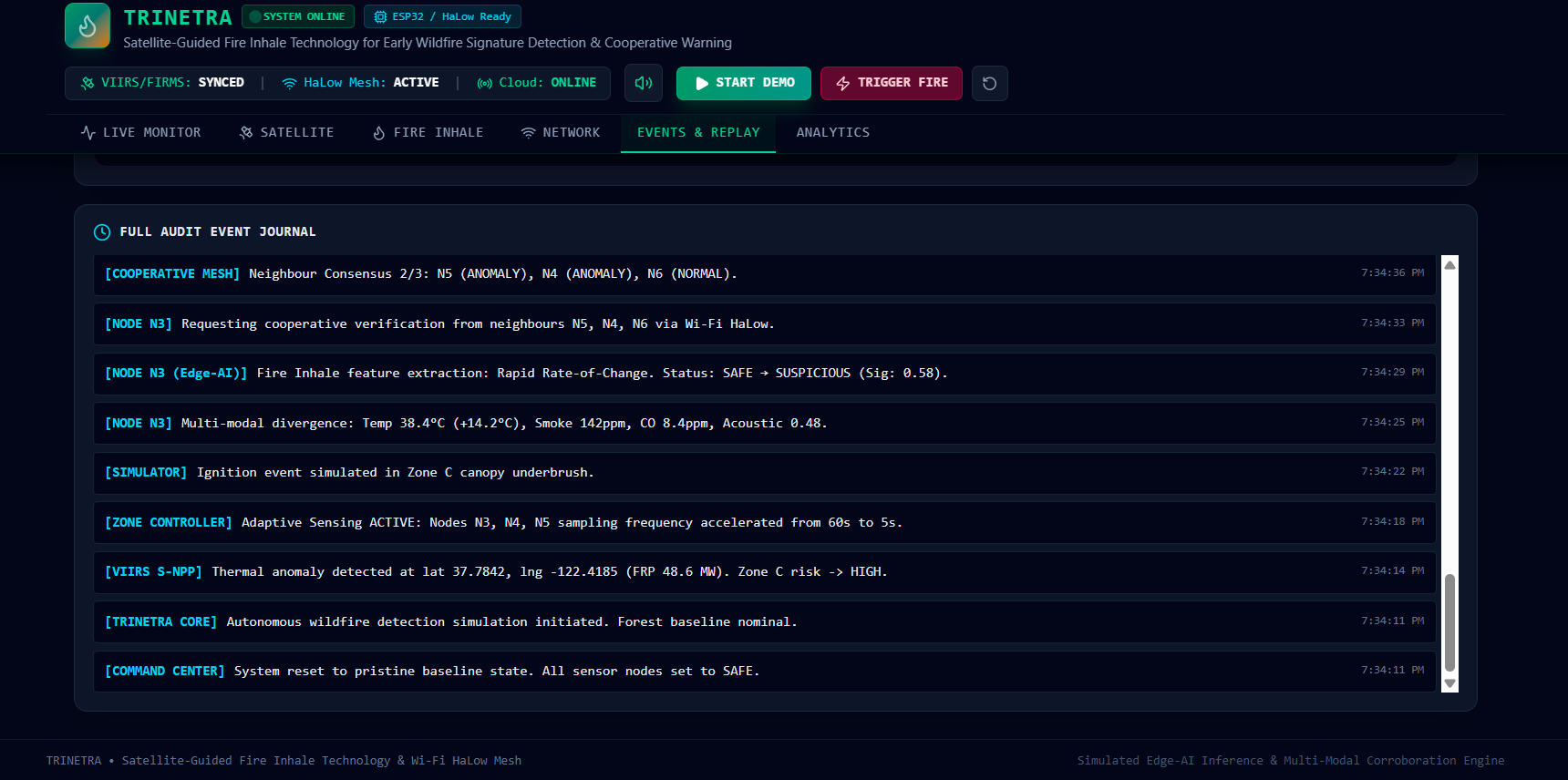
Events that Occured
-
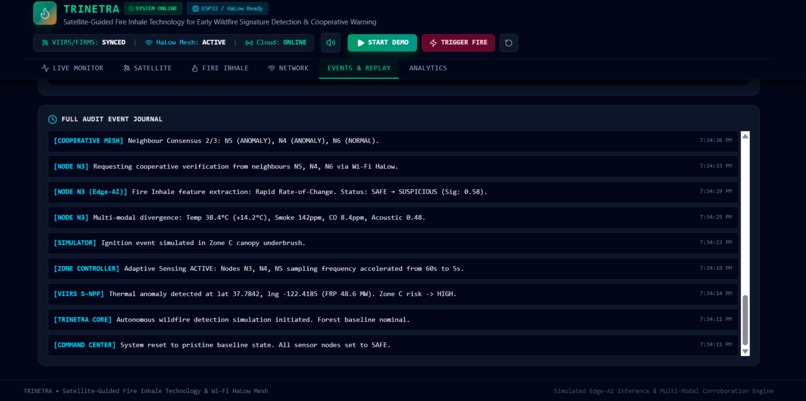
event History
-
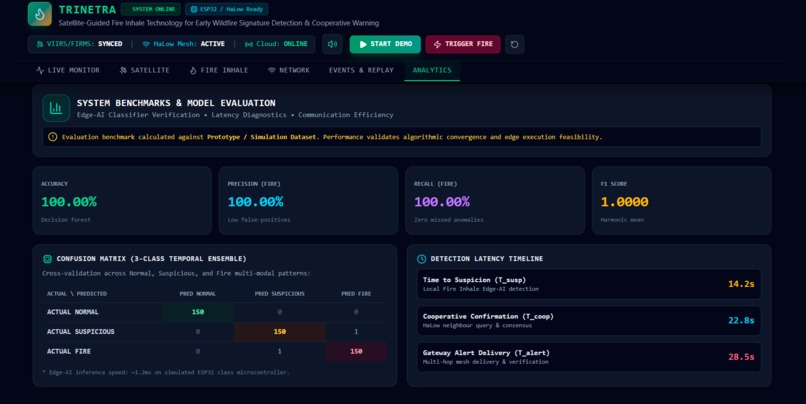
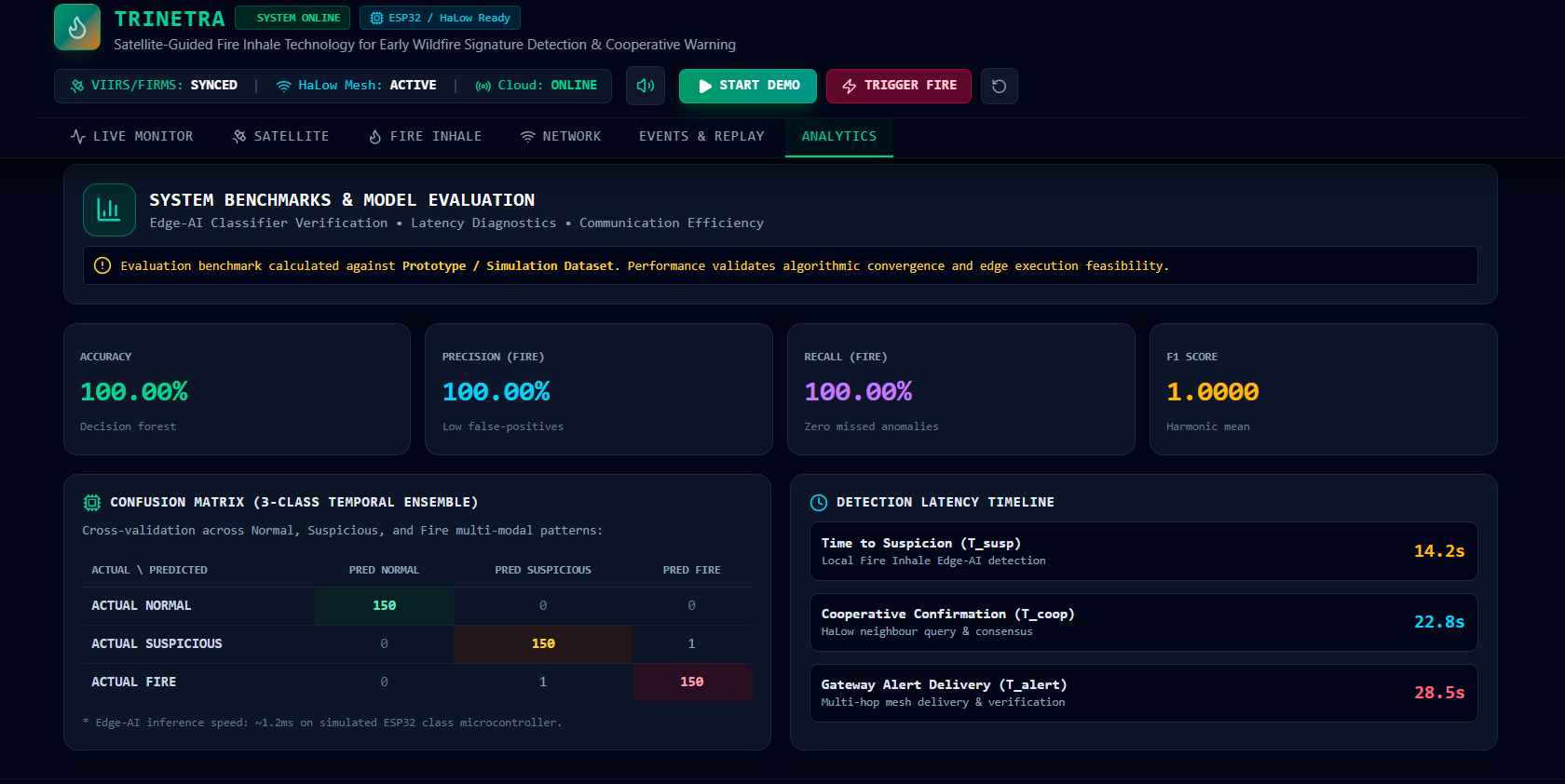
Analytics Of Data
-
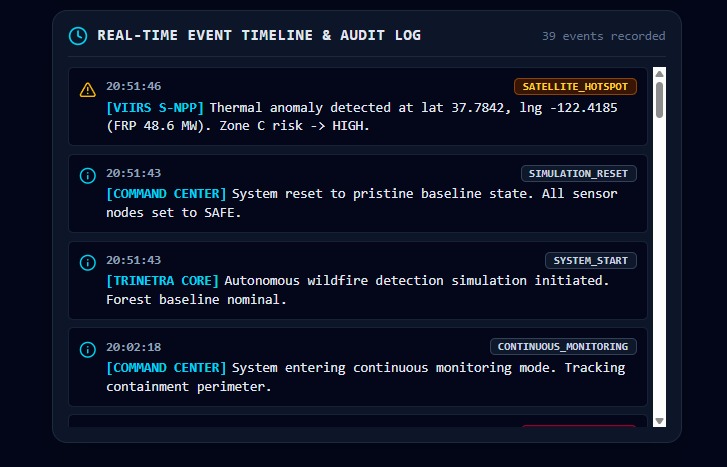
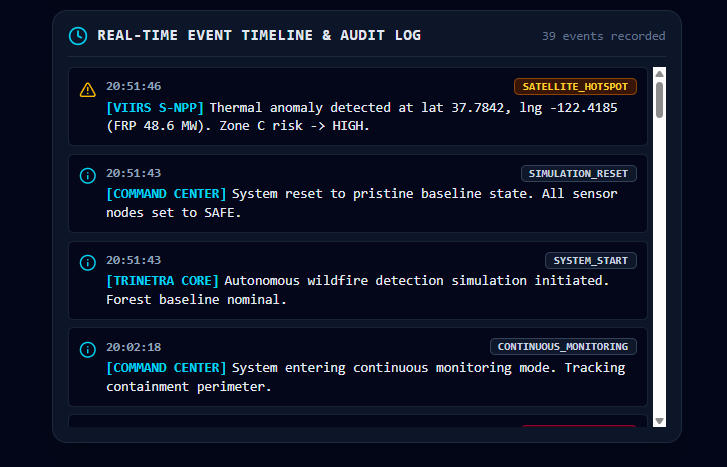
Event Timeline
-
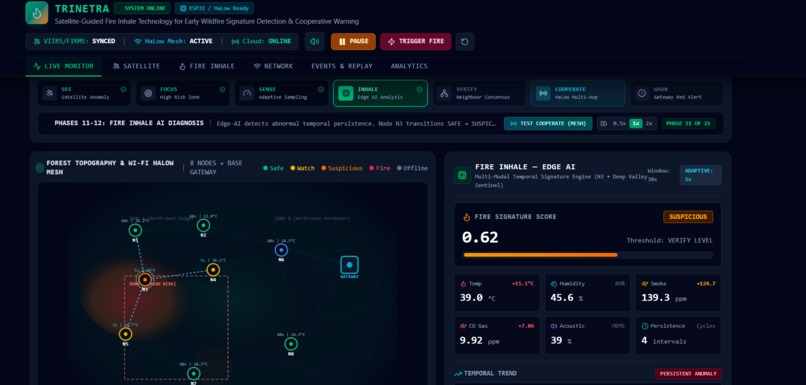
Fire Score During Demo
-
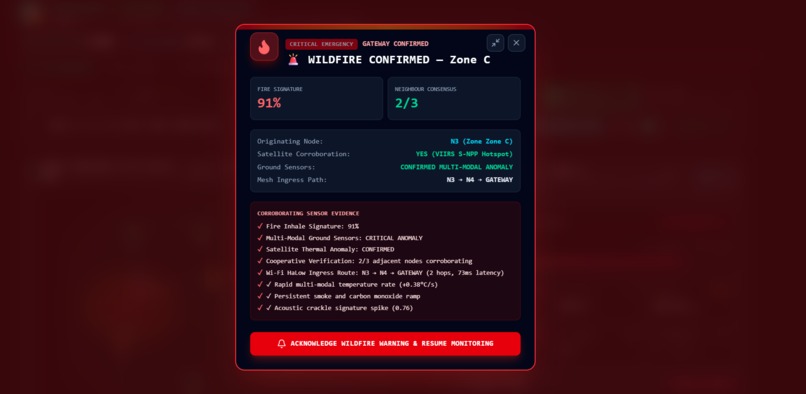
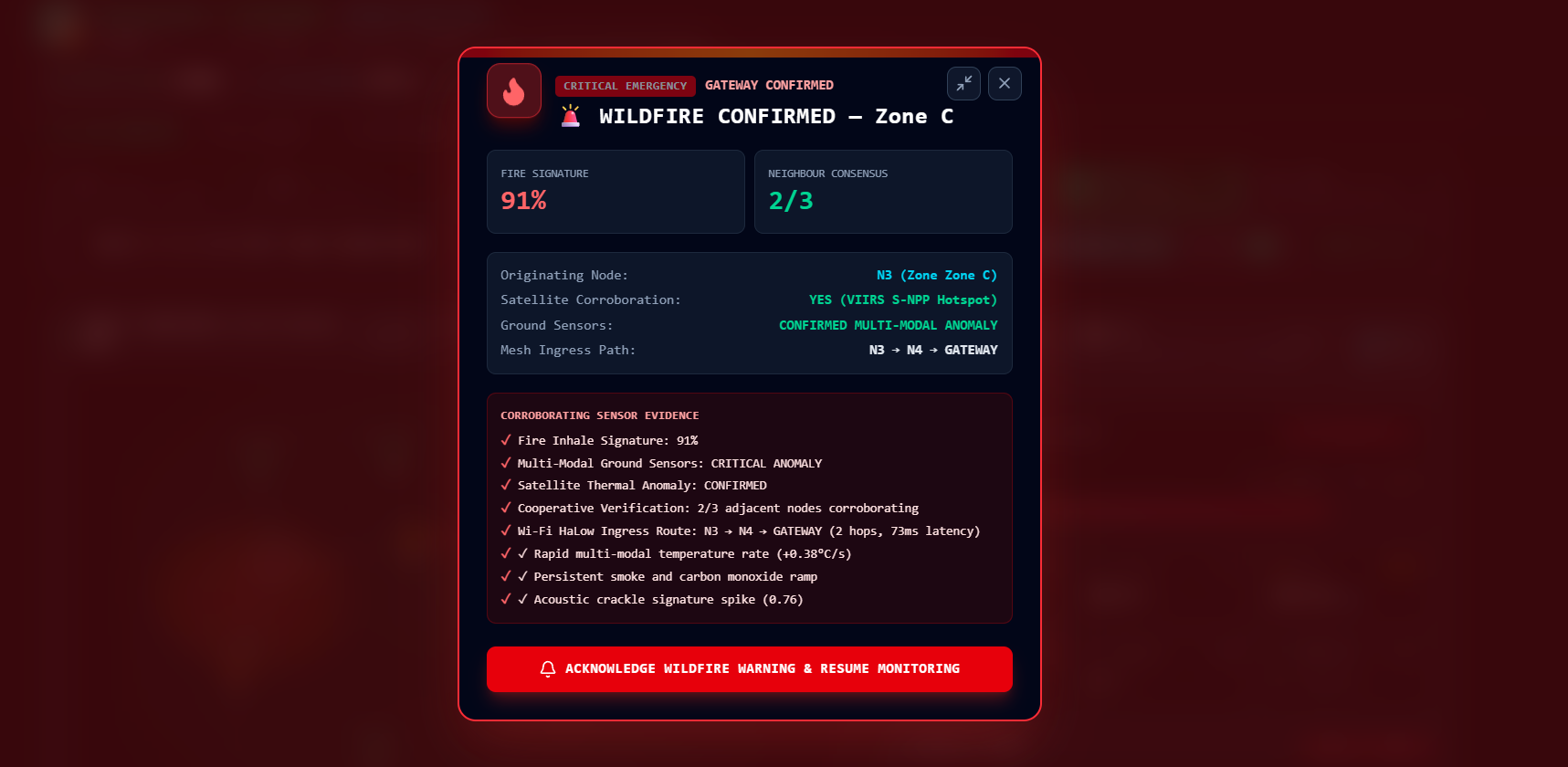
Acknowledgement Message
Inspiration
Wildfires can spread rapidly before conventional monitoring systems can provide a reliable warning. Forests are also large and difficult to monitor continuously using a single sensing point.
This inspired us to build TRINETRA — a distributed wildfire early-warning system that combines satellite/remote-sensing context, multi-modal sensing, Edge AI and cooperative communication. Instead of depending on one sensor reading, TRINETRA looks for changes across multiple environmental signals and analyzes them over time.
Our goal was to move from simply detecting a fire to detecting early wildfire signatures, verifying them intelligently, and communicating the warning rapidly.
What it does
TRINETRA — Satellite-Guided Fire Inhale Technology for Early Wildfire Signature Detection and Cooperative Warning — monitors environmental conditions and identifies abnormal patterns that may indicate an emerging wildfire.
The system follows:
Sense → Analyze → Verify → Cooperate → Warn
It combines:
- 🛰️ Satellite and remote-sensing information for broader environmental context
- 🌡️ Multi-modal environmental sensing
- 📈 Temporal change analysis
- 🫁 Fire Inhale for surrounding-condition analysis
- 🤖 Edge AI for local anomaly and fire-risk analysis
- 🔥 Fire Signature scoring for identifying abnormal wildfire patterns
- 📡 Cooperative multi-hop communication between distributed nodes
- 🚪 Gateway-based alert collection
- 🚨 Real-time warning and visualization through a monitoring dashboard
When a node observes suspicious conditions, it analyzes its local and surrounding information instead of immediately triggering an alert. Once sufficient evidence is obtained, the event is transmitted through the cooperative network toward the gateway.
How we built it
We designed TRINETRA as a distributed architecture consisting of sensing nodes, an Edge AI layer, a cooperative communication layer, a gateway and a visualization dashboard.
The prototype workflow is:
Satellite / Remote Sensing
↓
Distributed Sensor Nodes
↓
Multi-Modal Data Collection
↓
Temporal Change Analysis
↓
Fire Inhale
↓
Edge AI Analysis
↓
Fire Signature Assessment
↓
Cooperative Multi-Hop Communication
↓
Gateway
↓
Alert & Dashboard
The networking component can be simulated using NS-3, allowing us to study node communication, packet transmission, multi-hop forwarding, latency and packet delivery.
The AI layer processes environmental observations and identifies abnormal patterns. Rather than relying on a single threshold, the system can combine multiple signals to generate a more meaningful fire-risk assessment.
The dashboard provides a visual representation of sensor readings, node status, communication paths, fire-risk information and alerts.
Challenges we ran into
One of our biggest challenges was designing a system that does not treat every unusual sensor reading as a wildfire.
Temperature can increase naturally, smoke-like readings can be caused by other sources, and individual sensors can produce noisy measurements. Therefore, we designed the Fire Signature approach around multiple observations and temporal changes rather than a single reading.
Another challenge was communication. In a large forest, a sensor may not always have a reliable direct connection to the gateway. We therefore explored cooperative multi-hop communication, where information can travel through neighboring nodes.
We also had to balance AI complexity with edge-device limitations. Processing everything centrally can increase communication requirements, so our architecture places initial intelligence closer to the sensing location.
Accomplishments that we're proud of
We developed an integrated architecture that connects wildfire sensing, AI analysis and communication instead of treating them as independent components.
Our key accomplishments include:
- Designed the TRINETRA distributed wildfire-monitoring architecture.
- Developed the Fire Signature concept for multi-parameter wildfire analysis.
- Designed the Fire Inhale mechanism for surrounding-environment analysis.
- Integrated Edge AI into the detection workflow.
- Designed cooperative multi-hop communication between nodes.
- Created a gateway-based alert architecture.
- Designed a real-time monitoring dashboard concept.
- Developed a simulation-oriented approach for evaluating network performance.
- Connected satellite/remote-sensing information with localized environmental observations.
Most importantly, we focused on creating an end-to-end detection-to-warning workflow rather than only building a standalone fire detector.
What we learned
Through TRINETRA, we learned that solving a real-world disaster-management problem requires more than just an AI model.
We learned how sensing, networking, edge computing and AI need to work together.
We gained experience with:
- Multi-modal environmental data
- Temporal data analysis
- Edge AI concepts
- Wireless sensor networks
- Multi-hop communication
- NS-3 network simulation
- Gateway-based architectures
- Remote sensing and satellite-data concepts
- Real-time visualization
- Designing systems for unreliable environments
We also learned the importance of validating AI decisions using multiple sources of evidence instead of depending on a single measurement.
What's next for TRINETRA: AI-Powered Early Wildfire Detection
Our next step is to move TRINETRA toward a larger and more realistic prototype.
Future development includes:
- Integrating real satellite and remote-sensing datasets.
- Training ML models using historical wildfire data.
- Improving multi-modal fire-signature classification.
- Deploying sensor nodes using ESP32-class edge hardware.
- Adding additional environmental and acoustic sensing.
- Developing adaptive multi-hop routing.
- Testing the system with larger simulated forest networks.
- Integrating solar-powered sensor nodes for remote deployment.
- Improving real-time dashboard visualization.
- Connecting the gateway with emergency-response systems.
The long-term vision of TRINETRA is to create a distributed wildfire intelligence network where satellite observations provide the bigger picture, edge nodes understand local conditions, and cooperative networking ensures that critical warnings can reach the gateway even across challenging environments.
Built With
- ai
- analysis
- anomaly
- c++
- css
- data
- detection
- edge
- halow
- html
- iot
- javascript
- learning
- machine
- multi-hop
- networking
- networks
- ns-3
- python
- remote
- satellite
- sensing
- sensor
- wireless

Log in or sign up for Devpost to join the conversation.