-
-
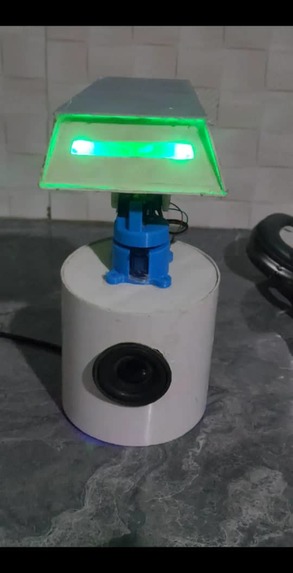
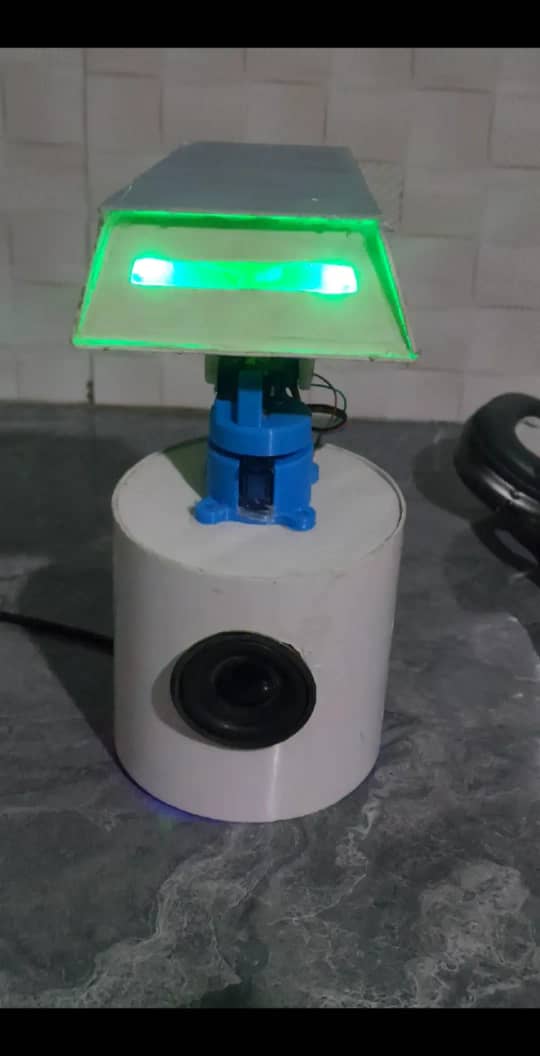
Blue: Physical AI Assistant featuring expressive RGB eyes, head movement, and an Arm/ESP32 hybrid architecture.
Inspiration As AI assistants and humanoid robotics become more popular, most systems rely heavily on cloud-based AI APIs and heavy external servers. This creates noticeable latency, ongoing API operating costs, privacy risks, and total failure when internet connectivity drops. Blue was built to tackle these challenges by creating a responsive physical AI robot designed to execute natural language processing and physical control locally on low-power, Arm-based edge architectures.
What it does Blue is a physical AI assistant that pairs natural language interaction with physical robotics:
Voice & Intelligence: Listens to user speech, processes logic via Python on an Arm mobile environment, and generates intelligent conversational responses.
Real-Time Hardware Control: Commands servo motors for head and body movements, animates expressive RGB LED eye patterns, and plays back speech audio responses.
Distributed Processing: Decouples heavy AI brain logic from real-time motor control loops for smooth physical interactions.
How we built it Blue uses a decoupled "Brain and Body" distributed architecture:
The Brain (Arm Mobile Processor + Groq API): Executes high-level logic, speech parsing, and behavior management in Python running on an Arm processor (via Termux on Android). It currently leverages the Groq API for low-latency LLM response generation.
The Body (ESP32 Controller): Acts as the physical hardware control layer, running real-time microsecond timing loops for servo motors, LED eye patterns, and hardware feedback.
Communication Bridge: The Python brain and ESP32 body communicate wirelessly over a local Wi-Fi network using standard TCP socket communication to translate AI responses into physical robot actions.
Challenges we ran into Network Latency: Tuning socket payloads over Wi-Fi so the robot reacts immediately when a voice command is recognized and processed by the API.
Resource Management: Running real-time Python audio-parsing loops on low-power Arm mobile hardware without hitting CPU bottlenecks or thermal throttling.
Asynchronous Execution: Preventing motor move loops on the microcontroller from blocking incoming wireless network packets sent by the main brain.
Accomplishments that we're proud of Successfully decoupling complex AI logic from real-time hardware execution using a wireless socket bridge.
Building a completely functional physical AI robot prototype from scratch.
Creating a seamless wireless communication flow between a Python environment on Arm hardware and an ESP32 microcontroller.
What we learned How to structure distributed robotics architectures using socket communication between edge processors and microcontrollers.
Techniques for running and optimizing Python runtime environments on Arm mobile architectures.
The importance of delegating high-frequency motor signal timing to dedicated hardware microcontrollers like the ESP32.
What's next for Blue: An Optimized Edge AI Humanoid Robot For the next phase of the Arm Create Challenge, Blue's primary focus is migrating from cloud API dependencies to 100% on-device Arm edge AI:
Hardware Migration: Moving the core Python brain pipeline from Termux on Android to a dedicated Arm-based single-board computer (such as a Raspberry Pi 4).
Cloud to Local AI Migration: Replacing cloud API calls with quantized local models (such as INT8 Gemma or Phi-3) running directly on the Arm CPU to achieve true offline functionality, zero API cost, and strict data privacy.
Edge Computer Vision: Adding a camera module to run lightweight local face detection and gesture tracking directly on Arm hardware alongside the local voice pipeline.

Log in or sign up for Devpost to join the conversation.