Inspiration
BLUE AI began with a simple observation: coastal communities are the first to feel the impact of pollution, fish kills, algal blooms, and oil spills yet they're the last to get access to advanced monitoring tools. Most ocean buoys cost anywhere between \$10,000 -\$100,000, which makes them completely inaccessible for fishermen, students, researchers, and small local authorities. We wanted to change that. The idea for BLUE AI came from wanting to give everyday people a way to understand what's happening in their waters, before the damage becomes visible.
What We Built
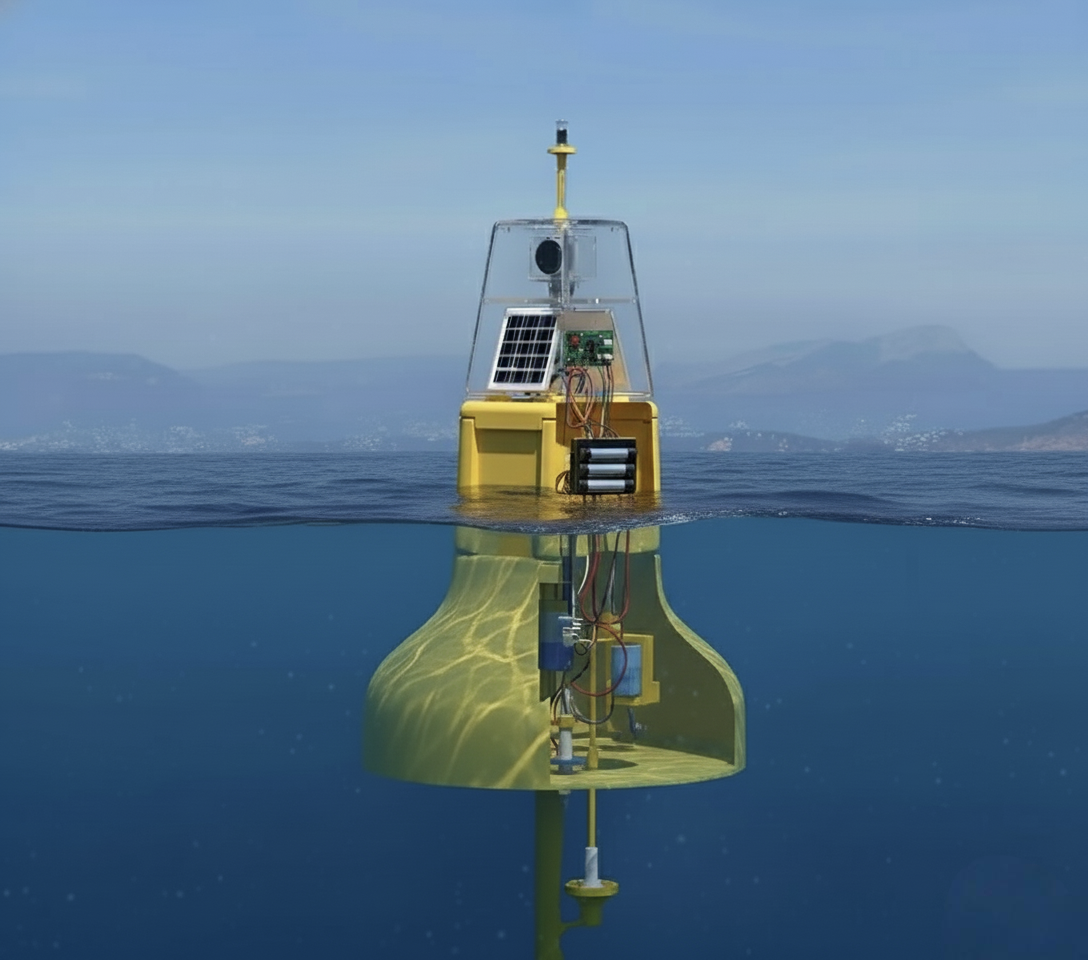
We created BLUE AI, a low-cost, AI-powered smart buoy system that collects essential environmental data like pH, temperature, salinity, turbidity, and UV-based pollution levels. Instead of flooding users with confusing raw data, our system cleans and processes it, then uses machine learning and LLMs to turn it into simple, helpful insights. Anyone can open the dashboard and ask questions like "Is my coast getting polluted today?" and receive a clear answer - no scientific background needed.
How We Built It
We used affordable ESP32-based hardware with modular sensors, designed to survive the challenges of near-shore water. Data from the buoy is filtered on the device and sent to our cloud pipeline using MQTT/HTTP. There, our models analyze patterns represented as:\ ( X = {pH,,T,,S,,Turb,,UV} )\ and convert them into an anomaly or pollution score. We trained these models using publicly available datasets and built an interactive dashboard powered by an LLM that explains trends in plain, friendly language.
What We Learned
This project taught us how unpredictable real-world environmental data can be. We learned to handle noisy sensor signals, design hardware that can survive saltwater, build stable edge-to-cloud communication, and create forecasting models that make sense of constantly changing patterns. Most importantly, we learned how to transform complex data into insights that communities can actually use.
Challenges
Not everything worked on the first try. Sensors behaved differently in real conditions, waterproofing needed repeated improvements, and communication signals near the water were unstable. Cleaning live sensor data for AI models was harder than expected, and designing a dashboard that looked simple but conveyed deep insights took time. Every challenge pushed us to refine both our engineering and our understanding of the environment.
Why It Matters
BLUE AI exists because everyone not just big research labs or governments deserves access to environmental intelligence. By making predictive smart buoys affordable, we're giving coastal communities the power to understand, protect, and respond to changes in their waters. In the end, our goal is simple: help people protect the oceans they rely on, using technology they can actually afford and understand.
Built With
- amazon-web-services
- and-uv-sensors.-c/arduino-for-firmware-and-edge-filtering.-python-+-flask/fastapi-for-backend.-numpy
- arduino
- azure
- chart.js
- css
- docker
- esp32
- fastapi
- firebase
- flask
- gcp
- html
- http
- javascript
- llama
- mongodb
- mqtt
- numpy
- openai
- pandas
- ph-sensor
- python
- pytorch
- salinity
- salinity-sensor
- temp
- temperature-sensor
- turbidity
- turbidity-sensor

Log in or sign up for Devpost to join the conversation.