-
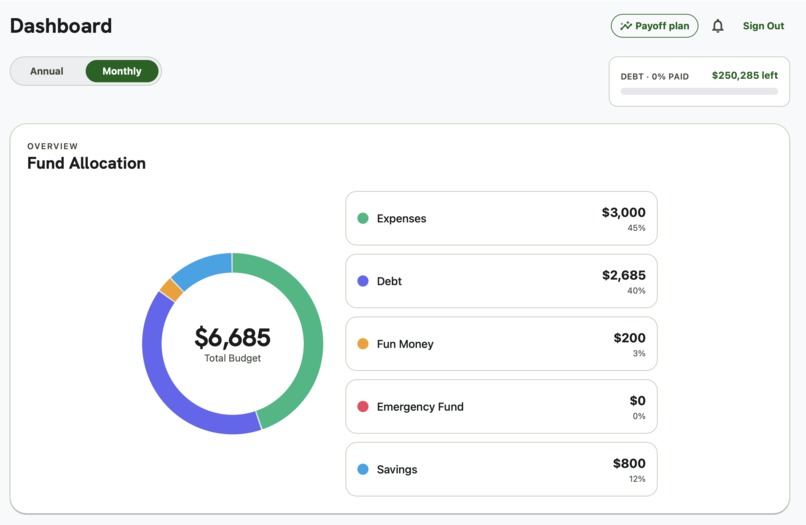
landing page
-
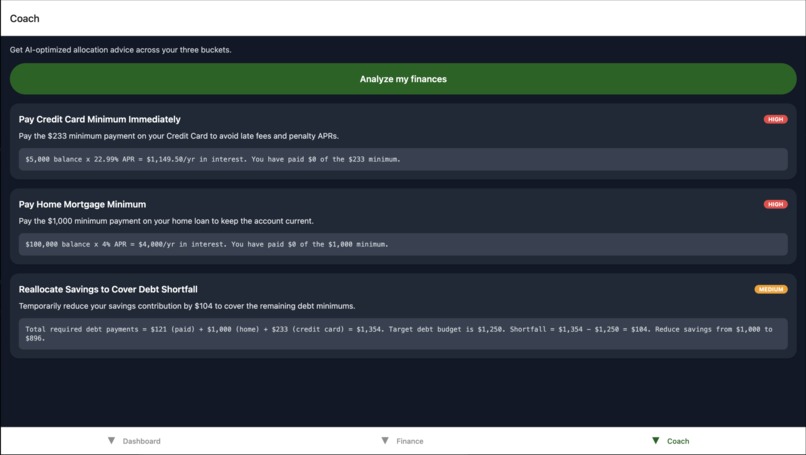
financial coach page
Inspiration
Our inspiration is that the fact that budgeting is very concerning to us. In a ever-more competitive job market, and rising costs of living, we believe that budgeting is a skill not properly understood. What we also know is that American debt has never been as high as it is now. While most budgeting apps focus on keeping within your means, our budgeting app focuses on getting back to that point. Debt is easy to build up, and hard to get rid of, because living off of peanut butter jelly sandwiches is not how anyone wants to go about their breakfast, lunch and dinner.
What it does
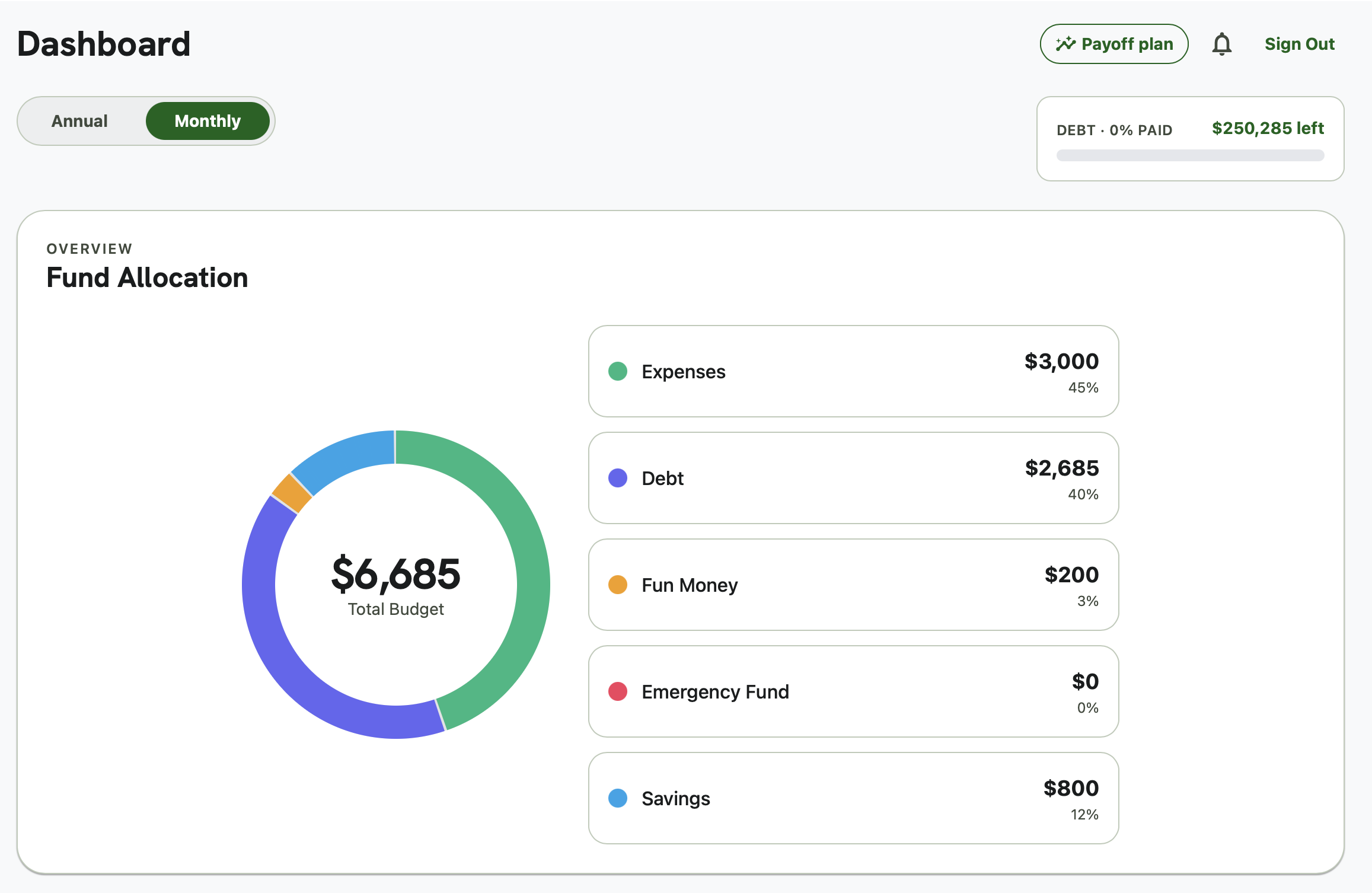
Our budgeting app utilizes Gemini to determine what your means should be, and how you can live within them. From there, we use specialized algorithms to determine how much goes into your debts, savings and what money you can spend. Our budgeting app is meant to help you climb out of high debts, whereas typical budgeting apps already assume you are within your means.
How we built it
For how we built, we utilized a robust tech stack. Starting off with typescript as our programming language, our...
Front End
- React Native & Expo: Core framework that our website runs off of, chosen specifically due to its mobile support.
- Google Stitch: Our alternative to Figma, we utilized this tool due to our familiarity with the Google Suite. We used it as our digital sketchbook to visualize design sketches for our pages, and html format to quickly build out our front end.
Backend
- Backend as a Service (BaaS)
- Google OAuth: We utilize OAuth to securely sign in our users without worry of data breaches and security concerns on our end.
- Google Firebase: The core of our database, we store our users' debts, saving goals, incomes and other necessary data in order to run our calculations.
Testing
- Jest: To ensure everything was running correctly, we used Jest in order to validate user input and verify functionality.
LLMs
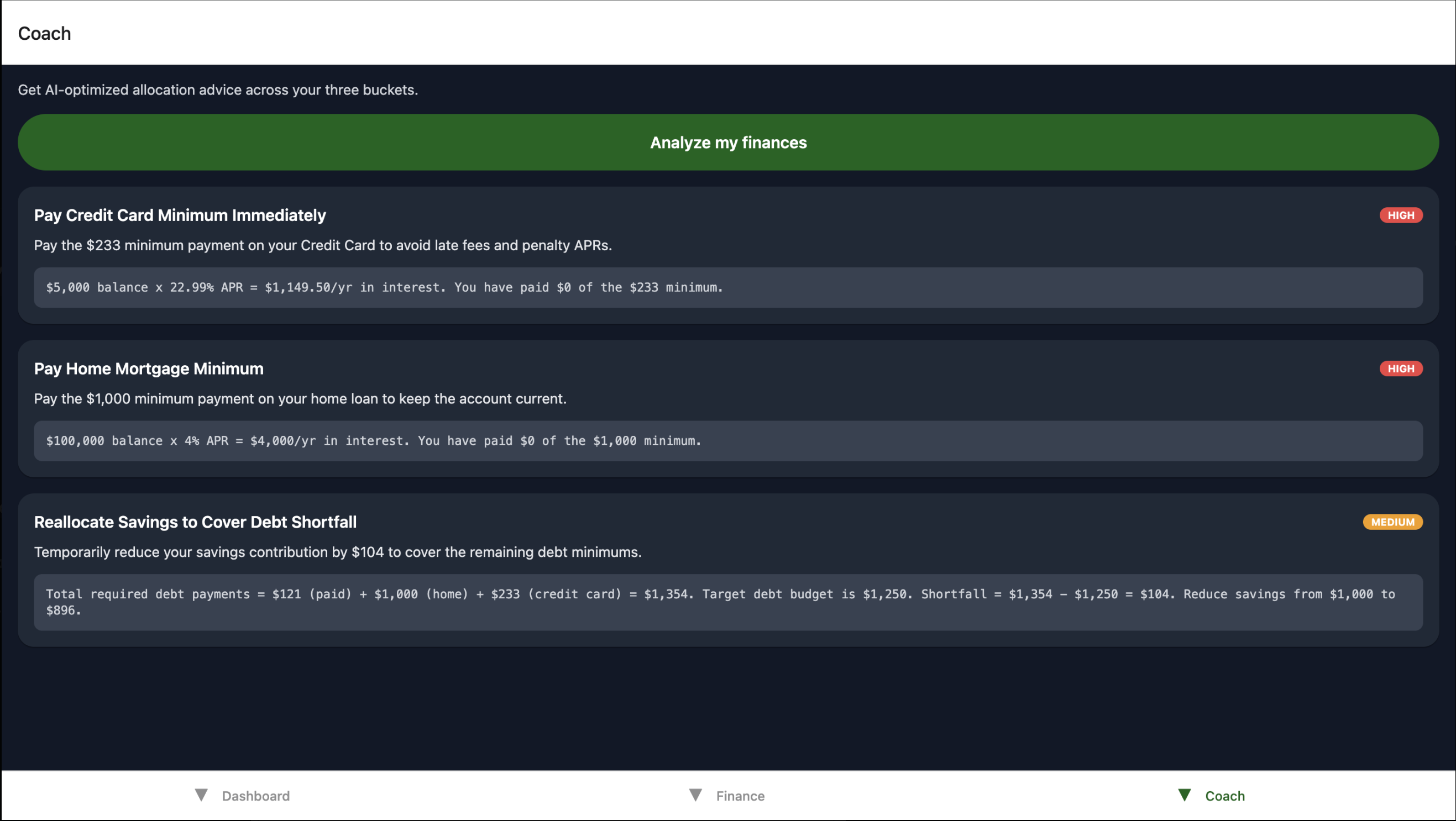
- Gemini: Acting our financial coach for our userbase, they adjust saving and debt payment targets for our users that are both reasonable and attainable. We power our financial coach using a RAG system to provide expert advice from like from NAPFA, and then feed our LLM user data to make the decision for our user. This allows our LLM to fetch compliant, legal, and high quality advice readily.
- Claude Code: Used in constructing our boiler plate, database editing and handling our testing library.
Challenges we ran into
Some challenges we ran into were the utilization of the Gemini API, as we were going through many hurdles to fix this. Luckily, the MLH page provided good context in how to fix it. From there, we had a problem figuring out how to differentiate our budgeting app, as many are out there, and we wanted to provide our unique spin on it to stand out.
Accomplishments that we're proud of
For many of us, this is our first ever hackathon project. Also, in just 12 hours, our team went from zero code to a fully integrated app featuring secure Google OAuth, a live Firebase database, an operational RAG pipeline, and a polished user interface.
What we learned
We learned quite a bit regarding how to use git, handling merge conflicts, and rebasing. In addition, we learned how to integrate LLMs into our engineering workflow.
What's next for Bloom Budget
We want to expand our project by including a stronger agent workflow to provide better financial advice. In addition, we want to expand our saving methods. We also want to use Plaid so users can automatically put in their finances, to make it a more "hands-off" workflow. We want to provide more gamification to inspire people to aggressively save and pay off debt.

Log in or sign up for Devpost to join the conversation.