
Bloom — Adaptive, AI-Powered Learning Pathways Structured Around Bloom's Taxonomy
Why this is so Important and Impactful
Every year, millions of students struggle with passive learning, superficial video tutorials, and unstructured AI chats that lead to a "false illusion of competence". When learners depend on open-ended prompts, they often receive quick answers without engaging in deep cognitive processing. Many fall behind because traditional tools test lower-level recall while neglecting higher-order critical thinking like synthesis and evaluation. Bloom restructures self-directed study by turning passive reading into an active, structured ladder grounded in educational psychology. Even if we reach just 10% of self-directed learners, we have the potential to help over 500,000 students elevate from rote memorization to true subject mastery.
The Problem We’re Tackling:
- The Chatbot Pitfall: Open-ended LLM chats lack structure, leading to scattered learning, hallucinations, and shallow engagement.
- Passive Consumption: Skimming articles or watching lectures creates an illusion of understanding without forcing active recall.
- One-Size-Fits-All Quizzing: Standard multiple-choice tests measure base knowledge but fail to evaluate complex analysis or creative synthesis.
- Lack of Mastery Metrics: Traditional platforms measure progress by "completion time" rather than probabilistic cognitive understanding.
Our Intention
Bloom is not a generic textbook wrapper or a simple quiz generator. It is a compassionate, structured cognitive pathway designed to guide learners step-by-step from foundational facts to rigorous, interactive evaluation—helping anyone master complex topics at their own pace.
What Inspired Us
Coming from IB based schools, we kept seeing our peers rely heavily on AI to study, only to struggle on exams because open-ended chats gave them instant answers without forcing them to think. We wanted to build a platform that doesn't just answer questions—it structures the journey, challenges assumptions, and demands demonstrated mastery before letting you move forward.
What We Built
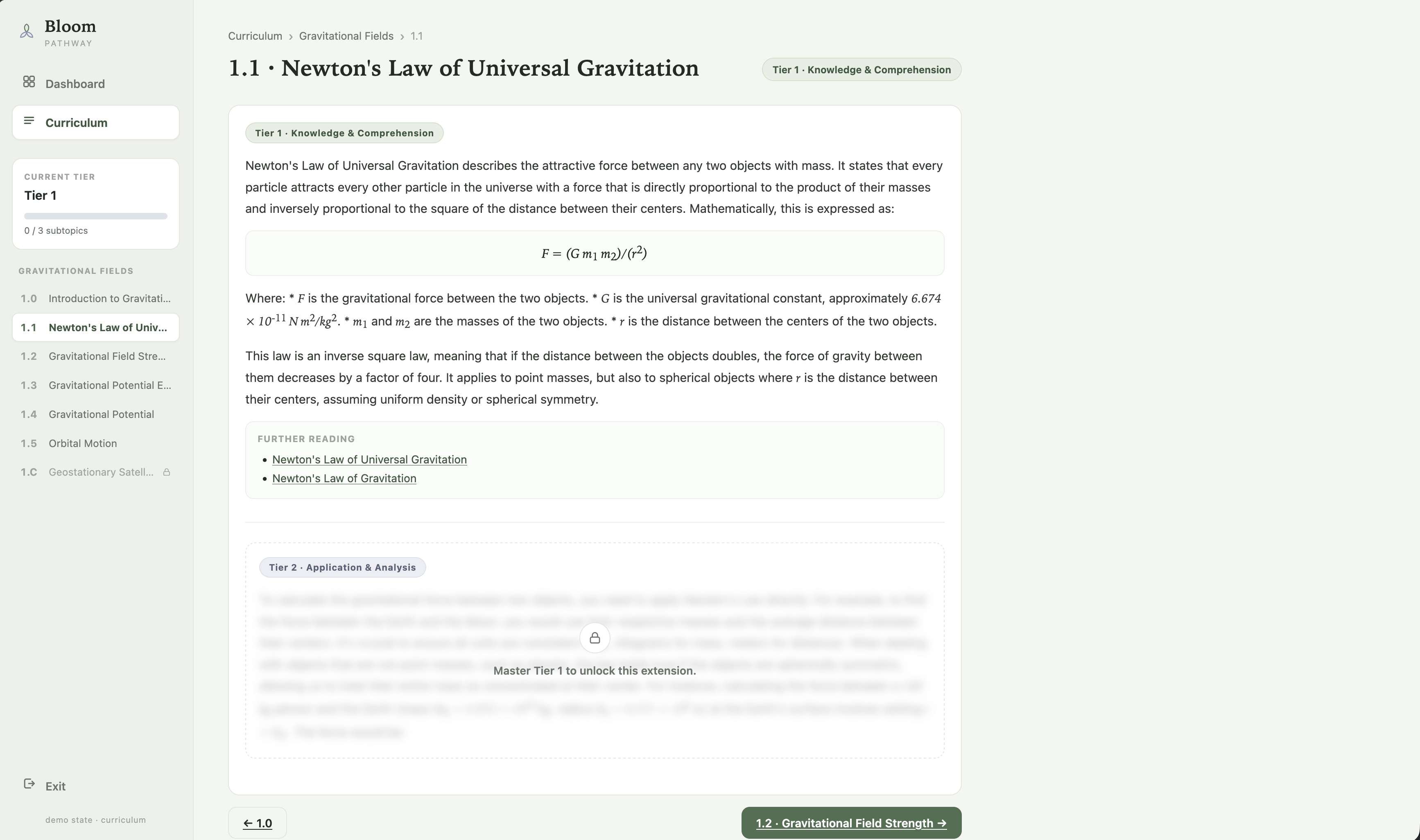
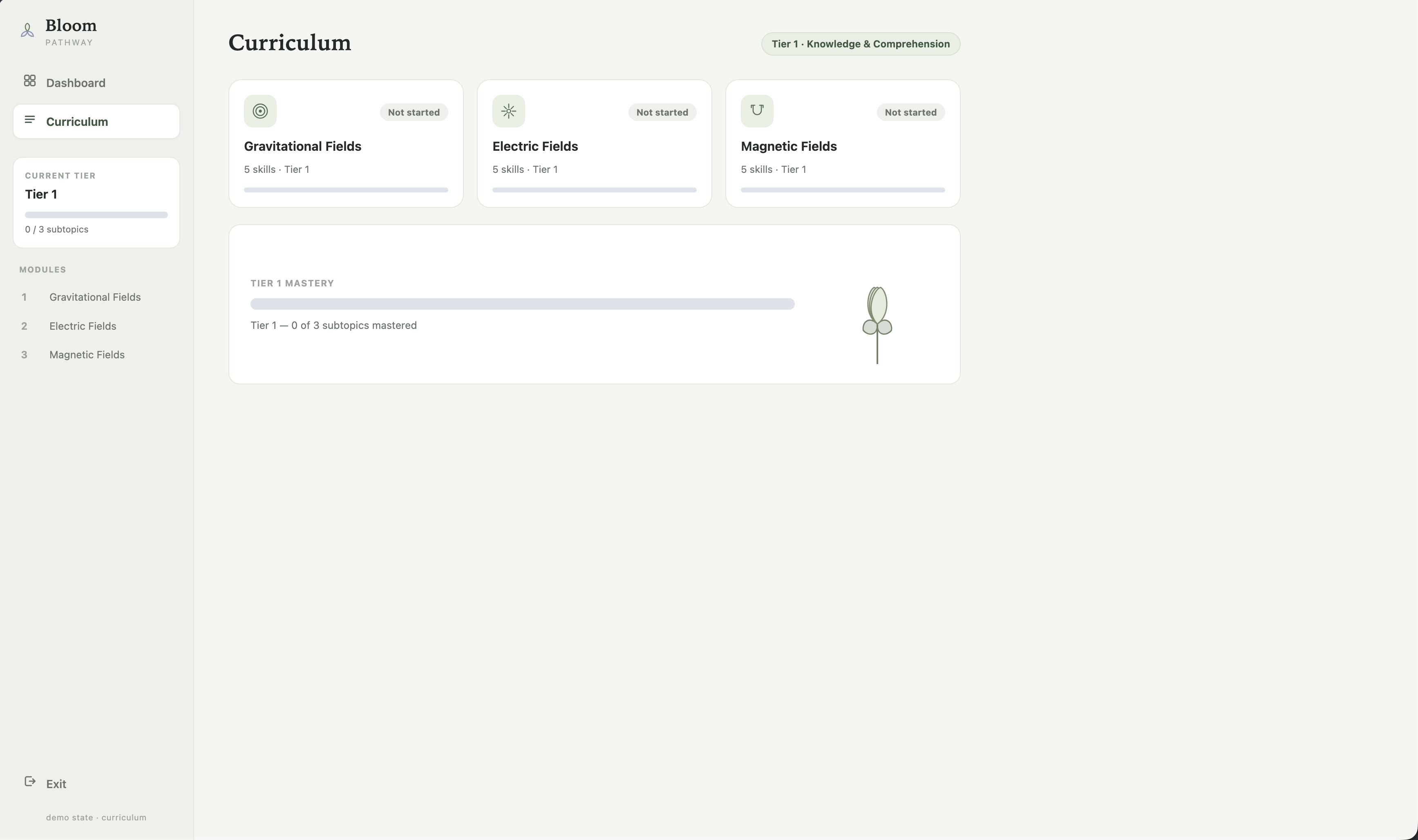
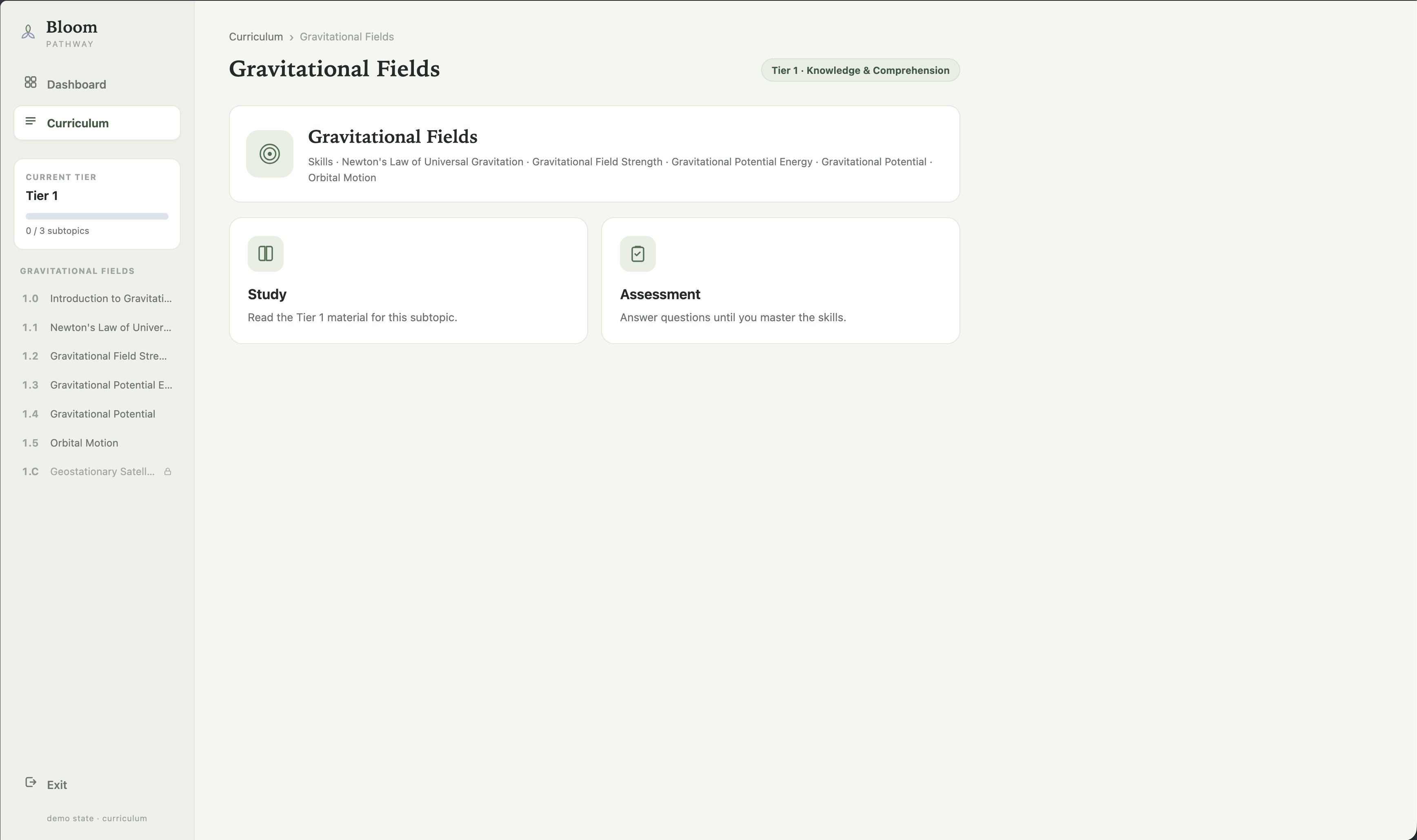
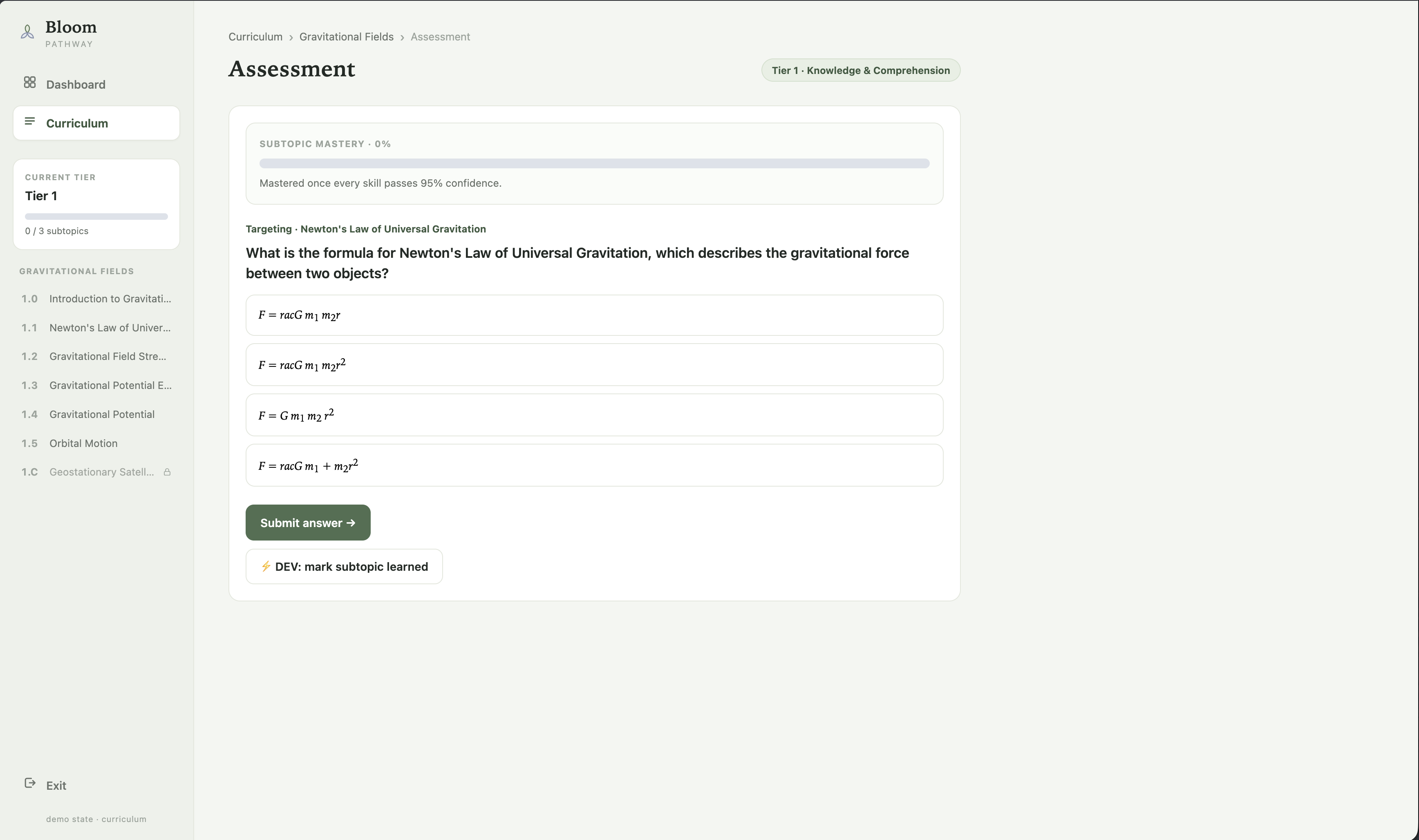
Dynamic Curriculum Engine: Enter any topic (e.g., "IB Physics Waves" or "Macroeconomics"), and Bloom generates a custom, 3-tier pathway mapped directly to Bloom's Taxonomy.
Three Cognitive Tiers:
- Tier 1 (Knowledge & Comprehension): Multiple-choice and semantic-similarity short-response grading to build a solid foundational base.
- Tier 2 (Application & Analysis): Rubric-based evaluation where an AI agent grades longer-form analytical responses against strict criteria.
- Tier 3 (Synthesis & Evaluation): An interactive Socratic chatbot that pressure-tests and "grills" the learner until they defend their ideas effectively.
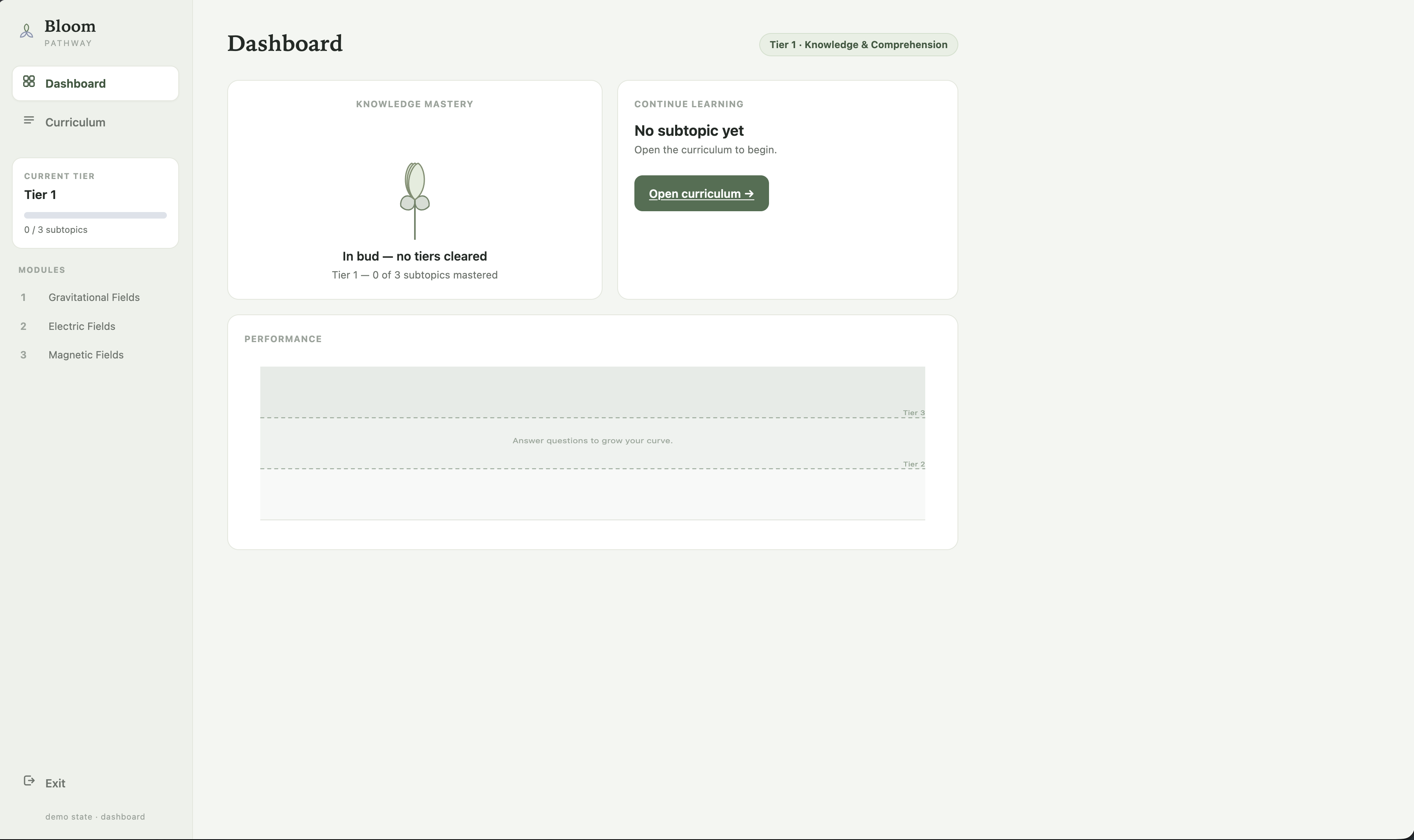
Bayesian Knowledge Tracing: Real-time probabilistic tracking that calculates true understanding per subtopic. Visual Knowledge Flower: A blooming visual indicator that unfolds as the student achieves mastery across tiers.
How We Built It
Interface: Modern, high-contrast dark UI designed with vanilla JavaScript, HTML5, and CSS3 for speed and accessibility. AI Pipeline: FastAPI (Python) backend using LangChain to orchestrate OpenAI (gpt-4o and gpt-4o-mini) for structured JSON curriculum generation and deep-dive study engine synthesis. Reliability & Concurrency: Asynchronous semaphores, schema normalization layers, and local token caching (sessionStorage) to prevent rate limits and guarantee reliable response parsing. Math & Logic Engine: Implemented Bayesian Knowledge Tracing ($P(\text{learned}) > 0.95$) to govern tier progression objectively.
What We Learned
Structure Beats Open Text: Students learn far more effectively when forced through structured cognitive tiers than when given an open prompt box. Schema Strictness is Vital: LLMs require strict JSON schema boundaries to ensure reliable UI rendering and zero runtime errors.
Curated Hand-Offs Work: Pointing learners to high-quality external resources alongside AI summaries beats trying to generate 100% of educational prose from scratch.
Challenges We Faced
- Concurrency Bottlenecks: Firing simultaneous LLM calls for multiple study guides caused server throttling (503 errors); solved by implementing asynchronous semaphores and queue management.
- Schema Drift: LLMs occasionally hallucinated variable JSON key names, which was resolved using strict JSON-mode prompts and backend normalizers.
- Socratic Balance in Tier 3: Fine-tuning the Tier 3 chatbot prompt so it remains challenging and probing without becoming unfair or overly harsh.
Impact We’re Aiming For
- Convert Passive Reading into Active Mastery: Bridge the gap between remembering facts and synthesizing complex ideas.
- Democratize 1-on-1 Socratic Tutoring: Give every student access to a high-level private tutor that pressure-tests their understanding.
- Provide Objective Proof of Learning: Replace arbitrary test scores with transparent, probabilistic knowledge estimates.
How Can We Expand Onto This?
Multi-Modal Inputs: Allow users to upload handwritten lecture notes, diagrams, or textbook snapshots to generate instant pathways. Community Pathway Exchange: Enable educators to publish, customize, and share specialized Bloom learning paths. Adaptive Remediation Loops: Automatically insert targeted review submodules when a student's mastery probability drops.
Inline Math Example: We update the learner's knowledge state after an attempt using our custom equation. Display Math Example: $$P(L_{t-1} \mid \text{correct}) = \frac{P(L_{t-1}) \cdot (1 - P(S))}{P(L_{t-1}) \cdot (1 - P(S)) + (1 - P(L_{t-1})) \cdot P(G)}$$
Our Ethos
We’re building for self-directed learners who want to truly understand—because education shouldn't be about memorizing facts for a single test, but about climbing the ladder of critical thought. Bloom’s job is simple: provide the structure so anyone can reach mastery.
Credits & Disclaimer
Built by a student team passionate about AI and educational technology. Bloom is an experimental learning pathway platform designed to support self-directed study and does not replace accredited institutional coursework.

Log in or sign up for Devpost to join the conversation.