
Inspiration
Bloom Protocol started from the idea of making a survival game where the danger is not a monster outside the wall, but the living system keeping everyone alive. The goal was to create an underground greenhouse that feels beautiful, fragile, and dangerous: every organism is a solution, but every solution has a biological side effect. The core inspiration is the tension of managing a sealed ecosystem under pressure, where Oxygen, Food, Medicine, workers, and containment all pull against each other.
What it does
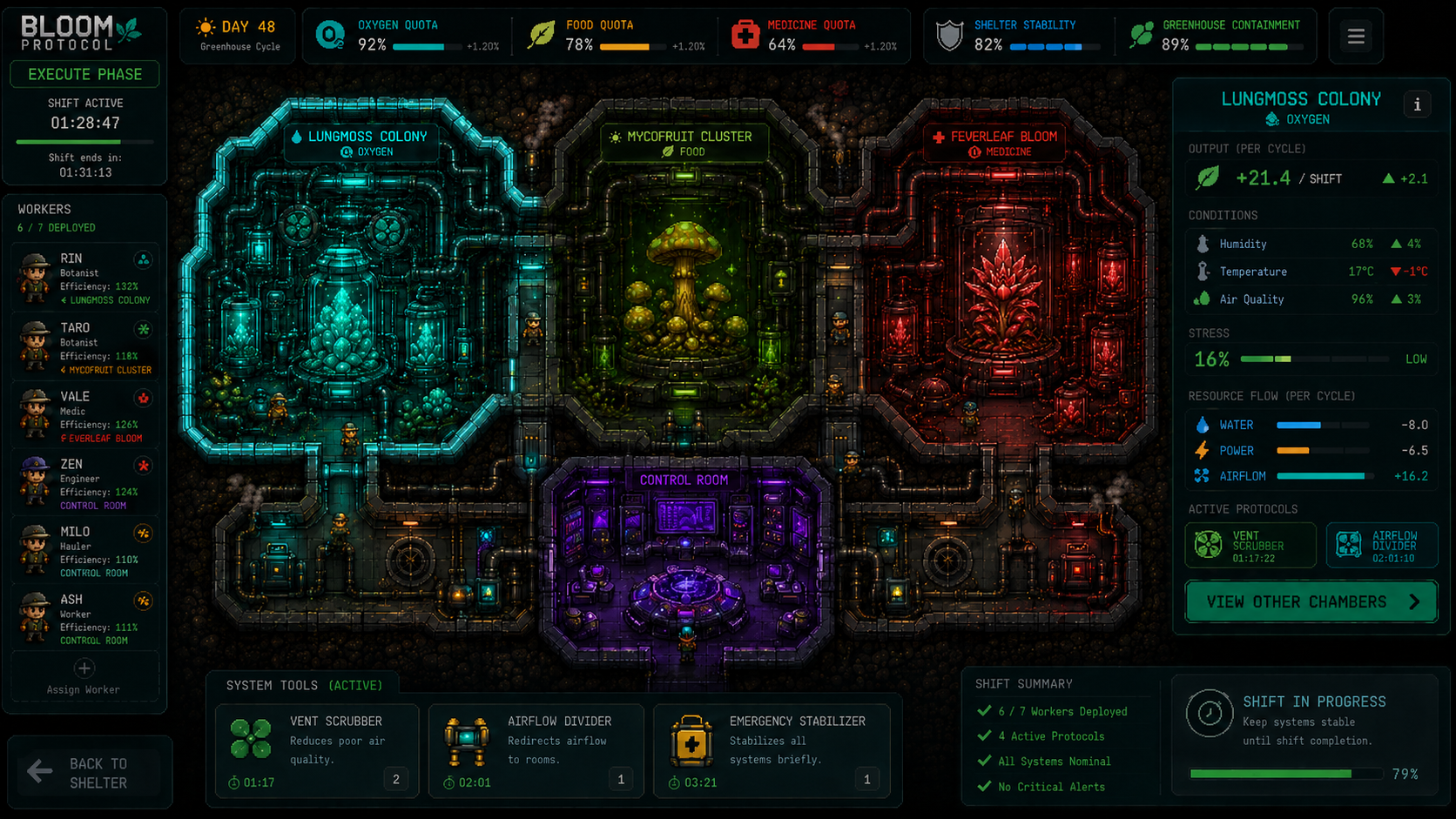
Bloom Protocol is a landscape mobile survival-management roguelite where players operate the last underground greenhouse connected to a sealed human shelter. Each operation day, the player reviews shelter quotas, assigns workers, chooses protocols, and distributes Water, Power, and Airflow between chambers that grow Lungmoss for Oxygen, Mycofruit for Food, and Feverleaf for Medicine.
During each shift, the greenhouse runs semi-autonomously while the player watches warning signs and makes course corrections. Overfeeding one chamber can save a quota but damage another system, so the game is about deciding which risk the shelter can survive. The player wins by stabilizing the shelter, or loses when Shelter Stability or Greenhouse Containment collapses.
How we built it
Since this is a pre-production design entry, Bloom Protocol was developed as a complete design package rather than a finished playable build. The process began by defining the core loop: briefing, prep, execution, intervention, and resolution. From there, the MVP was scoped around three output quotas, three operating controls, and three signature bioforms so the main pressure-transfer system could be tested clearly.
The first 15 minutes of play were mapped out, landscape mobile UI mockups were created, the pixel-art underground greenhouse visual direction was developed, and the production plan was structured around the smallest playable version that proves the loop before expanding into broader roguelite variety.
Challenges we ran into
The hardest part was making the pressure-transfer system clear instead of abstract. It was easy to say “every fix creates a new problem,” but the design needed specific proof: warning states, thresholds, recovery rules, and examples of how one chamber affects another.
Scope also had to be cut aggressively. Bloom Protocol naturally expands toward more bioforms, more events, more roguelite modifiers, and deeper meta progression, but adding all of that too early would bury the MVP. Another challenge was readability. The greenhouse is visually dense by design, so the UI and art direction needed to communicate resource pressure clearly without overwhelming a mobile screen.
Accomplishments that we're proud of
Bloom Protocol has a clear identity: a beautiful but uneasy underground greenhouse where survival decisions are biological tradeoffs, not simple menu choices. The three-bioform MVP triangle provides a strong foundation, and the pressure-transfer rule makes every correction feel meaningful.
The visual direction also strongly supports the gameplay. The pixel-art greenhouse, chamber layout, bioform designs, and landscape UI all reinforce the same fantasy: managing something alive, unstable, and worth saving.
What we learned
Specificity is what turns a cool concept into an actual game design. The design became much stronger once broad survival language was replaced with clearly defined resources, chamber risks, warning states, and player responses.
Mobile management games require ruthless clarity. The player should understand the current problem quickly, make one meaningful decision, and immediately see what pressure moved somewhere else. Complexity works best when it emerges from simple rules interacting.
What's next for Bloom Protocol
The next step is building a playable MVP around a three-day operation slice. That version would include Lungmoss, Mycofruit, Feverleaf, Water, Power, Airflow, shelter quotas, warning thresholds, recovery actions, and day-end resolution.
After the MVP proves the core loop, Bloom Protocol can expand with additional bioforms, new daily incidents, worker traits, tools, bioform modifiers, meta unlocks, and a final sustainability crisis. The long-term goal is a compact mobile roguelite where each run tells a different story about how the greenhouse survived - or how it failed.


Log in or sign up for Devpost to join the conversation.