-
-
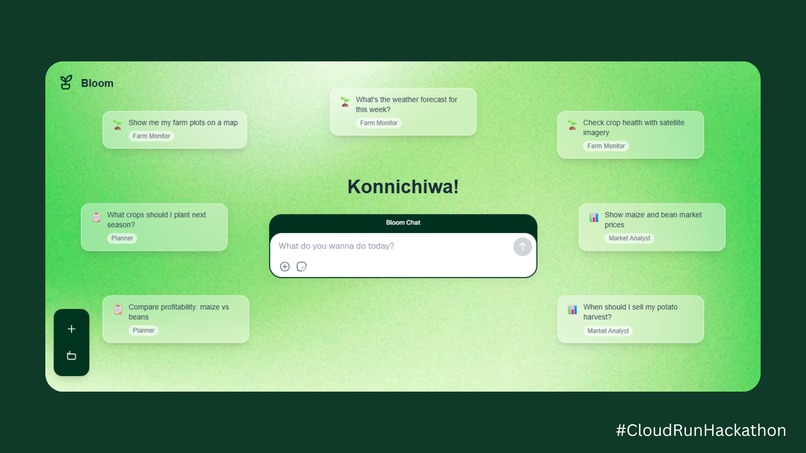
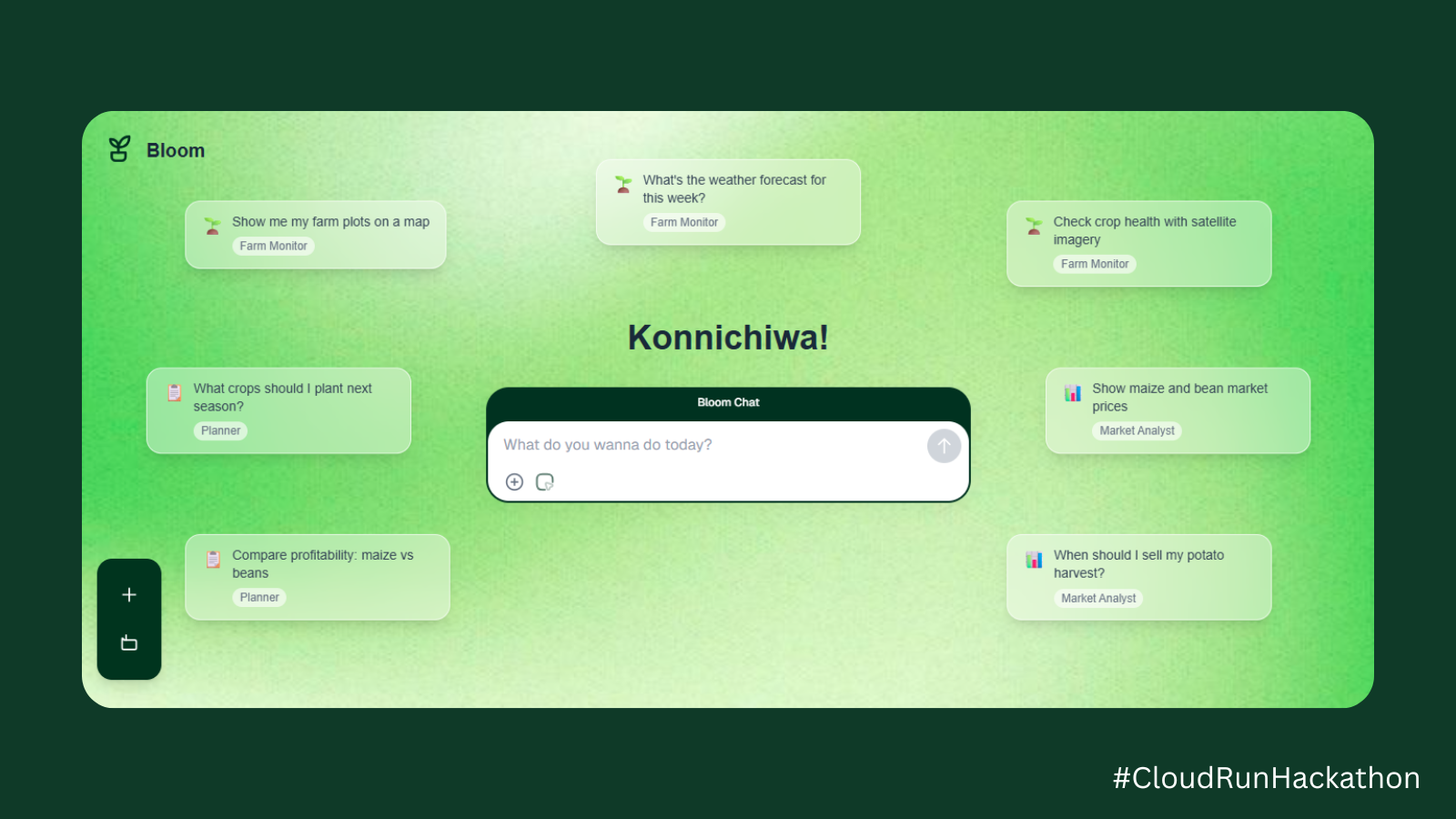
Landing page
-
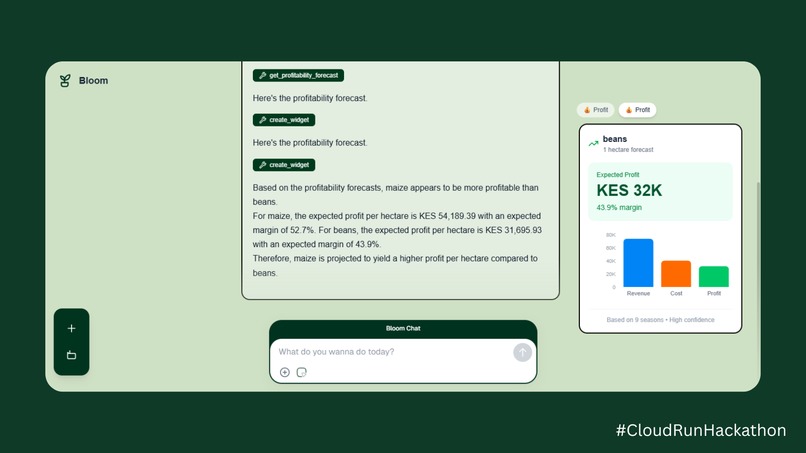
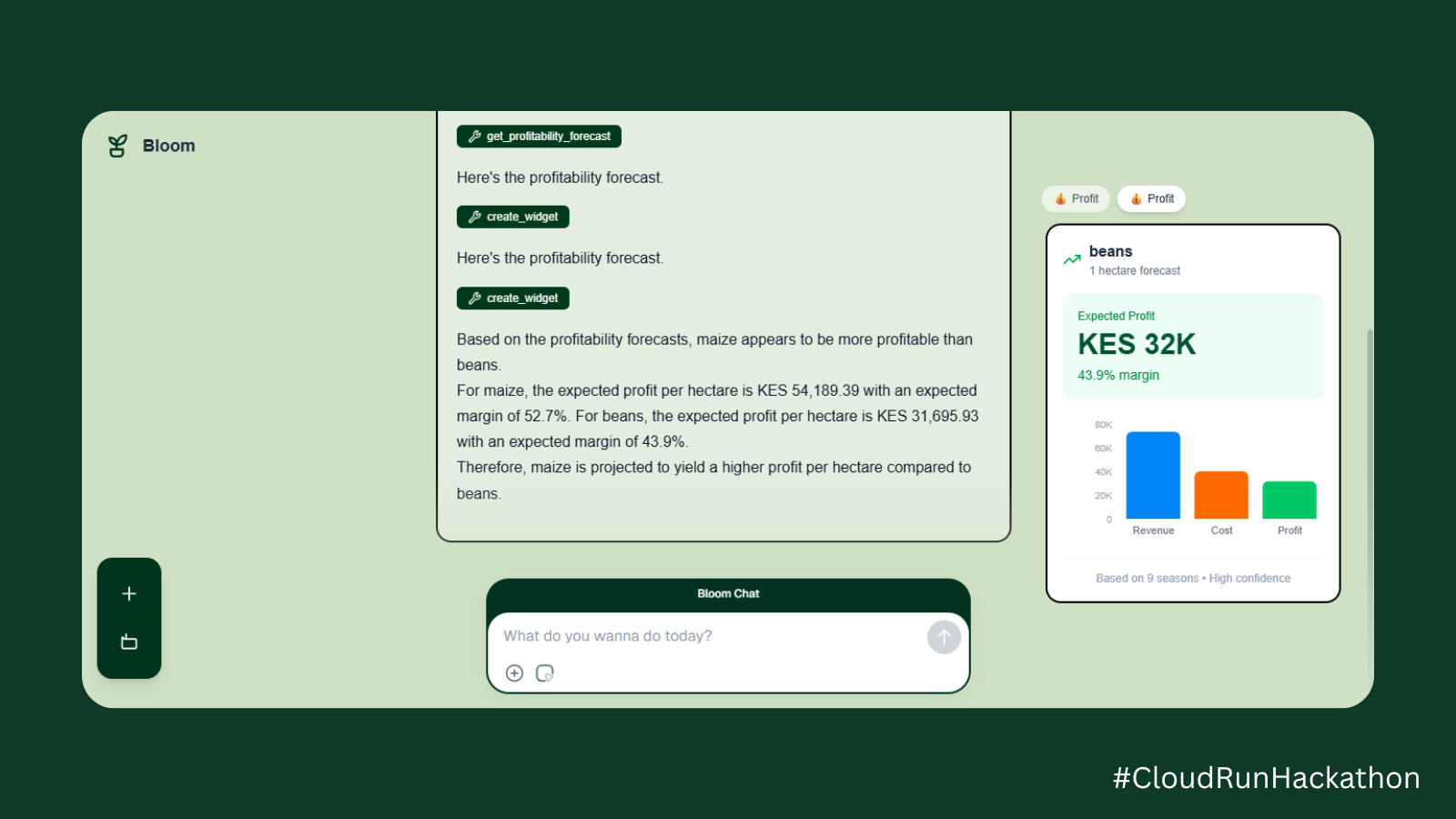
crop perfomamce comparison
-
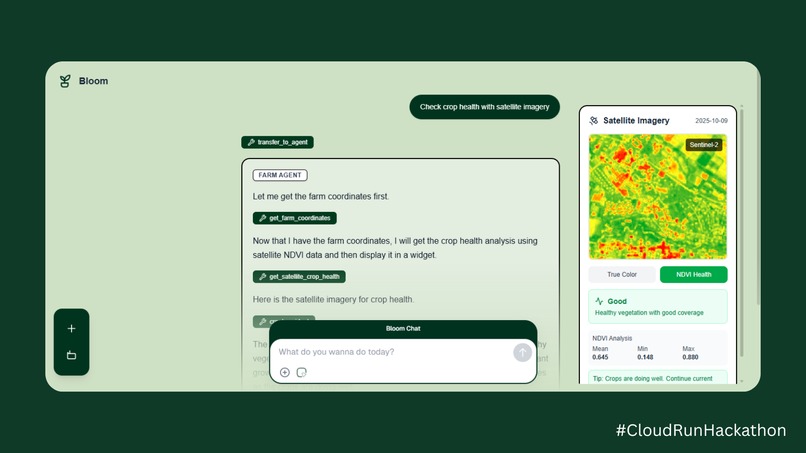
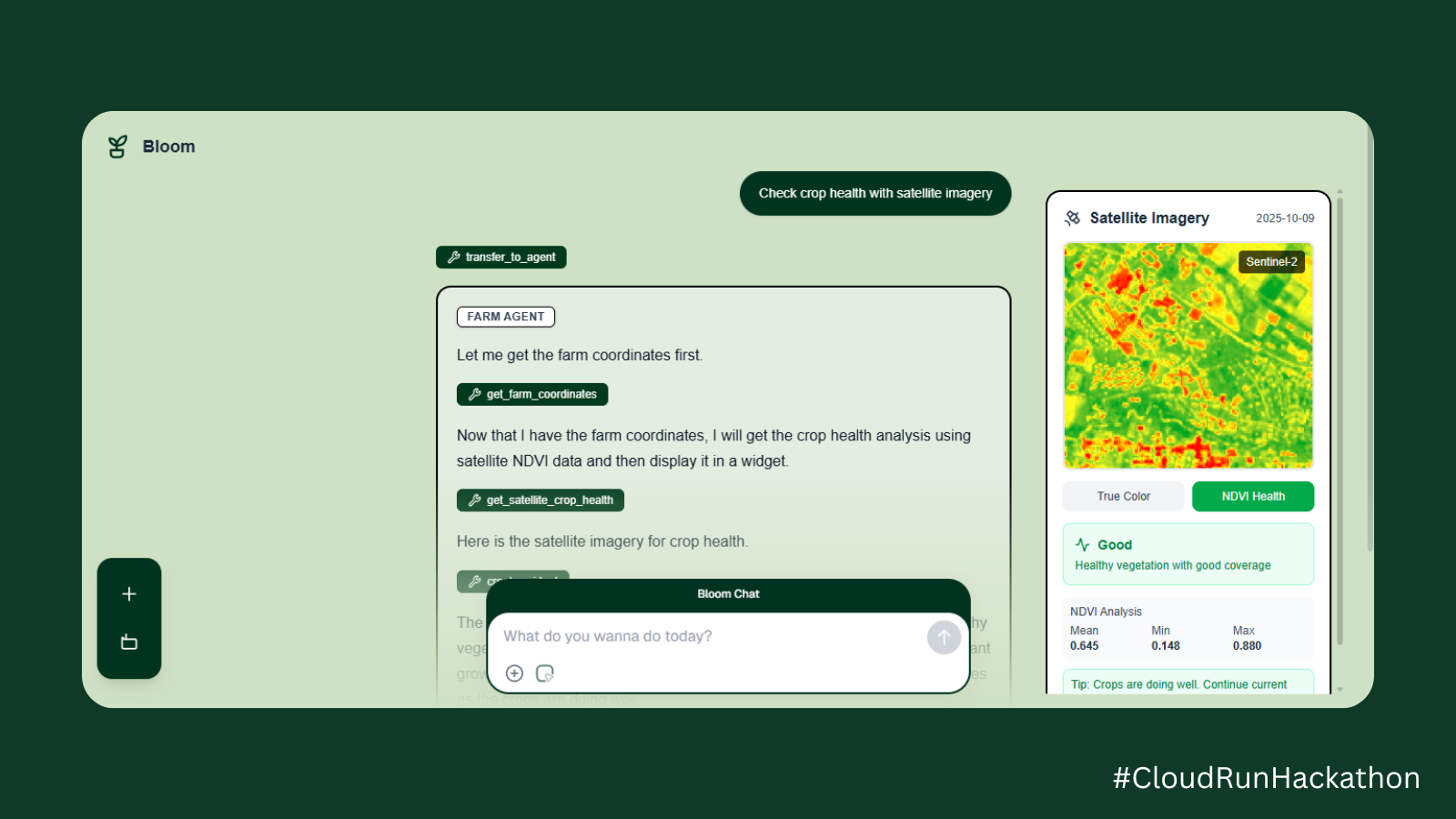
get instant sattelite imagery and nvdi analysis via natural languange
-
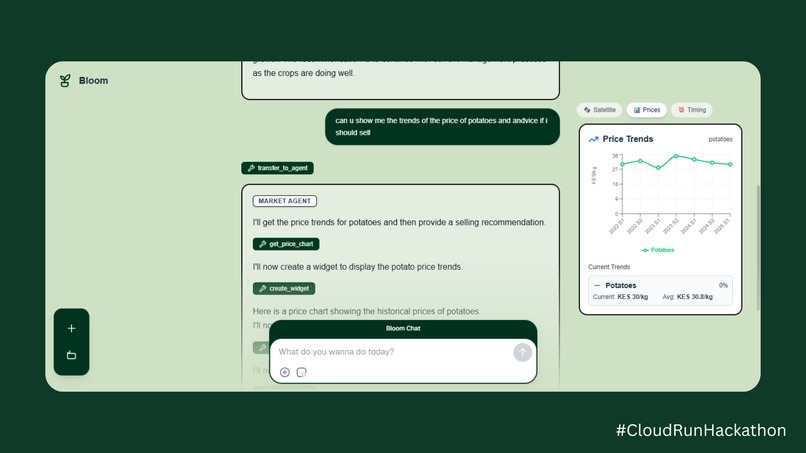
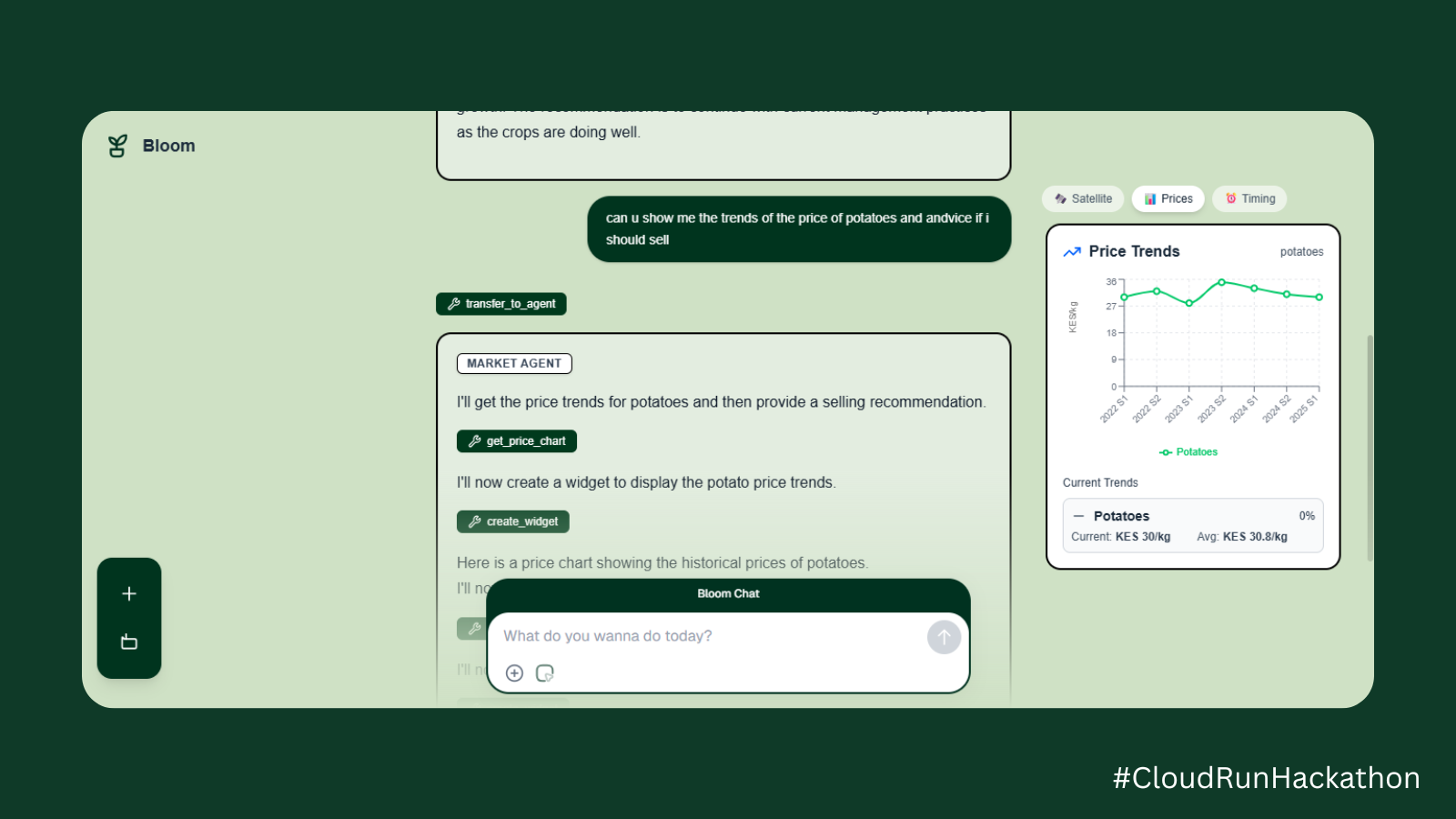
get price trends for your crops
-
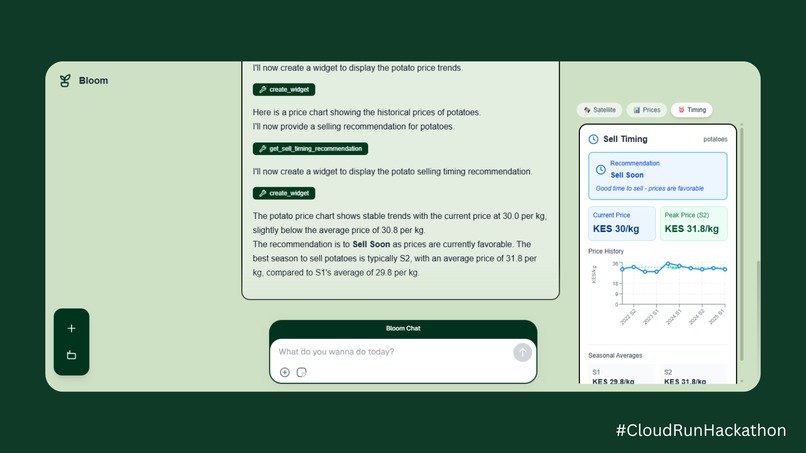
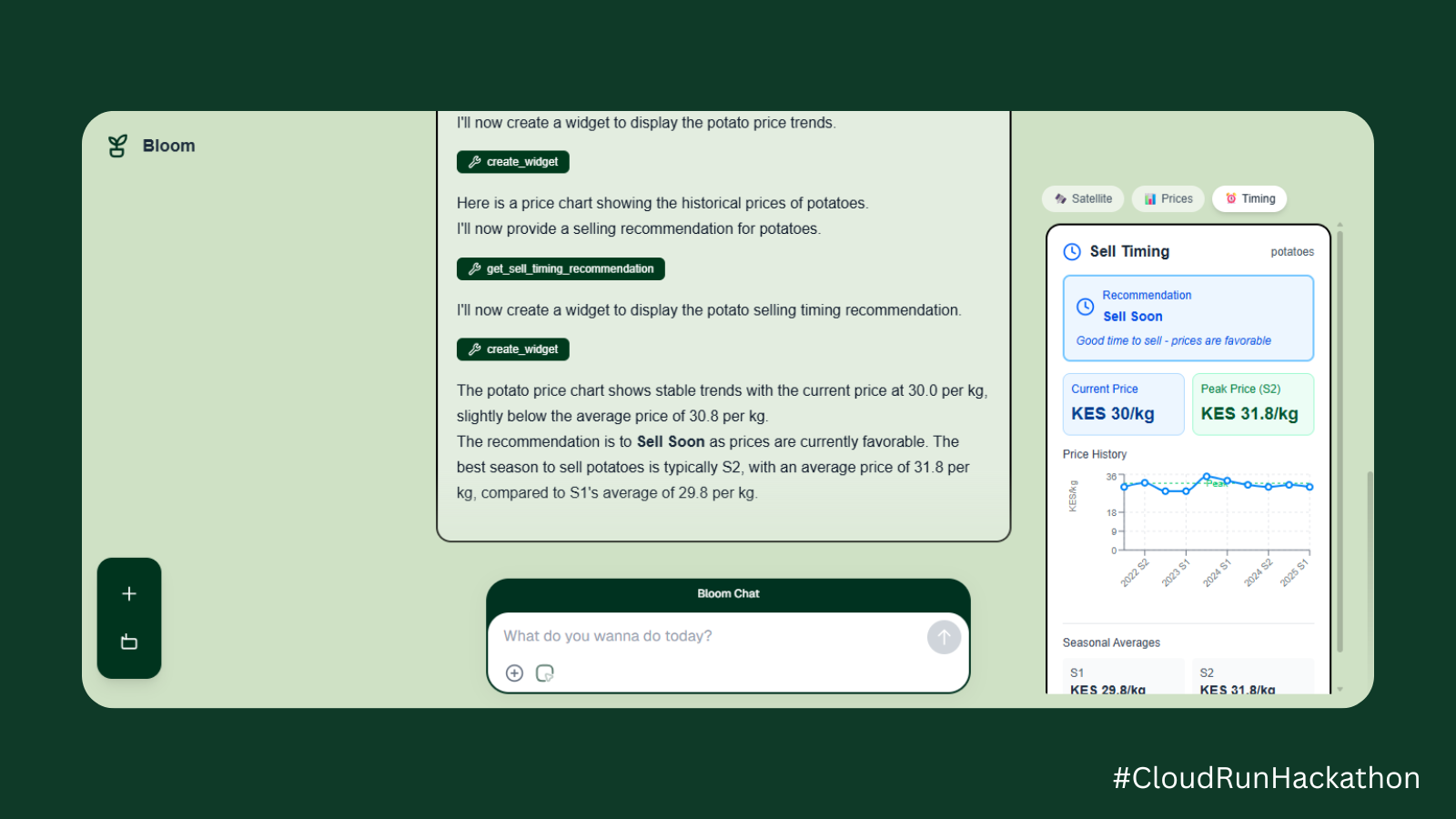
get sale reccomendations based on the market
Bloom: AI-Powered Agricultural Intelligence Platform
Built for the Google Cloud Run Hackathon
Leveraging multi-agent AI to transform complex farm data into conversational insights.
Inspiration
Modern farms generate enormous amounts of data — from satellite imagery to soil moisture readings and market prices.
Yet most farmers still rely on intuition because this information is locked away in dashboards designed for analysts, not practitioners.
Bloom was inspired by a simple idea: what if agricultural intelligence could be as easy to access as a conversation?
No dashboards. No spreadsheets. Just ask questions and get clear, actionable insights.
What it does
Bloom is an AI farming assistant that brings advanced analytics to everyday farming decisions.
It combines real-time satellite data, weather forecasting, and market intelligence into one chat-based interface that speaks the farmer's language.
Ask:
"How healthy are my crops this week?"
"Should I irrigate today?"
"When's the best time to sell my maize?"
Bloom responds with concise answers — often supported by maps, charts, or PDF reports generated in real time.
Behind the scenes, a multi-agent system divides expertise into specialized domains:
- Farm Agent – Analyzes satellite imagery and calculates NDVI to monitor plant health.
- Market Agent – Tracks commodity prices and forecasts selling opportunities.
- Planner Agent – Suggests crop rotations, planting schedules, and profitability projections.
Together, they create a full-picture understanding of a farm's performance and future potential.
How we built it
Bloom's architecture is built entirely on Google Cloud, combining a flexible backend with scalable AI infrastructure.
Core Stack
- FastAPI Backend deployed on Google Cloud Run
- Next.js (React 19 + Tailwind) Frontend for real-time chat and visualization
- Google Gemini 2.0 Flash for reasoning and conversation handling
- Google Earth Engine for satellite imagery and vegetation data
- Vertex AI Search (Vector Search) for semantic retrieval of historical farm data
- Google ADK (Agent Development Kit) for orchestrating multiple specialized AI agents
Each query goes through Bloom's orchestrator agent, which delegates subtasks to domain agents.
Responses are streamed to the frontend through Server-Sent Events, allowing interactive visual outputs alongside text responses.
Challenges we ran into
Building Bloom required balancing performance, scale, and reliability across multiple Google services.
- Integrating real-time satellite data with conversational responses demanded efficient caching and async execution.
- Managing multi-agent coordination meant creating a clear hierarchy of responsibilities and tool scopes.
- Maintaining consistent report formatting across AI-generated outputs required a robust data validation and rendering layer.
Despite the complexity, Cloud Run's resilience and ADK's modularity made it possible to ship a production-level architecture within the hackathon timeframe.
Accomplishments that we're proud of
- Deployed a fully functional multi-agent intelligence system capable of reasoning across multiple agricultural domains.
- Implemented real-world farm analysis using Google Earth Engine satellite data (demo farm: Njoro Agri-Hub, Kenya).
- Built automated PDF report generation that converts insights into clean, shareable reports with charts and tables.
- Designed a minimalist interface that blends simplicity with depth — farmers see only what they need, when they need it.
What we learned
- Specialization scales better than generalization. Multi-agent design ensures reliability across diverse data types.
- Google Cloud simplifies complexity. Cloud Run, Earth Engine, and Vertex AI worked seamlessly together under pressure.
- Conversational design beats dashboards. Farmers engage better when insights feel conversational, not analytical.
- Data is powerful only when it's understood. Translating data into decisions is where AI makes its real impact.
What's next for Bloom
The next phase focuses on expanding Bloom's intelligence and accessibility:
- Localized yield prediction models tailored to regional climate and soil conditions
- Integration with IoT sensors for ground-level soil and irrigation monitoring
- Offline-first support for areas with limited connectivity
- Farmer feedback integration to refine recommendations over time
Bloom's mission is simple — make data-driven farming a reality for every farmer, regardless of scale or technical background.
Bloom transforms agricultural complexity into clarity — one conversation at a time.
Built for the #CloudRunHackathon with Google Gemini, Vertex AI, and Earth Engine.
Deployment Note
A quick heads-up: During development and testing, we pushed Bloom through its paces — running satellite analyses, generating reports, and stress-testing the multi-agent orchestration. This exhausted our API quotas and cloud credits faster than anticipated.
The hosted deployment may be temporarily unavailable or running with limited functionality as we manage resource constraints.
However, the system is fully functional and production-ready. You can:
- Clone the repository and run everything locally following the setup instructions
- Review the deployment configuration and architecture documentation
- Check the demo videos and screenshots to see the full system in action
We built Bloom to work at scale — the infrastructure is there, the agents are coordinated, and the insights are real. Sometimes hackathon budgets run out before the ambition does. The code speaks for itself.

Log in or sign up for Devpost to join the conversation.