-
-
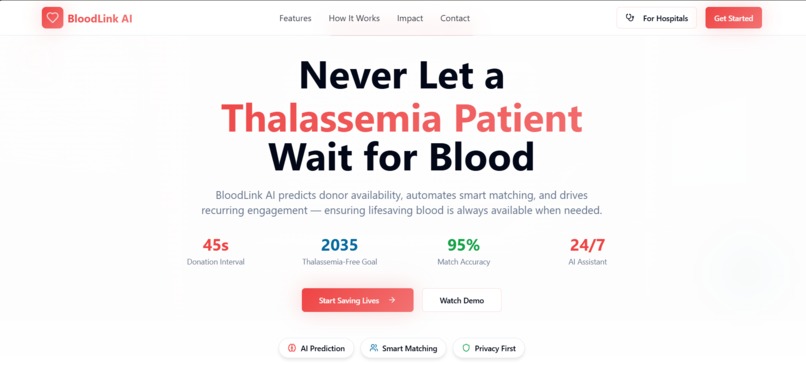
AI-powered platform designed to predict blood donor availability and ensure timely, lifesaving transfusions for Thalassemia patients.
🚑 BloodLink AI
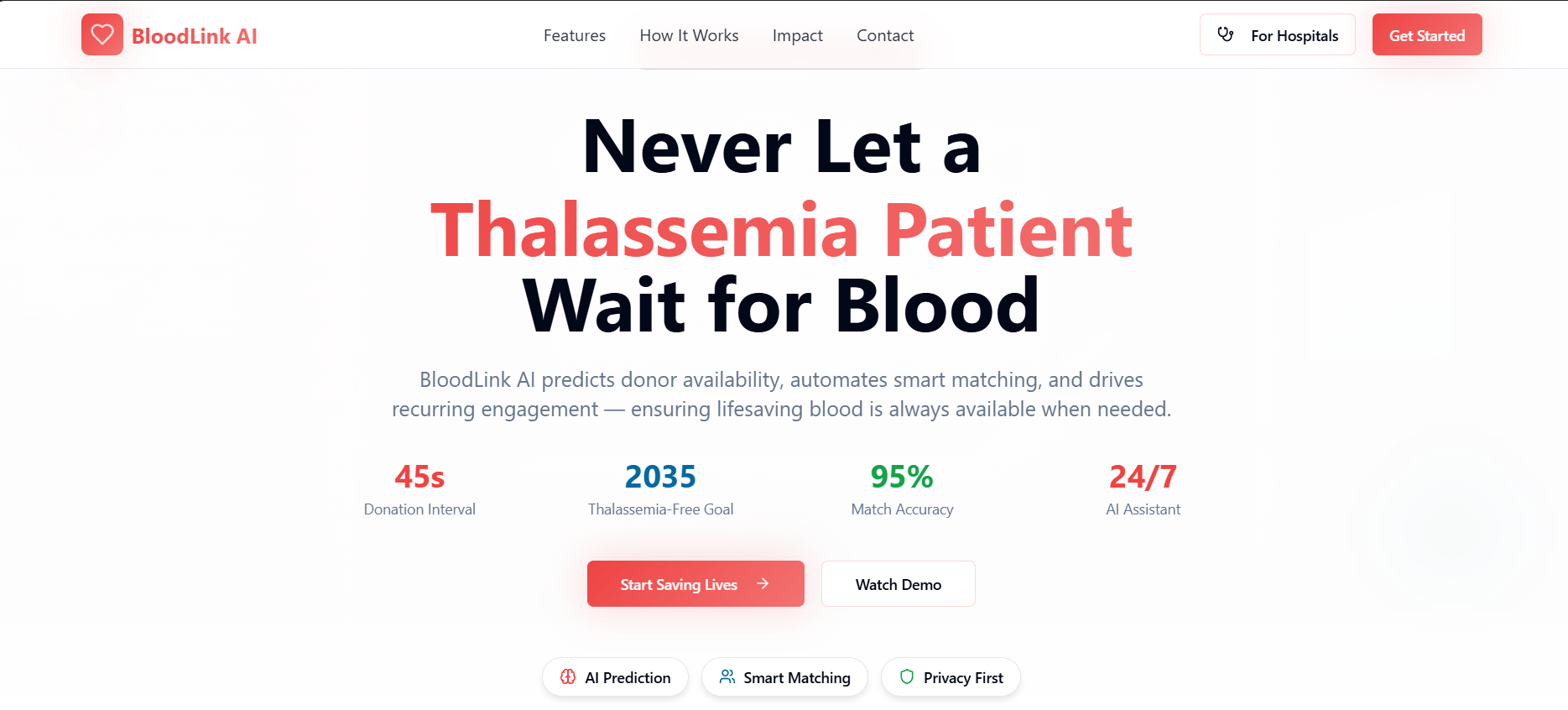
An intelligent AI platform that predicts donor availability, automates smart matching, and drives recurring engagement — so Thalassemia patients never face a delay in receiving lifesaving blood.
🔥 Inspiration
Every 45 seconds, a Thalassemia patient in India needs a blood transfusion. Despite platforms like e-RaktKosh, finding reliable, recurring blood donors remains a crisis, not a convenience. We were inspired by Blood Warriors' mission to eliminate Thalassemia by 2035 and wanted to create a solution that doesn’t just respond to emergencies — but prevents them altogether.
We realized the real problem isn't just supply — it's predictability and participation. Can we forecast who will donate and when? Can we motivate them to return regularly? That question inspired BloodLink AI.
🤖 What it does
BloodLink AI is a smart donor-patient matching and engagement platform that:
- 📊 Predicts donor availability using machine learning based on past donation cycles, blood type, location, and donation behavior.
- 🔄 Matches patients with optimal nearby donors who are eligible, available, and most likely to respond.
- 🔔 Sends personalized reminders and nudges to donors through WhatsApp/SMS when they become eligible again.
- 🕹️ Uses gamification (badges, streaks, milestones) to encourage recurring donations.
- 🗣️ Offers a multilingual AI assistant (powered by Azure OpenAI or Hugging Face) to answer questions for both patients and donors in a friendly, accessible way.
- 🔗 Integrates with systems like e-RaktKosh and Blood Warriors' Blood Bridge to sync patient needs in real time.
🧠 How we built it
We designed the solution in modular components with a future-facing roadmap:
Donor Prediction Engine:
Built a mock dataset of donation timelines and trained a basic model using scikit-learn and Azure ML services to detect recurrence likelihood.Matching Logic:
Designed a donor-patient matching algorithm using filters like blood type, location proximity (via Geo APIs), and donor eligibility window.Communication System:
Integrated mock Twilio/WhatsApp flows to simulate donor nudges, birthday pings, and eligibility alerts.Gamification Framework:
Designed badges, leaderboards, and milestone reward logic (e.g., 3 consecutive donations = Hero Badge).AI Chat Assistant:
Explored Azure OpenAI and Hugging Face for multilingual conversational flows (in Hindi and English) for donor FAQs and patient support.Integration Blueprints:
Drafted an integration plan for e-RaktKosh + Blood Bridge API interoperability (pending production access).
🚧 Challenges we ran into
Data Privacy & Ethics:
We were cautious about privacy in donor/patient data and designed consent-first user flows.Access to Real Data:
We used mock data and public insights due to the lack of live donor data — but our models are structured to swap in real data easily.Engagement Psychology:
Designing gamification that motivates without annoying was a delicate balance — we researched behavioral triggers that work in healthcare.Complex Matching Logic:
Optimizing match quality when location, eligibility, blood type, and donor behavior all vary was challenging but achievable with constraints tuning.
🏆 Accomplishments that we're proud of
- Designed a complete end-to-end ecosystem — from AI prediction to social behavior activation — all tailored for Blood Warriors' real-world impact.
- Created a system that is technically scalable, socially responsible, and empathetically designed.
- We aligned 100% with the hackathon goal: using AI to save lives, not just improve workflows.
- Developed a project that's not just a prototype — but a potential pilot for deployment in real networks.
📚 What we learned
- Health + AI requires more than just code — it needs emotional intelligence, trust, and user-centered design.
- Real-world AI impact comes from predictive thinking and motivational reinforcement, not just automation.
- Social impact tech needs to be simple for users, scalable for orgs, and sensitive to privacy.
🔮 What's next for BloodLink AI
- 🔧 Real Dataset Training: Partner with Blood Warriors to gain anonymized donor logs and fine-tune prediction models.
- 📱 Mobile-first Experience: Launch a lightweight PWA (Progressive Web App) for rural accessibility.
- 🌐 e-RaktKosh Integration: Initiate API-level sync with government infrastructure for live donor-patient connections.
- 🧠 Smarter Nudging: Use LLMs to personalize motivational messages for each donor based on past behavior and impact.
- 💬 Voice-based Assistant: Build a Hindi/vernacular voice support module for rural, elderly, and visually impaired users.
Together, we can turn every donation into a story, and every Thalassemia case into a predictable, manageable journey — powered by AI, driven by compassion.
Built With
- azure
- azure-functions)-databases:-mongodb
- azure-ml
- azure-openai-cloud-services:-microsoft-azure-(cognitive-services
- blob-storage
- chart.js-(for-gamification-dashboard)
- css
- figma
- firebase-apis:-twilio-/-whatsapp-api
- flask-or-azure-functions-(for-backend-apis)-ai/ml:-scikit-learn
- for
- geo-apis-(google-maps-or-azure-maps)-tools:-power-bi
- hugging-face-transformers
- javascript-frameworks:-react.js-(for-ui)
- postmam
- python
- rest-apis-(for-e-raktkosh-/-blood-bridge-integration)
- tailwind
- ui


Log in or sign up for Devpost to join the conversation.