Inspiration
What it does
How we built it
Challenges we ran into
Accomplishments that we're proud of
What we learned
What's next for BLOODLINK
Inspiration The seed for BloodLink was planted during a terrifying personal experience. A while ago, my mother was scheduled for a critical surgery. She has AB Negative blood—an incredibly rare type found in only 0.6% of the population (and even rarer in certain regions). The doctors advised us to keep a donor on standby "just in case." We did what everyone does: we called friends, spammed WhatsApp groups, and frantically searched through static online directories. After hours of panic, we found zero available donors. Miraculously, the surgery went smoothly, and she didn't need the transfusion. But the fear of that moment stayed with me. I realized that the problem wasn't a lack of donors—there were likely compatible donors within a few kilometers of the hospital—but a lack of connection. We were living in a city of millions, yet we were disconnected from the very people who could save us. That experience highlighted the "Critical Latency" gap that endangers the 6% of the population with negative blood types. We built BloodLink so no other family has to face that helpless silence again. What it does BloodLink is a Real-Time Emergency Logistics Network. Think of it as an "Uber for Blood." Instead of relying on passive, outdated donor lists, BloodLink uses geospatial intelligence to actively manage the connection between patient and donor.
Geo-Matching: It instantly identifies eligible donors within a 5km radius and alerts them via WhatsApp. Privacy Shield: It protects donor safety by masking their exact location until they accept a request. Trust System: It assigns a Reliability Score (Karma) to donors, filtering out "Ghost Donors" who say yes but don't show up. B2B Integration: It helps hospitals swap near-expiry blood units ("Flash Exchange") to reduce medical waste.
How we built it We leveraged Base44 to rapidly prototype and deploy the application, which allowed us to focus on the complex backend logic rather than getting stuck on boilerplate code.
Frontend: Built with React (Base44) for a responsive, cross-platform mobile experience. We used CSS-based 3D rendering for the "Hero" visuals to keep the app lightweight. Backend: Node.js handles the logic, utilizing MongoDB's geospatial queries ($near) to calculate distances in real-time. APIs: We integrated the Google Maps API for visualization and the WhatsApp Business API for deep-linking alerts, ensuring zero-latency communication.
Challenges we ran into The biggest challenge was designing for Trust and Feasibility.
The "Ghost Donor" Problem: Early user feedback showed that people often accept requests but fail to show up. We solved this by designing the Karma Score algorithm, which gamifies reliability. Privacy vs. Utility: We needed to show donors on a map without stalking them. We engineered a "Fuzzy Location" middleware that randomizes coordinates within a 500m radius, balancing utility with privacy. Hospital Onboarding: Convincing hospitals to join a student app is hard. We pivoted our business model to include the "Flash Exchange" feature—giving hospitals a financial incentive (waste reduction) to join our network.
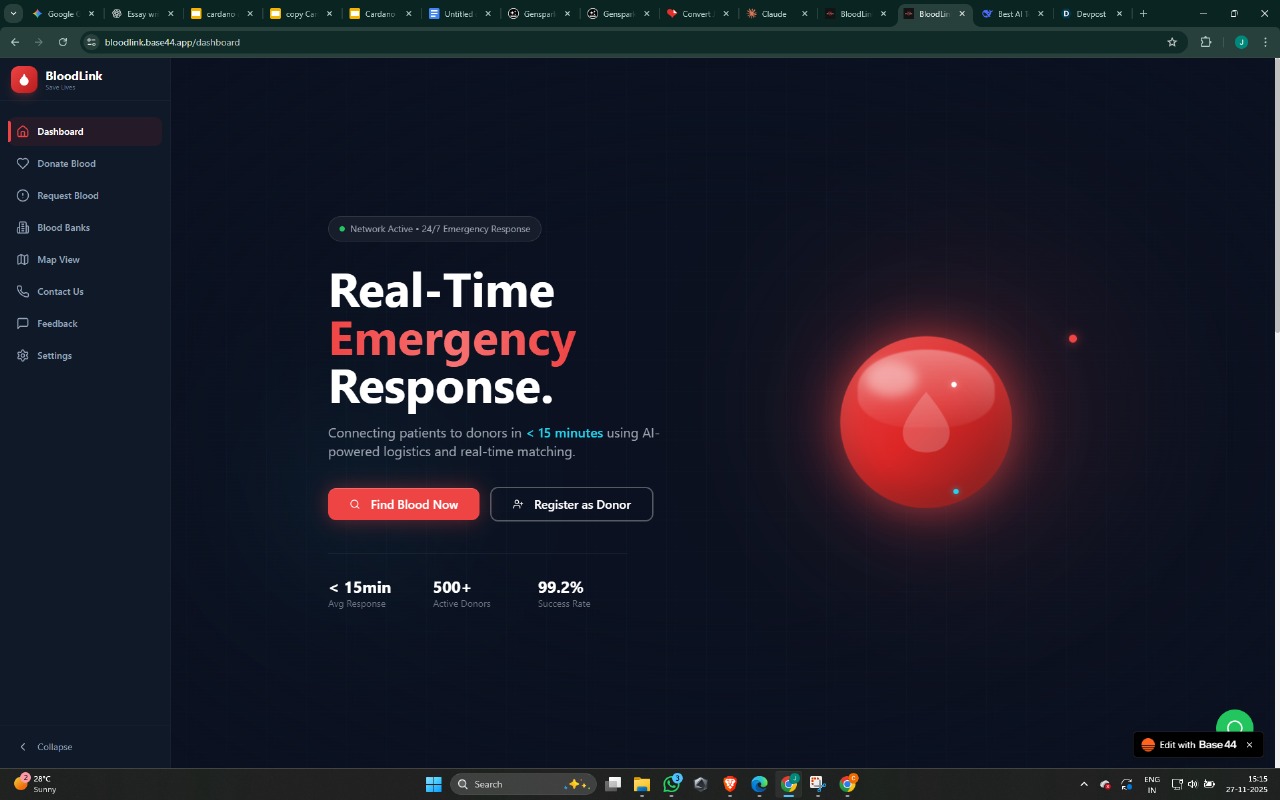
Accomplishments that we're proud of We are incredibly proud of the Latency Reduction. In our simulations, we reduced the theoretical "Time-to-Match" from hours to under 15 minutes. We are also proud of the UI/UX Overhaul, transforming a standard medical form into a "Dark Mode Emergency Console" that feels professional, urgent, and accessible. What's next for BloodLink We plan to launch a pilot program with 5 mid-sized private blood banks in Hyderabad to validate our B2B model. Following that, we aim to integrate AI-driven Demand Prediction Heatmaps to help city officials plan blood donation drives more effectively based on historical shortage data.
Built With
- base44

Log in or sign up for Devpost to join the conversation.