Inspiration
Project Story: HemoLink – AI-Powered Companion for Thalassemia Warriors
About the Project
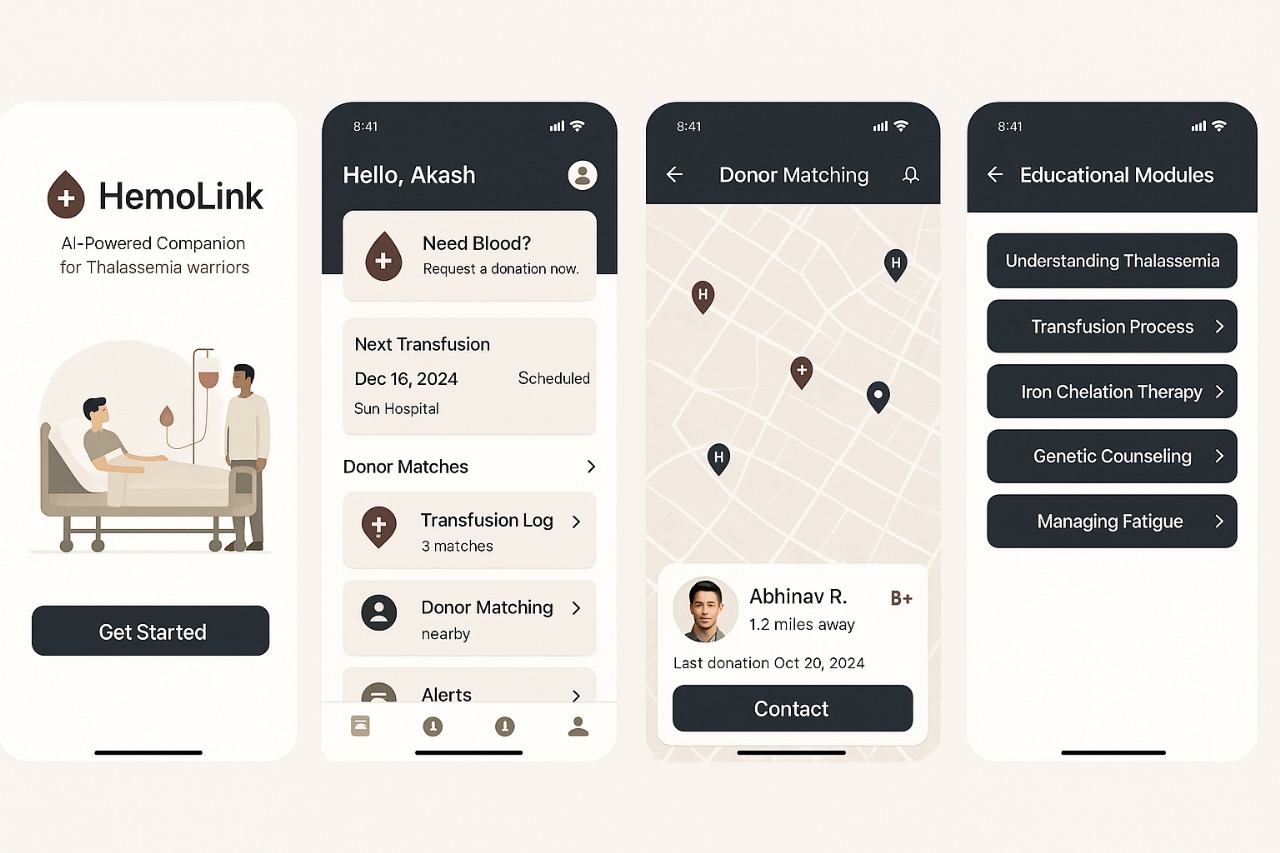
HemoLink is an AI-powered mobile application designed to support Thalassemia patients and amplify the efforts of Blood Warriors, a dedicated volunteer network. The app bridges critical gaps between **patients, donors, hospitals, and support systemsby offering features like:
- Real-time blood donor connectivity
- AI-based donor availability prediction
- Health education in regional languages
- Mental and emotional support tools
All this is achieved while maintaining data security, **accessibility, and **inclusivity for diverse user groups.
What Inspired Us
Our inspiration stemmed from real-life conversations with Thalassemia-affected families during a blood donation camp. One particularly moving story involved a mother who traveled over 100 km every few weeks, uncertain if blood would be available for her child.
This led us to ask:
“Can we use AI and real-time technology to reduce the uncertainty and improve lives for such families?”
That question sparked the creation of HemoLink — a digital solution to support lives, one link at a time.
What We Learned
This project taught us valuable technical and human lessons:
- Empathy in design is essential — direct interviews guided feature development.
- AI can save lives, even with simple predictive models.
- Privacy and encryption must be prioritized when handling health data.
- Collaboration with NGOs and doctors is crucial for realistic workflows.
How We Built It
We followed a modular approach, prioritizing real-world user needs and scalability.
🔧 Tech Stack
| Component | Technology Used |
|---|---|
| Frontend | Flutter (Android/iOS) |
| Backend | Node.js + Firebase |
| Database | Firestore (NoSQL) |
| AI Models | Python (scikit-learn, TF) |
| Authentication | Firebase Auth |
| Notifications | Firebase Cloud Messaging |
| Hosting | Google Cloud |
| APIs Integrated | e-RaktKosh (mocked), Blood Bridge |
AI Logic
We implemented a basic AI model to predict donor re-availability based on historical data.
Let:
- ( f ) = past donation frequency
- ( d ) = days since last donation
- ( l ) = location proximity
- ( h ) = donor's health score
Then the probability ( P ) of a donor being available is modeled as:
$$ P(\text{available}) = \sigma(w_1 f + w_2 d + w_3 l + w_4 h + b) $$
Where ( \sigma ) is the sigmoid function and ( w_i ) are model weights.
Challenges We Faced
| Challenge | Solution |
|---|---|
| Limited public health data | Created anonymized sample datasets |
| Security concerns | Used AES encryption & Firebase Auth |
| Rural accessibility | Added offline access + SMS fallback |
| Multi-language needs | Added Hindi, and planned regional expansion |
| Donor retention | Designed gamified rewards system |
What Makes HemoLink Special
- Predictive AI to forecast donor availability and transfusion needs
- Real-time donor–patient–hospital connection
- Health education modules in local languages
- Mental health and peer support features
- Gamified donor experience to encourage regular donations
- Offline mode & SMS fallback for rural regions
- Fully encrypted health records with secure access
Conclusion
Building HemoLink wasn’t just a technical challenge — it was a mission to empower Thalassemia patients and families across India. Through AI, empathy, and design, we developed a solution that has the potential to scale nationally and save thousands of lives.
"Where technology meets empathy, real change begins."
Built With
- aes-256
- agora
- dart
- e-raktkosh
- express.js
- figma
- firebase
- firestore
- flutter
- github
- google-directions
- javascript
- lite
- msg91
- node.js
- postgresql
- python
- scikit-learn
- sdk
- tensorflow
- twilio
- vercel
- webrtc

Log in or sign up for Devpost to join the conversation.