-
-
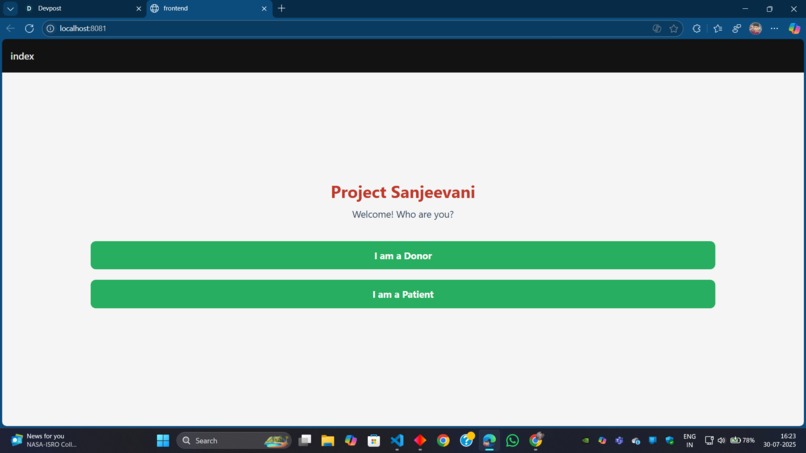
Project Sanjeevani

Inspiration
Our inspiration came from the AI for Good Hackathon's mission to support Blood Warriors India. We were moved by the immense daily struggles of Thalassemia patients who require lifelong blood transfusions. The challenge of finding regular donors and managing their condition is a critical problem that we believe technology and AI can help solve in a meaningful way.
What it does
Project Sanjeevani is an AI-powered mobile ecosystem designed to be a lifeline for Thalassemia patients. It does three key things:
Connects Patients & Donors: It provides a real-time platform for patients to create blood requests and for registered donors to find and respond to these urgent needs.
Predicts Availability (AI Core): Our roadmap includes an AI model that forecasts donor availability based on past patterns, helping to prevent last-minute shortages and proactively manage the blood supply.
Provides Support: We've designed an integrated AI "Care Companion" chatbot to offer patients 24/7 support, including medication reminders, answers to frequently asked questions, and educational resources on managing Thalassemia.
How we built it
We built a functional proof-of-concept using a modern, full-stack approach:
Backend: The API server is built with Python and FastAPI, chosen for its high performance and ease of integrating AI/ML libraries.
Frontend: The cross-platform mobile app is built with React Native (Expo) and TypeScript, allowing us to create a clean and responsive user interface for both Android and iOS.
Database & Cloud: The architecture is planned for a PostgreSQL database hosted on Supabase. The backend is configured to securely manage environment variables for database URLs and external services like the Google Maps API.
Challenges we ran into
Our biggest challenge was navigating the complexities of a modern development environment. We ran into several critical issues that tested our problem-solving skills:
Node.js Instability: We initially used an experimental Node.js version (v23) which caused persistent "out of memory" errors. We learned the importance of stable LTS versions and successfully downgraded our environment to Node v20.
Dependency Conflicts: We troubleshooted and resolved numerous npm dependency conflicts (ERESOLVE errors) to get the required frontend libraries to work together.
Full-Stack Communication: Ensuring seamless communication between the mobile app (on a phone) and the local backend server required careful network configuration of IP addresses and firewalls.
Accomplishments that we're proud of
We are incredibly proud of building a functional, end-to-end proof-of-concept that brings our idea to life. Overcoming the significant environmental and dependency challenges taught us resilience and advanced debugging. Most importantly, we're proud of designing a solution that not only solves a logistical problem but also addresses the crucial need for patient support and education.
What we learned
This project was a deep dive into both technology and empathy. We gained hands-on experience in full-stack development, from API creation with FastAPI to mobile app development with React Native. We learned the critical importance of a stable development environment and how to methodically debug complex issues. Above all, we gained a profound appreciation for the challenges the Thalassemia community faces and the immense potential for AI to create a positive social impact.
What's next for Blood_AI_Sanjeevani
Connect the backend to the PostgreSQL database. Implement the DonorMatch AI model for predictive matching. Develop and integrate the Thalassemia Care Companion chatbot. Add user authentication and authorization using JWT. Build out the full user profiles and donation history tracking.
Built With
- ai/ml
- expo.io
- fastapi
- google-maps
- postgresql
- python
- react-native
- supabase
- typescript

Log in or sign up for Devpost to join the conversation.