-
-
section 2
-
section 4
-
section 1
-
section 3
Inspiration
Picture a delivery room. A mother is losing blood faster than her body can replace it. Ten minutes away, a hospital fridge holds exactly the blood type she needs, enough to save her twice over. Nobody there knows she exists.
That's not a supply problem. That's a silence problem.
We went looking for the real numbers behind that scene, and they were worse than we expected. The World Health Organization reports that most low- and middle-income countries collect less than half the blood they need. At the same time, independent hospital audits report expiry-driven wastage as high as 16.6% meaning blood is being thrown away in the same kinds of systems that are simultaneously running short. Not two separate problems. The same problem, happening in two buildings that never learned to talk to each other.
Once we saw it that way, the question changed. It stopped being "how do we get more blood" and became: can two hospitals coordinate without a shared database, without exposing their real numbers to each other, and without any infrastructure beyond what already exists in low-resource regions? That question is what we built.
What it does
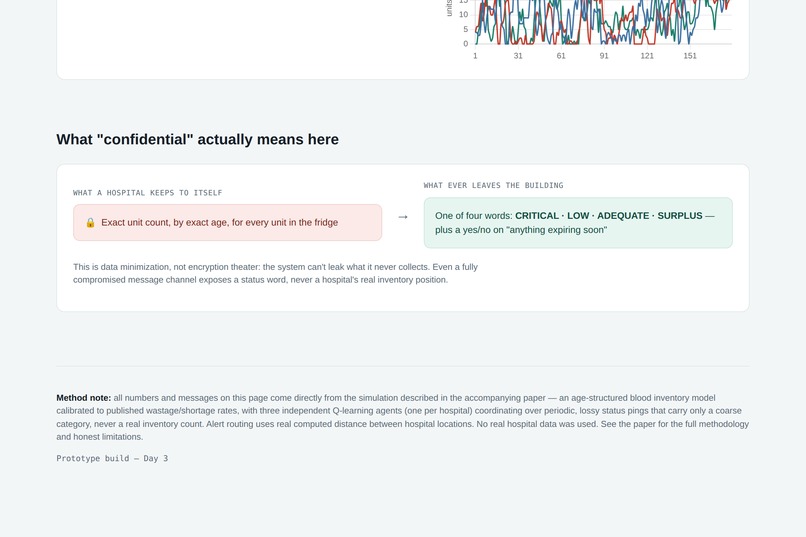
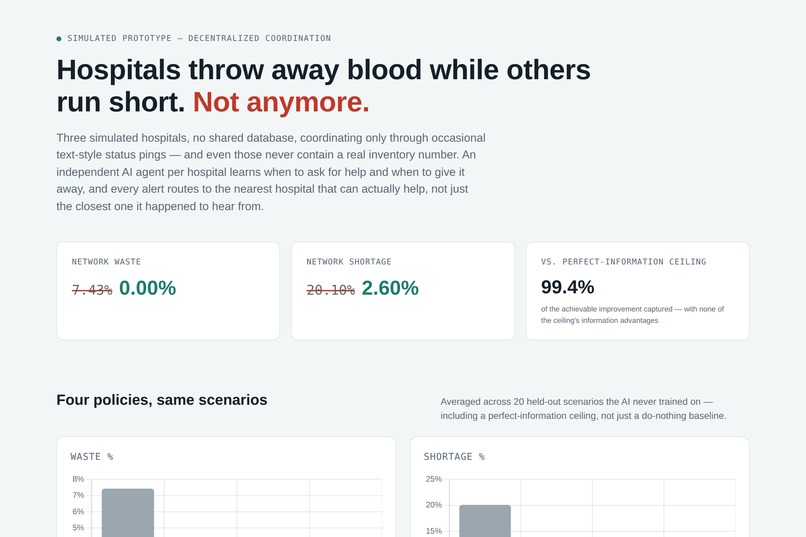
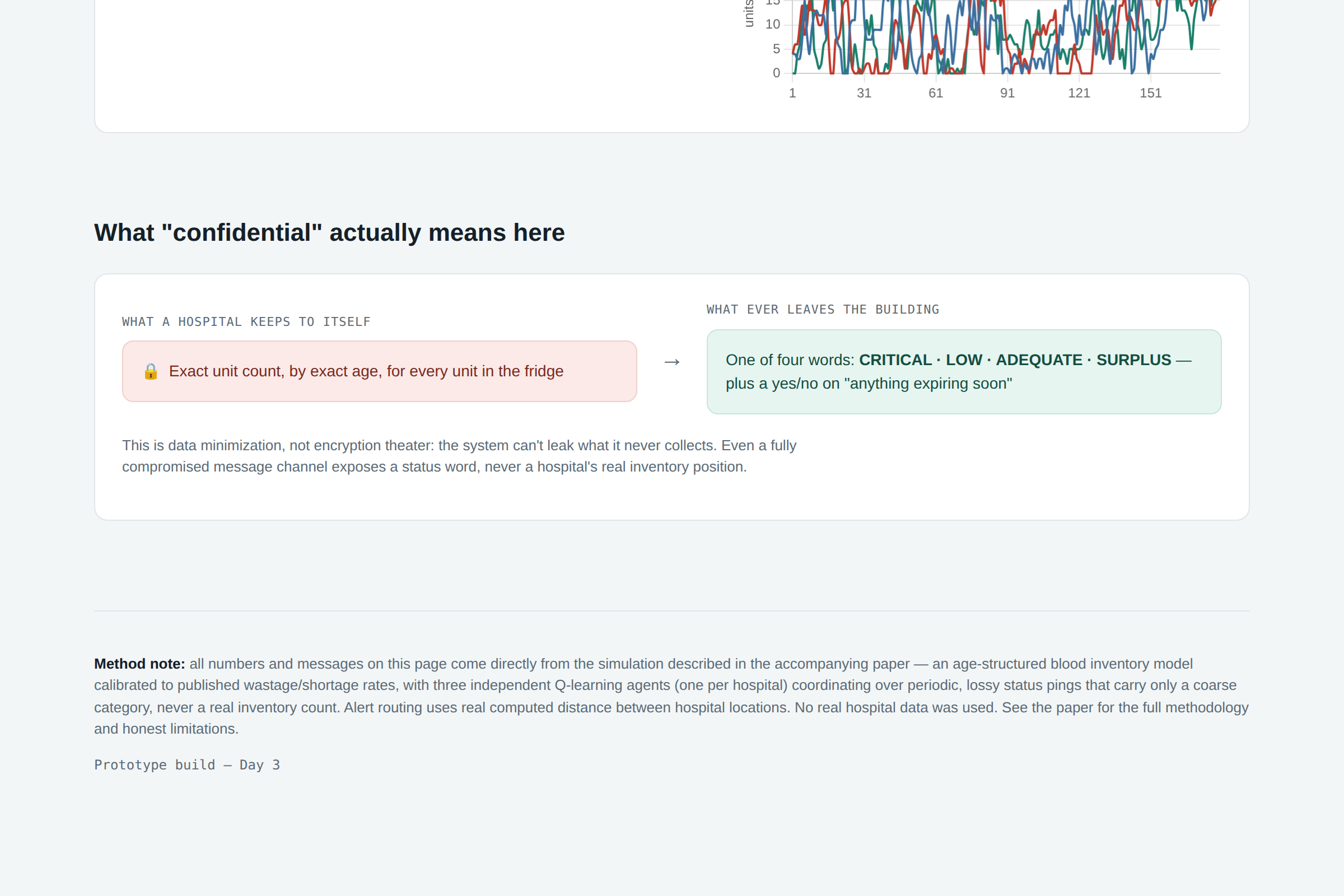
Blood Without Borders is a decentralized AI system we call the underlying model Lifeblood where every hospital runs its own independent learning agent. There is no central server and no shared login. Hospitals coordinate only through short, infrequent, text-message-style updates, and even those updates never contain a real inventory number only a coarse status word: CRITICAL, LOW, ADEQUATE, or SURPLUS.
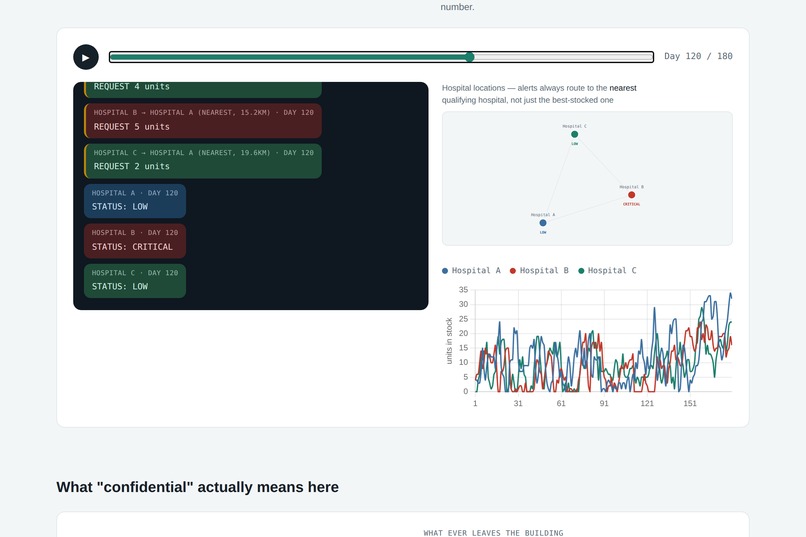
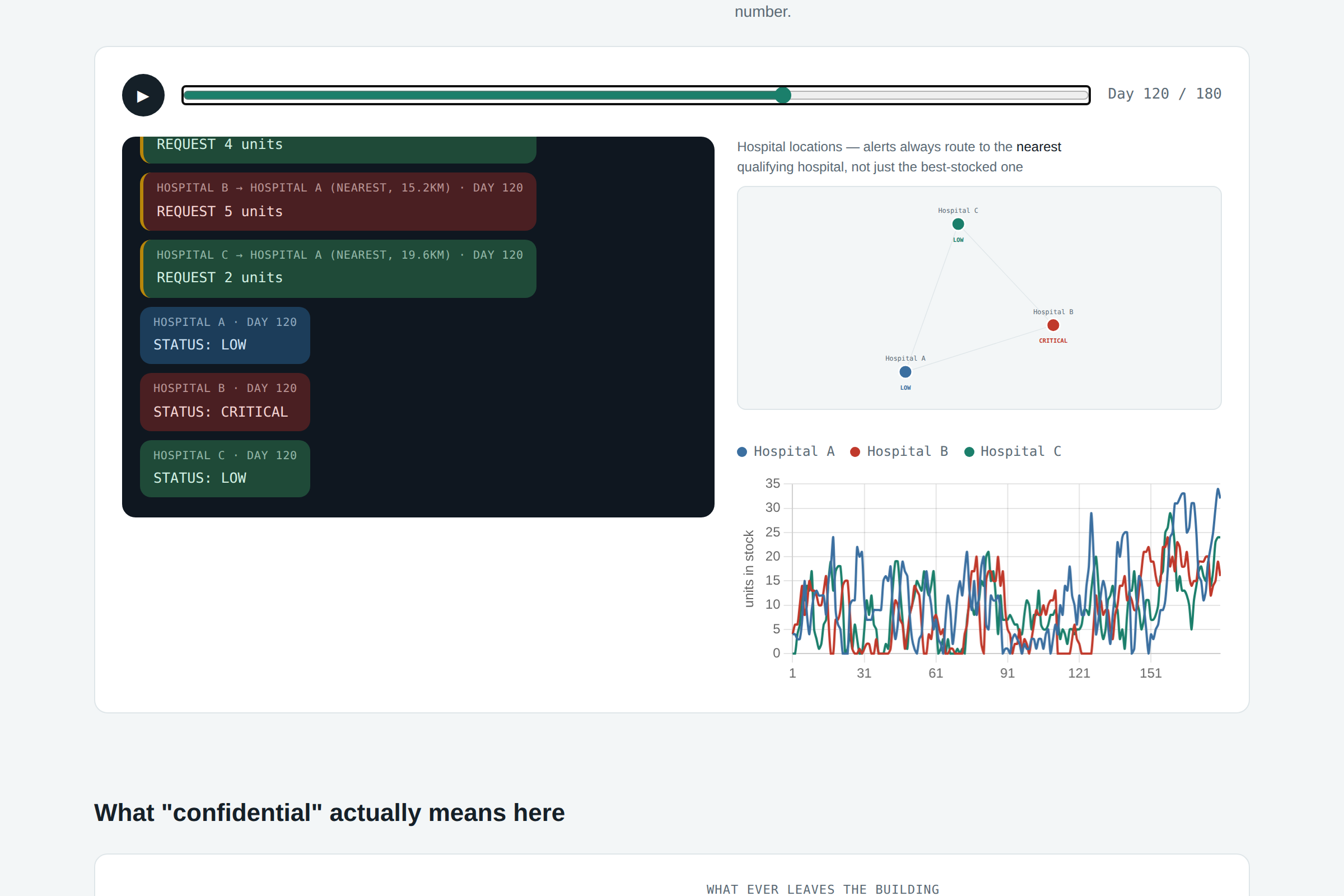
Each hospital's AI learns, purely from its own experience, when to ask for help and when to offer its own surplus before it expires. Every request or offer is automatically routed to the nearest hospital that can actually help, using real geographic distance, not just whichever hospital happened to report good numbers last.
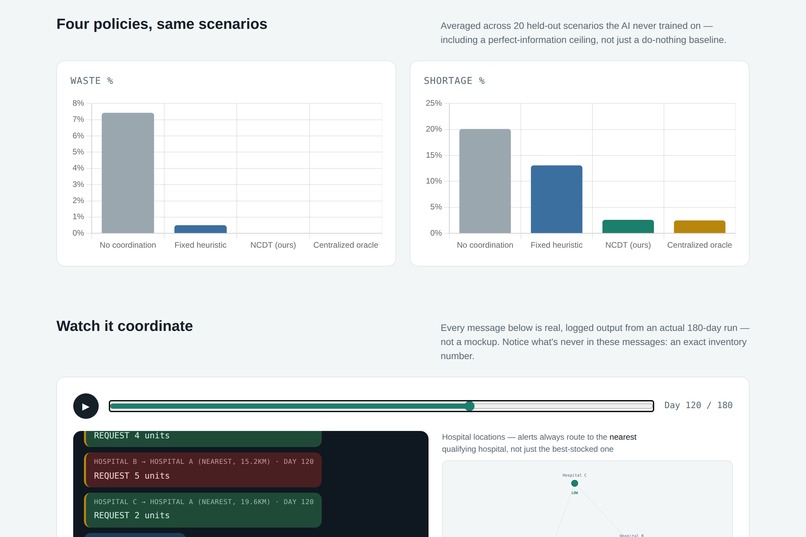
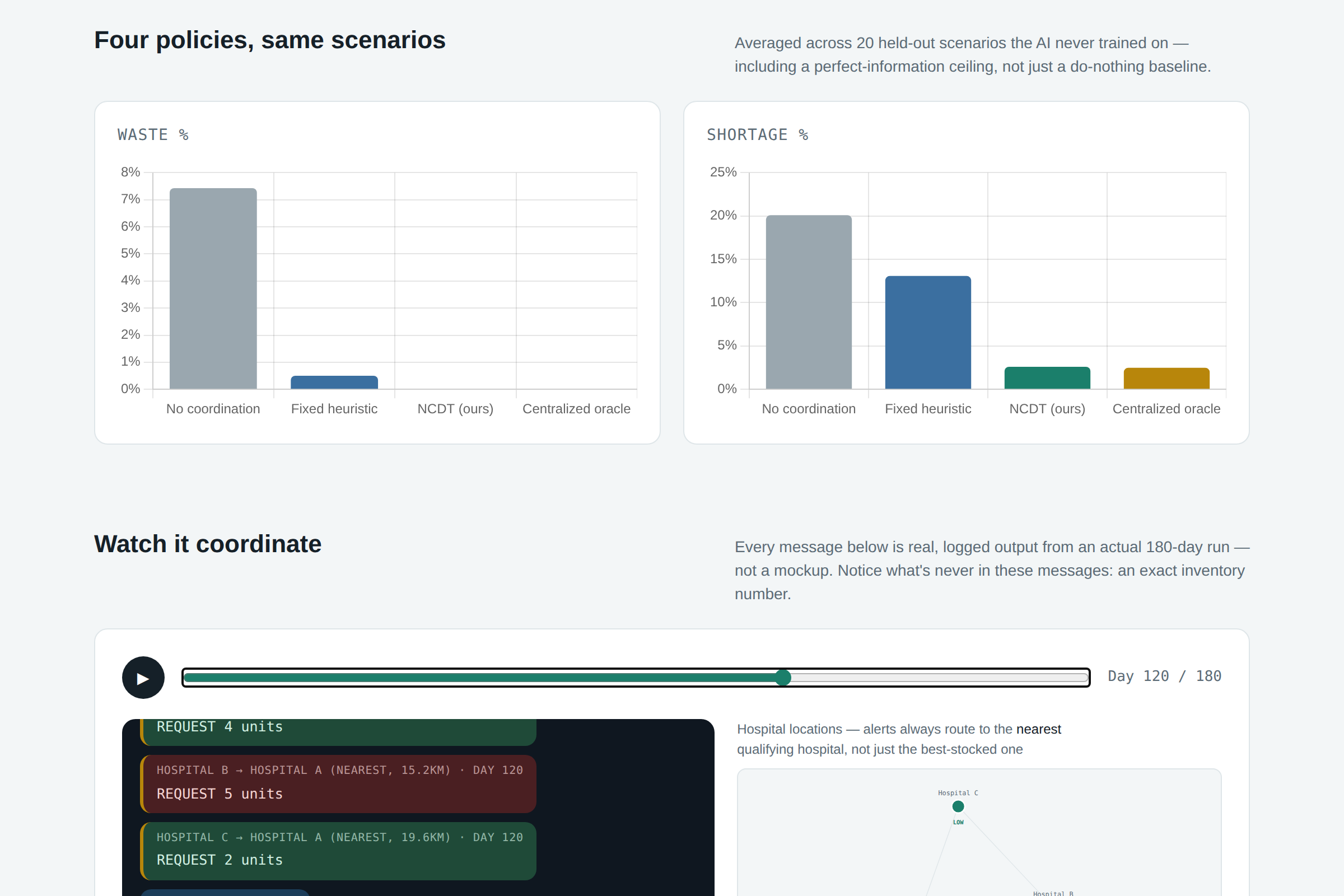
We benchmarked it against three honest comparisons, not just a flattering one:
- No coordination at all - hospitals acting independently
- A simple human-written rule - using the exact same limited information the AI gets
- A perfect-information oracle - a hypothetical all-seeing dispatcher with zero real-world constraints
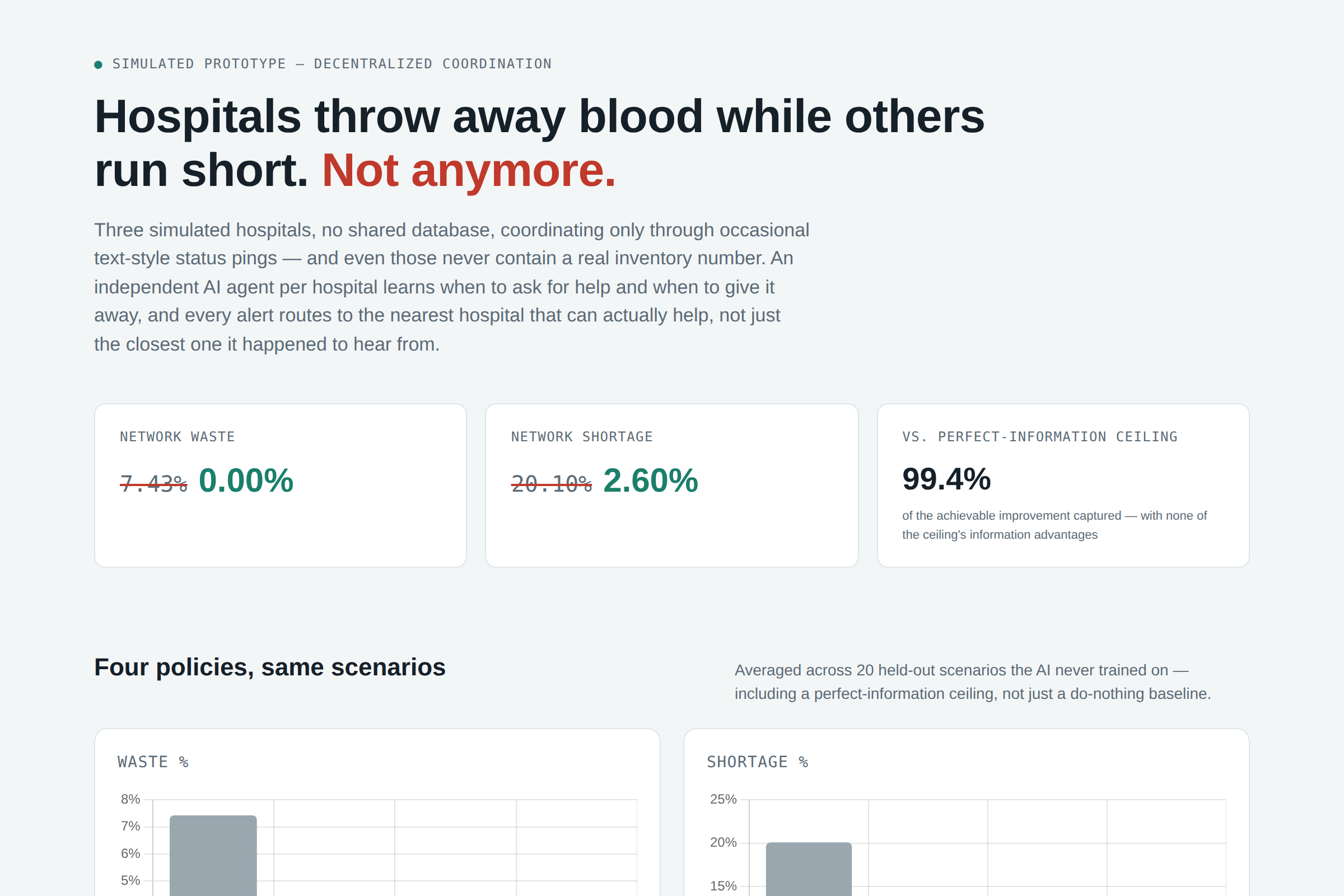
Result: Lifeblood cut network-wide waste to effectively zero and reduced shortages by roughly 87%, capturing 99.4% of what the perfect, unconstrained oracle achieved - despite having none of its advantages.
How we built it
We built the whole pipeline from the ground up, in layers:
The simulation environment - an age-structured blood inventory model in Python, tracking every unit by exact age, calibrated against real published wastage and shortage rates rather than made-up numbers. The confidentiality layer - a category function that converts a hospital's true stock into one of four coarse labels before anything ever leaves the building. This isn't encryption; it's data minimization, the system can't leak what it never collects. The nearest-hospital routing rule - real hospital locations, real computed distance, resolved deterministically and separately from anything the AI decides. The AI itself - one independent Q-learning agent per hospital, trained over 800 simulated 180-day episodes, with no shared parameters and no central controller. The centralized oracle - a perfect-information upper bound, built specifically so we'd know how much our real-world constraints actually cost us, rather than just assuming. The dashboard - a single self-contained HTML file (Chart.js bundled locally, no external dependencies) that replays real logged events from an actual evaluation run: real status pings, real dropped messages, real transshipments, on a live map.
Every number in the demo is real simulation output. Nothing is a mockup.
Challenges we ran into
Proving it was actually novel, not just untested. Before writing a line of code, we ran an extensive literature search and kept finding that "obvious" good ideas in this space were already published, sometimes within weeks. We had to specifically hunt for the combination of decentralization, confidentiality, and distance-based routing that nobody had put together, rather than assuming any one clever idea was automatically new.
Catching our own bug in the fairness of our best result. Our first version of the centralized oracle only let hospitals push away expiring surplus, it never let a hospital in shortage pull from one with plenty. That made our AI look like it was beating a "perfect" system, which should never happen and was our signal something was wrong. We found it, fixed it to be symmetric, and only then trusted the number.
While preparing screenshots, we discovered the dashboard's charts depended on an external CDN that silently failed in a restricted network environment. That's exactly the kind of thing that could kill a live demo in front of judges. We rebuilt it to be fully self-contained, it now works with zero internet connection.
Accomplishments that we're proud of
- Capturing 99.4% of a perfect-information system's achievable improvement, using none of its advantages: a genuinely surprising, rigorously checked result, not a rounded-up estimate.
- A dashboard that shows the AI's actual decisions in real time - a live map, a real message thread, a real confidentiality boundary - instead of a static slide claiming it works.
- Grounding every claim against real, dated, cited research, and being willing to say "this exact idea already exists" and pivot, rather than overselling.
- Formalizing the system as a precisely defined model - not just an idea, but named equations, an architecture diagram, and a reproducible experiment.
What we learned
We learned that "AI for social good" is one of the most heavily worked research spaces in the world right now - nearly every clever idea we generated turned out to already have a 2024–2026 paper behind it. Finding a genuine gap meant getting specific about exactly which combination of constraints nobody had modeled together, not just picking a good cause.
We learned that a fair upper-bound comparison is worth building even when it's inconvenient - our first instinct produced a flattering result, and only by building the harder, more honest comparison did we find out our real result was even better than the flattering one.
And we learned that privacy doesn't have to mean cryptography. Sometimes the most deployable version of "confidential" is simply never generating the sensitive number in the first place.
What's next for Blood Without Borders
- Model real transport time and cost between hospitals: transshipment is currently treated as instantaneous once decided; real distance should affect real delivery delay, not just routing choice.
- Validate against a trained centralized RL model, not only a greedy oracle, to get an even tighter estimate of what decentralization truly costs.
- Scale to larger, more heterogeneous hospital networks beyond our current three-hospital proof of concept.
- Build a platelet-calibrated variant: platelets have a far shorter, more volatile shelf life than the red blood cells we modeled, and the same coordination problem likely looks different under tighter time pressure.
- Replace the simulated SMS layer with a real SMS/USSD integration, and look for a real regional hospital network willing to pilot it.

Log in or sign up for Devpost to join the conversation.