Inspiration
Our journey began with the "AI for Good" hackathon, which introduced us to the critical mission of the Blood Warriors NGO in India: to support patients with Thalassemia, a condition requiring lifelong blood transfusions. We realized that solving this problem required more than just a logistics app; it required a deep understanding of the human experience.
Patients, especially children, face immense emotional and mental tolls. Donors, the heroes of this story, are driven by altruism and deserve to feel truly valued. This inspired us to ask: How can we use AI to facilitate empathy and connection at scale?
The idea wasn't just to build a chatbot, but to create a culturally-aware companion. This led us to the core concept of this project: fusing a custom Large Language Model (LLM) with the rich cultural and consumer insights of the Qloo Taste AI™ API to build a platform that supports the whole person, not just their medical condition.
What it does
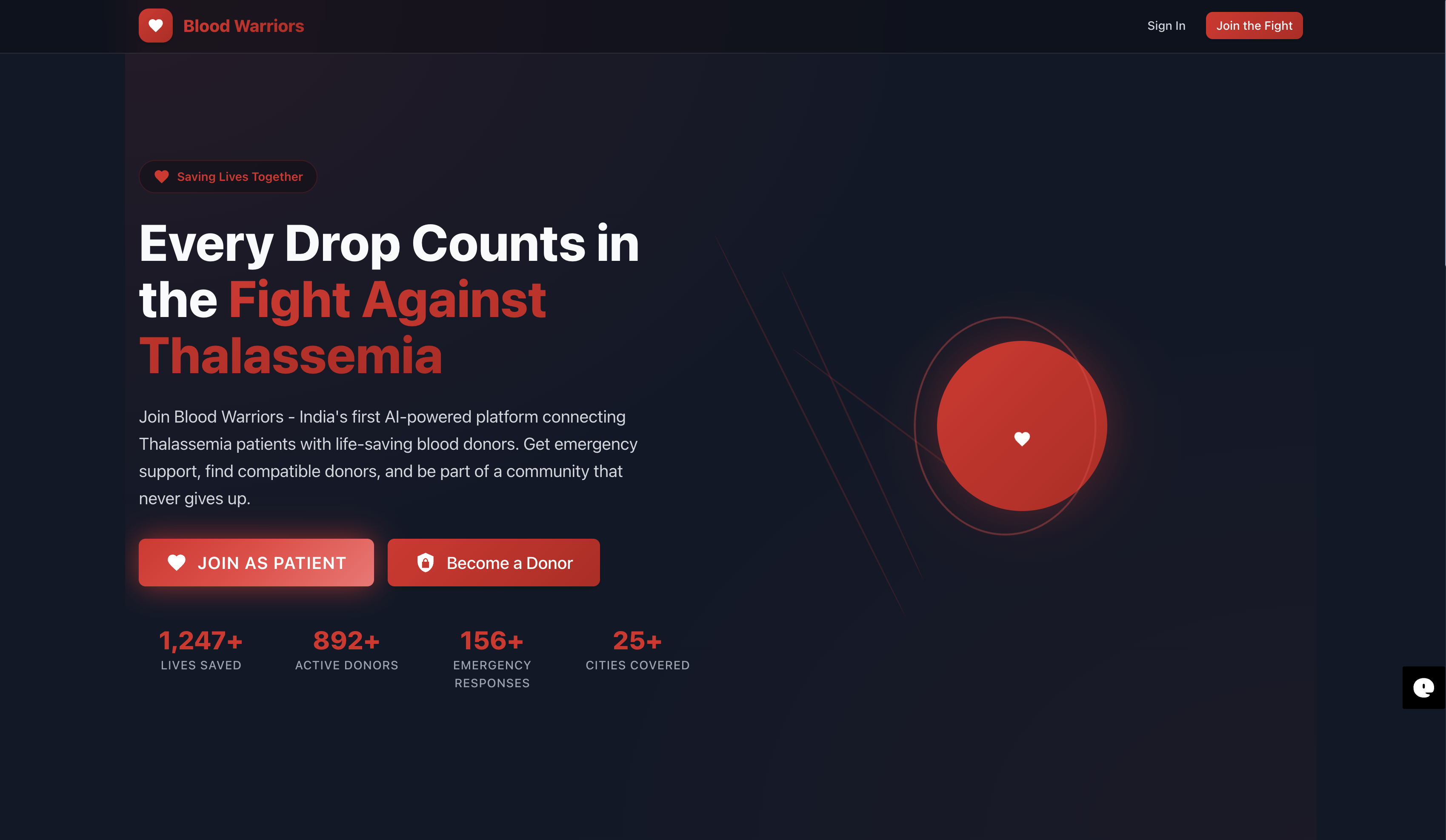
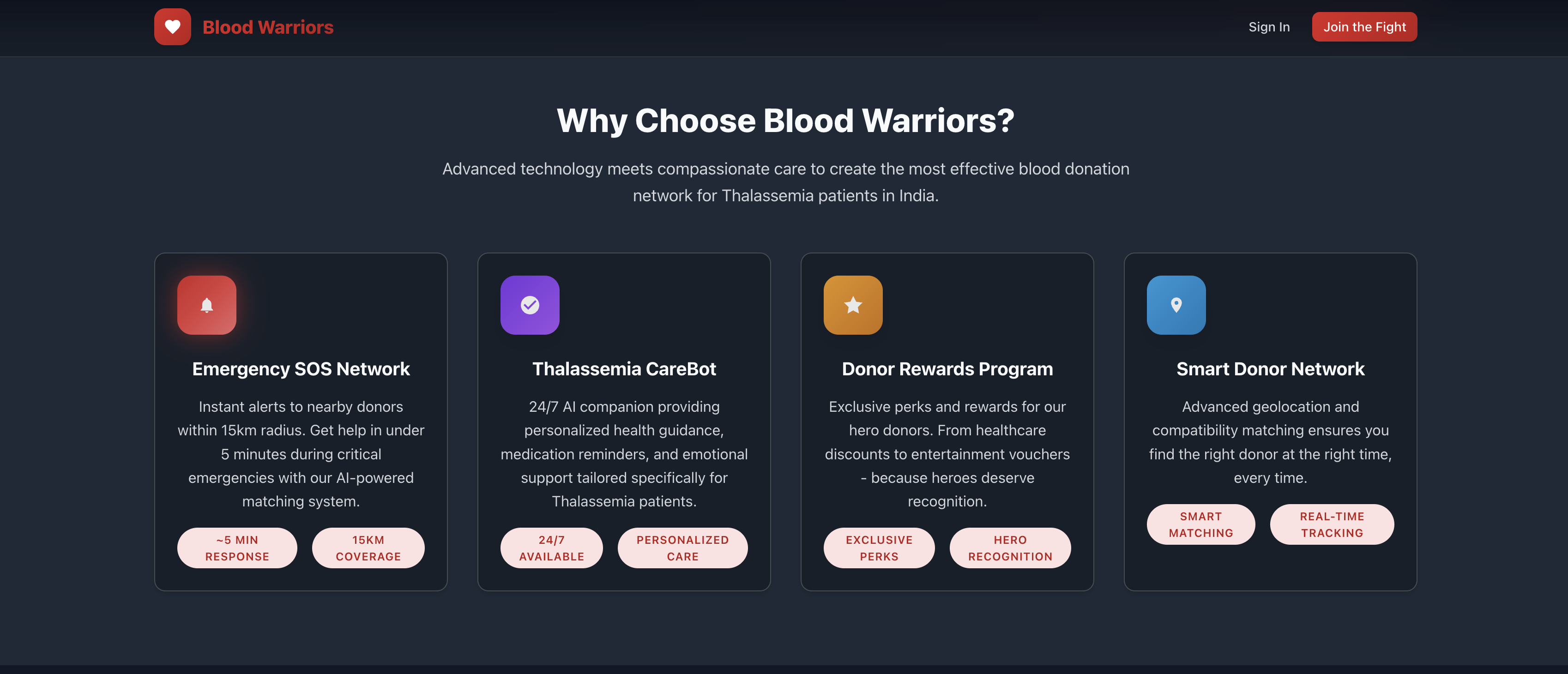
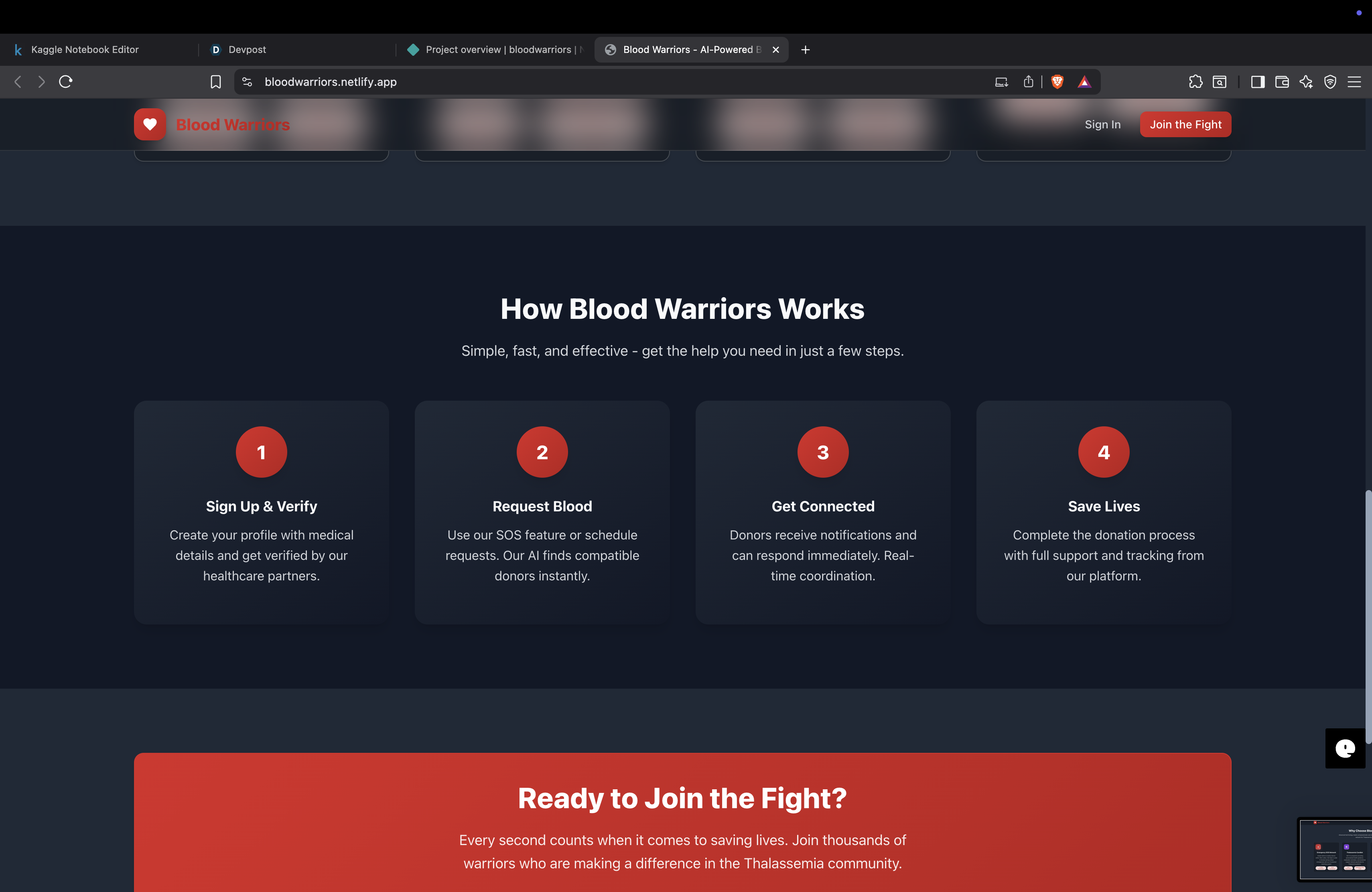
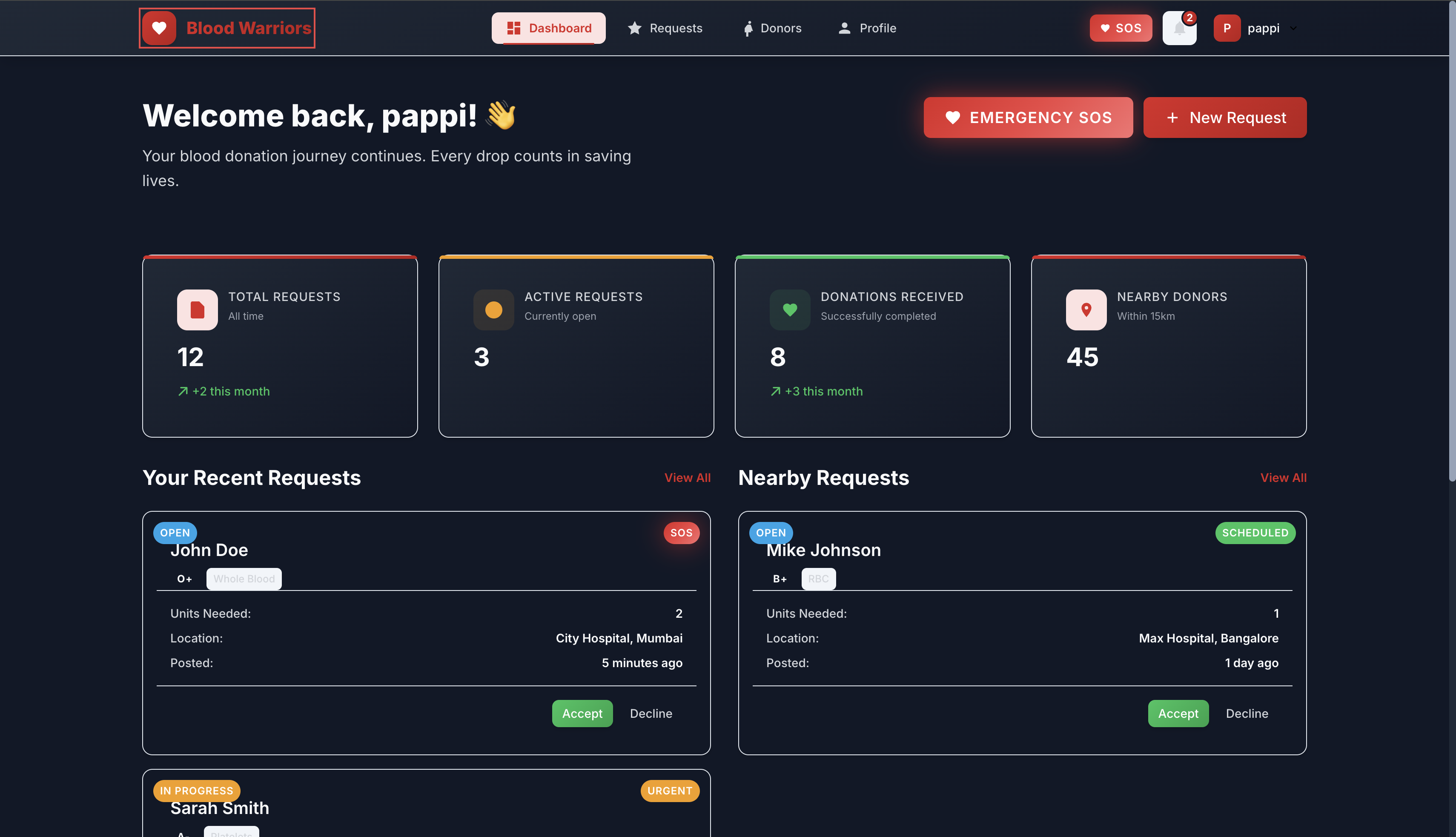
Blood Warriors AI is a comprehensive platform designed to support Thalassemia patients and blood donors. For this hackathon, we focused on two key features powered by the LLM + Qloo integration:
The Empathetic Companion (for Patients): We built an AI chatbot, the "CareBot," that serves as a supportive companion. When a patient expresses feelings of sadness or boredom, our system uses their known interests (e.g., "cricket," "movies," "art") to provide personalized, comforting conversations and suggest relevant, uplifting distractions. It moves beyond generic responses to create moments of genuine connection.
The Donor Perks Program (for Donors): To combat donor fatigue and show appreciation, our platform automates a personalized rewards system. After a successful donation, the backend uses the Qloo API to analyze the donor's taste profile. It then matches them with a relevant, real-world reward from our database of partner coupons, sending them a "thank you" that feels personal and meaningful.
How we built it
Our platform was built with a modern, scalable tech stack, with the AI integration at its core.
Backend: We used Node.js with Express to build a robust REST API.
Database: PostgreSQL on Supabase served as our single source of truth, housing our detailed schema for users, donations, and partner coupons.
The LLM (CareBot): We fine-tuned the powerful Llama 3 8B Instruct model using QLoRA. To overcome hardware limitations, we ran our training script in a Kaggle Notebook, which provided the necessary free GPU resources. The model was trained on a custom dataset of empathetic, context-aware conversations tailored to the Indian cultural context.
The Cultural AI (Qloo):
- For the Empathetic Companion, our Node.js backend fetches a patient's interests from our database and injects them as
User Contextinto the system prompt before calling our fine-tuned LLM. - For the Donor Perks Program, a database trigger on a new donation calls a backend webhook. This service queries the Qloo Taste AI™ API with the donor's interests to get an enriched taste profile, which is then used to find a matching coupon from our database.
- For the Empathetic Companion, our Node.js backend fetches a patient's interests from our database and injects them as
Challenges we ran into
Hardware Limitations: Our biggest technical hurdle was fine-tuning the Llama 3 8B model. Our initial attempts on Google Colab's free tier consistently crashed due to RAM limits. We overcame this by migrating our entire fine-tuning workflow to Kaggle Notebooks, which provided free access to powerful GPUs (P100) with enough memory to complete the job.
Meaningful Prompt Engineering: Getting the LLM to effectively use the cultural context was a challenge. We iterated through dozens of system prompt designs to find the perfect structure that instructed the model to be empathetic, leverage the user's interests, and adhere to safety guardrails (like never giving direct medical advice).
Data Scarcity: There are no public datasets for Thalassemia patient conversations. We had to manually create our entire fine-tuning dataset from scratch, carefully crafting high-quality examples to teach the model the specific tone and personalization we wanted.
Accomplishments that we're proud of
A True LLM + Qloo Integration: We're incredibly proud of creating a feature that doesn't just use two AIs, but makes them work together. By feeding cultural context from Qloo into our LLM's prompt, we created a conversational experience that is genuinely more personalized and empathetic.
Democratizing Fine-Tuning: Successfully fine-tuning a state-of-the-art LLM on a completely free platform (Kaggle) was a major accomplishment. It proves that any developer with a good idea can build highly specialized AI without needing access to expensive hardware.
Building for Impact: More than any technical achievement, we are proud of designing a system that addresses a real, pressing social need. Every feature was built with the goal of making a difficult journey a little bit easier for patients and making heroes feel truly celebrated.
What we learned
Context is the New King: This project proved that the future of AI is in context. A generic LLM is useful, but an LLM armed with specific, personal context from a service like Qloo becomes exponentially more powerful and human-like.
The Power of Small Data: We learned that for fine-tuning, a small, high-quality, and carefully curated dataset is far more effective than a large, noisy one. Our 50 hand-crafted examples were enough to drastically change the model's behavior.
AI for Emotional Connection: Our biggest takeaway is that AI's most profound application may not be just in automating tasks, but in its ability to facilitate empathy and understanding at scale.
What's next for Blood Warriors
Our vision for Blood Warriors is just beginning. Our next steps are:
Full Prototype Development: Build out the complete, working application, including the live SOS donor-matching system with real-time location tracking.
Onboard Local Partners: We will begin approaching local businesses in Lucknow, India, to partner with us and populate our
Couponsdatabase, making the Donor Perks Program a reality.Deploy and Test: Our ultimate goal is to partner with the Blood Warriors NGO to deploy a pilot version of the platform and gather feedback from real patients and donors, allowing us to make a tangible impact in our community.
Built With
- blood-warriors-rest-api
- express.js
- hugging-face-hub
- javascript
- kaggle-notebooks
- kiro-ide
- node.js
- python
- qloo-taste-ai?-api
- supabase

Log in or sign up for Devpost to join the conversation.