-
-
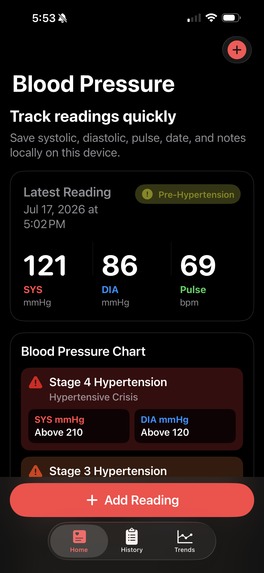
Main screen
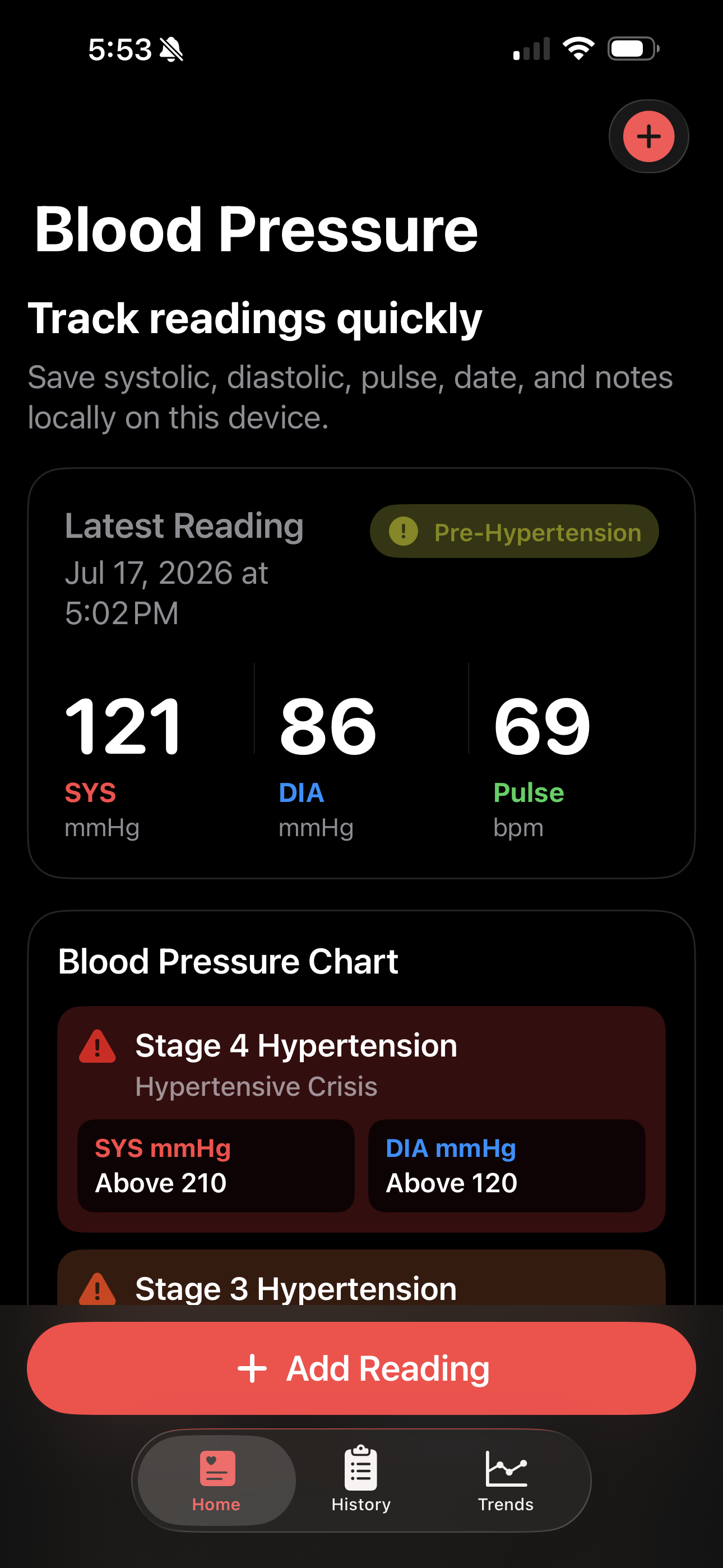
Inspiration
Blood pressure is often measured in a few seconds, but the useful story develops over time. I built Blood Pressure Log to make that routine simple and private: no account, subscription, advertising, or cloud service.
What it does
Blood Pressure Log is a native iPhone and iPad app that lets people:
- record systolic pressure, diastolic pressure, pulse, date/time, and optional notes;
- see the latest reading and an informational category at a glance;
- browse and delete reading history;
- visualize systolic, diastolic, and pulse trends;
- export history as a readable text summary or multi-page PDF;
- share an export through the standard iOS share sheet; and
- clear all locally stored readings.
The app is a personal tracking tool, not a medical device. It does not diagnose conditions, recommend treatment, or replace a healthcare professional.
How I built it
The app uses SwiftUI, Swift Charts, Codable models, an ObservableObject data store, JSON persistence in UserDefaults, and UIKit's UIGraphicsPDFRenderer. It has no third-party dependencies and no backend. Readings remain on the device unless the user explicitly exports them.
How I used Codex and GPT-5.6
Codex powered by GPT-5.6 worked as my AI pair programmer throughout the project. It helped me shape the SwiftUI architecture, implement the local model and persistence store, build the history and trend views, create the text/PDF export flow, and iterate on UI details, accessibility, dark mode, privacy language, and medical-safety boundaries.
I directed the product choices, reviewed the changes, ran the app in the simulator, and iterated with Codex. Codex also inspected the final repository for exposed secrets, improved the setup and testing documentation, and verified a clean simulator build. The shipped app does not call OpenAI APIs at runtime and does not send health data to OpenAI.
Challenges and decisions
The main product decision was to keep the architecture intentionally small and local-only. This reduces setup friction and gives users a clear privacy model. Exporting a polished multi-page PDF without external packages was another challenge; the app handles layout and pagination with native Apple frameworks.
Testing
The repository includes complete setup instructions and a manual acceptance checklist. The final command-line iOS Simulator build completed successfully with code signing disabled.
Privacy
The developer does not collect, receive, sell, or share app data. Users control local deletion and any exports they choose to share.
Links
- Source code and testing instructions: https://github.com/powerusa/BloodPressureLog
- Demo video: https://youtube.com/shorts/iMXxefjz82Q

Log in or sign up for Devpost to join the conversation.