-
-
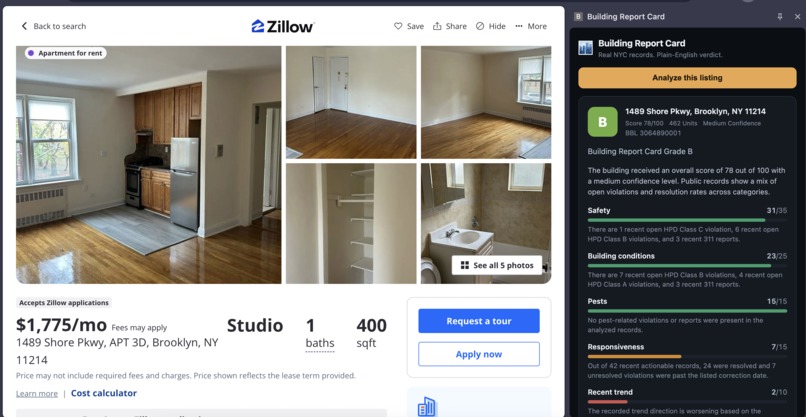
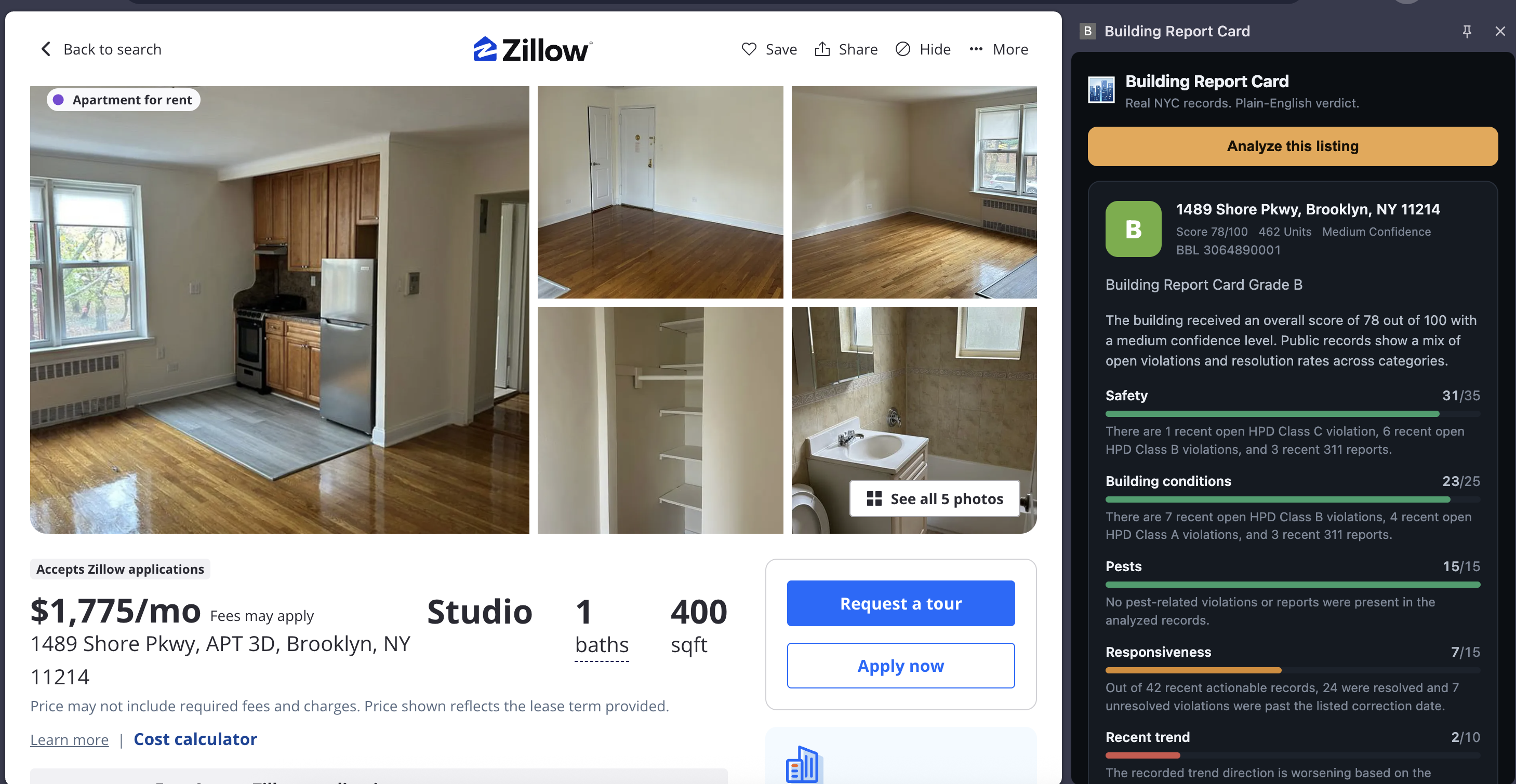
Display of report on apartment listing
-
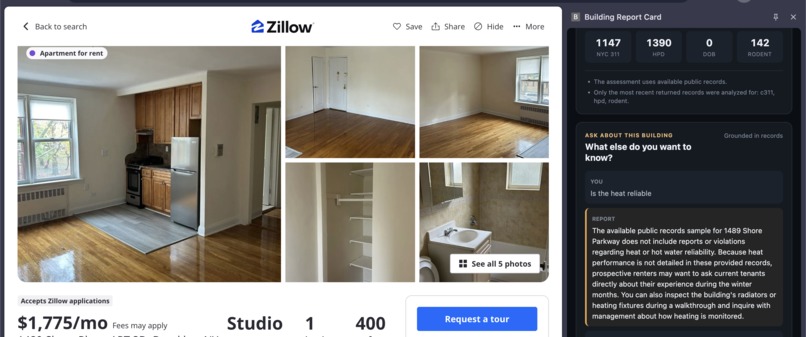
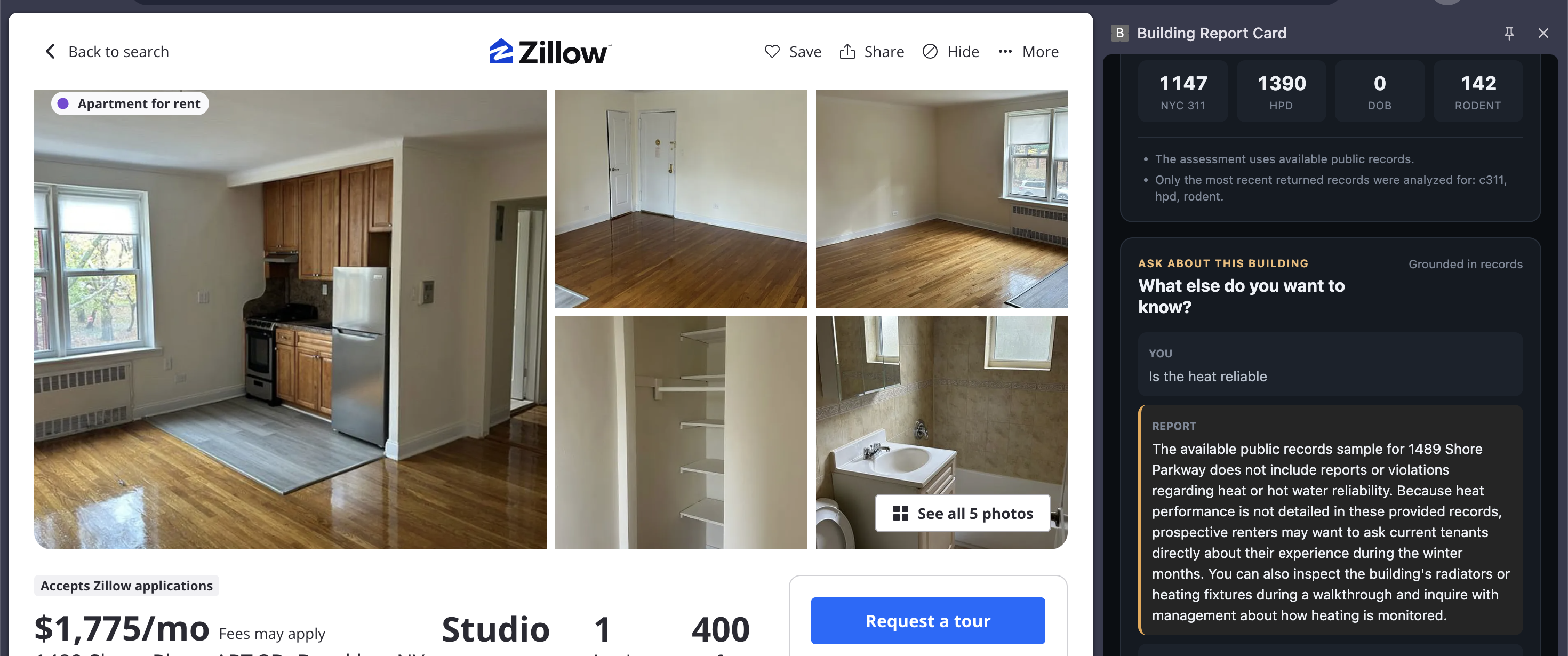
Continuation of report and chat bot feature
Inspiration
Recently I've been interested in apartment hunting as rent increases and there are a lot of factors I didn't even know existed. Having to look through housing violations for different apartments had us wondering how much of a pain it really is. On the internet there are several postings about people's "horror stories" about their apartments because they didn't research enough before signing the lease to the apartment.
What it does
Blockr is a Chrome extension that turns any NYC apartment listing into an honest report card on the building. Browse a place on Zillow or StreetEasy, click the icon, and a side panel gives you:
- A letter grade and score for the building, broken down by safety, building conditions, pests, and landlord responsiveness
- Simple explanations for each -> Example: "open hazardous violation for no hot water as of June 2026," not § 27-2031 ADM CODE
- The receipts: how many 311 complaints, HPD violations, DOB permits, and rodent inspections are on record
- An ask-anything chat: Example: "Are there rats?" or "Is the heat reliable?" which are answered straight from that building's records ## How we built it
- Frontend: a Chrome extension (React + TypeScript + Vite/CRXJS) rendered in the browser side panel.
- Backend: a Python FastAPI service that orchestrates the whole pipeline.
- Address extraction: we use Gemini to read the listing and pull a clean address by reading the /homedetails/ URL rather than scraping Zillow's obfuscated DOM.
- Data: we resolve that address to a building (BBL + BIN) via NYC Planning's GeoSearch, then join four NYC Open Data datasets (311, HPD violations, DOB permits, DOHMH rodent inspections) plus PLUTO for unit counts.
- Scoring: a deterministic engine computes the grade from weighted, normalized records so that the number is auditable, not made up.
- Explanation: Gemini then explains the score and answers chat questions, restricty by the records and forbidden from recomputing anything. ## Challenges we ran into
- We attempted to scrap the address from the listing on popular websites like StreetEasy and Zillow, although Zillow seemed to have blocked scraping so we had to use Gemini to extract the address from the website ## Accomplishments that we're proud of
- Getting a working backend in time, there was a lot of coordination needed on deciding who would work on which backend feature ## What we learned
- Civic data is very messy --> there are many parts of the datasets where we saw that addresses had different schemas, date formats, etc. ## What's next for Blockr
- Including more datasets to fit more locations (Cities, states, countries, etc.)
- A more thorough report for users to see (Specifics of 311 reports)
- Crowdsourcing (Since we don't have specific data on the apartment unit and only the building, being able to have data on the unit would be good)
Built With
- crxjs
- fastapi
- geminiapi
- python
- react
- typescript
- vite


Log in or sign up for Devpost to join the conversation.