-
-
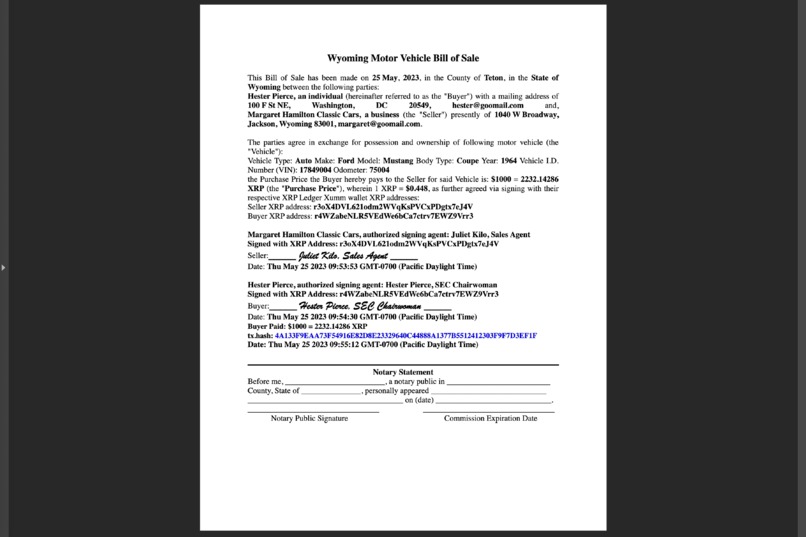
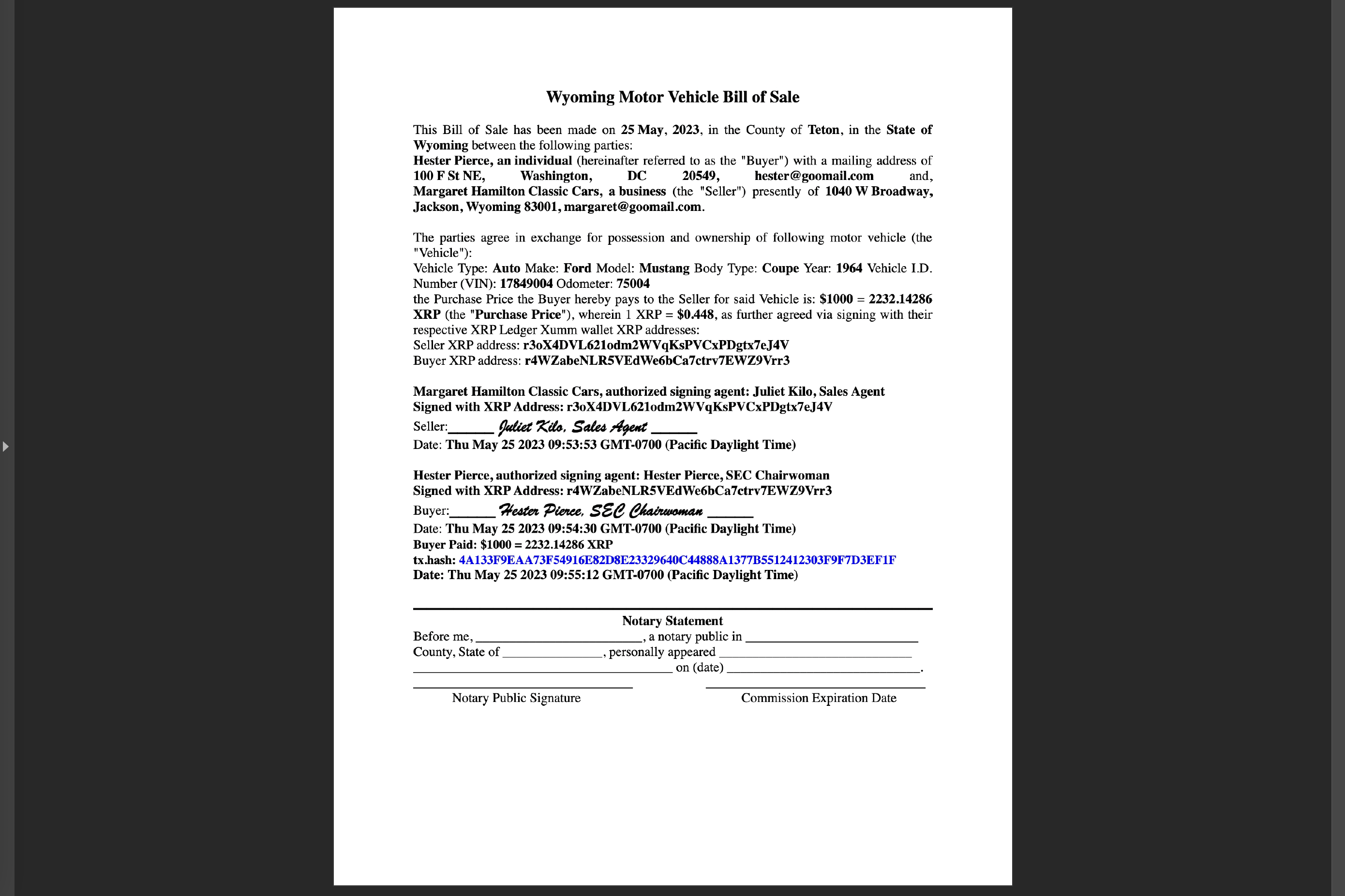
BlockDocuments.org Example: Wyoming Motor Vehicle Bill of Sale 1964 Mustang, Buyer: Hester Pierce and Seller: Margaret Hamilton Classic Cars
-
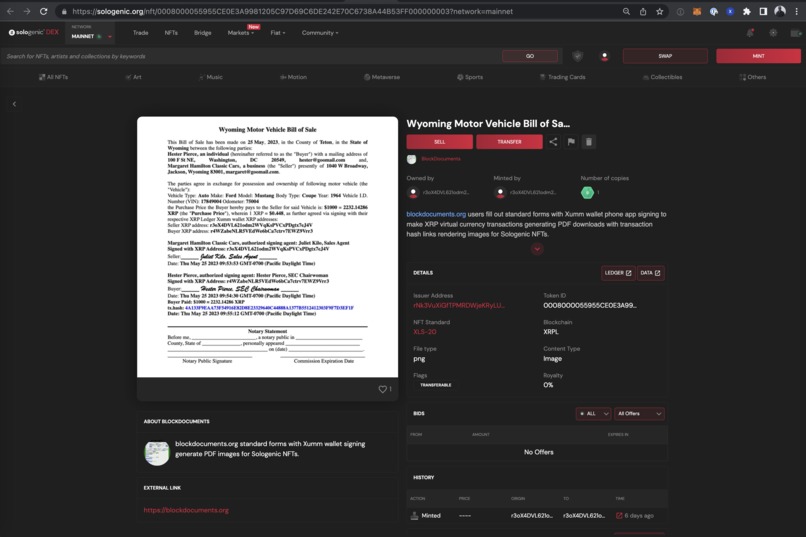
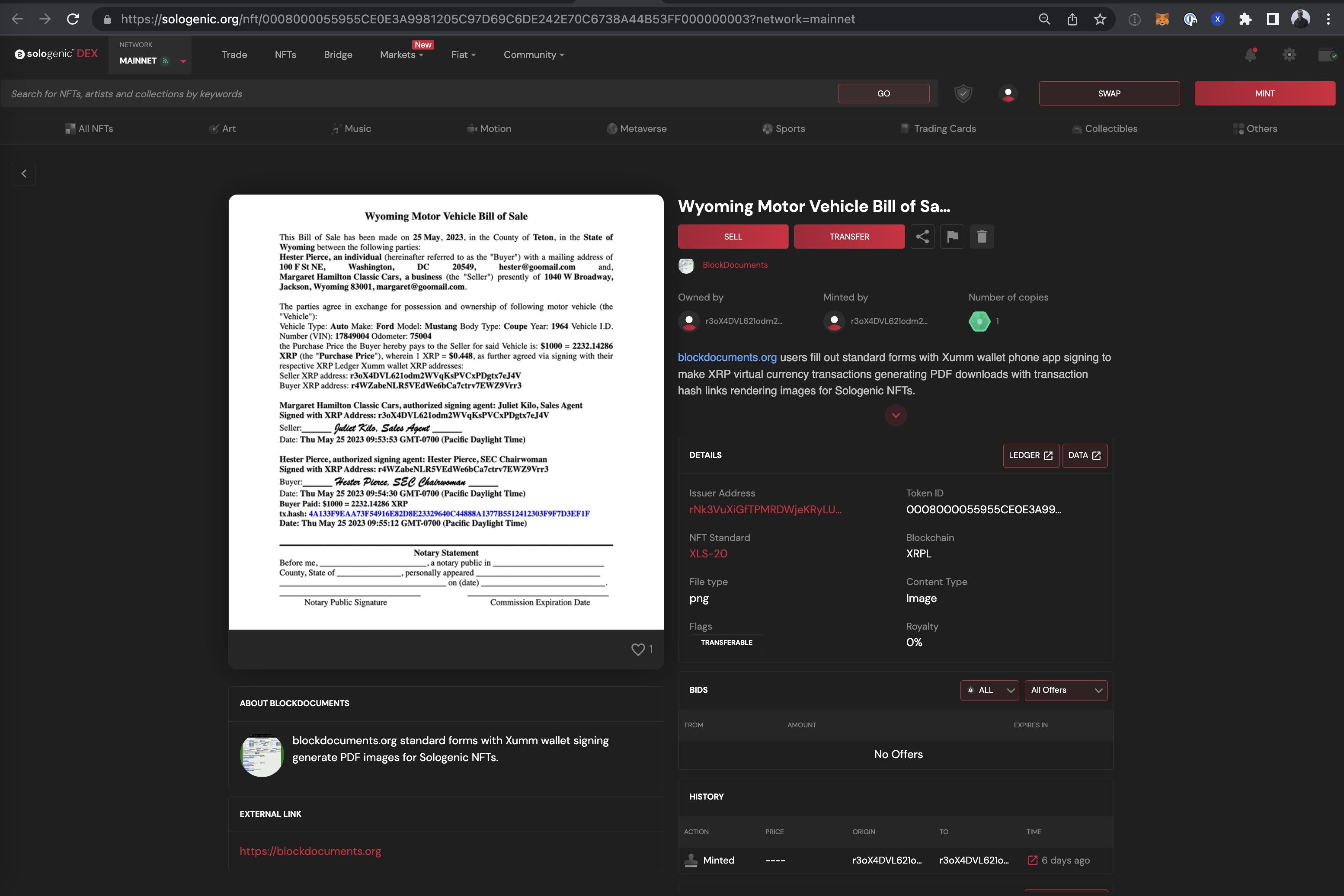
BlockDocuments.org Example: Wyoming Motor Vehicle Bill of Sale, PDF download optionally stored as PNG or (GIF) Sologenic DEX NFT image.
Inspiration
The blockdocuments.org Ripple CBDC innovation is to upgrade NFT liquidity from placeholder memes to standard retail form blockchain transaction records. The user experience is NFTs are upgraded from random memes to taking care of business.
This Devpost Hackathon project is directly supportive of the BIS-Bank of England Project Rosalind: building API prototypes for retail CBDC ecosystem innovation being "an experiment exploring application programming interfaces (APIs) for retail central bank digital currency (CBDC) and how the APIs could support innovation."
The project relates to CBDCs on the most fundamental level of liquidity with the blockdocuments.org retail XRPUSD transaction user interface workflow following the generally expected logical steps of conventional retail transactions to be negotiated, agreed to and carried out - also not to mention the source of much dispute.
What it does
Users input the standard retail forms {key: value} pairs into the Xumm API which signing and payment payloads which are executed on the XRP Ledger; thereafter generating a PDF download with transaction hash links back to their XRP Explorer record. Users then have the option to record the PDF->PNG-GIF converted images as Sologenic SOLO NFTs.
Workflow of XRPUSD retail forms UI follows general expectations sequence of first verifying material items, conditions, and identities of parties, agreeing on price in USD, then signing the document, finalized by payment in XRP at current XRPUSD rate and transferring of material items.
Security involves refreshing the screen wiping out all the data, which user data is not stored on the VPS hosting the website, only temporarily in users browsers to generate the PDF downloads.
How we built it
The blockdocuments.org website XRPUSD user interface requires only a computer, phone, and moderate learning curve practice with microscopic XRPUSD transactions operating entirely through the browser via Xumm API Javascript with the XRPL backend hence of lightest weight for the service provider networks.
Challenges we ran into
Simplification is more difficult than it sounds.
Accomplishments that we're proud of
The perception of CBDCs could use the image boost of upgrading NFT liquidity from avatar memes to widely used retail form transaction blockchain records strongly promoting direct peer to peer financial inclusion and unlocking of XRP Ledger scaling.
Users would do well to consider all immutable blockchain records are in a real sense becoming an integral part of the world view and memory field of artificial general intelligence, wherein nothing is completely hidden anymore including any evolving schemes by bad actors both inside and outside future governance, wherein blockdocuments.org provides for fundamental layer security of private property.
What we learned
At first the XRP Ledger code was a mystery to look at even with all the RippleX extensive and well-presented dev support. One could make the case blockchain software documents are evolving textbooks for some kind of graduate level lab experiment, aka, higher-order logic information age monetary system valuation of human-ai interests. We are not all mad scientists here so we spent a lot of time working through the more human-readable coding examples of the several Solidity hosting blockchains such as Cardano, Polygon, and XDC Network with several of the compiling and migrating platforms such as Remix, Ganache, React-TypeScript, and so on. All of which platforms are great however in the present case the compiling, migrating, processing learning curve ended up looking like XRPL JSON so the ledger became less of a mystery to interact with directly through the excellent Xumm wallet connectivity and developer support in the present programming instance.
What's next for BlockDocuments
At this stage one can still copy and paste a new blockchain into some level of existence -- ergo expect many to be shaken out when the proper reconciliation of sovereign-blockchain interests engages at which time the blockchains the vox populi have a reason to use will be in the surviving blockchains network of networks. Hence the Documents dropdown list is being expanded to include any number of standard retail forms Invoice, Quit Claim Deed and so on.
A new Web3 App Vender Payment Hook is proposed similar to the Super Saver partial payments transaction Hooks amendment proposal. The new app-vender partial payment transaction would replace credit card transaction fees via partial payment to website hosts disclosed to users similar to credit card-type transaction fees.
The user experience will be upgrading NFTs from random memes to taking care of business.
Built With
- html2pdf
- javascript
- sologenic
- xrpl
- xumm

Log in or sign up for Devpost to join the conversation.