-
-
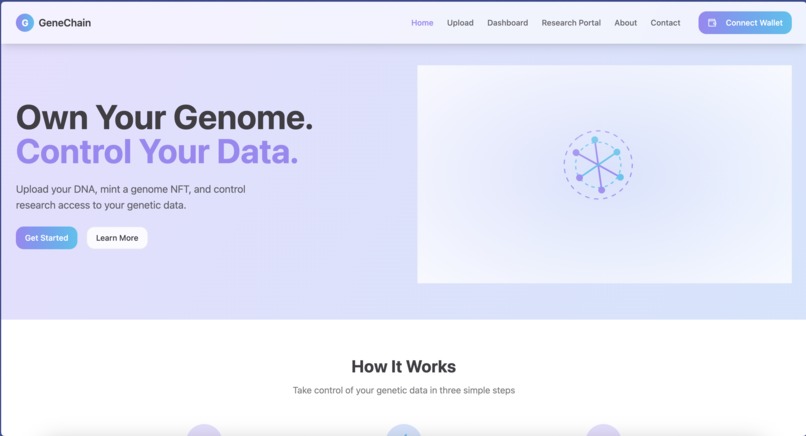
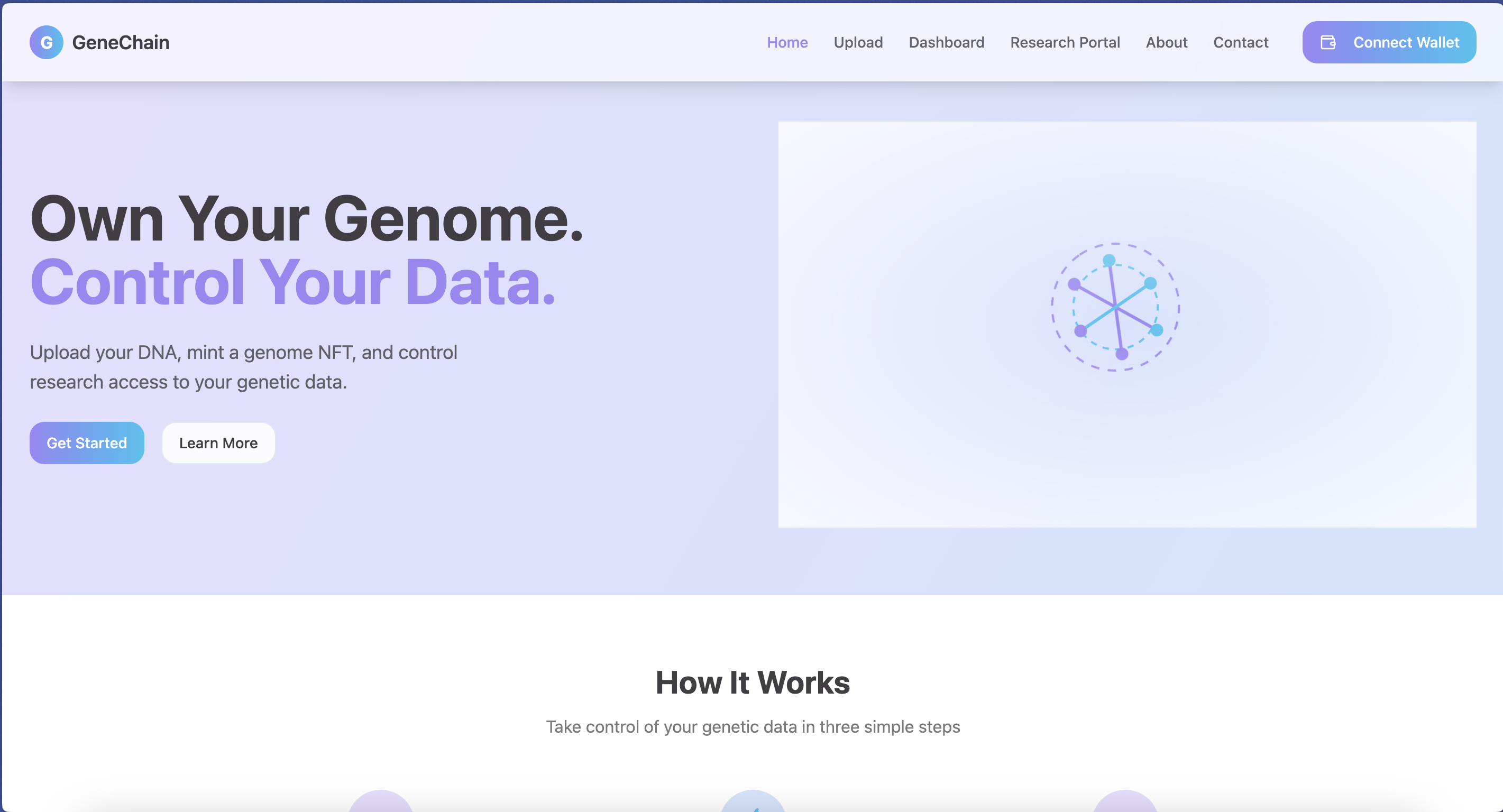
home page of the frontend part of the project
Inspiration
With the increasing use of personal genomics in healthcare and research, there’s a growing concern over privacy, misuse, and centralization of genetic data. Most current systems store this highly sensitive data on centralized servers, often without clear consent or control by the individual. Inspired by the principles of decentralization and the rise of blockchain technology, we created GeneChain to return data ownership and control to individuals — making their genome their property, not a corporation’s asset.
What it does
GeneChain is a decentralized platform that enables users to: • Upload their genetic data securely. • Mint an NFT (Non-Fungible Token) that represents and proves ownership of their genome. • Control access to their genome using smart contracts. • Store encrypted data on decentralized storage (IPFS/Arweave). • Lay the foundation for future applications like genomic marketplaces, consent-based sharing, and research collaboration with transparency.
How we built it
We built GeneChain using a modular tech stack combining: • Solidity for writing smart contracts (ERC-721 for NFTs). • Truffle for compiling and deploying contracts. • Polygon/Ethereum as the blockchain infrastructure. • IPFS for decentralized storage of genome files (planned). • Web3.js for blockchain interaction. • React + Tailwind CSS for the frontend interface. • Metamask for wallet authentication and transaction signing.
The platform allows users to upload genome files in various formats, verify their ownership, and mint a corresponding NFT to track and control that ownership.
Challenges we ran into
• Handling large file uploads (genome files can be hundreds of MBs or more).
• Ensuring data privacy while maintaining blockchain transparency.
• Designing ethical consent flows for data use in research.
• Creating intuitive UI/UX for non-technical users while dealing with complex blockchain interactions.
• Integrating IPFS in a seamless and secure way to encrypt and store files.
• Time constraints in testing and integrating all features in one cohesive flow.
Accomplishments that we're proud of
• Successfully built and deployed a smart contract for NFT-based genome ownership.
• Created a working prototype with genome upload, consent layers, and access control.
• Enabled decentralized storage and transaction flow simulation.
• Designed a clean, animated frontend that guides users through ethical data ownership.
• Sparked discussions on ethical, secure, and user-owned health data platforms.
What we learned
• Blockchain isn’t just for crypto — it can be leveraged for meaningful, privacy-centric healthcare solutions.
• How to integrate IPFS and Ethereum smart contracts in a real-world app.
• Dealing with bioinformatics file formats (.fasta, .vcf, etc.) and their storage challenges.
• Importance of UI/UX in creating trust for sensitive apps like genome data platforms.
• Nuances around consent, data ethics, and decentralized governance in genomics.
What's next for Blockchain based Genome Ownership- GeneChain
• 🔐 Encrypt and store genome data on IPFS, with on-chain hash mapping.
• 🌐 Launch a user dashboard with NFT tracking and access management.
• 🧬 Implement DAO-based governance for community-driven research access decisions.
• 💼 Enable monetization options for users who wish to license their genome data for ethical research.
• 🧪 Add genome fingerprinting to generate trait-based NFTs.
• 🧱 Build APIs for hospitals and research labs to integrate with the GeneChain ecosystem.
• 🎯 Expand awareness through educational outreach on genomic privacy and blockchain ethics.
Built With
- chai)-dev-tools:-git
- contract
- erc-721
- github
- javascript
- languages:-solidity
- nft
- node.js
- npm
- planned:-arweave)-wallets:-metamask-testing-tools:-ganache
- planned:-polygon)-cloud-&-storage-services:-ipfs
- planned:-react.js
- planned:-typescript)-frameworks-&-libraries:-truffle
- smart
- standards:
- tailwind-css)-blockchain-platforms:-ethereum
- truffle-test-suite-(mocha
- web3.js


Log in or sign up for Devpost to join the conversation.