-
-
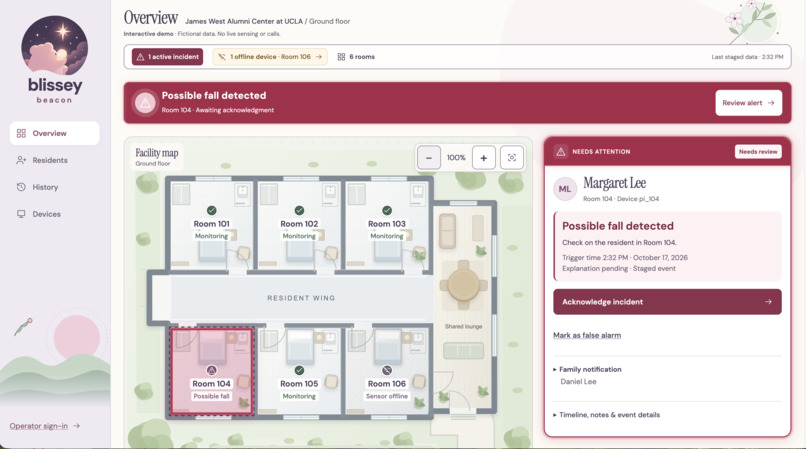
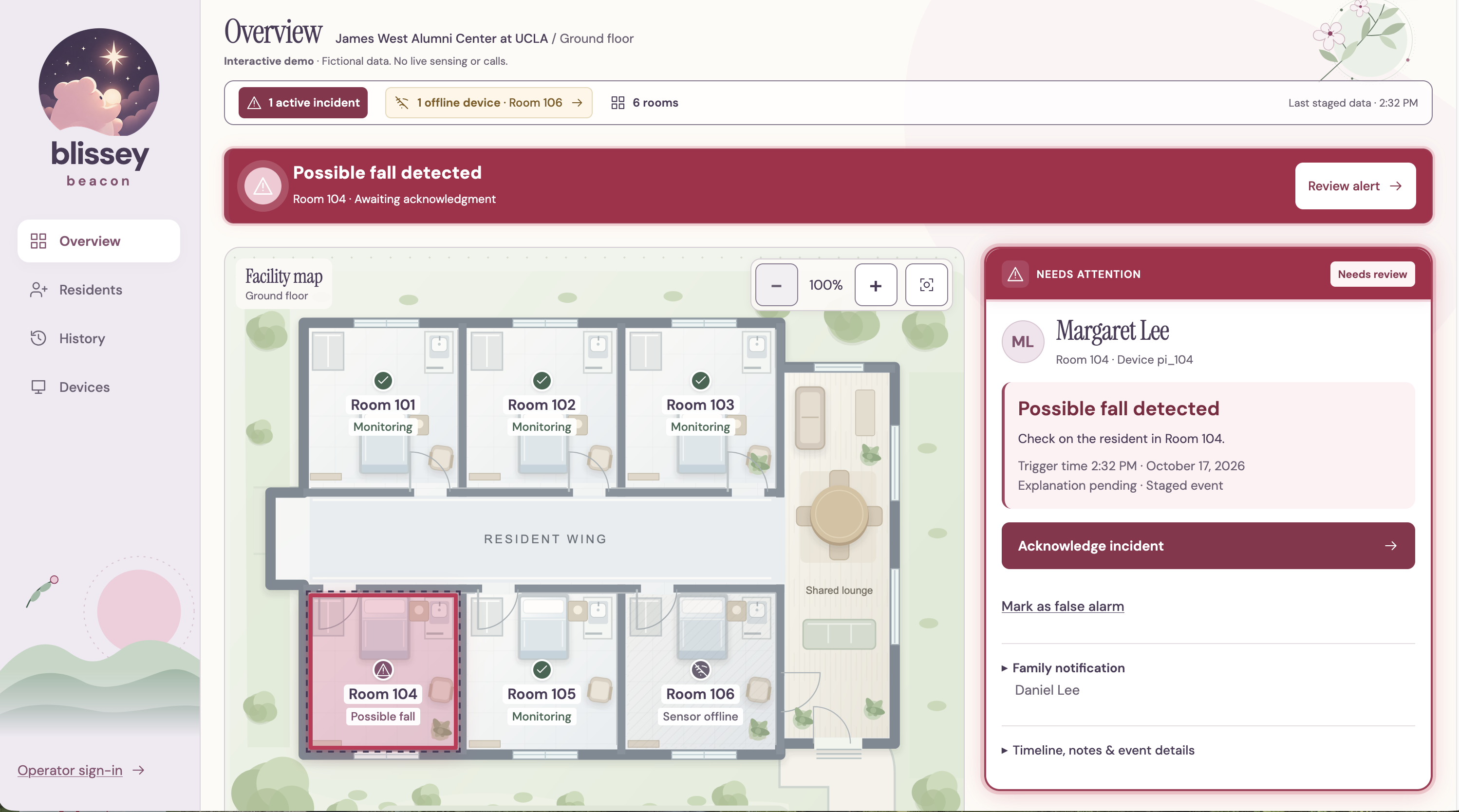
Dashboard overview
Inspiration
We were inspired by research showing how Wi-Fi signals can sense human movement and began thinking about what that could mean for people who need extra support at home. For one of our teammates, the connection was personal: their grandpa is paralyzed from the waist down, and whenever his family leaves him home alone, they worry about him falling while trying to get around. They want him to keep his independence, but it’s difficult to leave without wondering whether he’ll need help.
That concern gave our team a reason to explore the research further. Many families share the same worry, yet the available options can ask a lot of the people they’re meant to help. Cameras bring a loss of privacy in your own home, while smartwatches need to be worn and charged and are often designed around fitness. We wanted to explore whether Wi-Fi sensing could offer support without those demands.
Blissey Beacon grew from that idea. Wi-Fi is already woven into our daily lives, and we saw an opportunity to turn its signals into a quiet way to spot possible falls. Our goal is to help families look after the people they love while preserving their privacy, dignity, and independence.
What it does
Blissey Beacon explores how changes in Wi-Fi signals can reveal a possible fall, without cameras or wearables.
Our goal is to help caregivers notice when someone might need a check-in. A dashboard brings possible incidents into one place, with plain-language explanations and a workflow for reviewing updates before contacting family members.
Privacy shaped the design from the beginning. The system is designed to process movement signals locally and send structured incident information to the backend, rather than raw sensing data. Caregivers stay involved in deciding what happens next.
When the system identifies a possible fall, it creates an incident that caregivers can review through the dashboard. AI-generated explanations help make the recorded information easier to understand, while the caregiver review process keeps a person involved before escalating to family members. The notification workflow is designed to reach families through familiar communication channels, including voice calls and messaging.
How we built it
Our sensing approach uses ESP32 devices to collect Wi-Fi Channel State Information: measurements of how wireless signals change as they travel through a room. Movement affects those signals, providing patterns that a local model can learn to distinguish.
For the machine learning pipeline, we worked with collected Wi-Fi CSI data, using AP-received measurements to train a lightweight fall-detection model. We processed the raw measurements into numerical features, trained a logistic regression classifier on Veri's cloud compute infrastructure, and packaged the model for on-device inference using TensorFlow Lite. We also included a configurable detection threshold to help distinguish potential falls from everyday movement. To verify deployment, we compared the model's predictions on recorded test windows and measured inference latency on the target device.
We designed the edge system around a Raspberry Pi 5 running QNX. The backend uses Node.js, TypeScript, and Supabase to receive events, store incidents, and update a React dashboard. Gemini generates explanations from recorded incident facts. This architecture allows the sensing and inference components to operate separately from the caregiver-facing application, while keeping raw sensing data on the edge device for fast inference and security so the data stays local to the Raspberry Pi. We also built an operator-reviewed family notification workflow using ElevenLabs voice agents and Photon.
To make the system more resilient, we separated fall detection from network communication. The edge device uses a persistent, authenticated connection to transmit structured incidents, with a durable event queue that retains information during temporary connectivity failures. We also designed the backend to recognize duplicate events, preventing the same incident from being processed repeatedly. This separation allows local inference to operate independently of the cloud connection, reducing reliance on uninterrupted internet access.
We verified the hosted incident pipeline with synthetic events and tested a consented family call. Connecting and validating the full hardware sensing pipeline remains ongoing work.
Challenges we faced
The biggest challenge was getting all the pieces to work together: sensing hardware, local processing, a cloud backend, a live dashboard, and family notifications. Information had to move reliably between them, even when events arrived late, connections failed, or the same event came through twice.
We were also collecting Wi-Fi sensing data with ESP32 devices for the first time, all within a short hackathon window. Getting the devices set up, troubleshooting issues, and figuring out how to collect usable data took a lot of trial and error. Working through those problems helped us better understand the signals we were building around.
Another challenge was bridging the gap between training a machine learning model and deploying it on real hardware. We had to process the collected Wi-Fi CSI data into usable features, train a lightweight classifier, and adapt it for inference on a Raspberry Pi running QNX. Although our model passed recorded-data inference tests, getting consistent live CSI packets from the ESP32 devices proved more difficult. Debugging serial communication and hardware configurations taught us the importance of testing each part of the pipeline independently, rather than assuming that a working model meant the entire sensing system was ready.
What we learned
Building Blissey Beacon taught us that detecting an event is only part of the problem. The information also has to reach someone who can help, make sense to them, and support a thoughtful response.
We also learned to separate what our prototype demonstrates from what still needs testing. Blissey Beacon is a multi-component prototype with independently validated edge inference, cloud incident processing, and caregiver notification workflows. Our next step is to bring these components together into a fully validated live sensing system.
For us, this project is a step toward giving families more peace of mind while preserving the privacy and independence of the people they care about.
Built With
- docker
- elevenlabs
- esp32
- gemini-api
- node.js
- photon
- postgresql
- python
- qnx
- railway
- raspberry-pi-5
- react
- supabase
- typescript
- vercel
- vite
- wi-fi-csi

Log in or sign up for Devpost to join the conversation.