Inspiration
Every AI assistant on the market — Copilot, ChatGPT, Gemini — routes your data through someone else's servers. Your prompts, your files, your workflows: all of it logged, processed, and stored in the cloud. We kept asking: why does an AI assistant need to leave your machine to be powerful? It doesn't. Blink AI started from that frustration — the idea that privacy and capability shouldn't be a tradeoff.
What it does
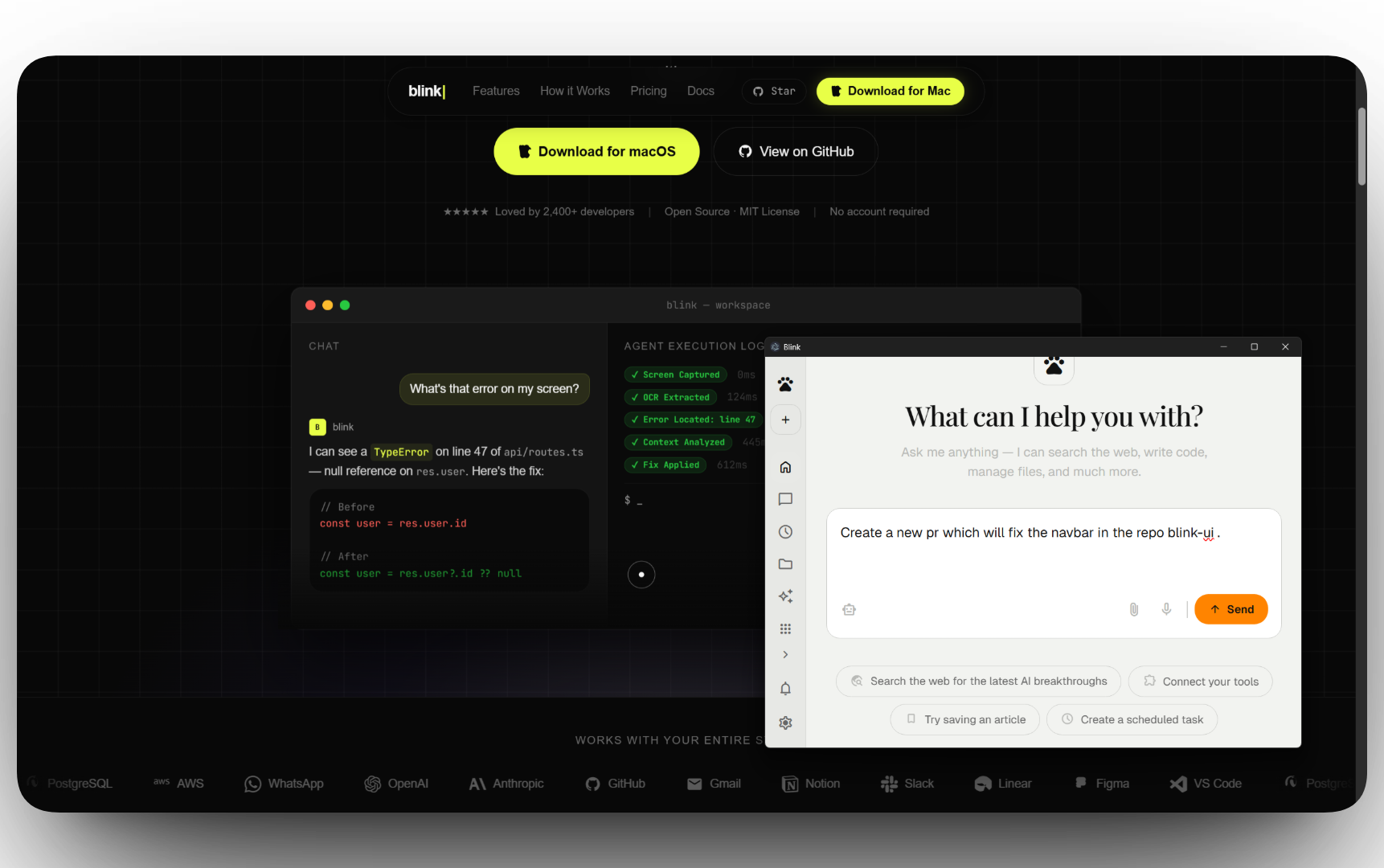
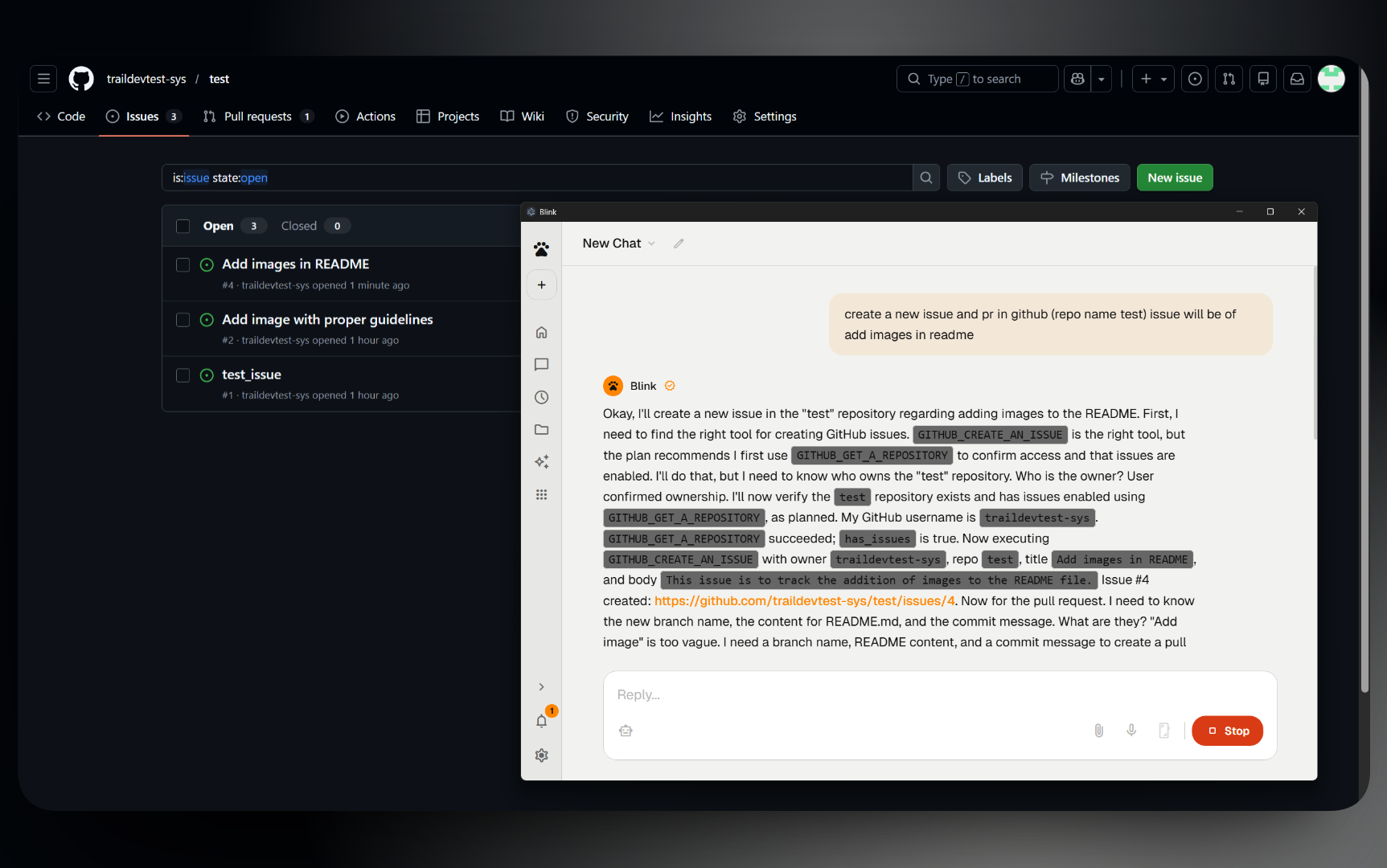
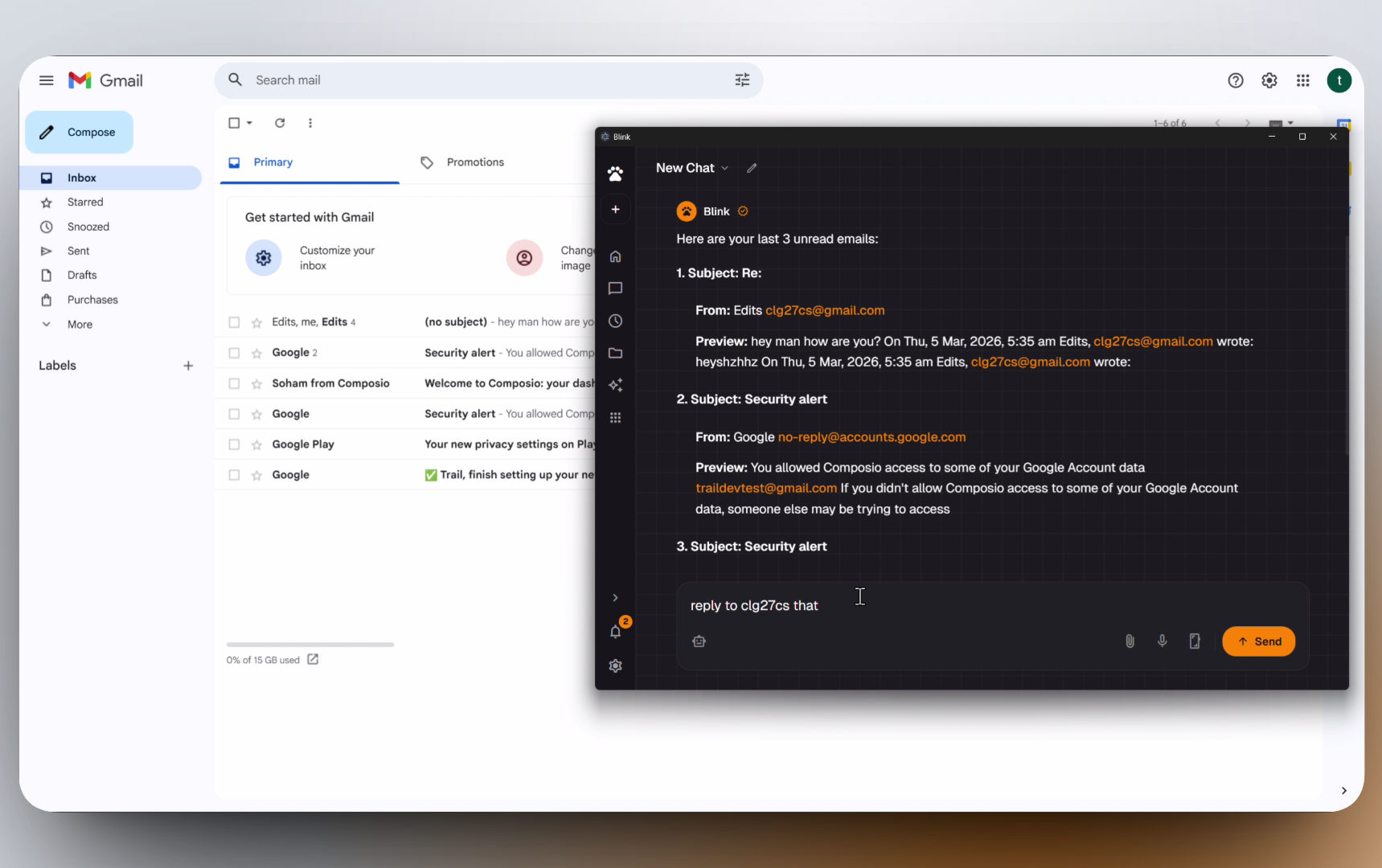
Blink AI is a desktop-native AI assistant that gives you 240+ tool integrations without sending your data to the cloud. It runs locally on your machine, connects to your apps and workflows through Composio, understands voice input via Deepgram, and handles everything from task automation to context-aware assistance — all while keeping your data exactly where it belongs: with you.
How we built it
We built Blink AI on an Electron + React frontend for a native desktop experience across platforms. Mastra powers the AI agent orchestration layer, giving us structured, reliable tool-calling without the flakiness of raw LLM outputs. Composio handles the integration layer — 240+ pre-built connectors to tools like Notion, Gmail, GitHub, Slack, and more. Deepgram provides real-time, low-latency voice transcription that runs efficiently without constant cloud round-trips. The entire architecture was designed to minimize external data exposure at every layer.
Challenges we ran into
Getting 240+ integrations to behave consistently inside a sandboxed Electron environment was non-trivial — Composio's connectors weren't designed with desktop-first constraints in mind, so we had to carefully manage OAuth flows and credential storage locally. Voice input latency was another challenge; syncing Deepgram's transcription pipeline with the agent's context window in real time required significant tuning. Keeping the UX snappy while the agent was reasoning in the background was a UX problem that took multiple iterations to get right.
Accomplishments that we're proud of
Getting 240+ live tool integrations working in a privacy-first desktop environment is something no mainstream assistant has done at this scale. We're proud that Blink AI doesn't ask users to choose between power and privacy — it delivers both. The voice-to-action pipeline working end-to-end in a live demo environment, reliably, under hackathon pressure, was a genuine technical win.
What we learned
Electron is powerful but unforgiving — desktop constraints force you to think about sandboxing, credential management, and local state in ways that web-first development never demands. We also learned that "privacy-first" is a product decision that touches every architectural layer, not just a marketing claim you bolt on at the end. And practically: Mastra's agent orchestration saved us an enormous amount of time compared to building raw tool-calling chains from scratch.
What's next for Blink AI
Local model support — letting users run smaller, quantized LLMs entirely on-device for fully offline operation. Deeper OS-level integration for file system awareness and clipboard access. A plugin SDK so developers can build custom Composio-style connectors for internal tools. Long-term, we want Blink AI to be the default AI layer for anyone who won't compromise on data ownership.
Built With
- composio
- deepgram
- electron
- javascript
- mastra
- python
- react


Log in or sign up for Devpost to join the conversation.