-
-
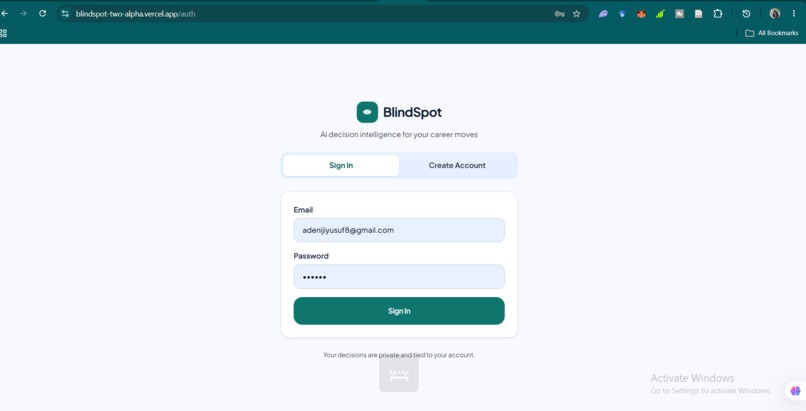
Blindspot Authentication page
-
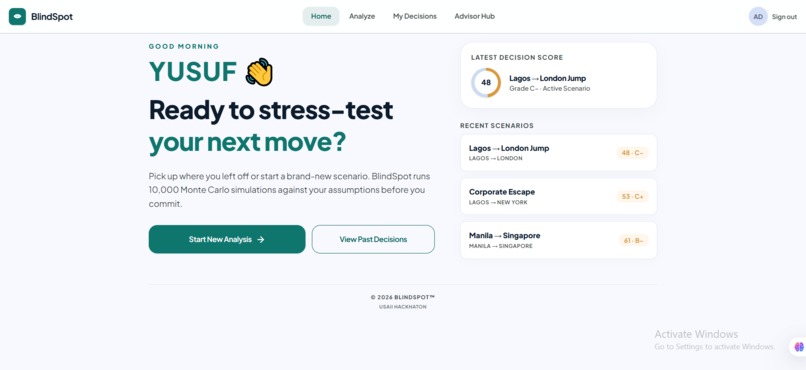
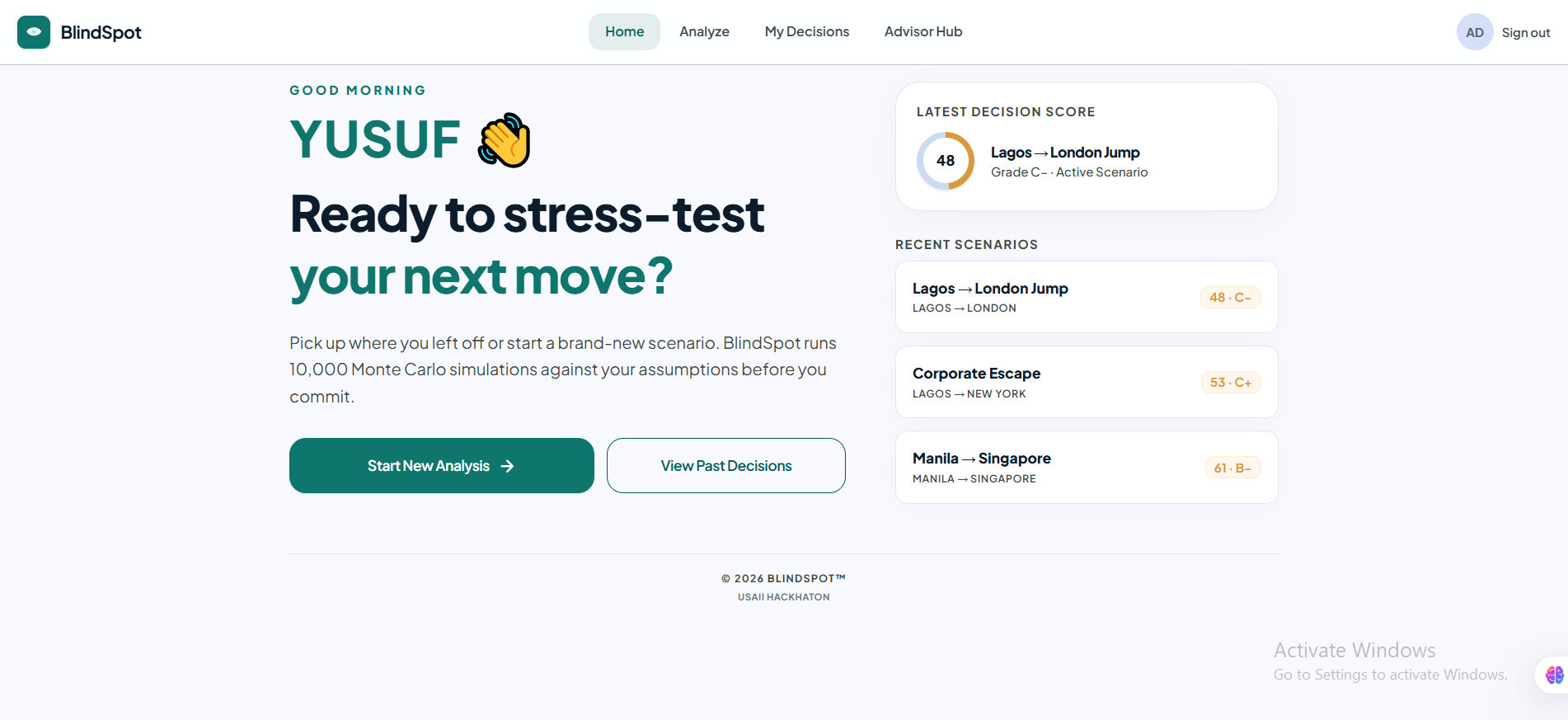
Blindspot Landing Page
-
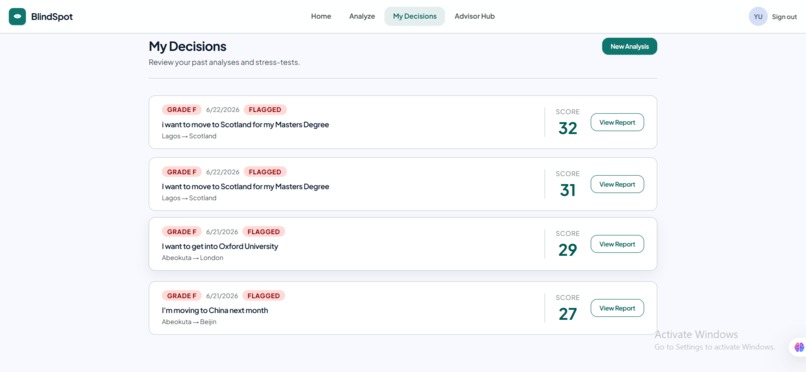
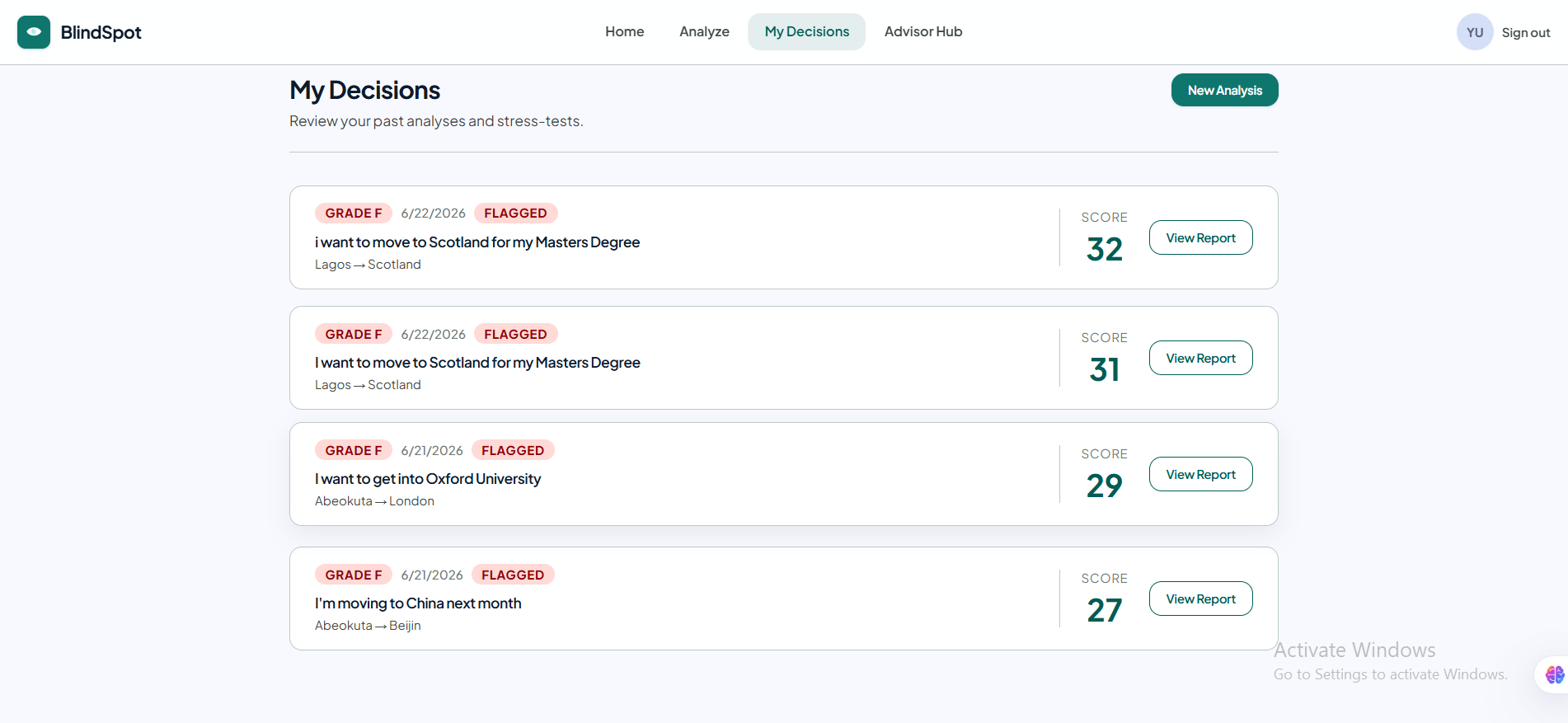
My Decisions Page (BlindSpot)
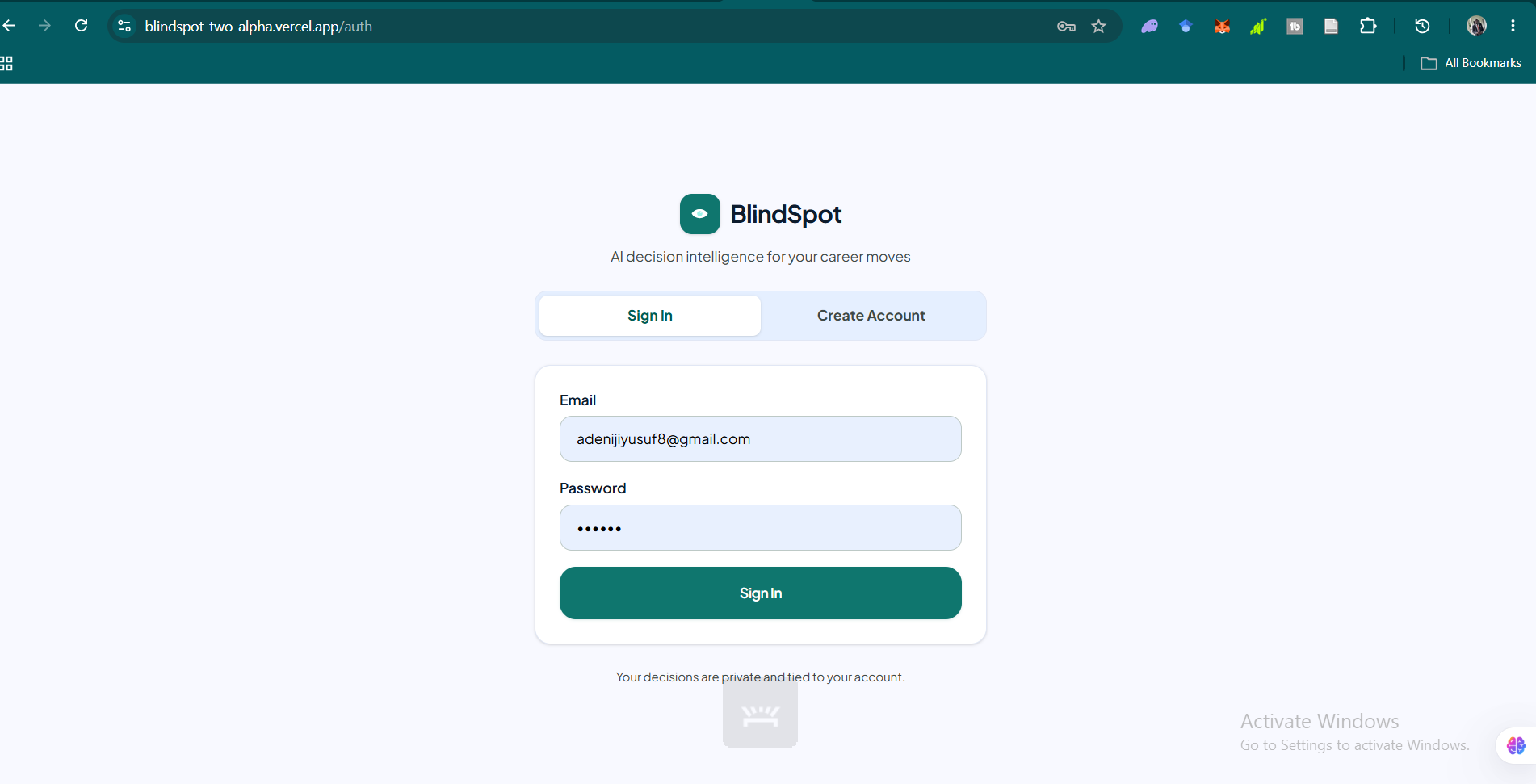
Inspiration Behind Blindspot
Every major life decision comes with the same invisible problem: you're working with assumptions, not data. We watched people around us, friends weighing relocation offers, classmates considering freelancing, family members thinking about going back to school, make these calls on gut feeling alone, while the actual numbers (real rent prices, real wage growth, real payback periods) sat publicly available and completely ignored.
At the same time, we noticed that most AI tools built for this kind of guidance are tuned for one market, usually the US, which leaves the rest of the world's decision makers underserved by the same technology. We wanted to build something that does two things generic AI chatbots don't: ground every claim in verified data instead of guessing, and work just as well for someone in Lagos, Manila, or Berlin. That's Blindspot
What it does
Blindspot is a decision intelligence tool. A user describes a high stakes career or life decision, relocating for a job, going freelance, going back to school, through a 5 step Input Matrix that captures their persona context (student, career changer, or professional), their decision, their financial assumptions, their counterfactual alternative, and their personal values ranking.
From there, the decision goes through a live three agent debate. ATLAS (the Optimist) and VERA (the Realist) stream their analysis side by side in real time, each citing real data, including real time currency figures tied to the destination country the user specified, as they argue. AXIS (the Reconciler) then synthesises both perspectives into a single Blindspot Score™, a 0 to 100 rating across four axes: Financial Realism, Optimism Bias, Planning Fallacy Risk, and Regret Alignment, visualised on a radar chart.
The user then sees a 5 Year Parallel Reality Timeline, a split screen simulation comparing the path they're considering against the path they'd take if they didn't, with Year 1, 3, and 5 milestones for each.
If the Blindspot Score™ falls below 40, the Advisory Hub activates. Instead of a generic warning, the user is shown real pathways to human guidance: LinkedIn, Topmate.io, and the national career services website for their specific target country. A "Connect Now" button also opens a prefilled email through our own domain, with the subject line generated automatically from the user's score card, so reaching out to a trustworthy counselor takes one tap instead of a blank email and a guess at what to say.
How we built it
The stack is a React, Vite, TypeScript, and Tailwind frontend talking to a Python FastAPI backend. The three agents, ATLAS, VERA, and AXIS, run on OpenAI's GPT 5.4 model, which we accessed through the Azure for Students plan. ATLAS and VERA stream token by token over Server Sent Events so the live debate is visible to the user as it happens, not delivered as a single blocking response. AXIS waits for both agents to finish, then returns a strict JSON verdict that the frontend renders directly into the score dashboard and timeline.
GetWhereNext powers our cost of living and country level economic data, and currency figures are matched to whichever destination country the user specifies, so every monetary gap shown is grounded in the right local currency. Supabase persists every analyzed decision so users can revisit their history.
As a two person team, we worked from a single shared API_CONTRACT.md defined on day one, exact request and response shapes, field names, and event types, before either of us wrote a line of feature code. That let one of us build the frontend and the other build the backend entirely in parallel on separate branches, merging into main without a single integration surprise.
Challenges we ran into while building
Our original plan was to use Numbeo for cost of living data. Partway through the build, Numbeo moved its API behind a paywall priced well outside a hackathon budget, which would have blocked the wide country coverage we wanted from day one. We needed a free source that still gave us genuinely global reach.
We found GetWhereNext, a free, open cost of living and relocation data API covering 95 countries, built on World Bank, OECD, and Eurostat data, and migrated our entire data layer to it. This ended up working in our favor. GetWhereNext's institutional sources cover regions that crowdsourced data tools often leave thin, so we came out with broader and more consistent global coverage than our original plan would have given us.
The second challenge was the Advisory Hub. Routing a user to "a counselor" sounds simple on paper, but there are limited and mostly found are behind paywalls API that connects someone to verified human career counselling across every country in the world. We were able to solve it in two layers. First, we surface real external platforms the user can onboard to directly, LinkedIn, Jobberman, Topmate.io, and a national career services link specific to their target country. Second, we built the "Connect Now" flow that opens a prefilled email through our own domain (a mocked-up domain mail) with a subject line generated from the user's actual score card, turning "I should talk to someone" into a single tap.
Accomplishments that we're proud of
We're proud that Blindspot can works for genuinely anyone, anywhere, not just students, not just one country. A two person team shipped a live multi agent AI debate, a real time streaming UI, a four axis scoring engine, and a 5 year simulation, all backed by real external data, in one hackathon cycle.
We're proud of the Advisory Hub. It was a deliberate choice to make Blindspot point users toward real human counselling the moment the stakes get high, with concrete platforms and a one tap email flow, instead of a vague "consider speaking to someone" message that no one ever acts on.
We're also proud of how clean the collaboration was. Defining the API contract before writing feature code meant two people building completely different halves of a complex system never once blocked each other, although were are thousand miles away from each other, the collaboration and experience was topnotch.
What we learned
We learned that "global" is a much harder engineering problem than it sounds. Saying a product works for any country is easy. Building a data layer that survives a vendor suddenly paywalling their API, without losing coverage, is the real work, and that exact problem turned out to have the same shape as the bias Blindspot itself is designed to catch.
We learned that contract first development isn't bureaucratic overhead for a two person team. It's the single highest leverage thing you can do before writing code, because it turns "let's sync later" into "we already agreed on this."
We also learned that responsible AI design isn't a checkbox you add at the end. Deciding what actually happens when a score crosses the advisory threshold, and making sure it leads somewhere real instead of a dead end message, had to be designed in from day one.
What's next for Blindspot
Our immediate next step is widening data source redundancy further, adding more fallback providers per region so coverage keeps improving as we find gaps. We also want to build out the persona specific tuning we started with the Input Matrix's persona context step, so a student's decision and a mid career professional's decision are scored against genuinely different baselines, not the same generic model.
Beyond that, a native mobile build so Blindspot* is as accessible on a phone in any country as it is on a laptop, deeper memory across a user's decision history so AXIS can spot personal patterns over time, and real partnerships with the career services platforms and counselors our Advisory Hub already points toward. The long term goal isn't just a hackathon demo. It's a tool that's actually sitting in someone's pocket the next time they have to make a decision that matters.
Built With
- azureopenai
- css
- fastapi
- getwherenext
- gpt
- html
- javascript
- python
- supabase
- tailwind
- topmate.io
- typescript


Log in or sign up for Devpost to join the conversation.