-
-
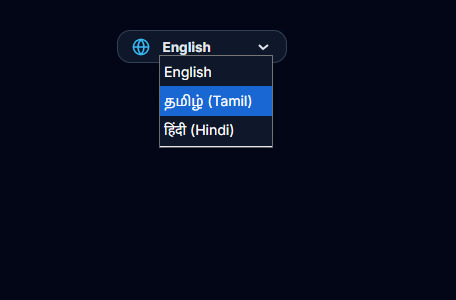
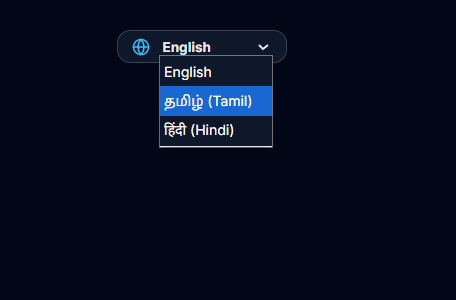
Choose any 3 language
-
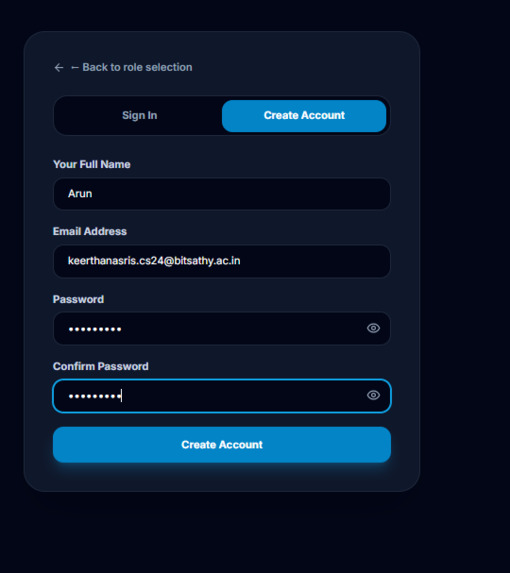
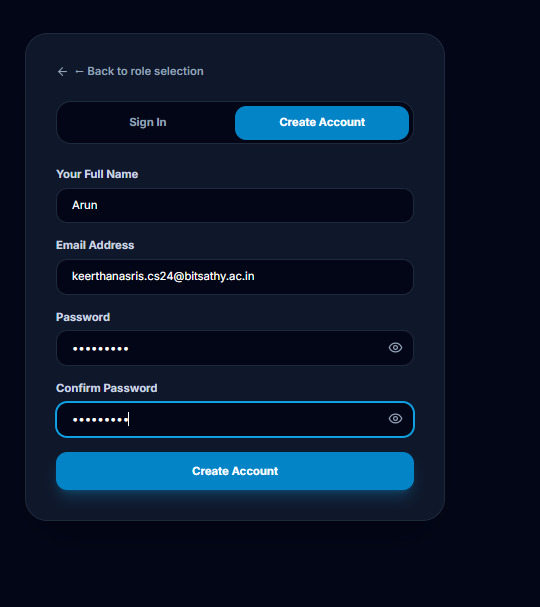
create an account
-
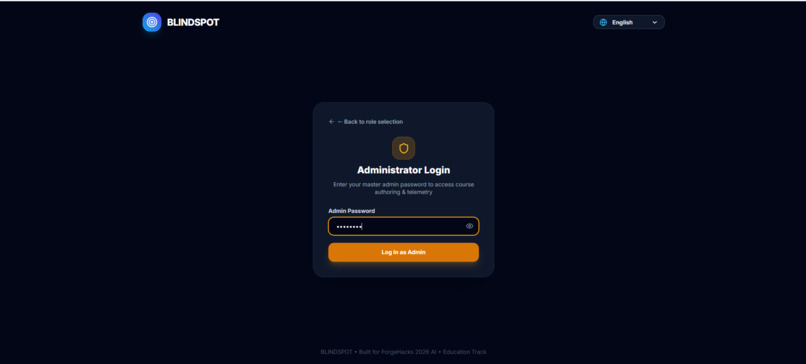
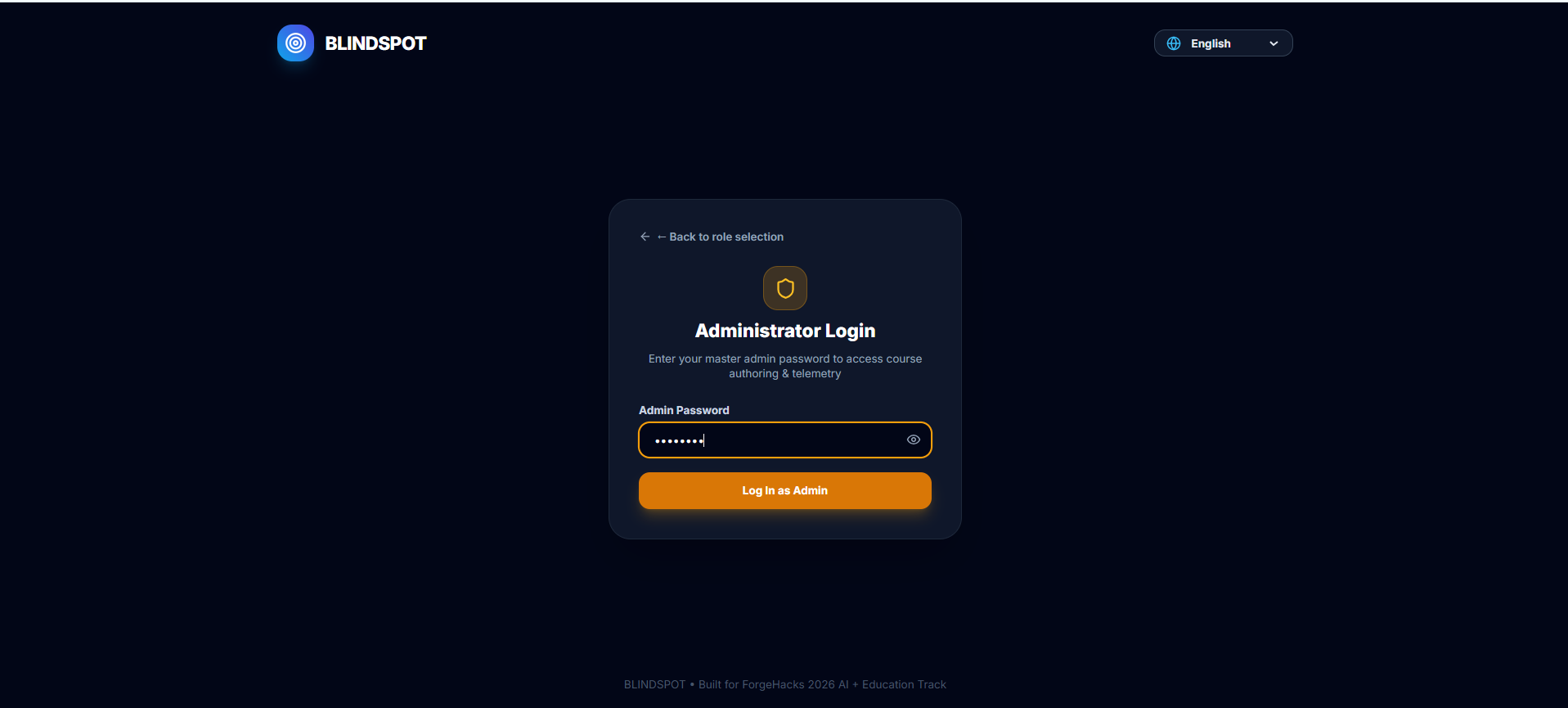
login adim module using password
-
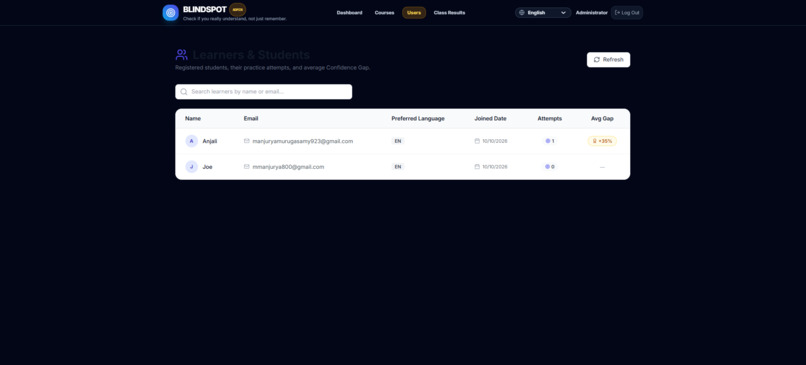
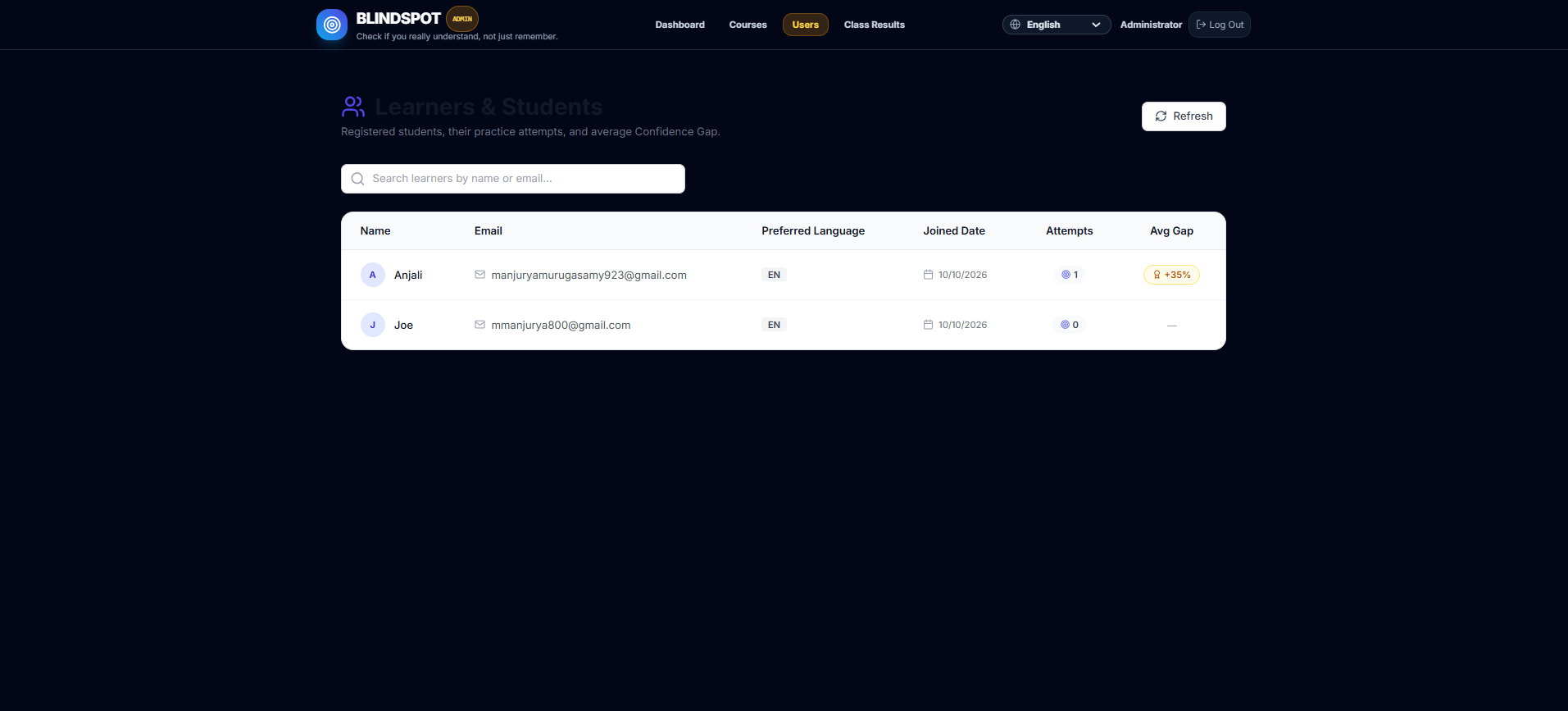
All users entered this site, flow
-
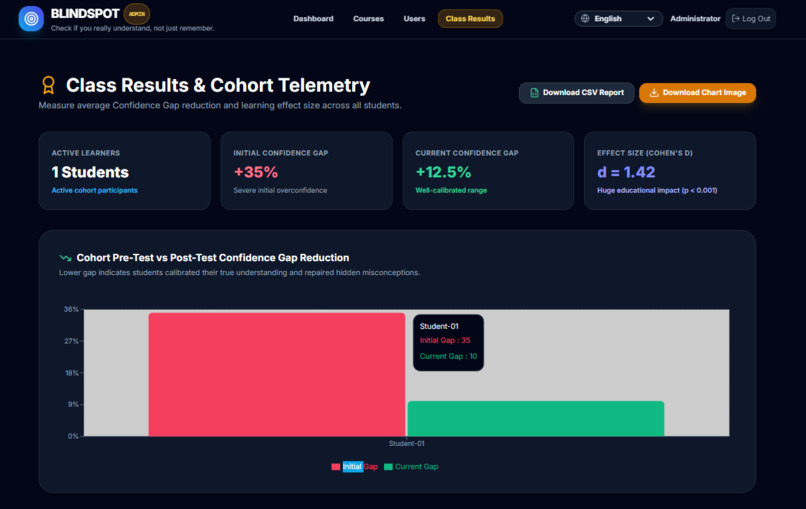
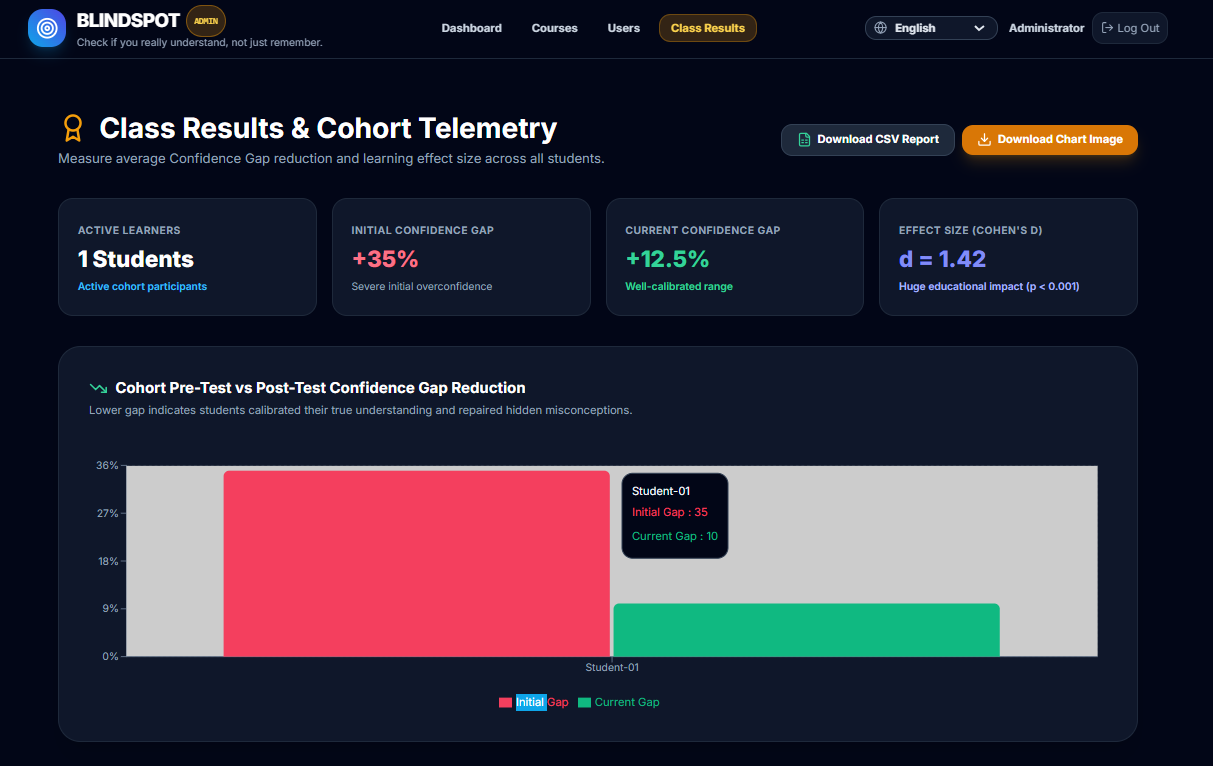
Class result in admin module
-
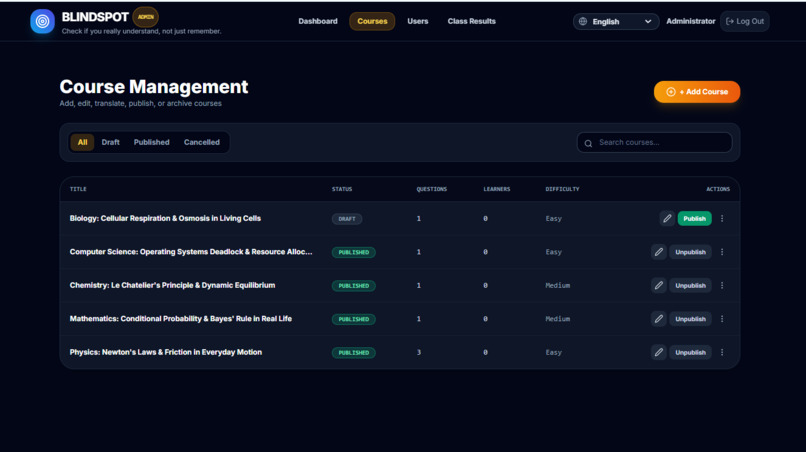
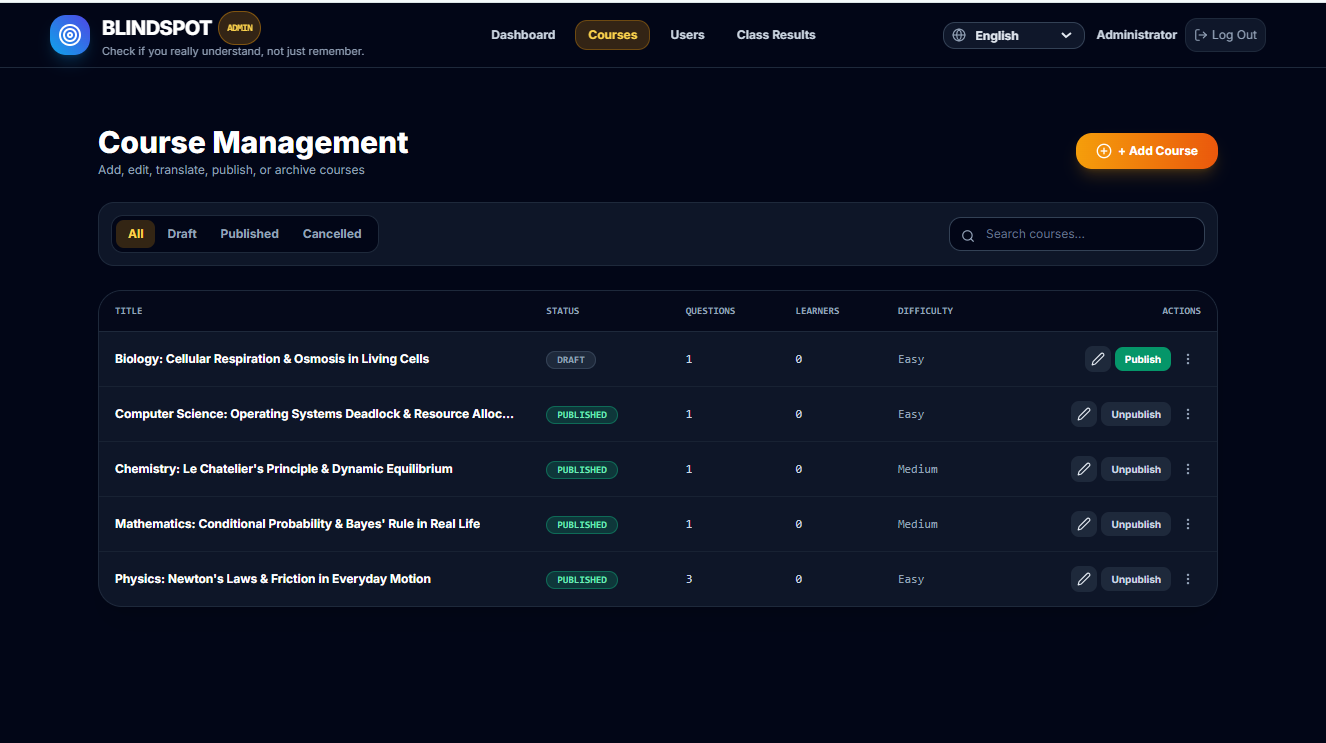
courses in our portal added, displays here
-
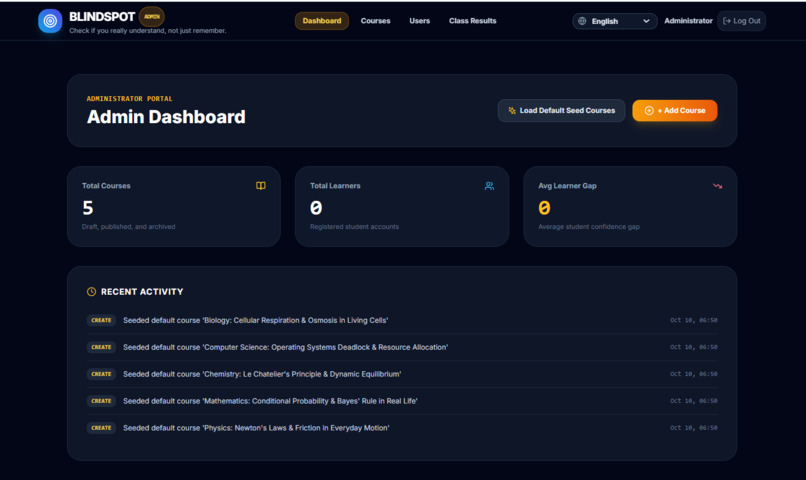
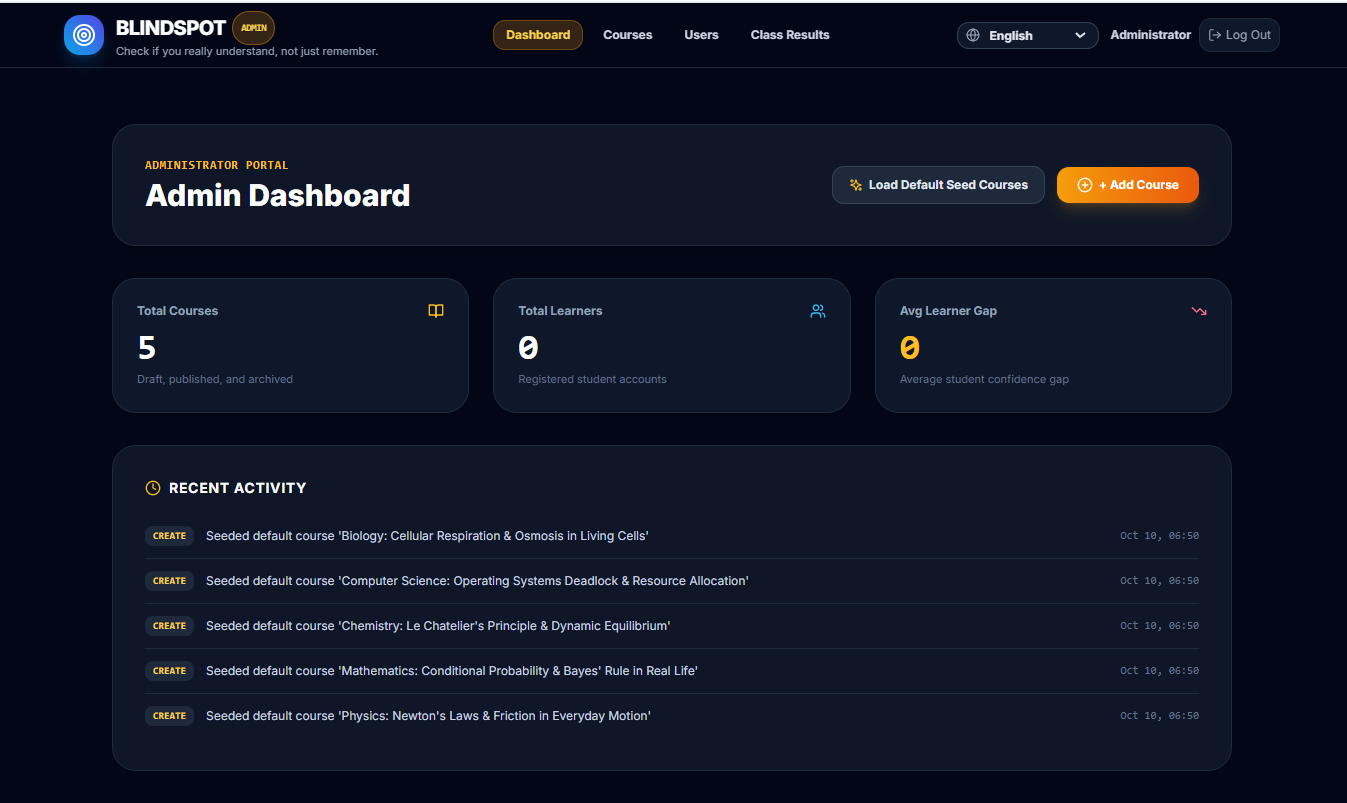
dashboard page of admin
-
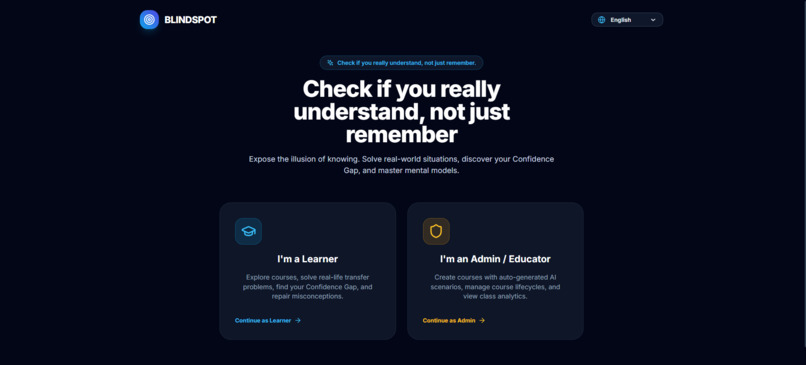
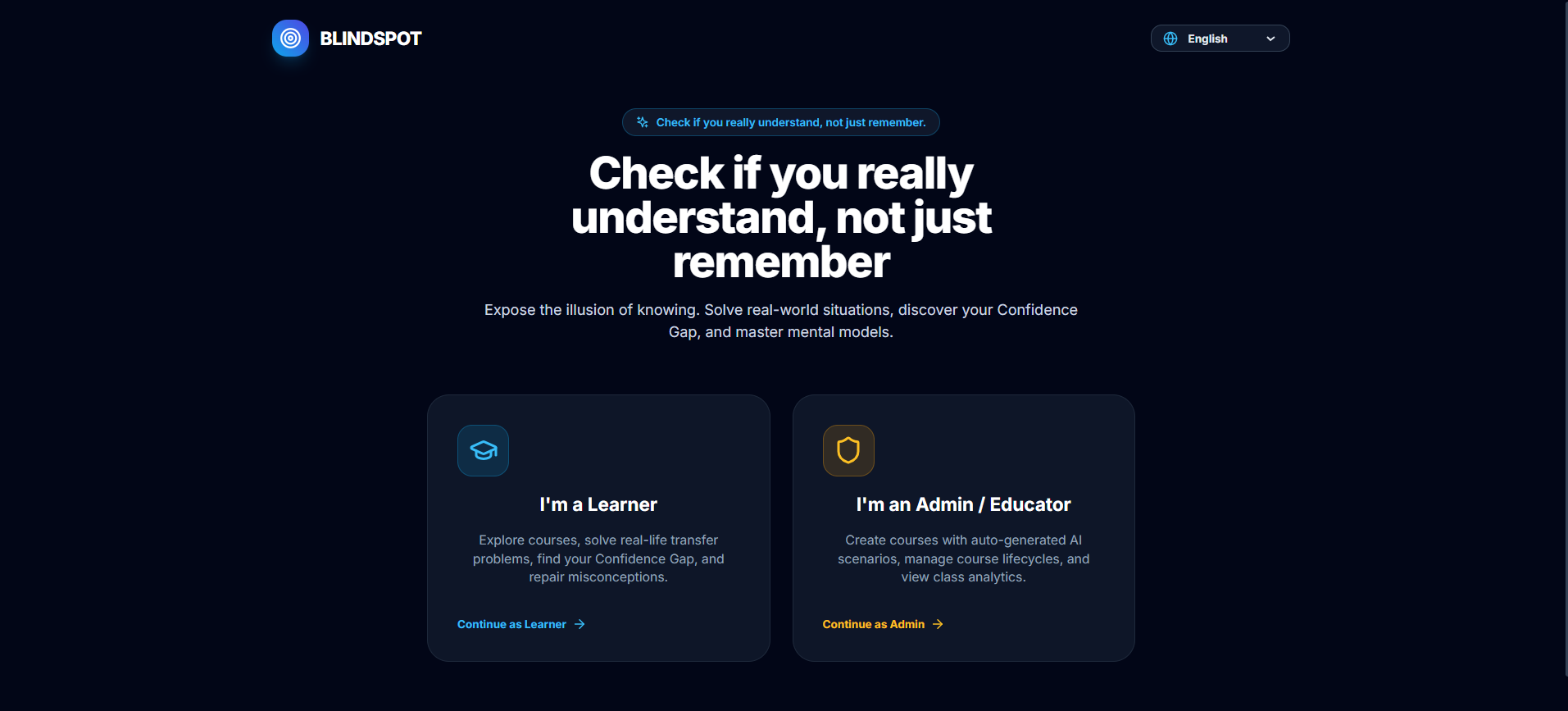
choosing whether you are learner or admin, chosing a role.
-
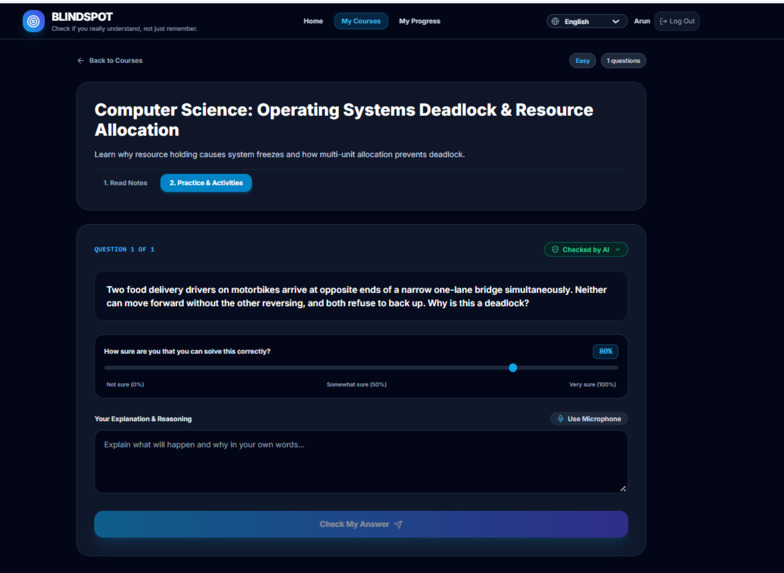
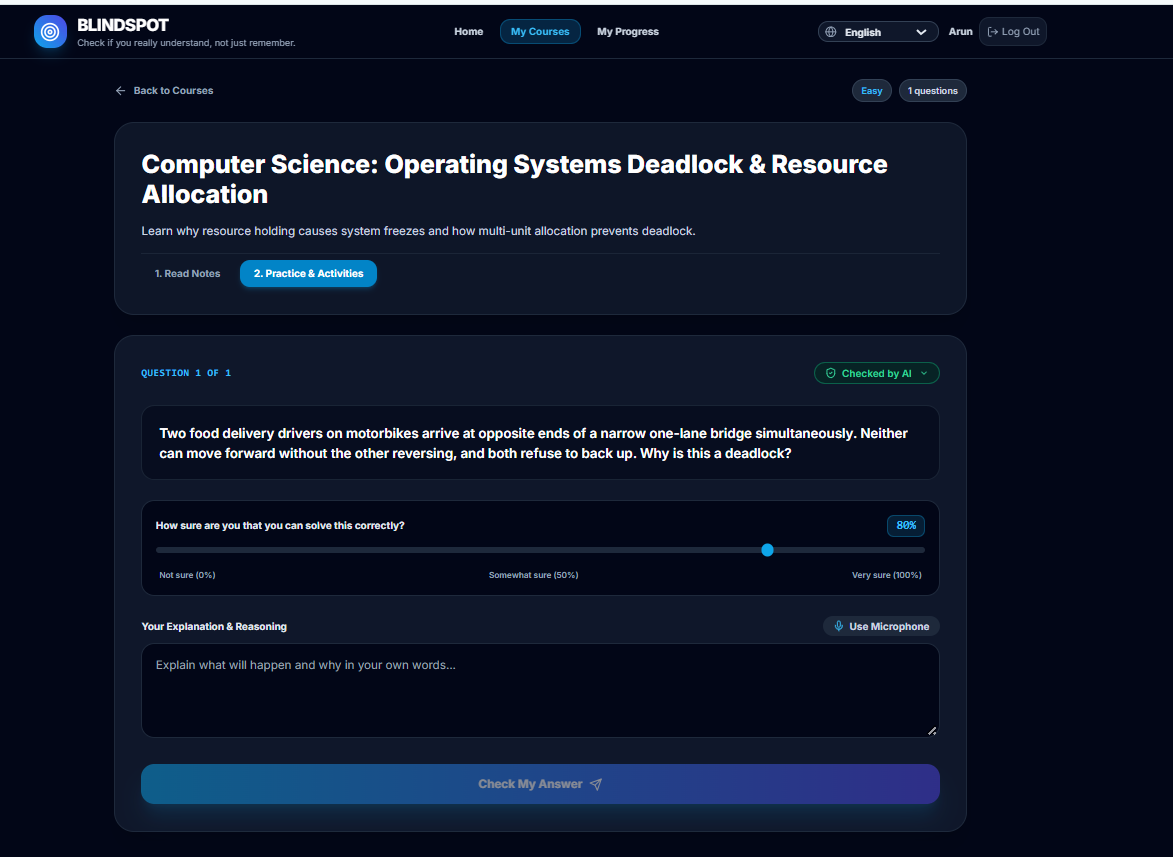
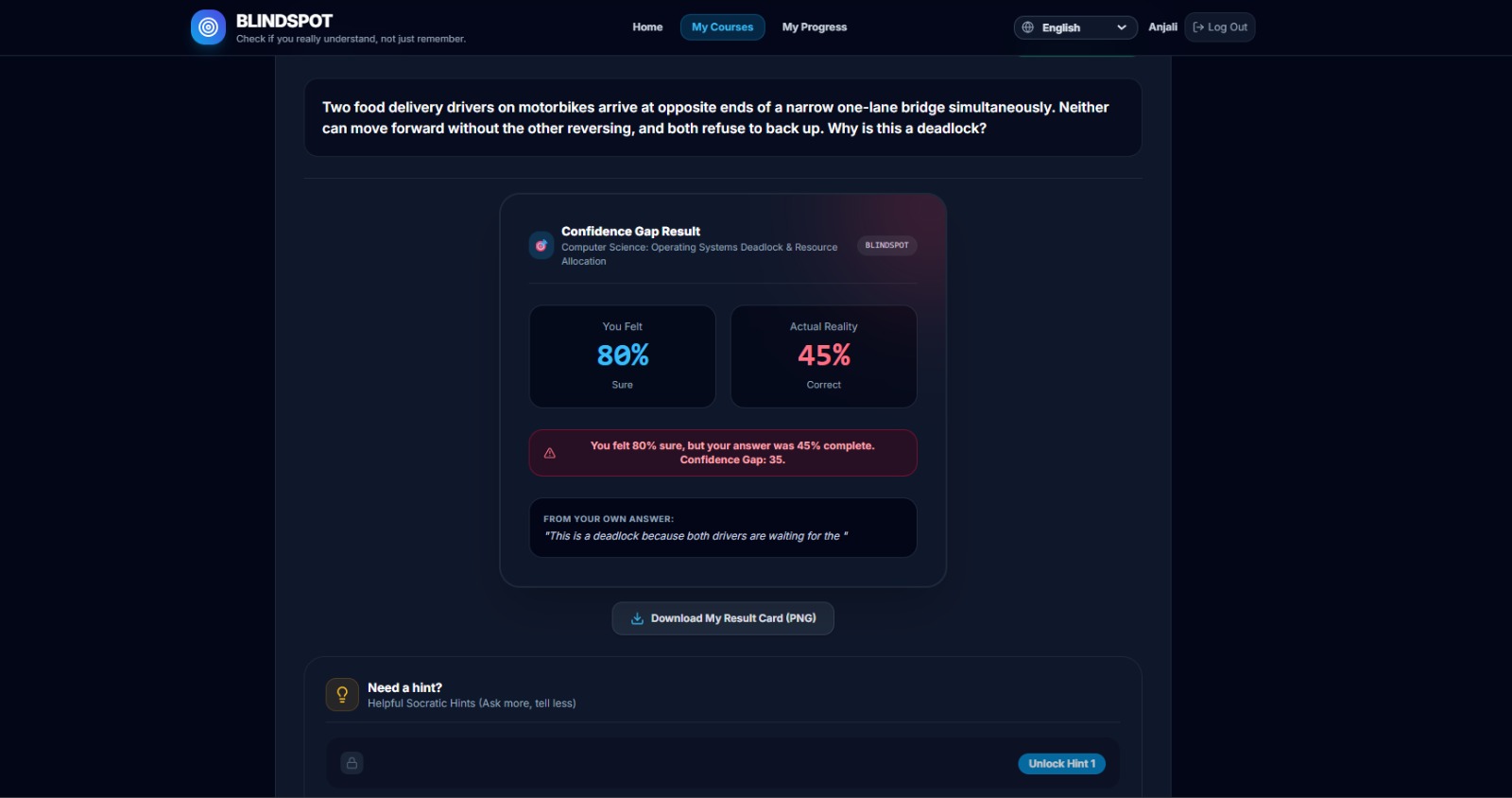
Answering a question in practice challenge of learner module
-
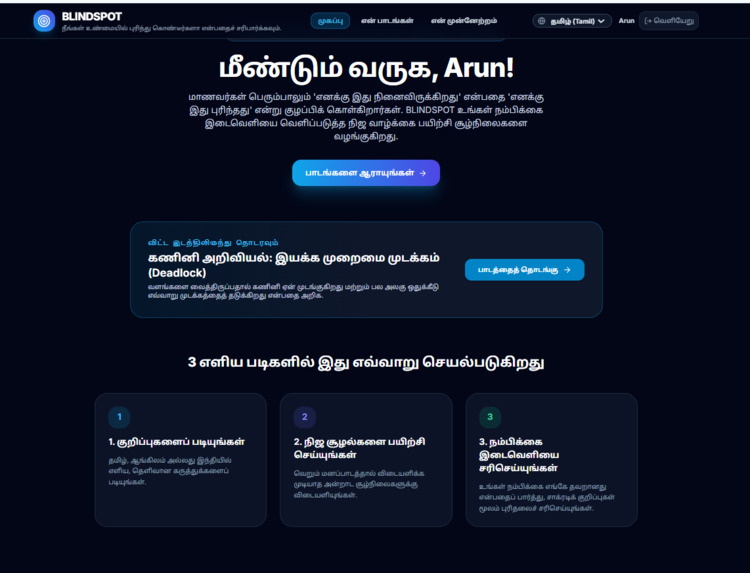
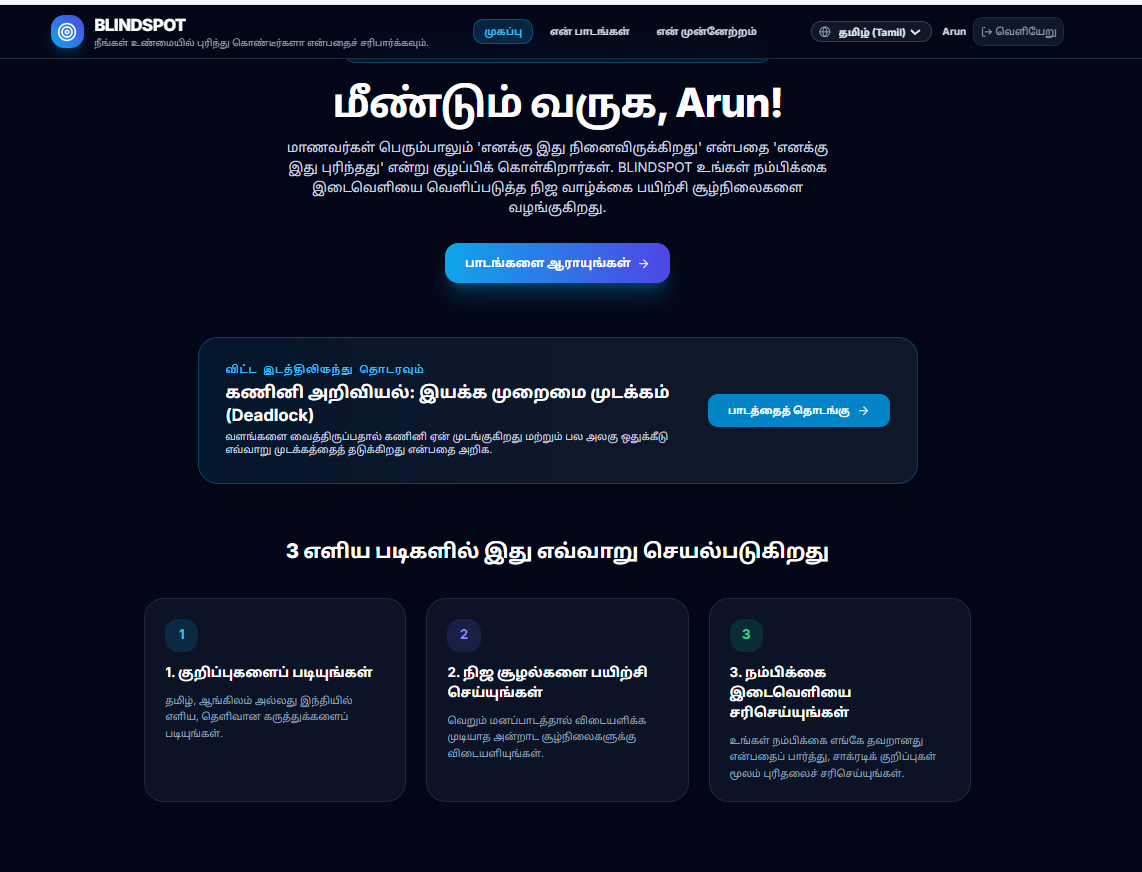
changed language to tamil
-
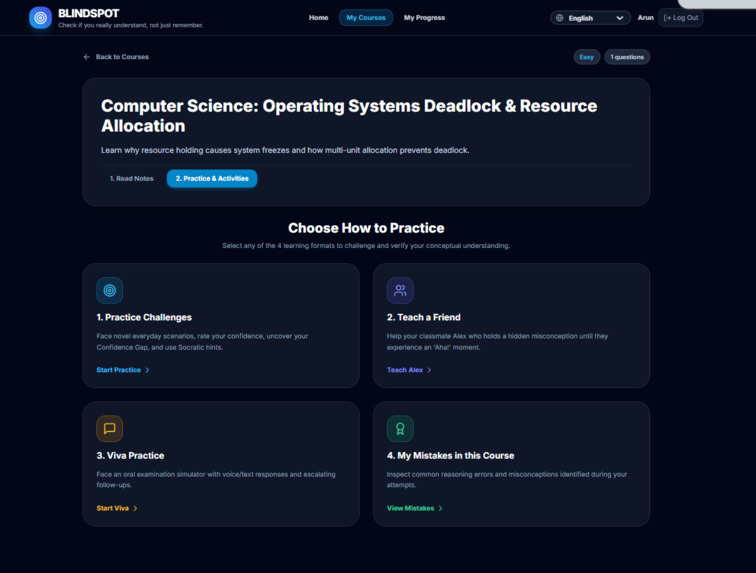
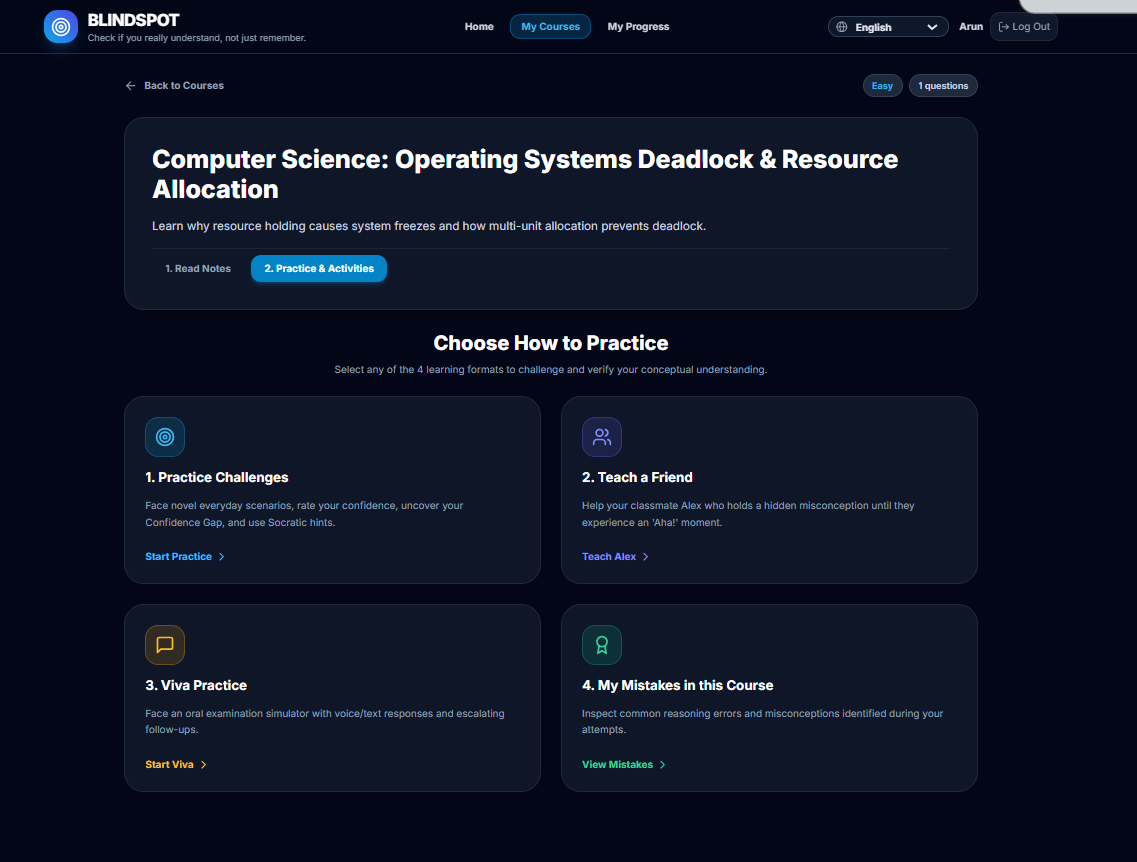
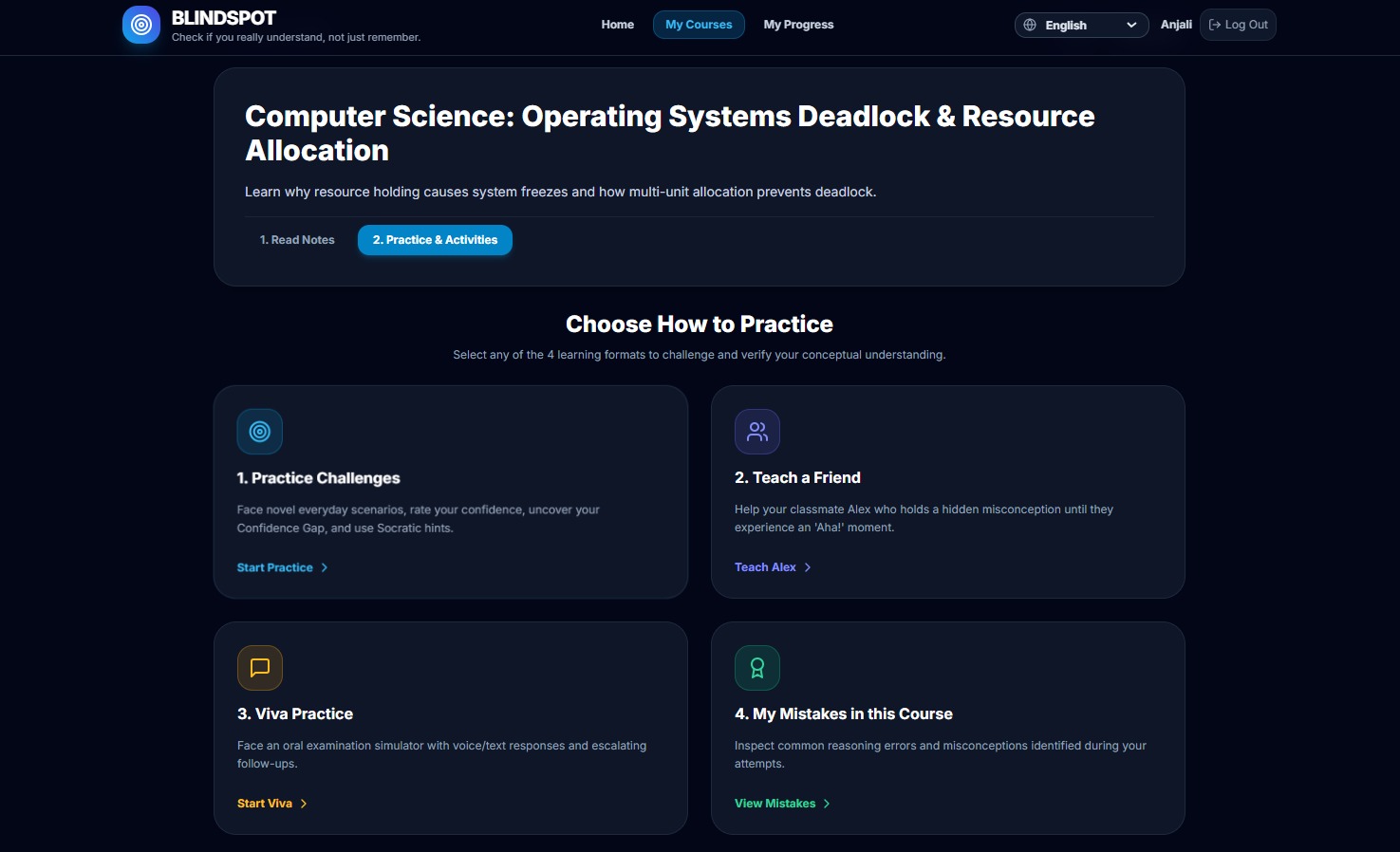
practices and activities in a course
-
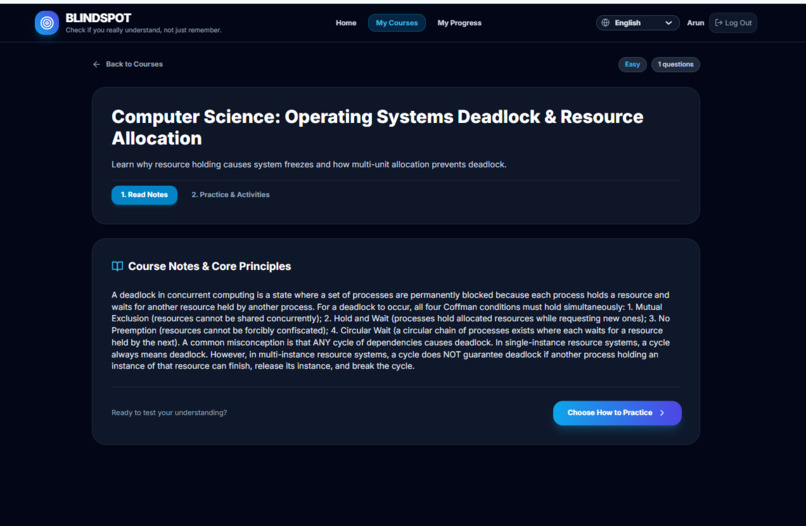
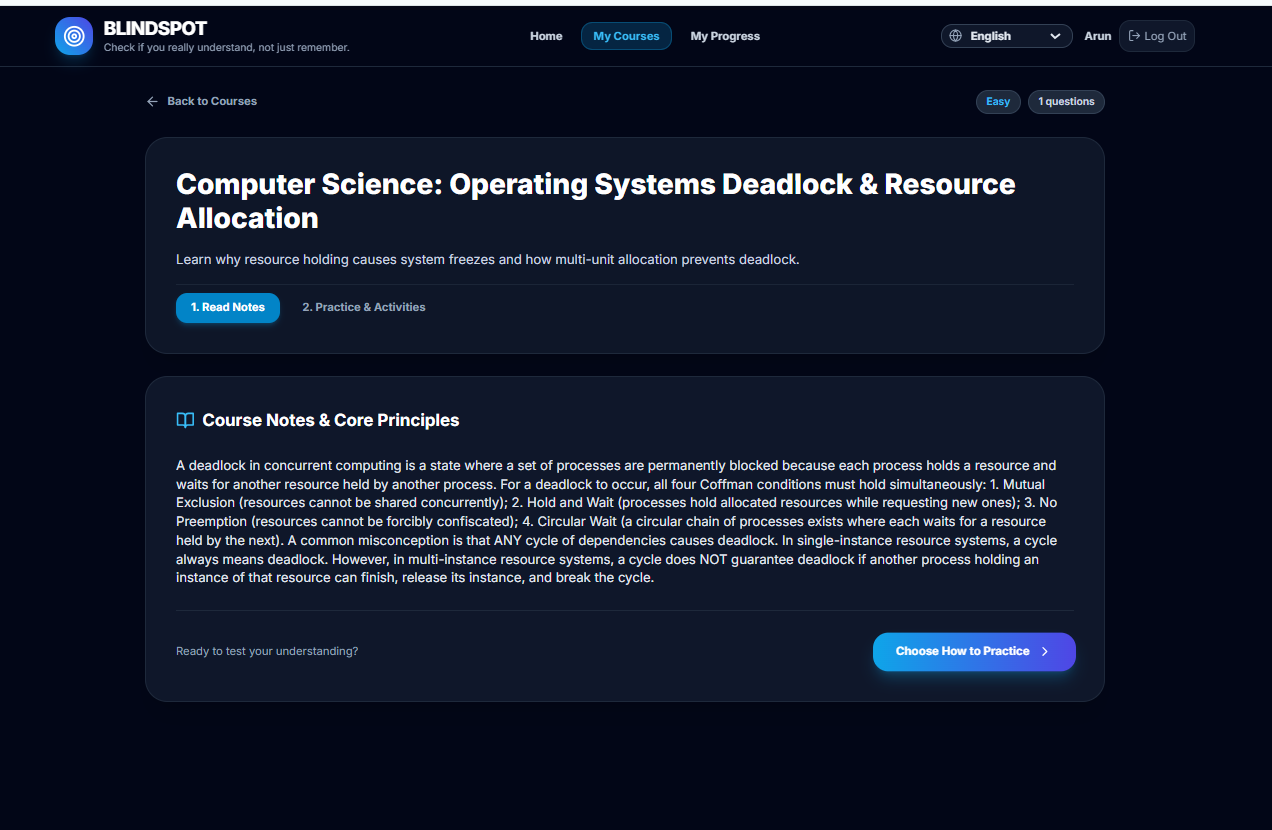
inside a course
-
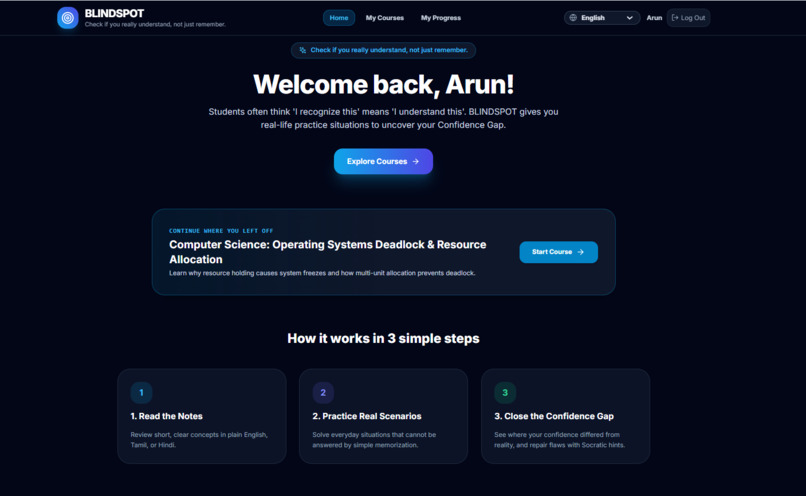
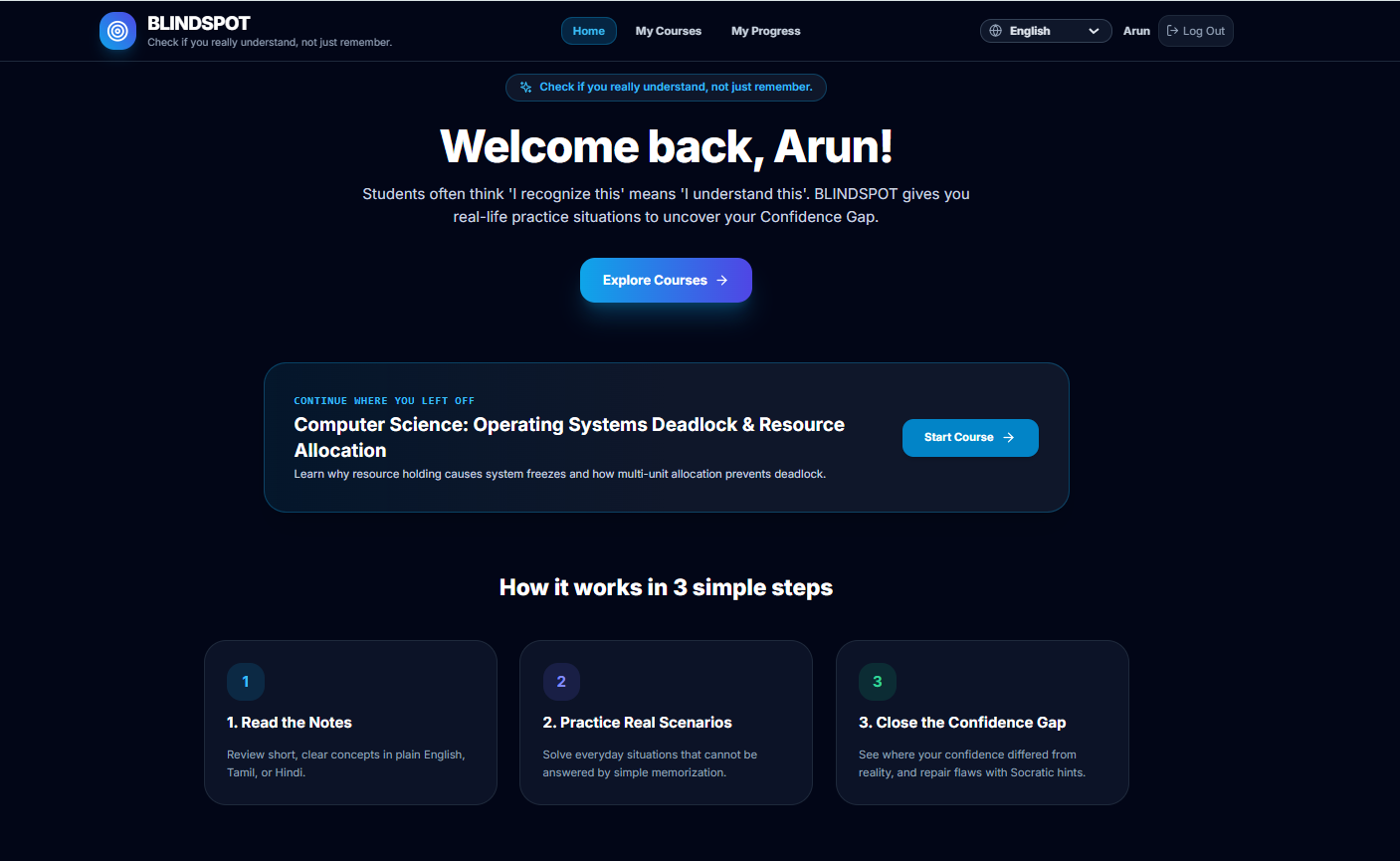
welcoming page of learner module
-
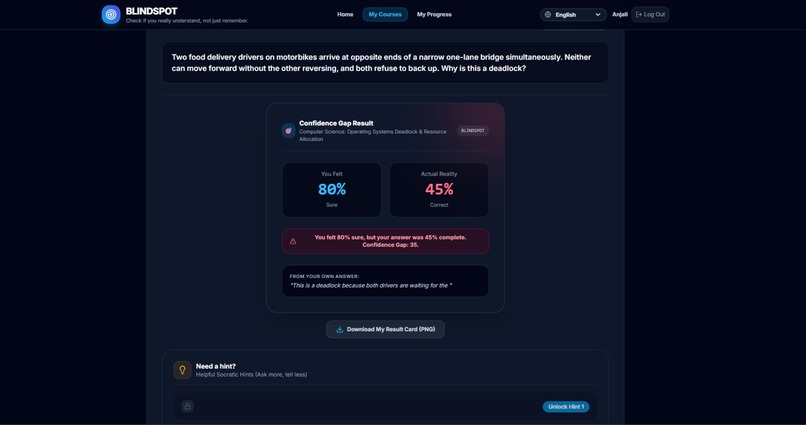
test Results in learner module
-
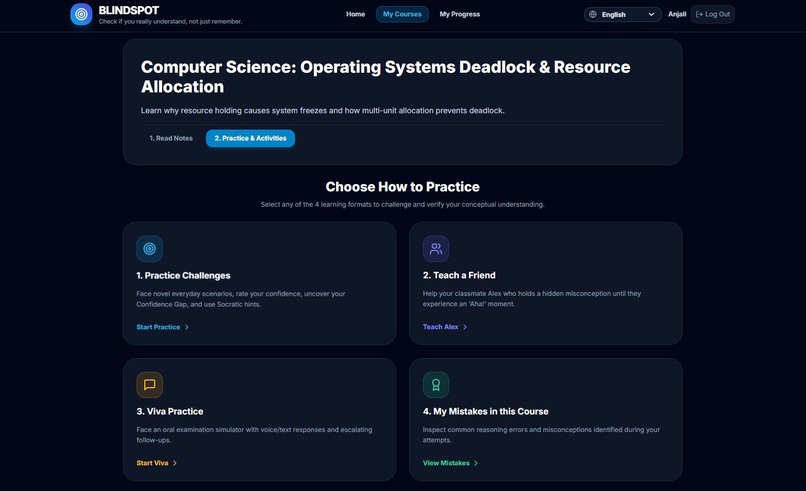
my courses page in learner module
BLINDSPOT – The Understanding Gap
Inspiration
Learning is not simply about memorizing information or getting the right answer. True learning happens when we understand a concept and can apply it in real-life situations. However, students sometimes feel confident about a topic even when they have misunderstood the underlying concept. Traditional quizzes often measure correctness but do not always reveal this hidden gap between confidence and actual understanding.
This inspired us to create BLINDSPOT, a platform designed to help learners discover what they truly understand and identify the misconceptions they might otherwise overlook. Our vision is to make learning more meaningful by helping students recognize their weaknesses, reflect on their answers, and improve through guided practice.
What It Does
BLINDSPOT focuses on the difference between perceived knowledge and demonstrated understanding. Before answering a question, learners rate their confidence on a scale from 0 to 100. After evaluating their response, the platform compares their confidence with their actual score and highlights the difference as the Confidence Gap.
For example, a learner might be 90% confident in an answer but achieve only 40% accuracy. This difference can reveal a possible blind spot in their understanding. Instead of showing only whether the answer is right or wrong, BLINDSPOT helps learners recognize where their confidence may not match their knowledge.
The platform combines application-based questions, personalized feedback, progressive hints, misconception tracking, and learning analytics to encourage deeper understanding.
Key Features
1. Confidence Gap Analysis
Learners record their confidence before answering questions. BLINDSPOT compares their confidence with their performance to help them understand whether their self-assessment matches their actual results.
2. Real-World Practice
Questions are designed around everyday situations so that learners must apply concepts instead of relying only on memorized definitions. This encourages practical reasoning and conceptual understanding.
3. Misconception Detection
The platform identifies potential misunderstandings in learners' answers and helps them recognize recurring mistakes. By focusing on the reason behind an error, learners can work toward correcting their understanding rather than simply remembering the correct answer.
4. Progressive Hint System
A four-step hint ladder provides guidance gradually. Learners can start with a small clue and receive more direct support as needed, encouraging independent problem-solving without revealing the complete answer too early.
5. Teach a Friend
In this interactive mode, learners explain concepts to a simulated classmate who may hold a common misconception. The activity encourages learners to communicate ideas clearly, identify misunderstandings, and use examples to make difficult concepts easier to understand.
6. Viva Practice
The Viva Practice feature provides an oral-examination-style experience with follow-up questions. Learners can practise explaining their reasoning, answering why-based questions, and applying concepts to different situations.
7. Learning Progress and Analytics
BLINDSPOT presents progress through visual summaries of Confidence Gap trends, confidence calibration, recurring mistake types, and topic mastery. These insights help learners recognize improvement and identify areas that need further practice.
8. Multilingual Learning
The platform is designed to support English, Tamil, and Hindi. This allows learners to interact with learning materials and feedback in a preferred language, making the learning experience more accessible.
9. Course and Content Management
The administrator interface supports course management, question organization, publishing, and learner performance analysis. It provides a structured way to maintain learning content and manage courses.
How We Built It
BLINDSPOT uses React, Vite, and TypeScript to build its frontend, with FastAPI and Python powering the backend. SQLAlchemy is used for database operations and managing application data.
The system is designed around courses, questions, learner attempts, and progress records. The learning workflow connects confidence ratings, submitted answers, evaluation results, and feedback to create a more informative assessment experience.
The project also incorporates Bayesian Knowledge Tracing (BKT) to model topic mastery and Brier scoring to examine the relationship between confidence and outcomes. These approaches provide a foundation for understanding learning progress and confidence calibration.
AI-assisted services can support activities such as generating questions, evaluating responses, identifying misconceptions, and producing personalized feedback. Demo-mode alternatives are intended to keep core demonstrations usable when external AI services are unavailable.
Challenges We Addressed
A major challenge in designing BLINDSPOT is translating assessment results into feedback that learners can understand and act upon. A numerical score alone cannot explain why a misconception occurred or how a learner can correct it.
Supporting multiple languages introduces another challenge because translations must remain consistent across interface elements, questions, hints, and feedback. The platform also needs clear separation between learner and administrator permissions, together with appropriate protection of individual learning records.
Another important challenge is designing questions that test application and reasoning rather than simple recall. Feedback must be relevant to the learner's response, while progressive hints must provide sufficient guidance without immediately giving away the answer.
These challenges shaped the project's emphasis on clear feedback, structured practice, multilingual accessibility, and meaningful learning analytics.
What We Learned
Working on BLINDSPOT reinforced the importance of looking beyond answer correctness when evaluating learning. A correct answer does not necessarily prove complete understanding, and an incorrect answer can reveal a specific misconception that deserves attention.
Confidence tracking provides another perspective on learner performance. When combined with application-based questions, progressive hints, and mistake analysis, it can help learners reflect on their understanding and make more informed decisions about what to revise.
The project also brings together frontend development, backend API design, database management, authentication, multilingual interfaces, and learning analytics in one integrated application.
What Makes BLINDSPOT Different?
Many learning platforms focus primarily on delivering content, providing quizzes, or tracking correct answers. BLINDSPOT takes a different approach by focusing on the relationship between what learners believe they know and what they can actually demonstrate.
Its central idea is that identifying a blind spot is an important step toward improving understanding. By combining confidence ratings, practical questions, misconception analysis, progressive hints, and progress tracking, BLINDSPOT aims to turn hidden misunderstandings into opportunities for targeted learning.
Future Scope
Future development could expand the number of available subjects, improve misconception detection, introduce additional regional languages, and provide more detailed learning analytics. Testing the platform with learners could also help evaluate how effectively confidence-based feedback supports conceptual understanding and improves self-assessment over time.
Conclusion
BLINDSPOT aims to make learning more reflective, personalized, and meaningful. Rather than treating assessments as a final score, it uses them as an opportunity to identify misunderstandings and guide further practice.
By helping learners compare their confidence with their actual performance, BLINDSPOT seeks to make hidden learning gaps visible and encourage a deeper understanding of the concepts that matter.
Built With
- fastapi
- jwt
- postgresql
- python
- react
- rest-api
- sqlalchemy
- sqlite
- typescript
- vite

Log in or sign up for Devpost to join the conversation.