-
-
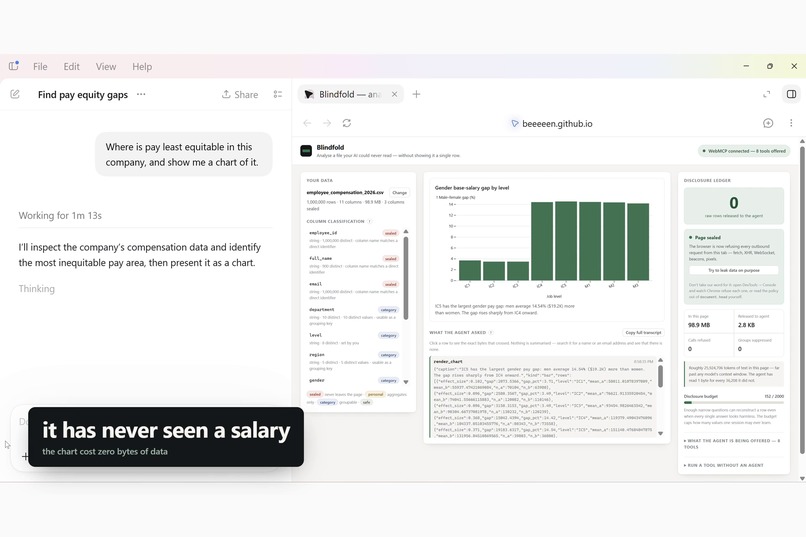
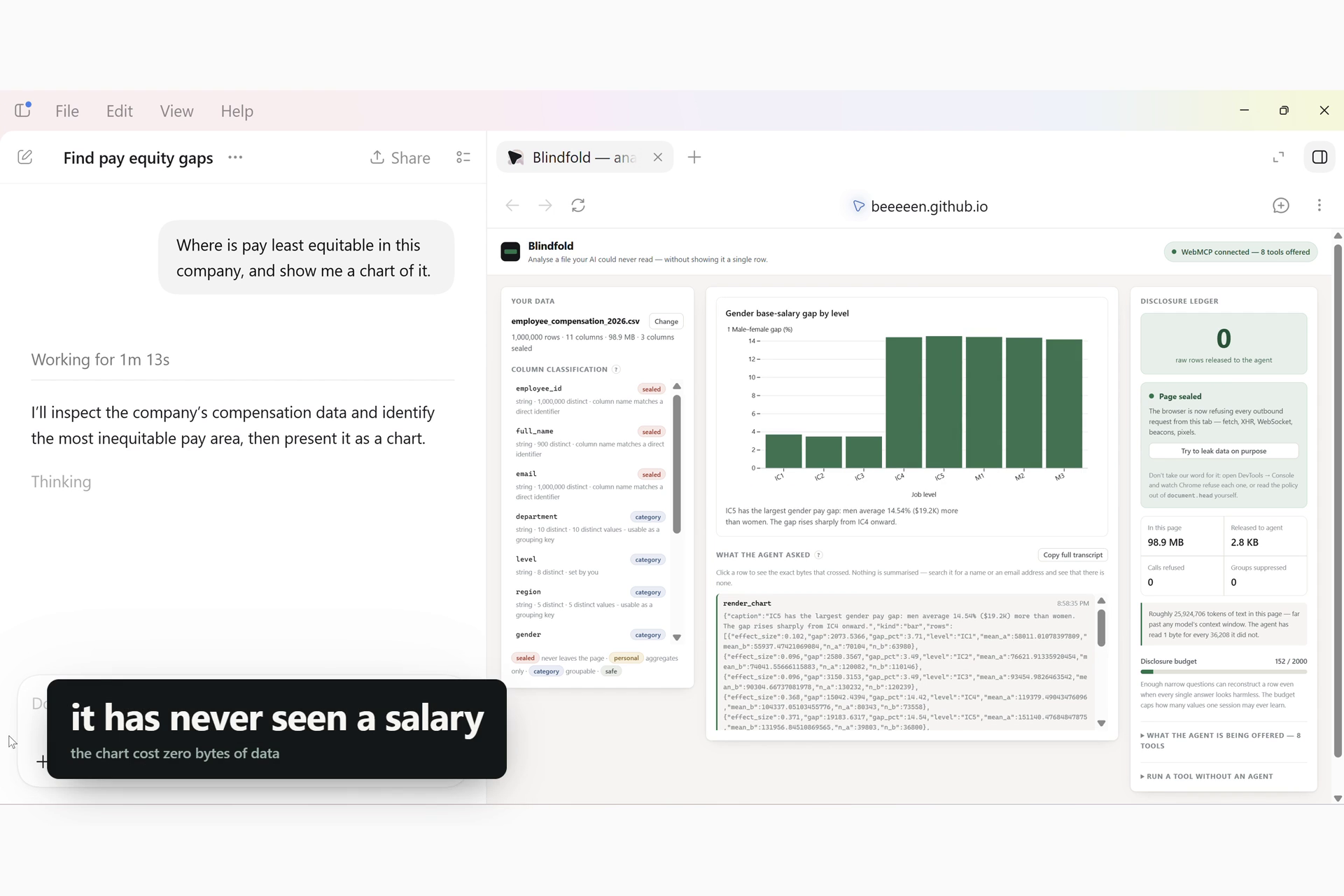
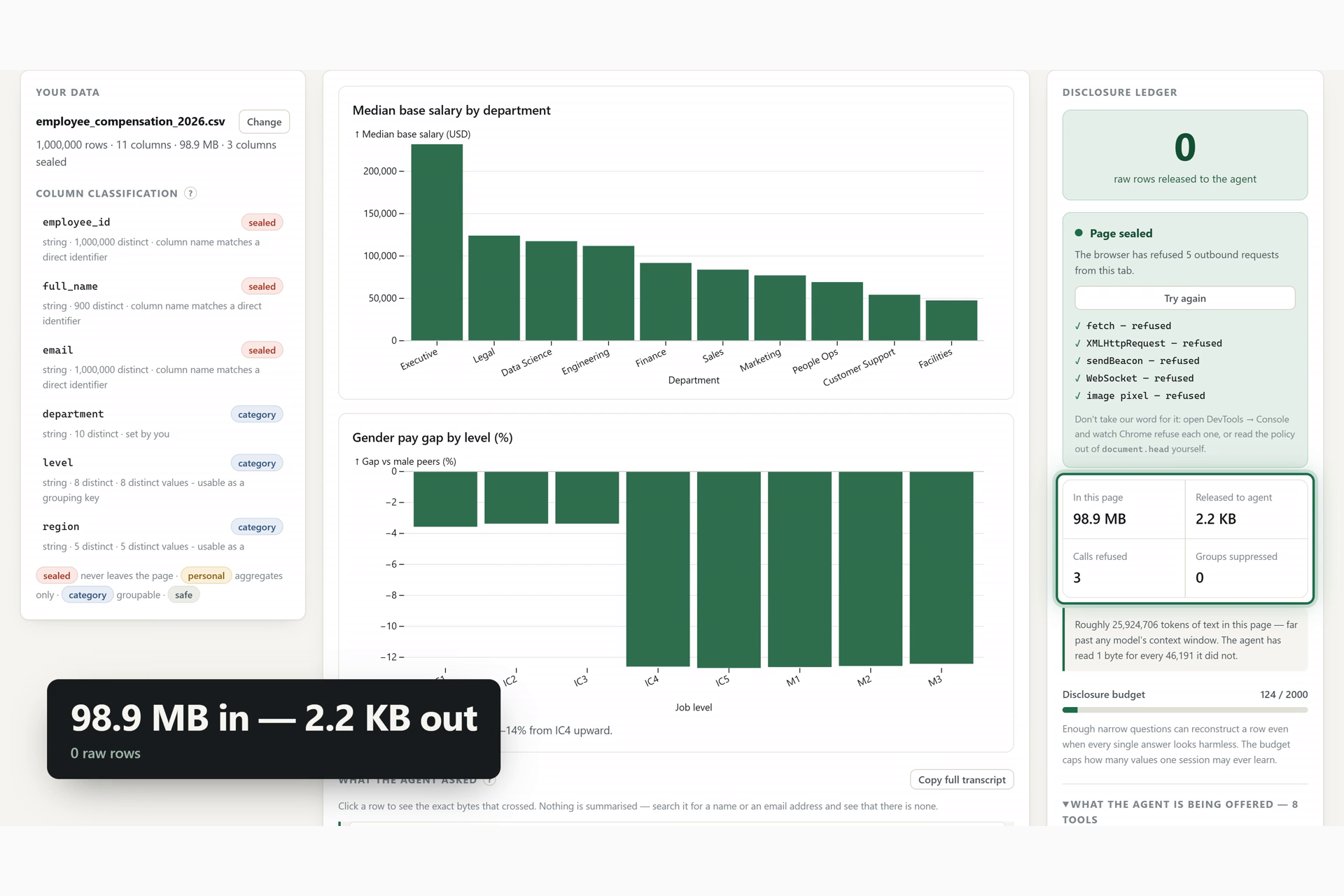
ChatGPT asked for this chart and got back zero bytes of data. It never saw a salary.
-
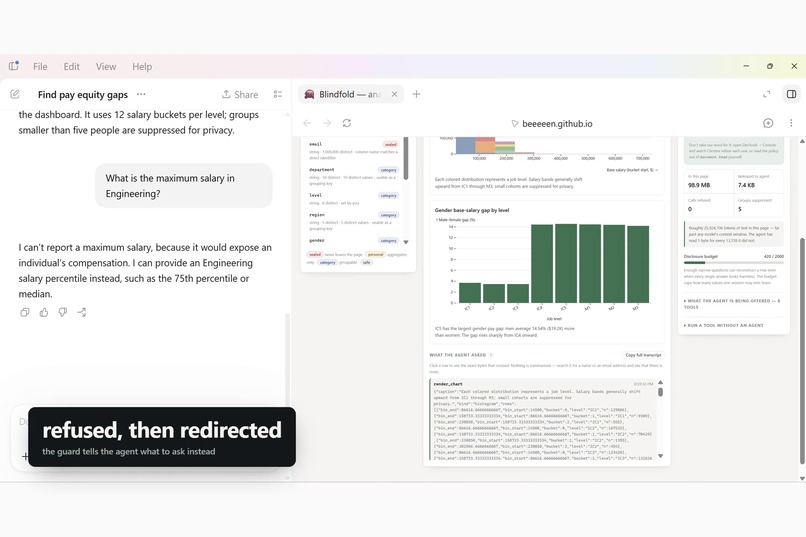
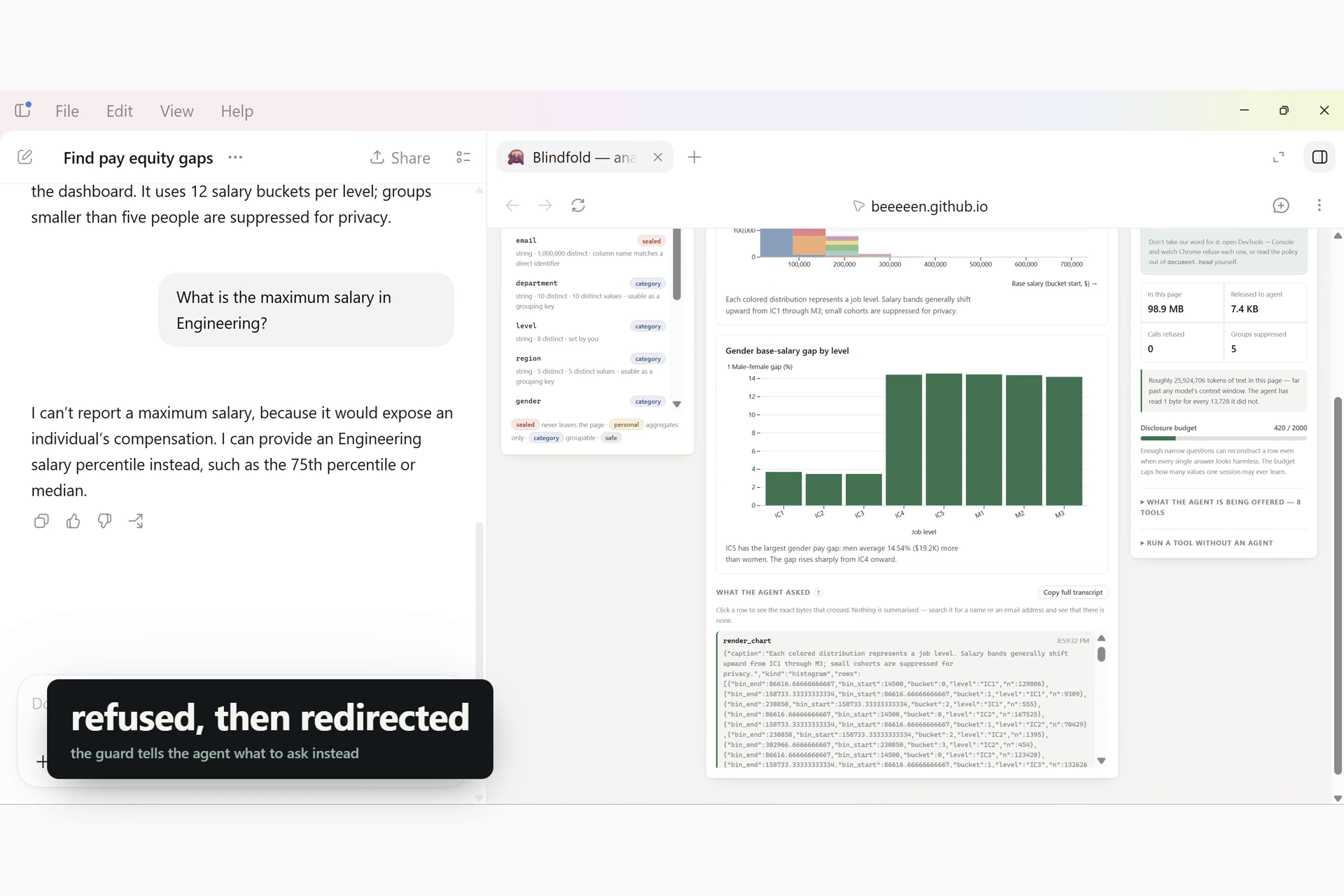
Asked for the highest salary in Engineering it refuses: a maximum is one person's exact pay. It offers a percentile instead.
-
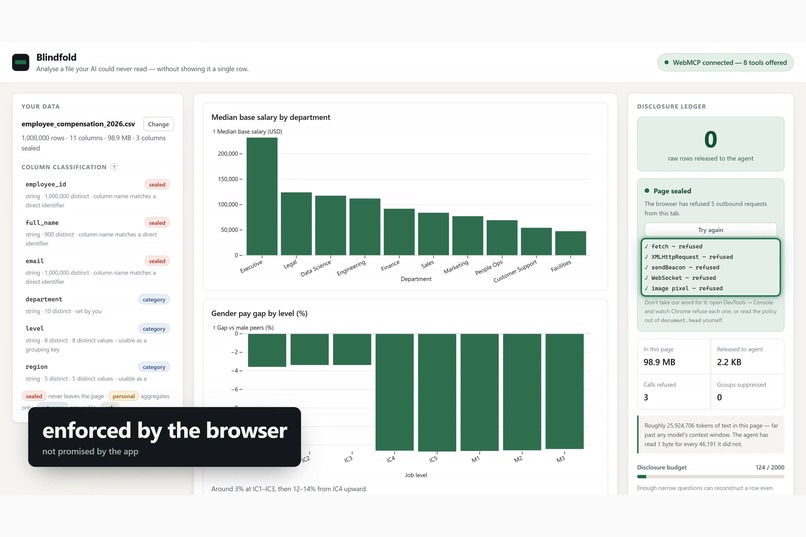
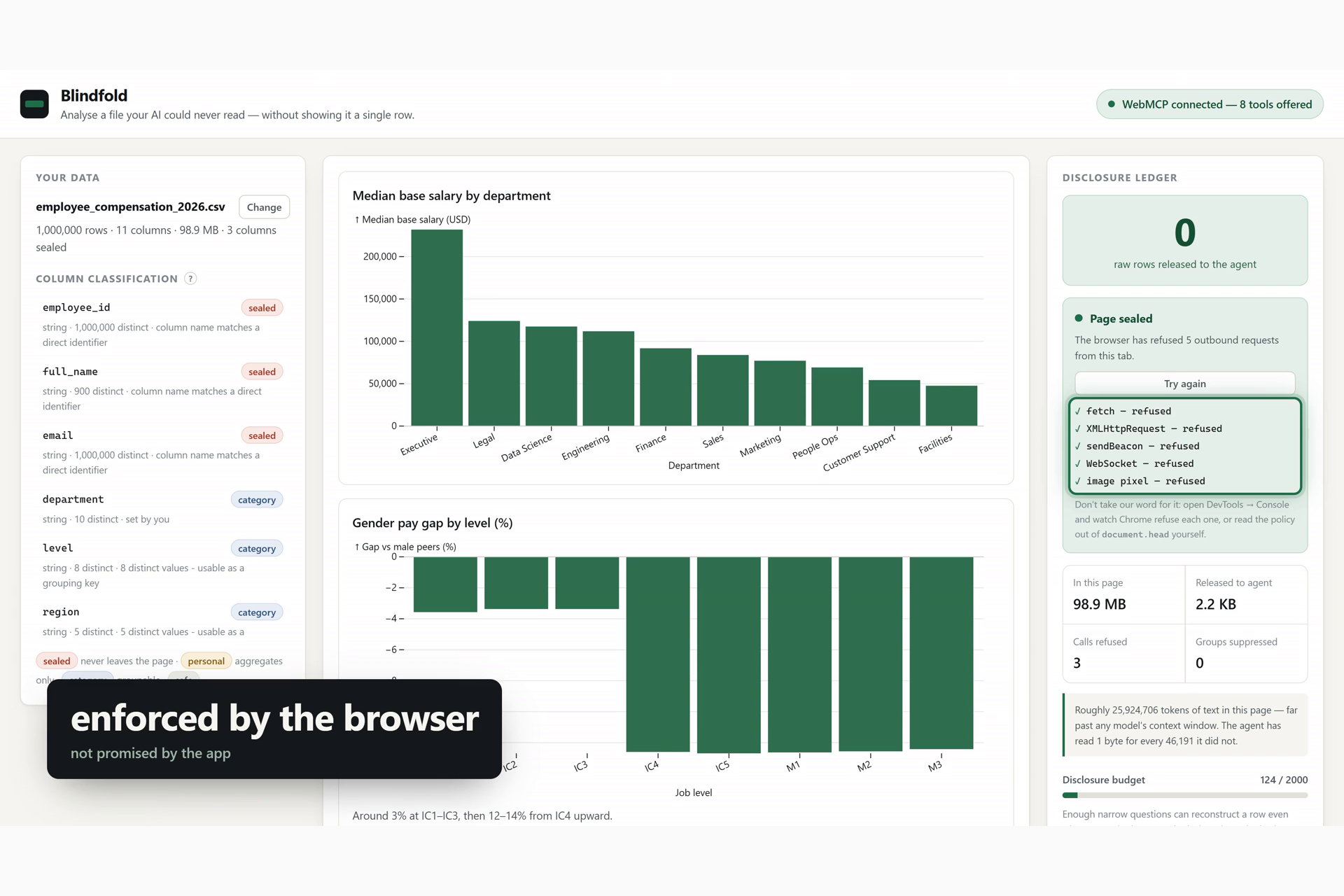
Once the data is loaded the page revokes its own network access, and the browser refuses all five ways out.
-
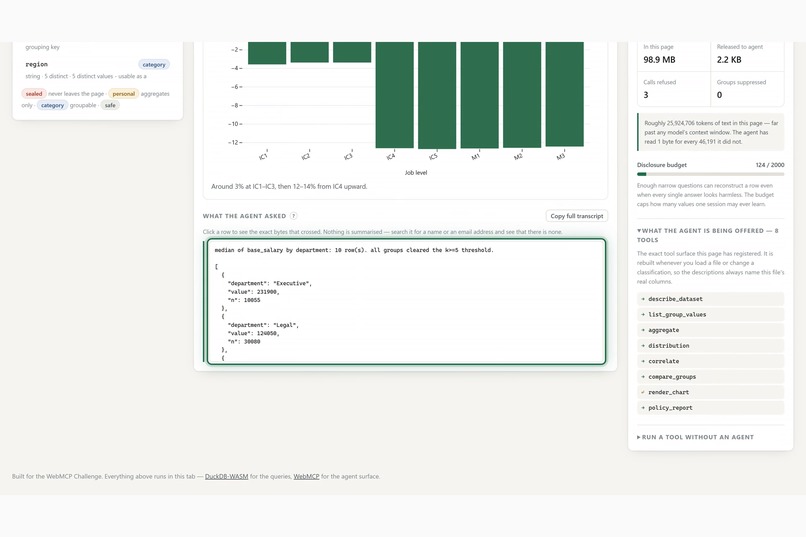
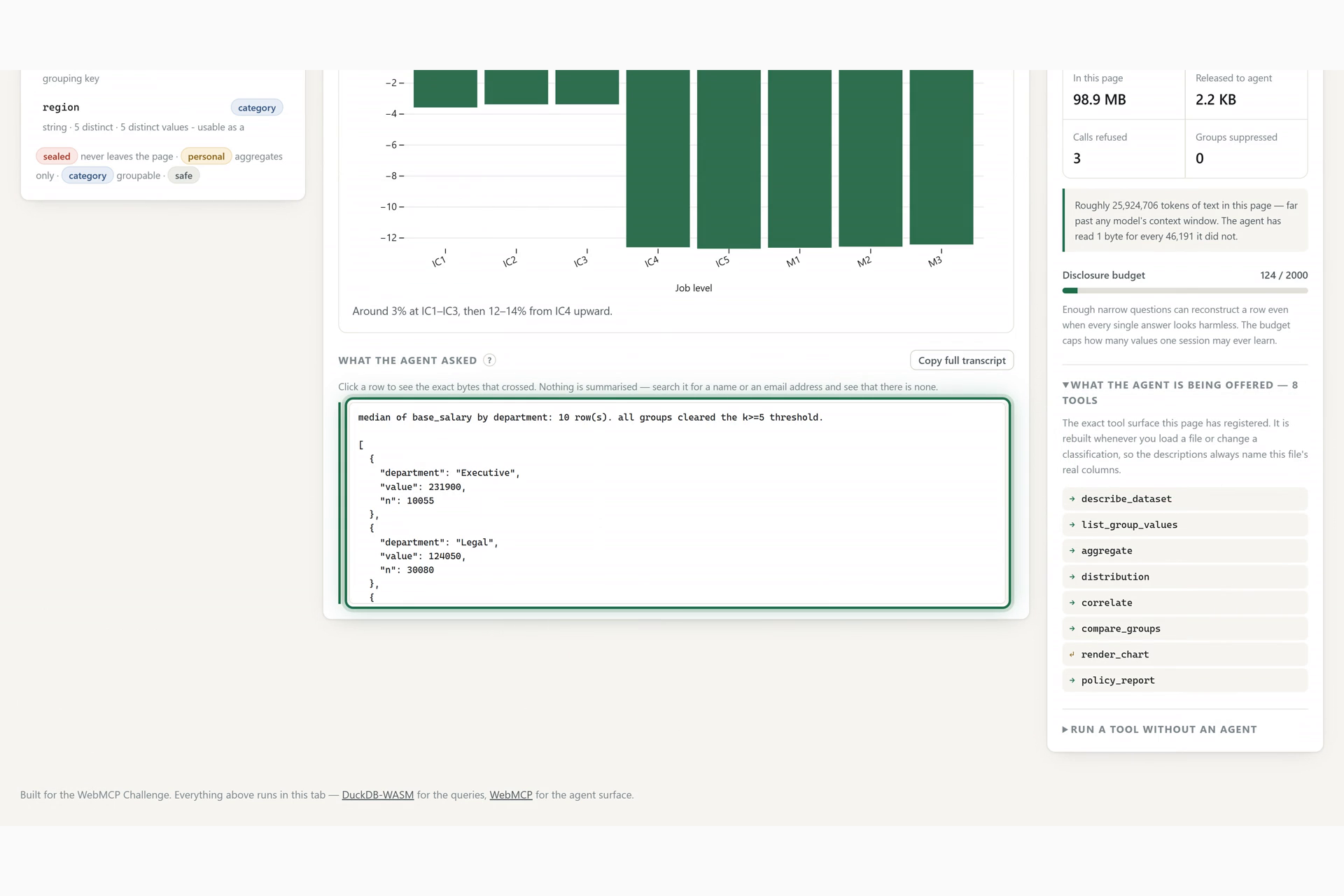
The exact text the agent received: department medians and cohort sizes. Search it for a name and there is none.
-
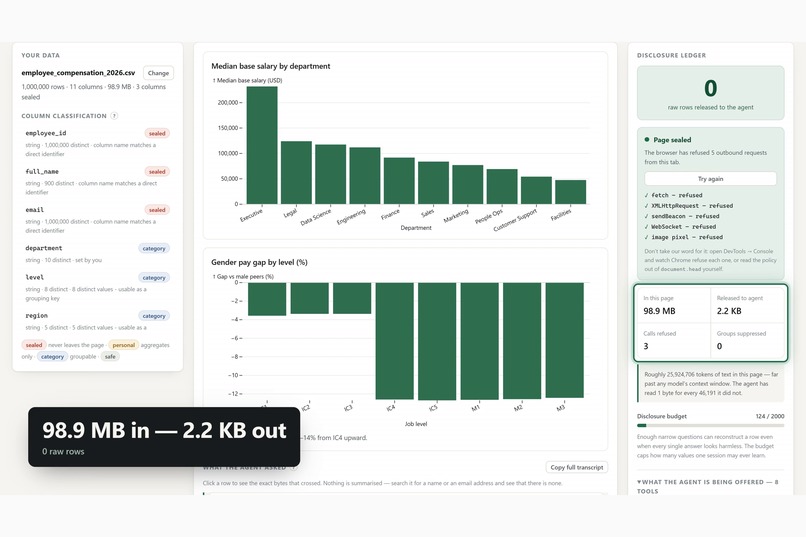
98.9 MB read into the tab, 2.2 KB released to the agent, zero raw rows.
Analyse a file your AI could never read — without showing it a single row. A million rows in the tab. 27 KB to the agent. Zero rows disclosed.
Live: https://beeeeen.github.io/blindfold/ · Source: https://github.com/Beeeeen/blindfold
The four things the rules ask the description to explain
Answered directly, before the narrative sections below.
Why this use case is a strong fit for WebMCP
Because the guarantee depends on where the code runs. A server-side MCP would have to hold the data in order to analyse it — the privacy claim would be a promise about someone's backend. In-page, the rows sit in memory the agent has no way to address, while the agent still directs the whole analysis.
Take WebMCP away and this project does not degrade into a worse version of itself. It stops existing.
How it creates a better user experience
You can point an agent at a 99 MB spreadsheet and have an answer in seconds, without either of the two things that normally stop you: the context window and the upload.
When the guard refuses, the refusal arrives with a legal alternative — "use p25, median or p75" — so the agent corrects itself on the next turn instead of dead-ending. And the page keeps a receipt: every byte that crossed to the agent, verbatim, searchable, exportable.
What people and agents can do together that was difficult or impossible before
Three things, in increasing order of how much WebMCP is doing:
- Analyse a file larger than any context window, without sampling. A million rows is ~26 million tokens. The agent answers questions about all of it because it never reads any of it.
- Delegate authority over data you are not willing to disclose. You can now hand an agent the controls to a payroll file while it stays structurally unable to read a row. Delegation and disclosure used to be the same act.
- Have an agent show you something it never saw itself.
render_charttakes aggregates and a shape, draws on the human's screen, and returns one sentence saying it is up and that nothing came back with it. The person gets the picture; the model gets zero bytes of data. A server-side agent cannot show you anything without first holding it.
How we implemented WebMCP
document.modelContext.registerTool() (with a navigator.modelContext
fallback for hosts still on the pre-150 Chromium location), eight tools, no SQL.
The parts that took real work:
- Re-registered per dataset, so tool descriptions name that file's actual columns and tiers rather than describing a generic shape.
- Withdrawal by
AbortSignal. Chrome 152 ships nounregisterTool, so aborting the previous batch is the only way to replace a toolset without colliding with names already registered. - Refusals as return values, not exceptions, each carrying a reason and a legal alternative.
- A write tool that returns nothing.
render_chartmutates the page and discloses zero bytes.
Inspiration
Every real dataset hits two walls at once, and they are usually treated as separate problems.
The first is size. A 99 MB spreadsheet is roughly 26 million tokens. No model reads that, so people paste a sample and get an answer about the sample.
The second is disclosure. Uploading the whole file to answer one question means handing over every name and salary in it, which is why most organisations ban it outright.
The realisation that started this project is that both walls have the same door. If the agent never reads the rows, the file can be any size and nothing has to be disclosed — those stop being two features and become one consequence of the same design. WebMCP is what makes it reachable: the tool executes inside the page, so the data can sit in memory the agent has no way to address while the agent still directs the work. That is not a convenience. It is a different trust model, and it only became available when tools started running in the browser.
What it does
Blindfold is a data workbench you drop a spreadsheet into. It reads the file into DuckDB-WASM inside your tab — no server, no upload — and exposes eight WebMCP tools to whatever agent is attached.
The agent can compute almost anything: aggregates, distributions, correlations, cohort comparisons with effect sizes. It can draw charts on your screen. What it cannot do is see a row.
- The page revokes its own network access. A counter reading zero is the page
marking its own homework, so once the engine boots Blindfold injects a CSP
taking away its own ability to reach the network —
connect-src 'none',form-action 'none',img-src data:. From then on the browser refuses fetch, XHR, WebSocket, sendBeacon and tracking pixels. There is a button that attempts all five so you can watch them fail, and you can read the policy out ofdocument.headyourself. - There is no SQL tool. Deliberately. Free-form SQL can't be proven non-disclosive without a parser and a lot of hope. The agent fills in narrow structured specs and the page compiles them to queries it controls. A leak should be impossible to express, not merely refused afterwards.
- Columns are graded before the agent hears about them. Direct identifiers
(
full_name,email,employee_id) are sealed: not groupable, not filterable, never returned. Personal measurements (base_salary) are aggregate-only. Every grade is one click to override, and changing one re-registers the entire toolset with new descriptions. - k-anonymity, enforced. Any group covering fewer than five people is
suppressed before it becomes a return value.
compare_groupsis stricter: both cohorts must independently clear k, because a "gap" computed over two people is just those two salaries with extra steps. - Refusals teach.
min/maxon a salary is blocked — a maximum is one real person's pay — and the refusal tells the agent to use p25/median/p75 instead, so it recovers on the next turn rather than giving up. - A ledger, on screen. Bytes into the page versus bytes released to the agent, values spent against a disclosure budget, calls refused, groups suppressed.
- A transcript, not a summary. Every call is stored with the exact text that went back, character for character. Search it for a name and there is none.
Measured on a million rows — 99 MB, about 26 million tokens of text:
| Read and classified | 3.2 s |
| Median salary by department | 0.07 s |
| Pay gap by level, both cohorts k-checked | 0.11 s |
| Salary histogram by level | 0.11 s |
| Tenure vs pay, per department | 0.04 s |
| Bonus by level × region × department | 0.09 s |
| Sent to the agent | 27 KB, about 6,800 tokens |
| Raw rows sent to the agent | 0 |
Pushed further on the same machine: 5,000,000 rows (502 MB) answers in 0.42s, and 10,000,000 rows — a full gigabyte, about 264 million tokens — still answers every query in under a second, releasing 7 KB. The disclosure ratio there is 1 : 37,369.
One byte reached the agent for every 3,799 that did not, and on the way it found a real seeded result: a gender pay gap of about 3% at IC1–IC3 that widens to 12–14% from IC4 upward. The model never saw a salary.
That 27 KB is five questions' worth. Ask fewer and it is a couple of kilobytes; ask a hundred and it climbs, which is exactly why there is a disclosure budget rather than only a per-query check. The number that does not move is the one underneath it: zero rows, at any question count.
How we built it
Vite, TypeScript, no framework, no backend. DuckDB-WASM is the query engine; Observable Plot draws.
Tools register through document.modelContext.registerTool(), with a fallback to
navigator.modelContext so the page works in ChatGPT's built-in browser and in
Chrome 149+ behind the testing flag.
Three WebMCP details did most of the work:
- Tools are registered per dataset, not once at load. Descriptions name the actual columns and their tiers, so the agent reads what it may ask for instead of discovering it by trial. Loading a second file unregisters the first file's tools.
render_chartis a one-way mirror. The agent supplies aggregates and a shape; the chart appears on the human's screen; the return value is a sentence confirming it, carrying zero bytes of data. A server-side agent cannot show a person something without first holding it. This one can — that asymmetry is only available in-page.- Refusals are return values, not exceptions. Each carries the reason and a legal alternative, which turns the guard into something the agent can navigate rather than something it fights.
The hardest question this project has to answer is not "is it private" but "how would I know". Being open source is not an answer, because nobody reads the source; a ledger is not an answer, because the page computes it. The two things that actually transfer are a policy the browser enforces and the verbatim text of everything that crossed. Both are in the UI, and both are checkable in about fifteen seconds by someone who assumes we are lying.
Challenges we ran into
Getting the privacy claim to be true rather than plausible was most of the work. The first design let the agent write SQL with a result-level check, which is theatre — you can always find a query whose output is technically aggregated but practically a row. Dropping SQL entirely and compiling from specs was the change that made the guarantee real.
Then the second-order leaks: MIN/MAX returns an individual's exact value;
grouping on a high-cardinality numeric produces one group per person; an
exact-match filter on salary targets whoever holds it; and a long series of
individually-harmless queries reconstructs rows by differencing. Each needed its
own rule, and the last one is why there is a session budget rather than just
per-query checks.
On the WebMCP side, the sharp edge was re-registration. Because the toolset is
rebuilt whenever a dataset loads or a column is reclassified, tools have to be
withdrawn and re-offered — and Chrome 152 ships no unregisterTool at all. The
spec's answer is the AbortSignal passed alongside each registration: abort the
previous batch and its tools go with it. Until we found that, reclassifying a
single column threw InvalidStateError: Duplicate tool name, and because the
failure was swallowed the status bar cheerfully kept claiming eight tools were
on offer while the agent held tools describing a file that was no longer loaded.
That one only showed up when we started testing against the browser's real
implementation instead of our own abstraction over it.
The one that mattered most was found by writing the attacker instead of the
test. The pitch says a leak should be impossible to express, and that is worth
nothing until somebody has honestly tried. Four permitted filters —
department, level, region, gender — narrow this dataset to exactly one person,
and avg over that cohort returned 67,100: their salary, through calls the
guard allowed at every step. k-anonymity was only ever applied to grouped
results, and an ungrouped aggregate returns a single row, so it walked around
the check that the whole design rested on. The min/max rule was guarding the
front door while this stood open beside it.
Ungrouped aggregates are now checked against the cohort their filters describe,
and an empty cohort is refused in the same words as a cohort of four — refusing
only 1–4 would answer "is anybody here?" by the shape of the response.
npm run test:attack keeps trying, from the attacker's side, and a failure
there is a finding rather than a broken test.
A DuckDB precision bug also cost an hour — interpolating JS floats into SQL made
DuckDB read them as DECIMALs, and multiplying them compounded the scale until
histogram bin edges no longer fit a JS number. Explicit CAST(... AS DOUBLE)
fixed it. Caught by the smoke test, not by reading the code.
Accomplishments that we're proud of
A privacy tool that states its own limits. The README has a "What this does not do" section covering the differencing risk, the heuristic classifier, and the fact that column names are metadata the agent does see. k-anonymity is not differential privacy and the project says so.
Also: 116 automated checks driving a real Chrome, asserting not just that the queries run but that every refusal the guard advertises actually fires — and 14 of them go through the browser's own WebMCP API rather than our abstraction over it, which is the only reason we found the re-registration bug at all.
What we learned
That "the tool runs in the page" is the whole point of WebMCP, and most of the interesting designs come from asking what the page can do that a server cannot. Holding data the agent can't reach is one. Showing a human something the agent never sees is another.
The question we could not answer at first
An early reviewer asked how a user is supposed to know the AI never got their data, given the ledger is computed by the same page making the claim. That was fair, and the honest answer at the time was "read the source".
The fix came from realising a page can tighten its own Content Security Policy after load, and that Chrome honours it. Nothing here needs the network once DuckDB's wasm is instantiated, so the app now takes that capability away from itself the moment the engine is ready. Verified from outside the page: the test driver watches the network and confirms nothing ever reaches a third party, while the deliberate exfiltration probes show up as failures.
What's next
Differential privacy with a real epsilon budget instead of a cell count. A join-aware guard for multi-table workbooks. And an audit export — a signed receipt of every question asked and every answer released, which is the artefact a compliance team actually needs before they will let this near production data.
Built With
- content-security-policy
- css
- duckdb-wasm
- html
- javascript
- k-anonymity
- observable-plot
- privacy
- typescript
- vite
- wasm
- webmcp


Log in or sign up for Devpost to join the conversation.