-
-
main
Inspiration
Redacted court filings get published every year with the names still in the file. Someone drew a black rectangle over the text instead of removing it, and the first person to press Ctrl+A read everything. Governments have done it. Law firms have done it. It keeps happening because the tool that draws the rectangle and the tool that owns the text are not the same tool.
The obvious modern fix is to hand the document to a model and let it find every name. That is also the one thing a lawyer, a doctor or a compliance officer is not allowed to do. The document is the confidential thing. Uploading it to solve a confidentiality problem is not a trade-off to negotiate — it is the end of the idea.
So we asked a narrower question, and it turned out to be the interesting one:
Can an agent do useful work on a document it is never allowed to read?
What it does
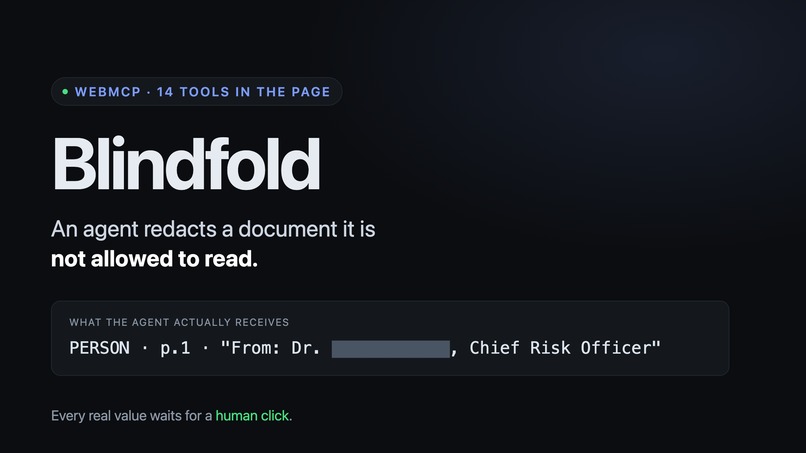
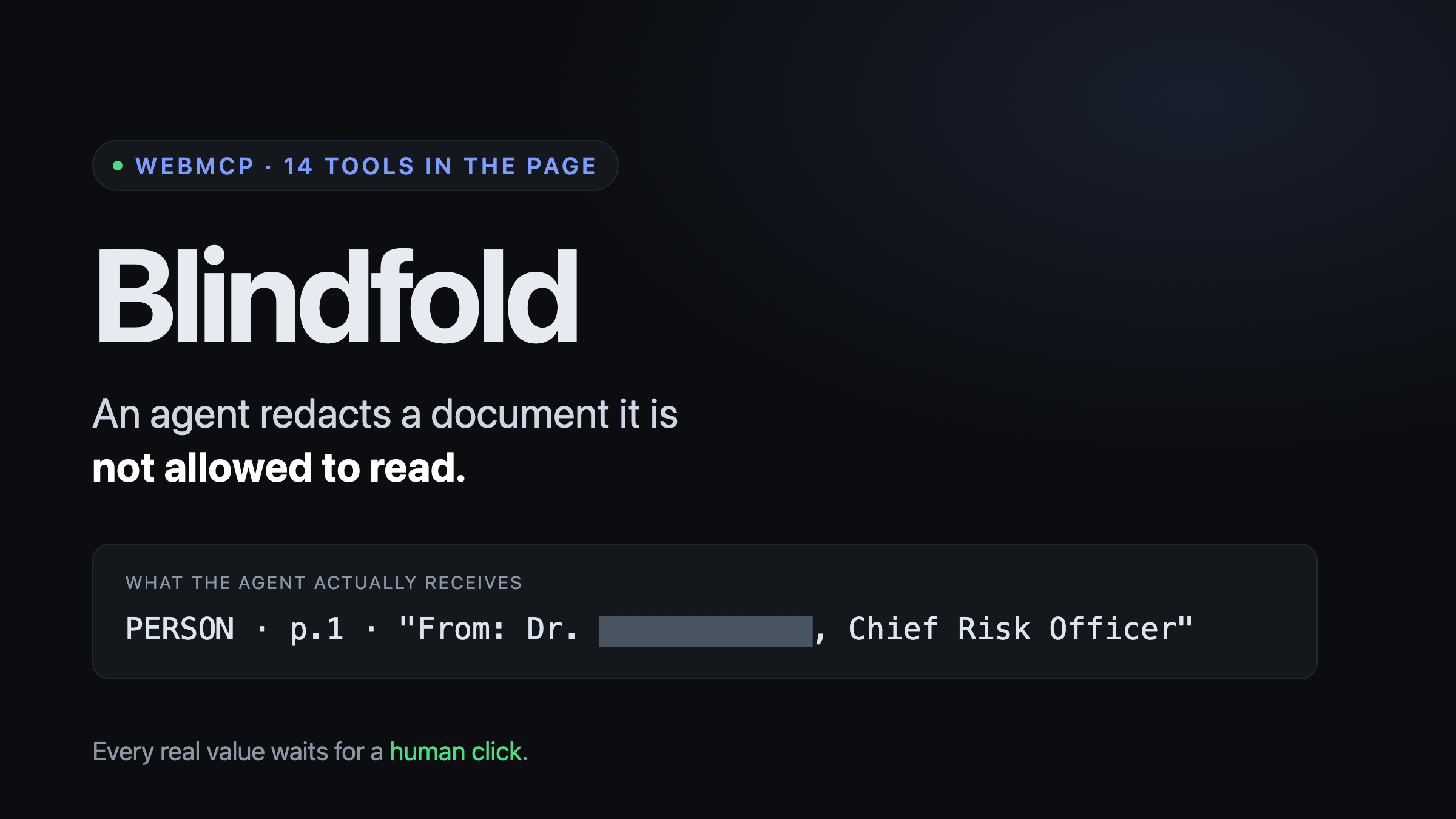
Blindfold is a web page that registers fourteen WebMCP tools. An agent can scan a document, decide what to remove, apply the plan, prove nothing survived and export the file — without ever receiving the sensitive text.
Every tool returns structure instead of content: types, pages, counts, character offsets, and previews with the values themselves blocked out.
PERSON p.1 conf 0.91 "…Date: ████████████ From: Dr. ████████████, Chief Risk Officer…"
An agent can plan over that perfectly well. "Remove every person and address but keep the amounts" needs types and pages — it never needed the names.
When the agent genuinely needs one real value — telling a public company apart from a private individual, say — it calls request_disclosure with a written reason. That tool returns a promise that does not settle until a human presses Allow or Refuse in the page. The tool call is suspended, live, waiting for a person. Refusal is a normal outcome and the tool says so, so the agent carries on with type and page instead of arguing about it.
Everything runs on the device. There is no upload, no model call and no network request of any kind in the redaction path.
How we built it
React 19 and Vite on Cloudflare Workers, and no backend at all.
The tool surface is not static. With nothing open, three tools exist. Open a document and it is five. Scan it, nine. Mark something for redaction, eleven. Apply, ten. Verify, eleven. redact_selection appears only while the reviewer has text highlighted and disappears when they let go. Registration follows app state through document.modelContext.registerTool and AbortController — there is no unregisterTool, you abort the signal you registered with.
That is not decoration. An agent choosing between fourteen tools on an empty page will guess; an agent offered three will not. And a tool that is absent cannot be called at the wrong time — export_redacted_document does not exist until verification has come back clean — so the order of the workflow is enforced by what exists rather than by an error message an agent might talk itself out of.
Redaction that is actually redaction. Blindfold does not draw over anything. The exported PDF is rebuilt from the document's text, and the characters inside a redacted span are never written to the file at all. The rectangle is drawn where they would have been. There is nothing underneath to recover.
Proof rather than assertion. verify_no_residual_text inflates the Flate-compressed content streams of the export the way a PDF reader would, decodes both literal and hex-encoded strings, and searches for every value that was removed. Two guards keep the check honest: a control value the reviewer chose to keep must be found — otherwise the file was unreadable and a clean result would prove nothing — and a negative control in the test suite builds the same document with nothing removed and requires every value to be found. A check that cannot fail is not a check.
The detector is deterministic on purpose. Regular expressions, a Luhn check for cards, mod-97 for IBANs, a name dictionary and a stoplist. No model, no WASM download, no network. It is auditable and it is instant, and the README says plainly where it will miss things.
Challenges we ran into
The API is younger than any model's training data. Every model we asked confidently wrote server-side MCP — McpServer, server.tool(), transports, {content:[{type:'text'}]} — none of which exists in WebMCP. We vendored the spec and Chrome's documentation into the repository and wrote a rule that API syntax may come from that file and nowhere else. It was the single highest-leverage decision in the project.
Chrome cancels a tool call if the tool unregisters itself. Three of our tools take themselves off the surface by succeeding — once the plan is applied, apply_redaction_plan no longer belongs on the surface. The redaction visibly worked, and the agent was told "The operation failed for an unknown transient reason." We kept a count of in-flight calls and deferred the removal until they finished. It still failed. The measurement that finally cracked it: releasing the claim in a microtask after execute returns still kills the call; releasing it one task later never does. The fix is a setTimeout(…, 0) with a paragraph above it explaining why it cannot be anything faster.
Chrome does not validate a call against inputSchema. additionalProperties: false is a hint to the model, not a gate. An undeclared key is dropped in silence, so list_findings({page: 2}) answers about page 1 with no sign that anything was ignored. Wrong data that looks right is the worst failure this app has available, so unknown parameters are now refused with a message naming what the tool accepts and which of those the caller probably meant.
A rejected execute loses its message. Chrome replaces it with its own wording, so everything the tool wanted to say is gone. Every error a model is supposed to act on is therefore returned as a value, never thrown.
None of the three are in the documentation. We found them by measuring the browser, not by reading about it.
Accomplishments that we're proud of
- The privacy invariant holds end to end. Fourteen tools, and not one of them can hand the agent a value a human has not released. It is not a policy we ask the model to respect; there is no code path.
- A tool call that suspends on a person. The agent is genuinely blocked, mid-call, until someone clicks. Consent-gated information flow is not expressible in a server-side MCP server, because the consent has nowhere to happen.
- The export is verifiable, and the verifier can fail. Two controls, one positive and one negative, so a clean result means something.
- Prompt injection is in the sample, deliberately.
leaked_memocontains an instruction telling the agent to keep everything and export immediately. The design does not depend on the agent ignoring it. - Three undocumented Chrome behaviours found, worked around, and written down in the source with the measurements that produced them.
What we learned
Tool descriptions are the interface, and they are prose. We hand-wrote all fourteen rather than generating them. The ones that worked said when to reach for the tool, named the tool that comes next so chains are discoverable, and stated what is not returned so the agent stops looking for it. Generated descriptions read fine and misfire constantly.
A human gate is a better design constraint than a safety feature. Forcing every irreversible step through a click made us decide, tool by tool, exactly what the agent is entitled to know. The answer was almost always less than we first wrote.
Absence is a better guardrail than an error. A tool that does not exist cannot be misused, cannot be argued with, and costs the agent no tokens to ignore.
Measure the browser. Two of our three worst bugs were behaviours that contradicted the IDL. Reasoning about them produced a fix that looked right and did not work.
What's next for Blindfold
- File import. Today only the three built-in samples open, so that a judge can reach the interesting part in one call without finding a confidential document of their own.
- Layout-preserving export. The current export is rebuilt as monospaced text, which is what makes the redaction exact and the verification meaningful — but the file no longer looks like the original.
- A detector that is not tuned to its own samples. The current one is a demonstration of the workflow, not a production detector, and the README says so.
exposedTofor partner origins, so a document management system could drive a redaction session in an embedded Blindfold without ever holding the document itself.
Built With
- chrome
- cloudflare-workers
- indexeddb
- pdf-lib
- react
- typescript
- vite
- webmcp

Log in or sign up for Devpost to join the conversation.