-
-
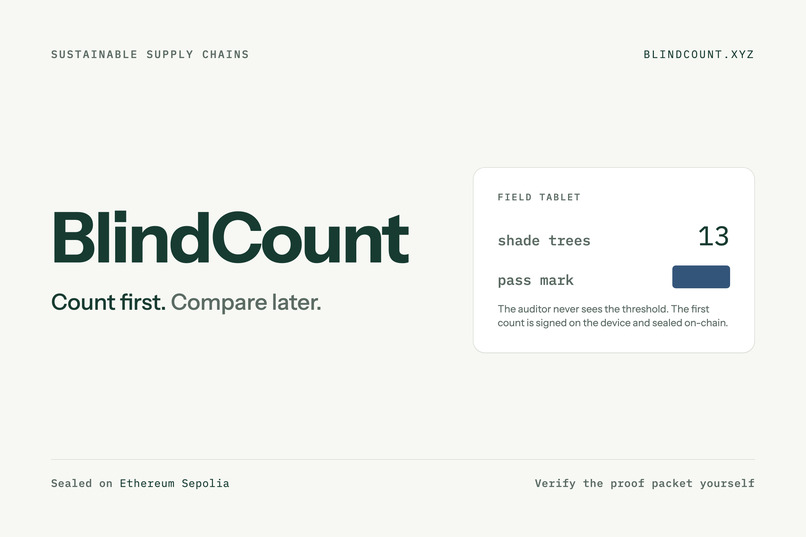
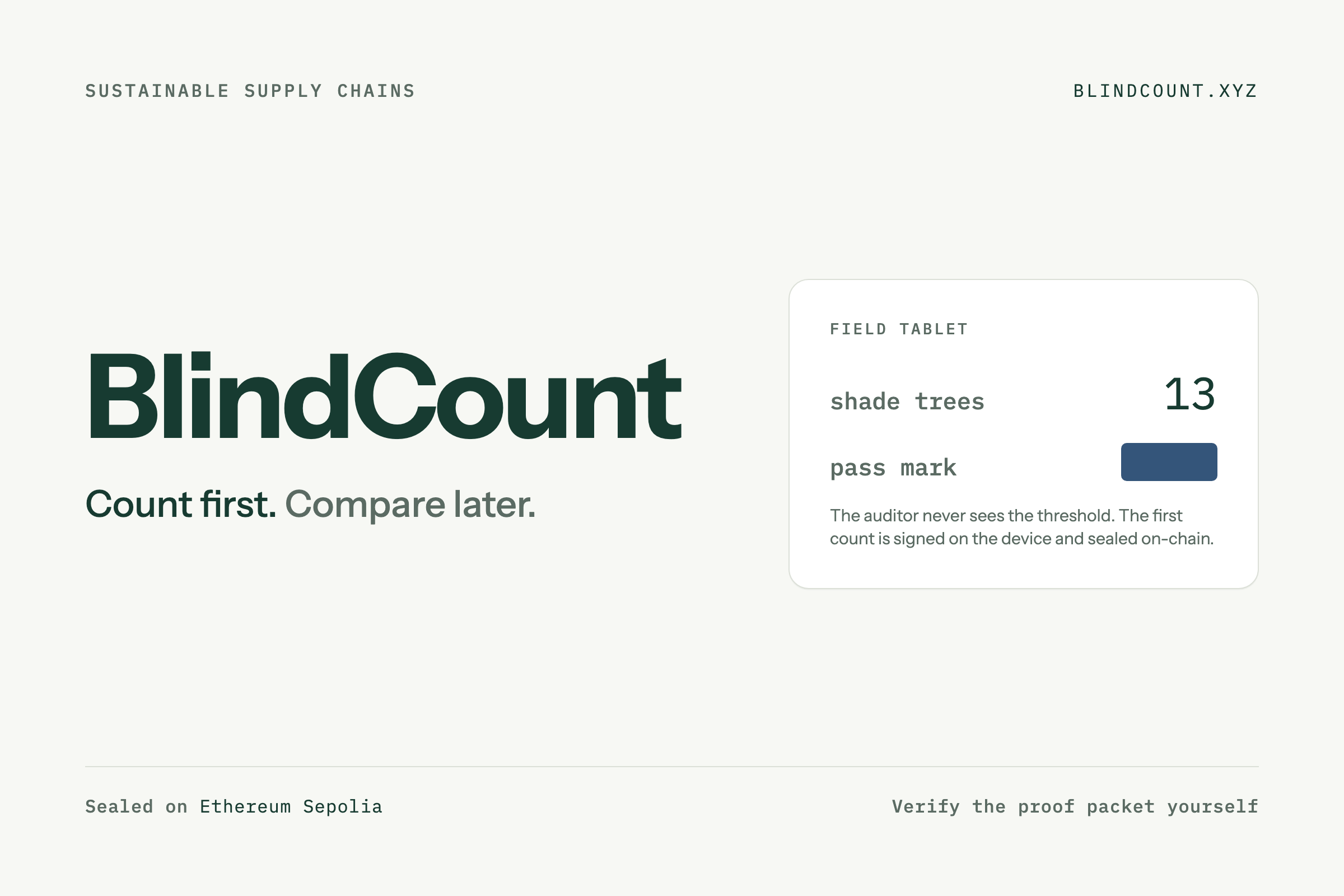
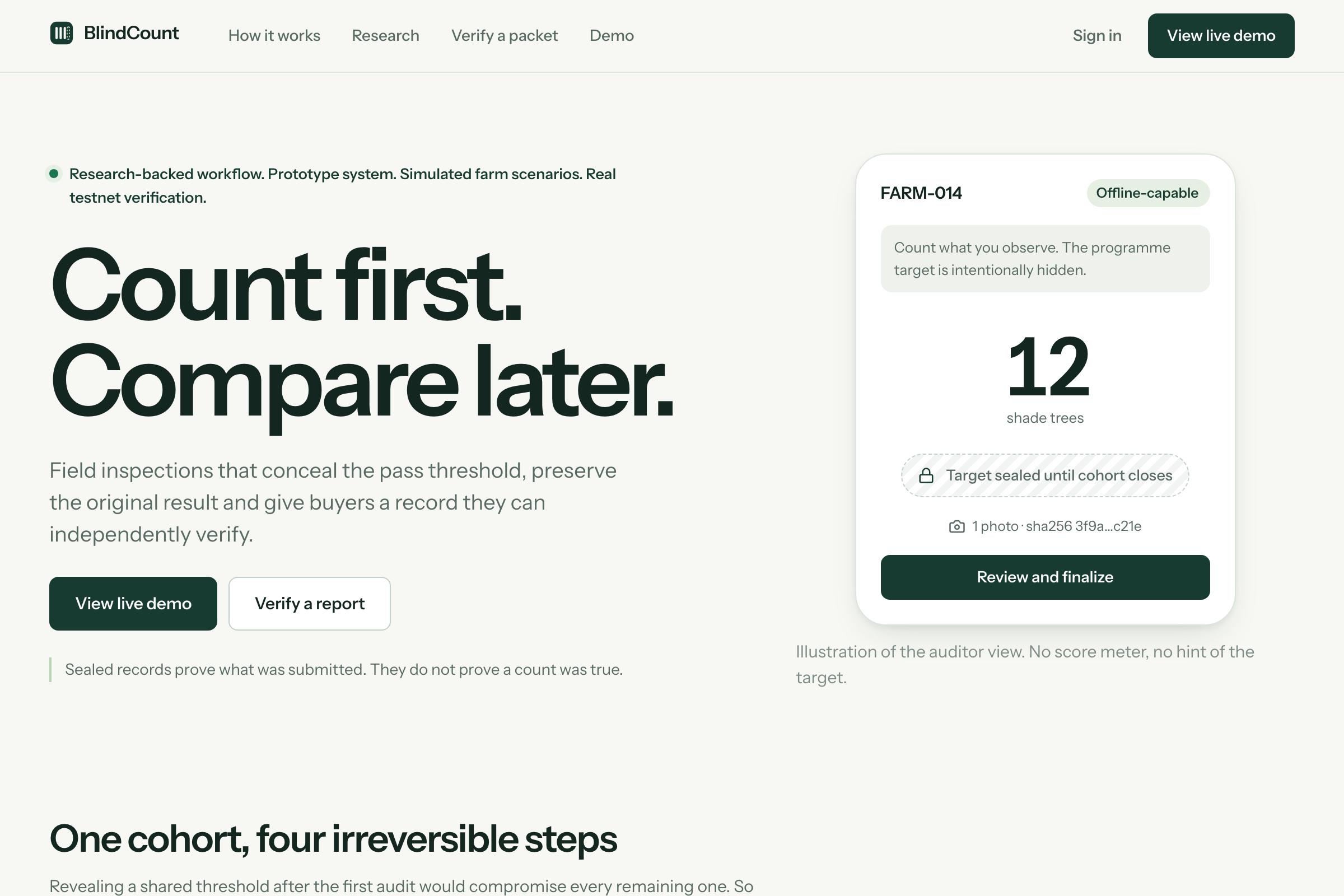
The field tablet shows the count but hides the pass mark. Count first, compare later.
-
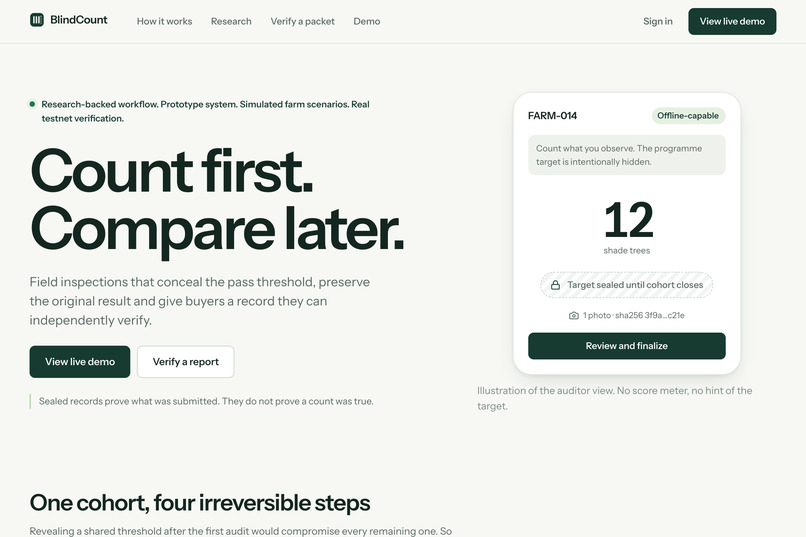
Auditors count with no target and no score meter. The first observation is signed on the device and sealed on Ethereum Sepolia.
-
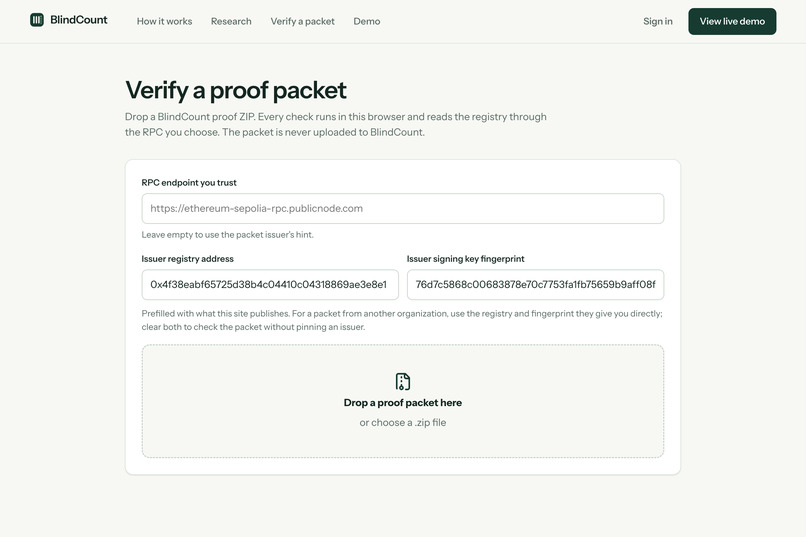
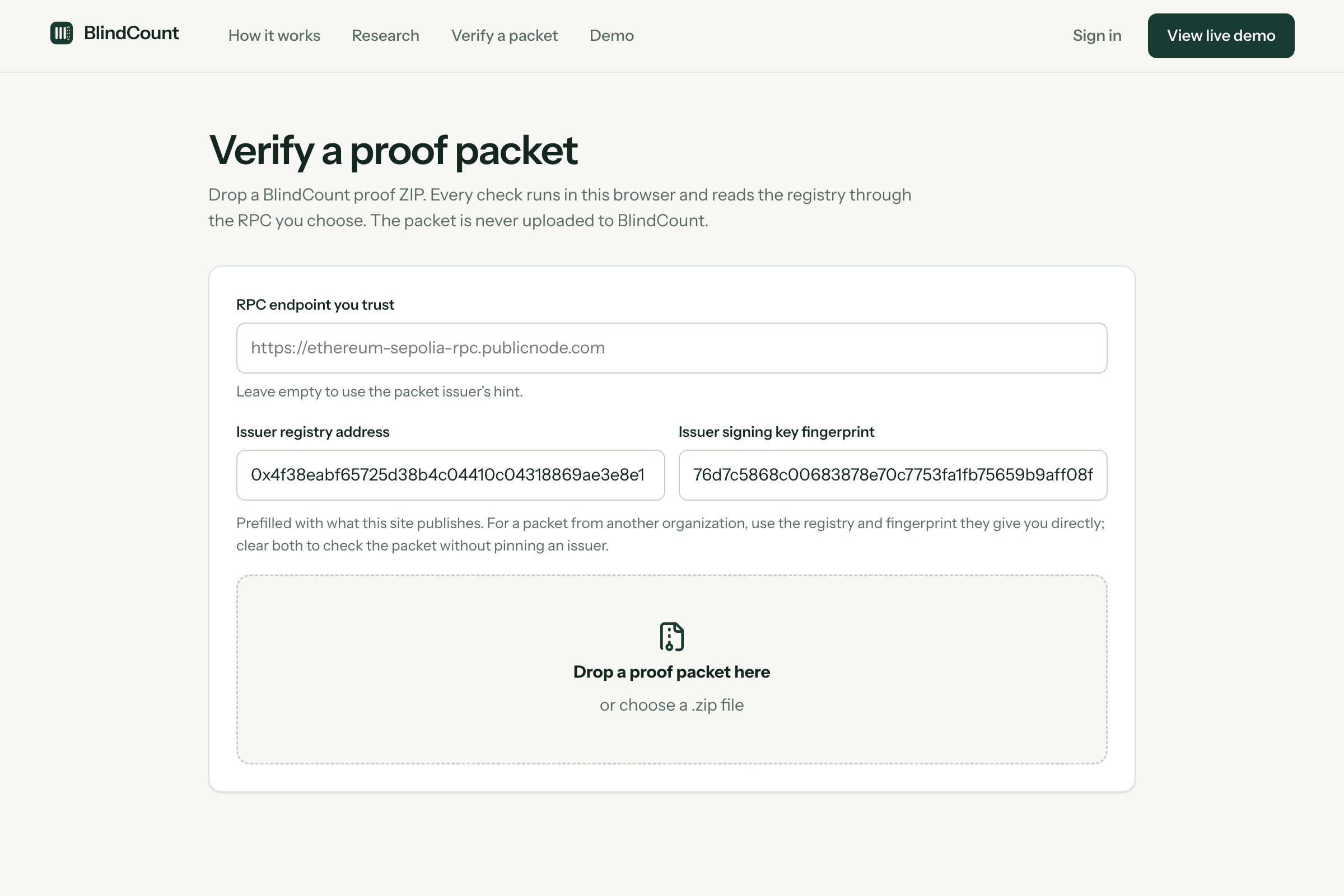
Anyone can verify a proof packet in the browser against their own RPC, no account. Change one digit and it fails on the exact file.
Inspiration
Cocoa sustainability programmes pay for shade trees, and buyers make public claims based on field counts. The people doing those counts usually know the minimum a farm needs to pass. A 2026 randomized study of 407 cocoa farms in Côte d'Ivoire (Cammelli, Six and Garrett; Dryad doi:10.5061/dryad.v9s4mw77q) found that verifiers who could see the threshold amended failing counts far more often. We downloaded the authors' public data and reproduced their headline result: 24.8 points of excess amendments with the threshold shown, 11.2 with it concealed. The fix is a design change software can enforce. Don't let the person counting see the number that decides the outcome, and preserve what they first reported.
What it does
A programme manager sets a hidden minimum (for example, shade trees ≥ 15) for a cohort of farm visits. The value is encrypted with its own key and committed on-chain as a salted hash, so it can be proven later but not guessed now.
Each field auditor gets a phone form with no target, no score meter and no hint. They record the count and photos. The phone signs the observation with a key that never leaves the device, and it works offline. The server verifies the signature and evidence digests, stores the first version append-only, and a relayer anchors a salted commitment on Ethereum Sepolia.
The cohort can't close, and the target can't be revealed, until every assignment is sealed or voided by two people. This is enforced by the API and by the smart contract, so revealing the threshold after the first audit can't compromise the others. After on-chain closure, the criterion custodian discloses the target, deterministic code evaluates each count, and a reviewer approves or disputes with a written reason. A correction is a new signed, anchored version; the original never changes.
A buyer or certifier verifies the proof packet in the browser or with an open-source CLI, without a BlindCount account. Change one digit in the packet and verification fails on the exact file. Sealed records prove what was submitted. They don't prove a count was true, and BlindCount says so on every report.
How we built it
Smart contract: BlindCountRegistryV1 (Solidity 0.8.24, OpenZeppelin 5.1), live on Ethereum Sepolia at 0x4f38eabf65725d38b4c04410c04318869ae3e8e1, source verified on Sourcify (exact match). Separate roles for publishing, anchoring, closing, voiding and pausing; voids need a second signer. It stores only opaque keys and salted commitments, never counts, targets or personal data. 28 Foundry tests cover every adversarial case, fuzzing, and commitment vectors shared with the TypeScript code. Slither and Aderyn report no high or medium issues.
Cryptography: RFC 8785 canonical JSON, SHA-256, domain-separated keccak commitments bound to chain id and registry address, WebCrypto P-256 device signatures.
Backend: Fastify + PostgreSQL (Prisma) with database triggers that refuse edits to sealed records, a Postgres job queue that reads chain state before every retry so nothing is anchored twice, and separation of duties. Hosted on a VPS behind Caddy; the web app is a Next.js PWA on Vercel with encrypted offline drafts, manager and reviewer workspaces, and an in-browser verifier.
AI, used honestly: an advisory evidence-quality check (blur, darkness, irrelevant scene, possible reuse) that never receives the criterion, the count or the outcome, can't set an outcome, and is labelled as a suggestion. Deterministic checks (duplicate photo digests, clock inconsistencies) run on every submission. BlindCount does not claim a model can count trees from a few photos.
Tests: contract, crypto, domain, CLI, an API integration suite that runs the whole story against the live Sepolia contract, and a Playwright test with four browser users covering offline work, corrections and tamper detection.
Challenges we ran into
Making the reveal per cohort instead of per form, in both the database and the contract, and letting the verifier prove it from the chain. Supporting corrections after closure without ever rewriting the original: corrections are appended, signed versions, and the contract guarantees the closed history can't change. Letting a phone sign offline before photos are uploaded, where the client proposes evidence ids that the server then checks. And the hardest discipline of all: never saying "sealed" or "verified" one step too early, including when the chain is slow or the verifier has no RPC.
Accomplishments that we're proud of
The reveal unit is the cohort, enforced on-chain: closeCohort reverts unless every registered assignment is anchored or voided. The whole story runs against the live Sepolia contract in CI, not a mock. Verification trusts nothing BlindCount serves, since the same verifier runs in the browser and a CLI, pins the issuer, and reads the chain through an RPC the verifier chooses. And we reproduced the published study's headline figures from its own public data.
What we learned
An integrity system earns trust by being precise about what it does and does not prove. A sealed record proves what was submitted, by which enrolled device, and that it was anchored before the criterion was disclosed. Whether the trees are really there is the reviewer's call, and every report says so. Overclaiming would undermine everything else.
What's next for BlindCount
A field pilot with a cooperative or monitoring provider on one crop and region, French field screens for Côte d'Ivoire, KoboToolbox/ODK import, Merkle-root rosters for very large cohorts, and customer-managed keys.
Built With
- caddy
- docker
- ethereum
- ethers.js
- fastify
- foundry
- next.js
- node.js
- openzeppelin
- playwright
- postgresql
- prisma
- react
- solidity
- typescript
- web-crypto

Log in or sign up for Devpost to join the conversation.