Inspiration
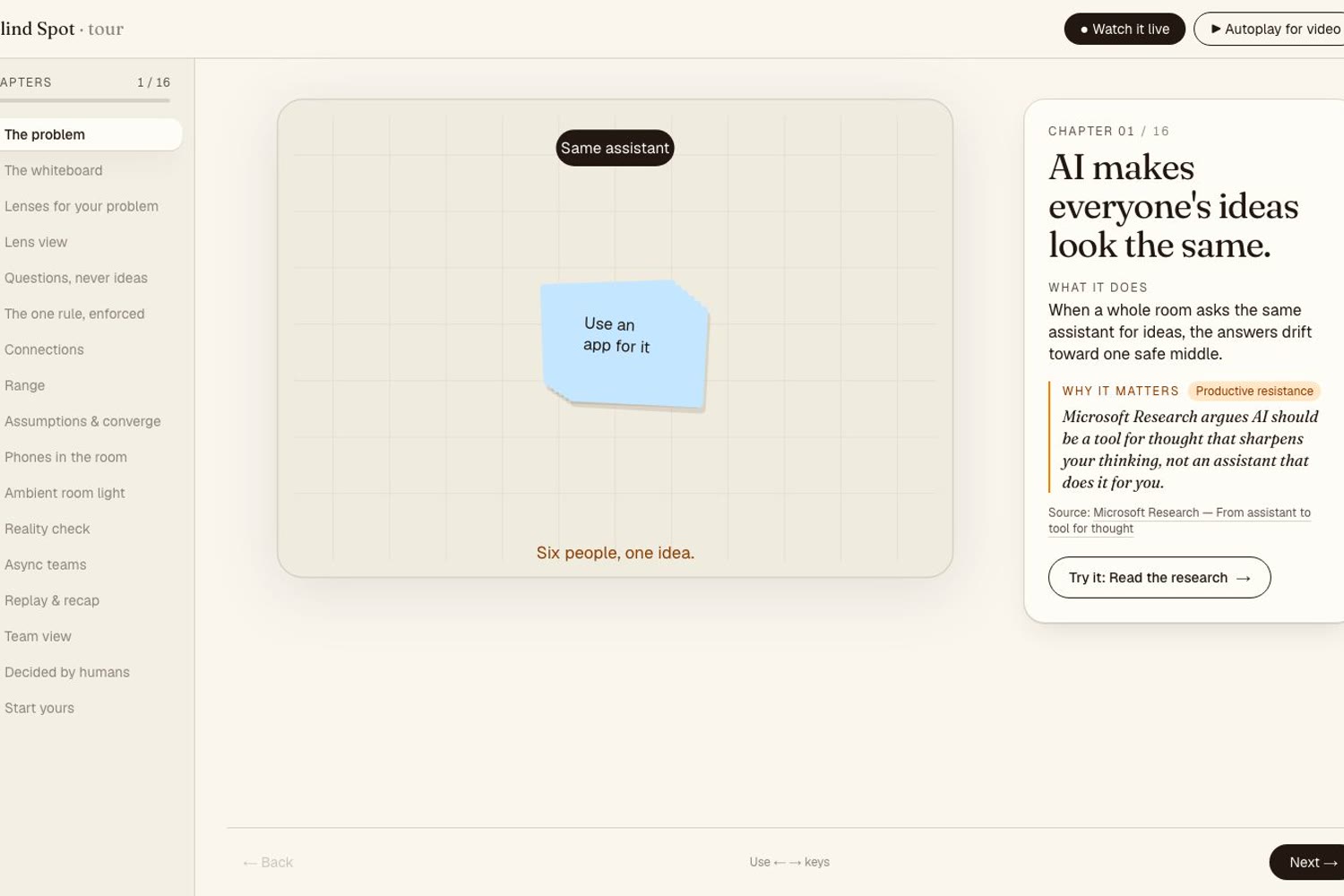
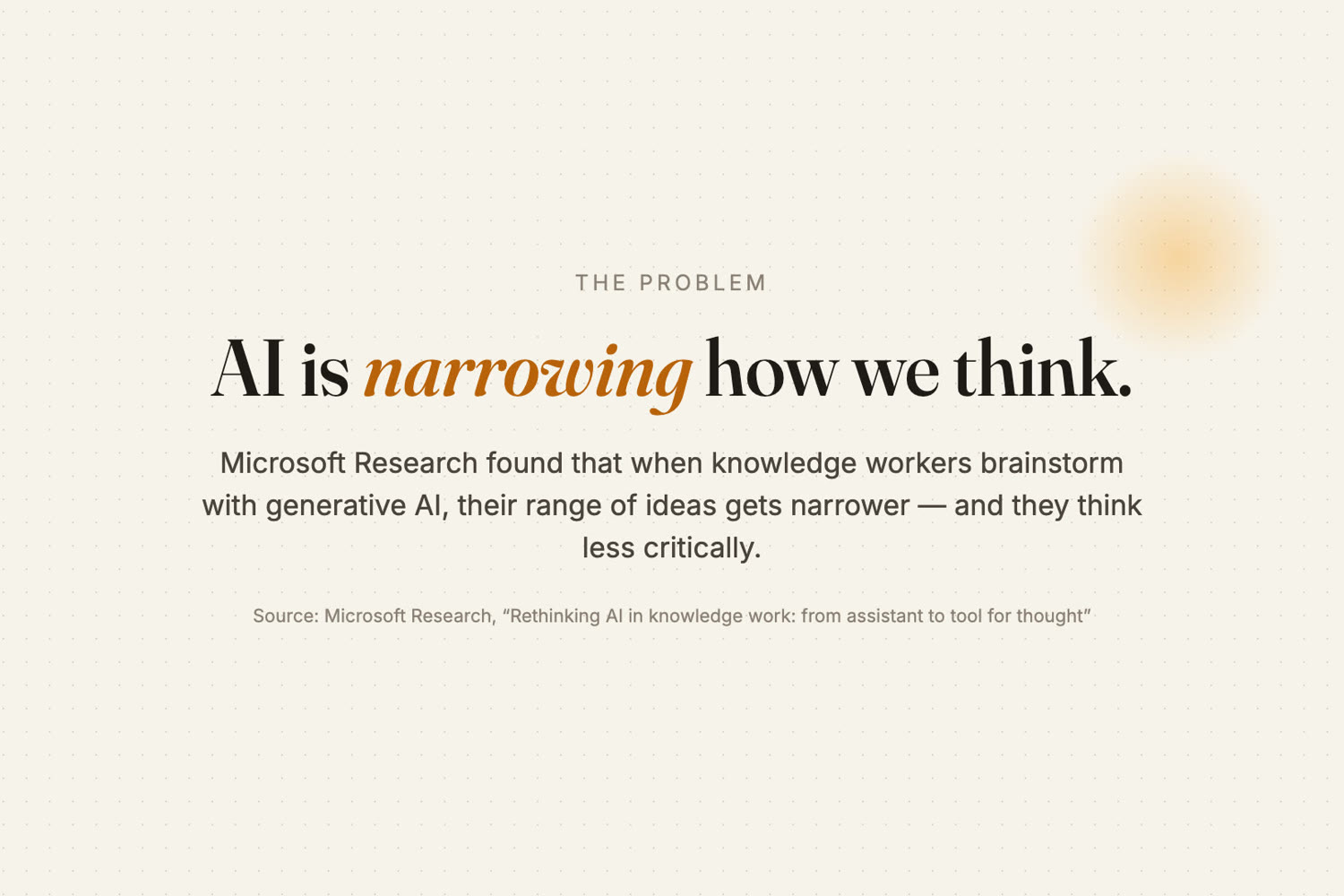
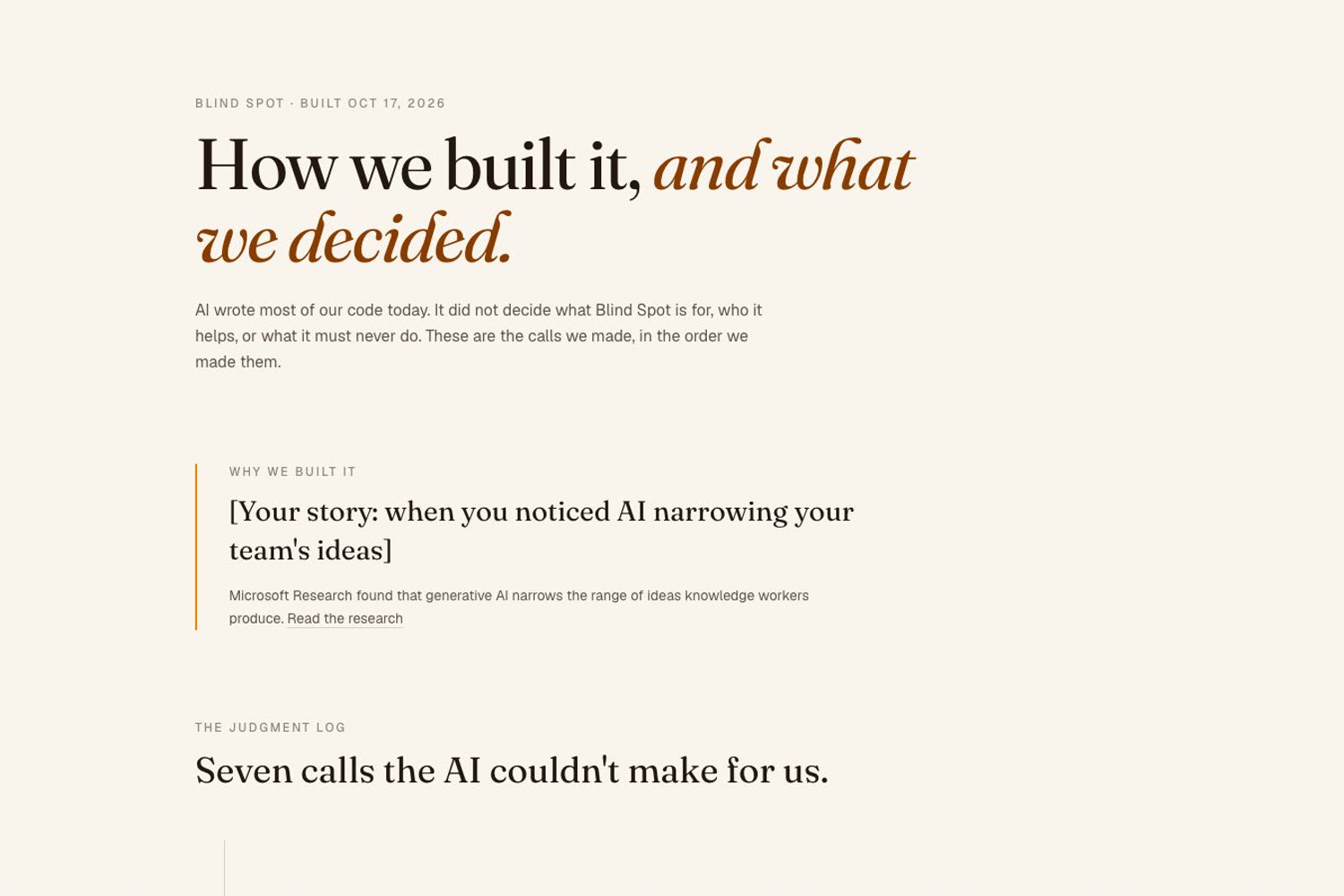
Microsoft Research found that when knowledge workers use generative AI, their range of ideas gets narrower and they think less critically (source). When everyone asks the same model, everyone gets the same answer. Teams are quietly converging on the same AI-flavored ideas.
We wanted the opposite: AI that shows a team where it hasn't looked and leaves the thinking to the people.
What it does
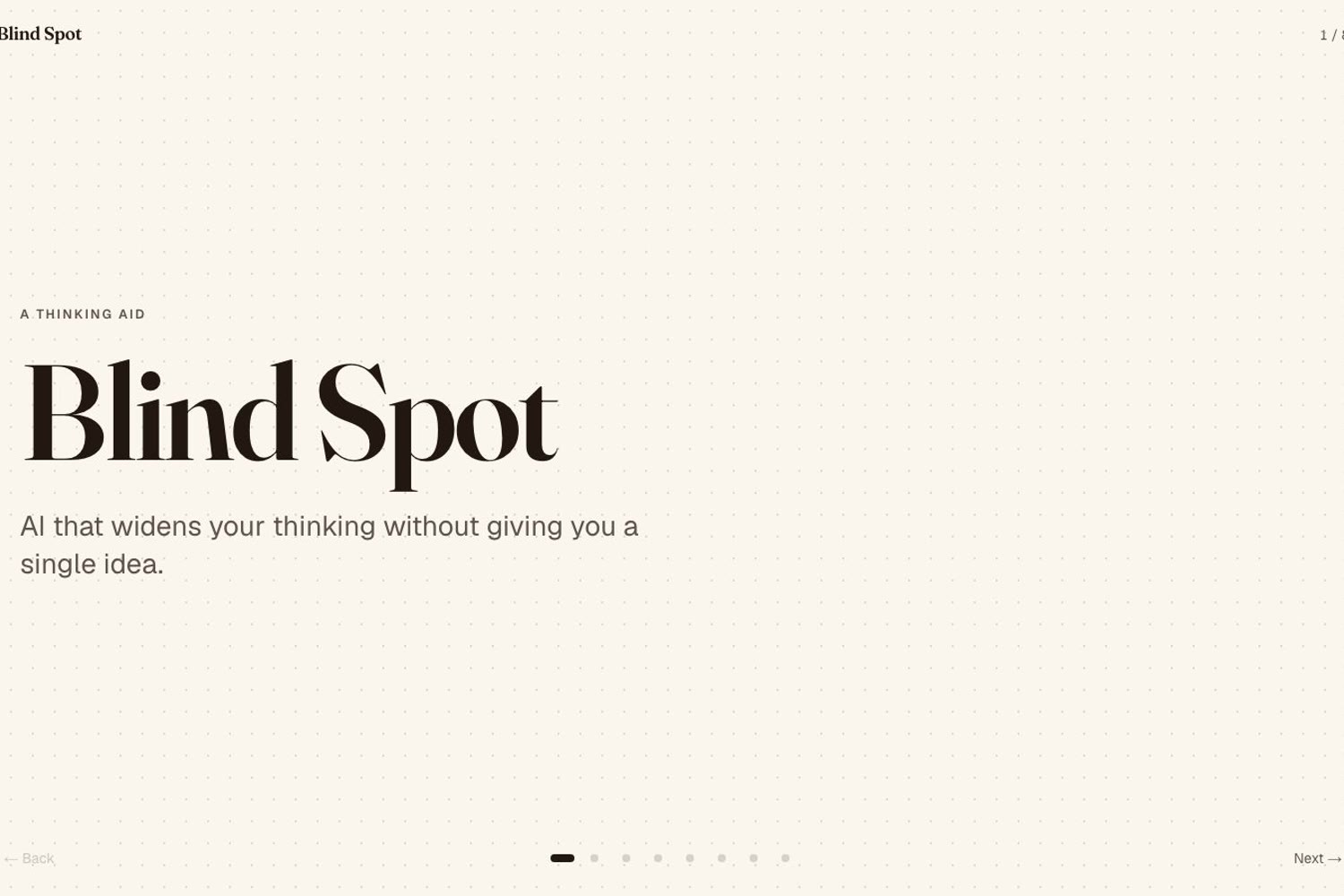
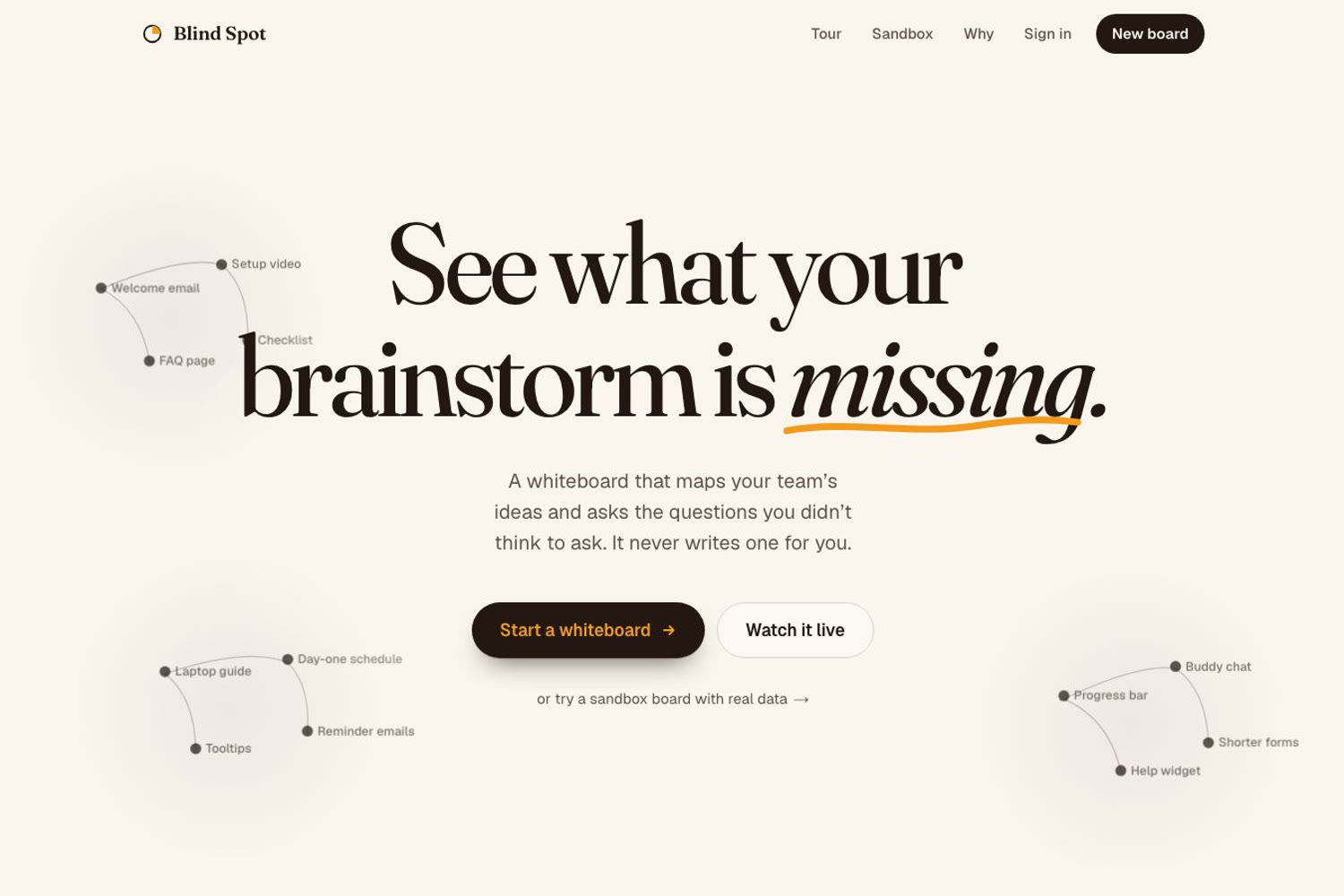
Blind Spot is a collaborative whiteboard for brainstorming, built around one rule: the AI never writes an idea.
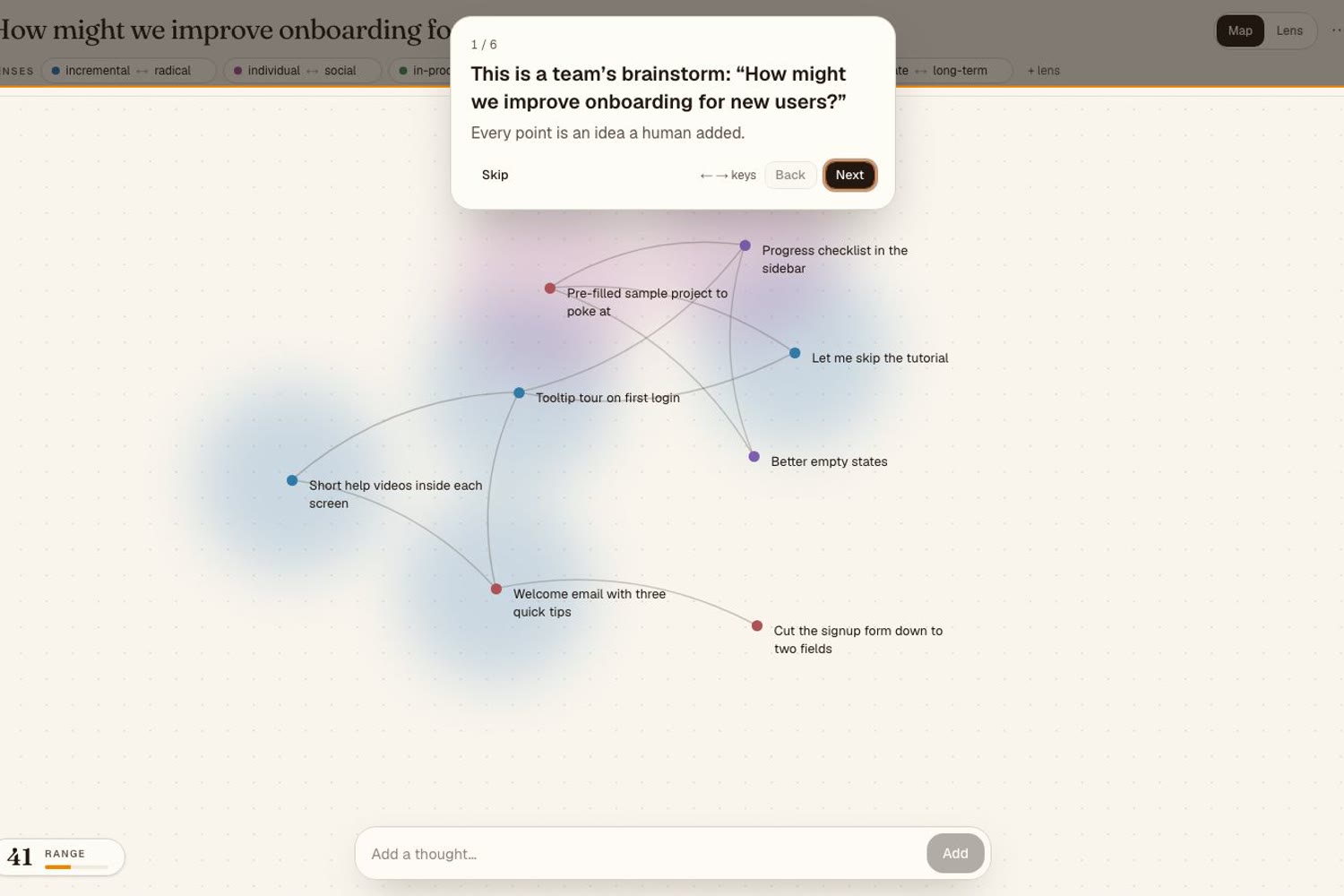
- A thought map. Add ideas as text, photos or voice notes. Each idea becomes a point; related ideas pull together and get connected by threads, so clusters and lonely "islands" appear on their own.
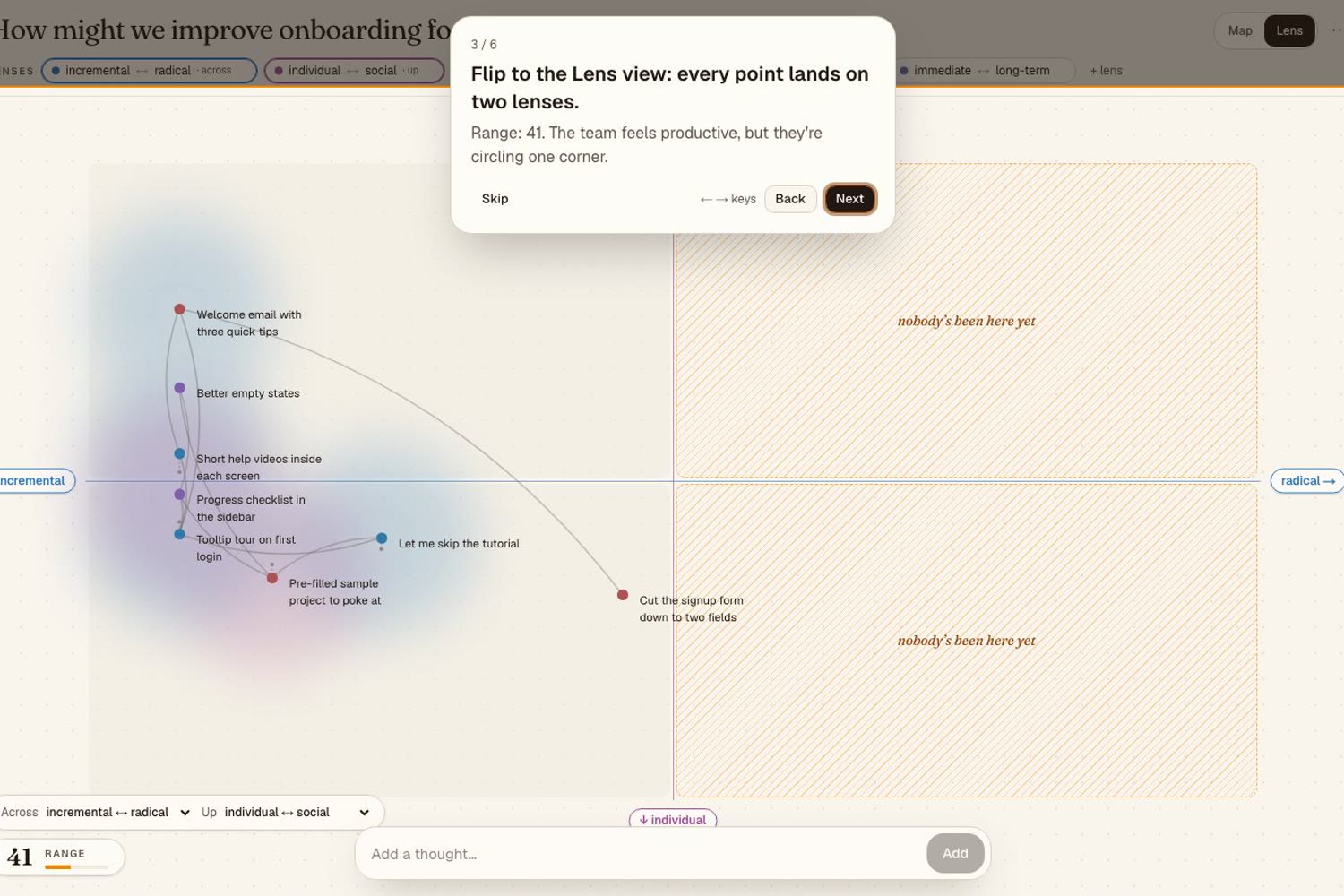
- Lenses. The AI picks named axes for your problem (like incremental ↔ radical or individual ↔ team) and scores every idea on them by meaning.
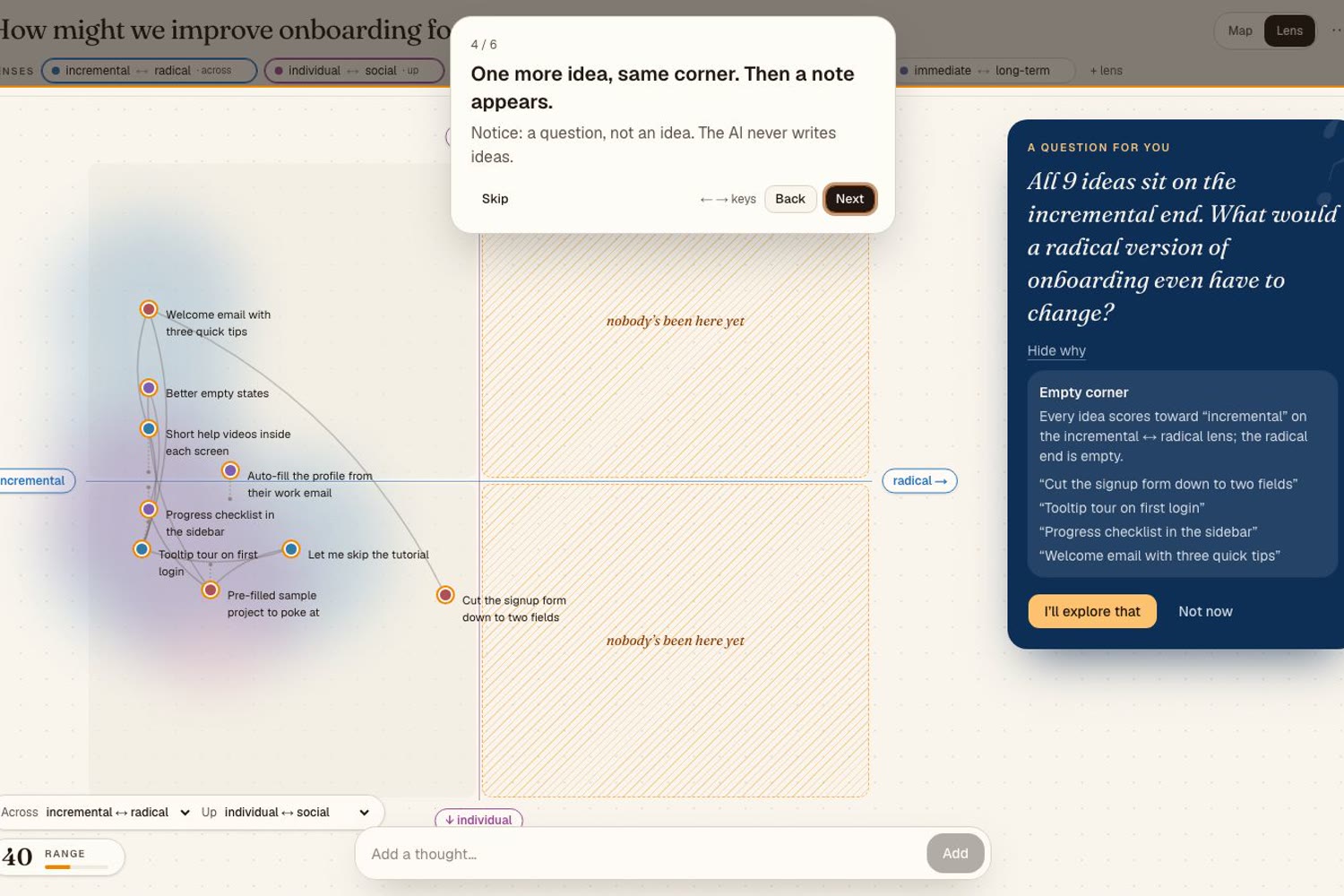
- Lens view. Flip the board and the points rearrange onto two lenses. The empty corner is your blind spot, and now it has a name: "nobody's been here yet."
- Questions, never ideas. When the team circles one corner, Blind Spot pins a question, not a suggestion. Nine question types: gap, fixation, near-duplicate, abandoned idea, unexplored lens, bridge, one voice dominating, lopsided shortlist, and shared assumption. Every question passes a regex blocklist and an LLM judge, with a template fallback, so a suggestion can never reach the board (eval: 40/40).
- Inspect any point. See its full content, where it leans on each lens, its closest and farthest ideas and why they connect, and Find context: real sources from the web via Exa. Evidence, not ideas.
- Teams, async. Accounts, invites, "My boards", and a "while you were away" digest. Replay how a board grew, converge on a shortlist, write down shared assumptions, and export a recap.
- Beyond the screen. Phones join by QR to snap photos of real sticky notes or record voice. A room camera reads a physical sticky wall. An ambient "room light" shifts from teal to amber when the team fixates. An AR view floats the map around you on any phone (and it would be even better on a headset like Meta Quest).
- Reality check (Glasser). Shows how crowded a space already is out in the world.
How we built it
- App: Next.js 16 (App Router), TypeScript, Tailwind v4, motion for animation, three.js for AR. Deployed on Vercel.
- AI, all through the Vercel AI Gateway: Claude Sonnet writes lenses and questions; Claude Haiku is the suggestion judge; OpenAI embeddings place ideas; OpenAI transcription handles voice notes; Claude reads photos of sticky notes.
- Data: Supabase Postgres + pgvector, Supabase Auth and Storage, row-level security.
- Engine: pure TypeScript for scoring, connections, clusters and gap detection, with unit tests.
- Integrations: Exa for web context, Glasser for the reality check.
- Quality: a Playwright end-to-end suite that, among other things, checks no question ever suggests an idea; per-IP rate limits on every AI endpoint.
- Process: a multi-agent build. Claude Code orchestrated Codex, Cursor and Claude subagents working in parallel git worktrees, merging each slice only after tests passed.
What AI couldn't do alone
AI wrote most of the code. It couldn't decide what the product is for or what it must never do. The calls that shaped Blind Spot were human (full log in the app at /why):
- The one rule. Models want to be helpful, so early drafts slipped into "you could try…". We built a separate checker, because the moment the AI generates ideas, the thesis collapses.
- Named lenses over clusters. An empty patch on a scatter plot can't be named; an axis can.
- We caught two scoring flaws. Per-session normalization made every lens look balanced and hid every real gap; and scoring against bare pole words ("radical") only matched ideas containing that literal word. We measured real embeddings and fixed both.
- Points and connections over sticky notes, after watching the board feel cluttered.
- Async teams, because brainstorms don't happen in one sitting.
- Evidence, not ideas. Even web search and the reality check only show what exists.
The product's rule mirrors how we built it: the AI does the work; people make the calls.
Challenges we ran into
- Hidden scoring bugs. Both scoring flaws looked correct and passed every check except the one that mattered: does it find real gaps?
- Keeping the AI from suggesting. "What if you tried a peer-mentor program?" is a question that's really an idea. One prompt wasn't enough, so we layered a blocklist, a judge and deterministic fallbacks.
- Coordinating many AI agents at once without them overwriting each other's work.
Accomplishments that we're proud of
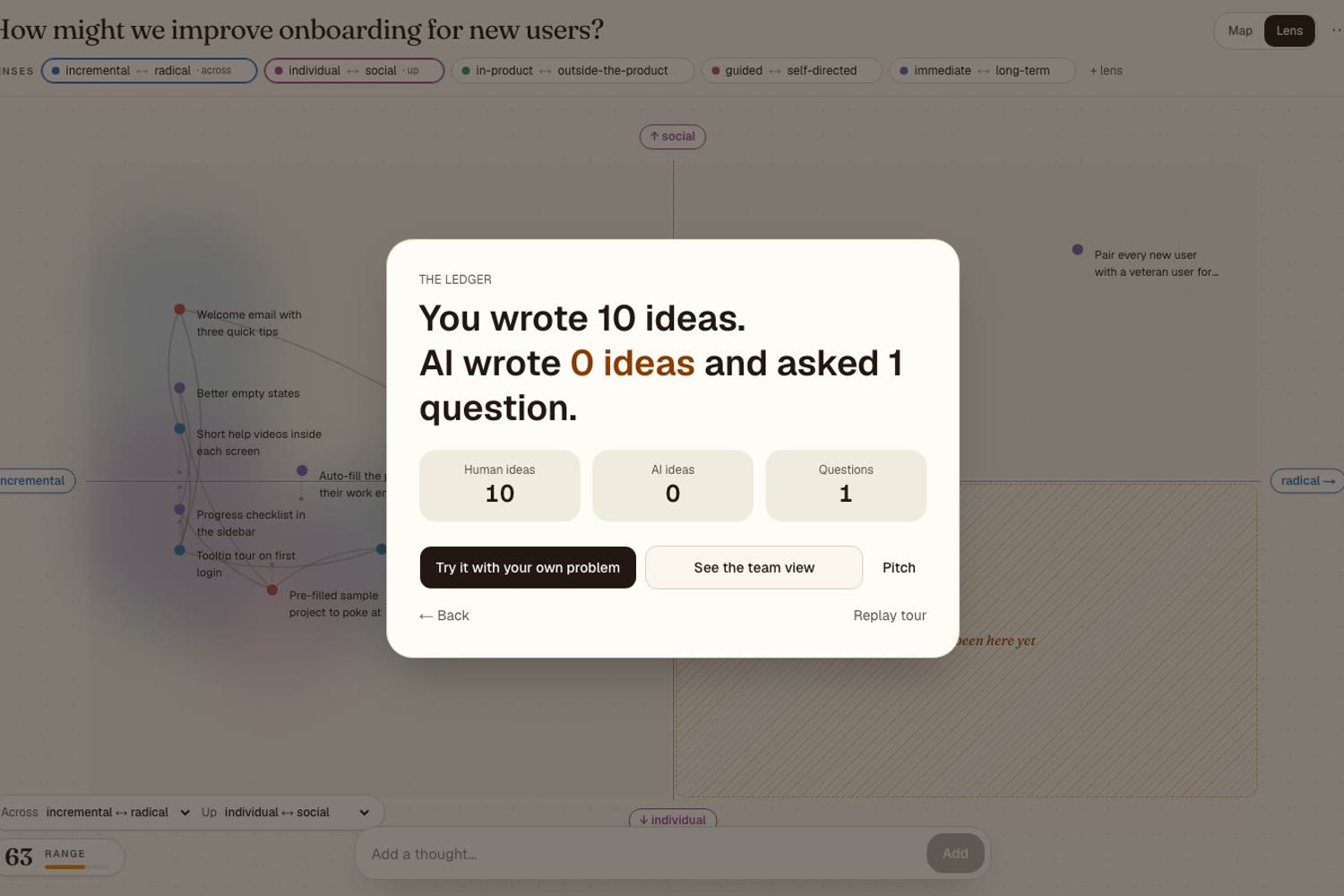
- An AI feature whose success metric is that it wrote zero ideas.
- Gaps you can read aloud: "Every idea sits on the incremental end."
- A complete product: shared boards, accounts, phones, room camera, AR, replay, converge, web context, and a live guided tour.
- 40/40 on our suggestion-guard eval.
What we learned
- The hardest part of building with AI is knowing when to overrule it.
- A constraint ("never write an idea") made the product clearer, not weaker.
- With fast parallel agents, judgment becomes the bottleneck, so make it explicit.
What's next
- Headsets and room hardware: Meta Quest for the map in space, and a camera bar, mic array and ambient light for team rooms.
- Longitudinal team insights: across sessions, show a team how it tends to think ("your team never goes radical").
- Education: classrooms where widening students' thinking matters more than handing them answers.
Demo video narration voiced with ElevenLabs; the script, product decisions and every idea on the board are human.
Built With
- anthropic
- claude
- claude-code
- codex
- cursor
- elevenlabs
- exa
- glasser
- motion
- next.js
- node.js
- openai
- pgvector
- playwright
- postgresql
- react
- supabase
- tailwindcss
- three.js
- typescript
- vercel
- vercel-ai-gateway
- zod

Log in or sign up for Devpost to join the conversation.