-
-
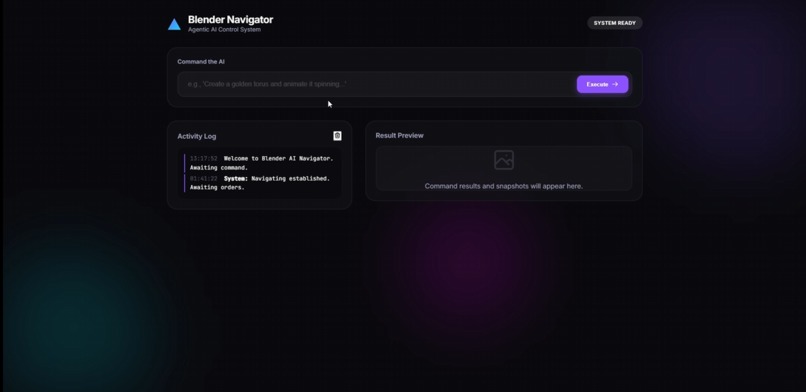
dashboard
-
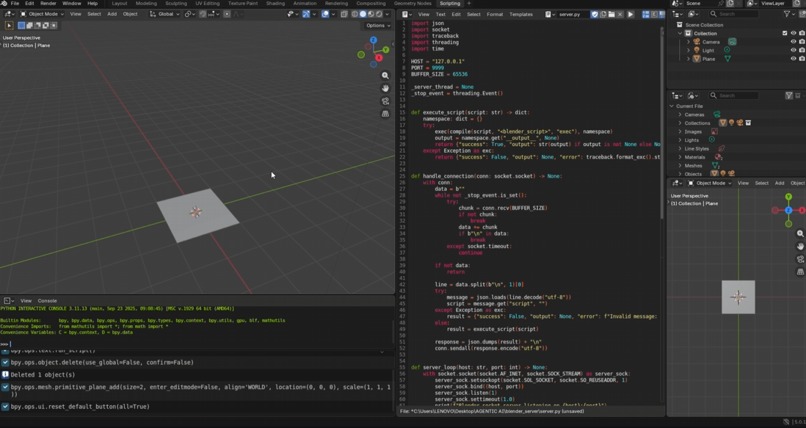
blender
Inspiration
Blender is one of the most powerful tools for 3D creation, but its interface and workflows can be intimidating, especially for beginners. Even simple models require navigating complex menus, tools, and modifiers. We wanted to explore a simpler way to interact with 3D software: what if users could just describe what they wanted to build? This idea led to BlendPilot — an AI assistant that understands natural language and directly operates Blender to construct 3D scenes.
What it does
BlendPilot is an agentic AI assistant that converts natural language prompts into fully constructed 3D scenes inside Blender. Users can describe what they want to create, such as a house, a landscape, or an object, and the AI interprets the request and builds the scene step by step. The system navigates Blender’s tools, creates meshes, applies transformations, and organizes objects automatically, acting as a smart co-pilot for 3D modeling.
How we built it
BlendPilot combines language understanding with automated control of Blender. An AI model interprets the user’s prompt and converts it into structured modeling instructions. An agent layer then breaks the task into logical steps such as creating base geometry, scaling objects, applying modifiers, and assembling the scene. These actions are executed through Blender’s Python API, allowing the AI to directly create and manipulate objects inside the software.
Challenges we ran into
One of the biggest challenges was translating vague natural language prompts into precise modeling actions. Requests like “a beautiful house” do not directly translate into exact geometry or dimensions, so the system had to infer reasonable structures and parameters. Another challenge was ensuring the agent generated logical modeling sequences rather than random commands, requiring careful planning of step-by-step workflows.
Accomplishments that we're proud of
We successfully built a working system that connects AI reasoning with Blender’s modeling capabilities. The project demonstrates how natural language prompts can be transformed into structured 3D modeling actions. We are proud of creating a bridge between AI agents and professional creative software, making complex tools more accessible.
What we learned
Through this project we learned how agent-based AI systems can interact with real software tools. We gained experience working with Blender’s Python API, designing workflows that translate human intent into structured commands, and building systems that combine language models with automated execution layers.
What's next for BlendPilot
Next, we plan to expand BlendPilot with more advanced scene generation, support for materials and textures, automated lighting and rendering, and interactive editing through follow-up prompts. Our long-term goal is to create a fully capable AI modeling assistant that allows anyone to design complex 3D environments simply by describing them.
Built With
- blender-python-api
- javascript
- langchain
- node.js
- openai-api
- python
- react
- three.js
- websockets


Log in or sign up for Devpost to join the conversation.