Inspiration
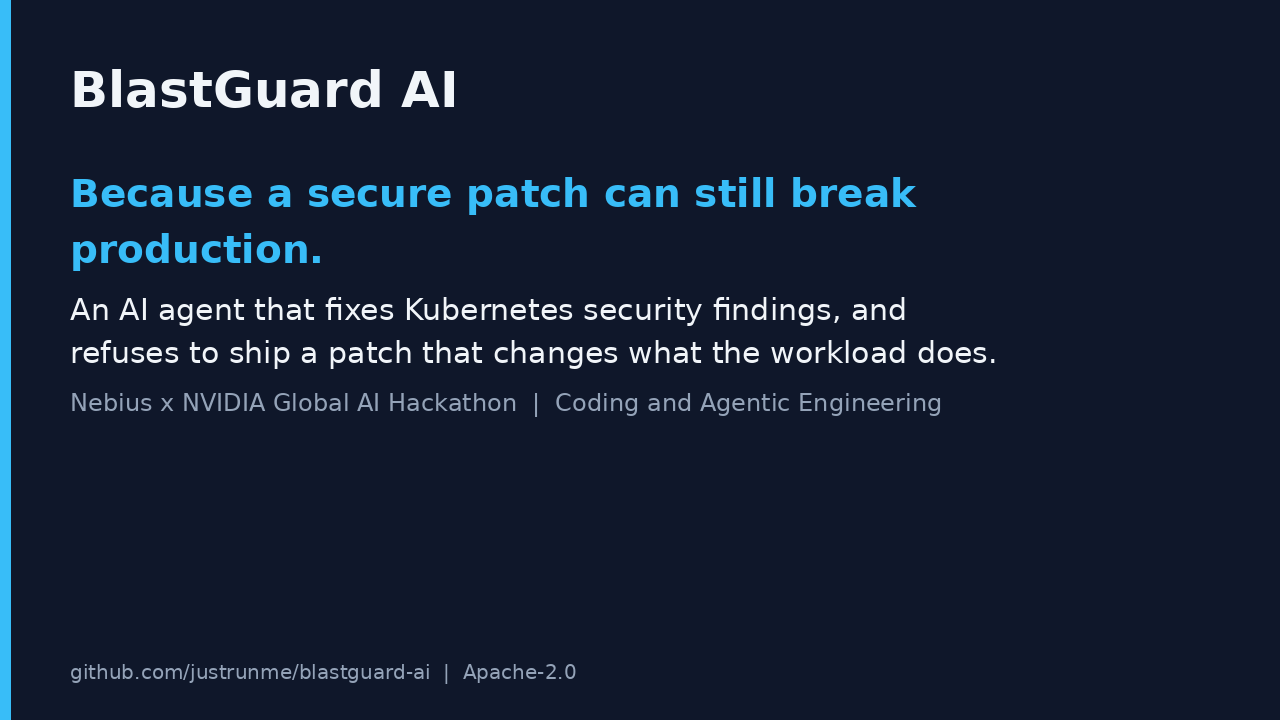
Scanners tell you what is wrong. AI fixers make the findings disappear. But a patch can pass every security check and still break the workload: a log collector loses its hostPath, an exporter loses hostNetwork, a service loses its exposure. "Findings: 0" is not the same as "still works".
What it does
An agent loop for Kubernetes security remediation. It finds misconfigurations with deterministic rules and external validators, asks NVIDIA Nemotron (through Nebius Token Factory) for a patch, re-verifies the patch from scratch with retries, and then runs an Intent Preservation Gate that decides whether the patch is safe to propose or needs a human, because it changed what the workload does.
Try it in 2 minutes
- Open the live demo, pick
01-privileged-hostpath, press "Run remediation loop" (real Nemotron call, about 5 to 10 seconds). - Read the four-part strip: policy checks, external validators, intent preservation, release decision (REVIEW_REQUIRED). Open the Diff and Intent gate tabs.
- Pick
04-stateless-api-missing-limits: it needs two attempts (kube-linter fails the first) and ends SAFE_TO_PROPOSE. - See the evidence: runtime proof in a real kind cluster, benchmark A/B, post-hoc audit.
How I built it
- Fail-closed YAML parsing (safe loader, size and document caps). Manifests are never executed.
- 13 rules (BG001 to BG013), kubeconform schema validation and kube-linter.
- Nemotron returns the full patched YAML through a
submit_patchtool call. The patch goes into a sandbox, an identity guard blocks "fixes" that delete or swap the workload, and everything is re-checked. - Verifier feedback goes back to the model: up to 3 attempts.
- The Intent Preservation Gate lists every drift (hostPath replaced, privileged removed, exposure changed, read-only root without a writable path, image tag changed, and more). High-impact drift means REVIEW_REQUIRED. If a validator is missing or the gate cannot decide, it fails closed to REVIEW_REQUIRED.
- Evidence report (JSON and Markdown) per run: attempts, findings, tokens, timings, release decision.
Challenges I ran into
- Treating the model output as untrusted: any parse, API, budget or validator problem fails closed.
- A public demo needs a spend cap: per-session (10) and process-wide (1500) run limits.
- Validators missing on the hosted app: it now installs pinned kubeconform and kube-linter at start-up and records each validator's real status.
- My own oracles turned out too weak on the blind suite, so I ran a cluster audit instead of tuning the gate to the answer.
Accomplishments that I'm proud of (all on my own corpus, nothing hidden)
- Demo samples (real Nemotron runs): 01, 02 and 03 pass security verification and are sent to review; 04 reaches SAFE_TO_PROPOSE after a real retry.
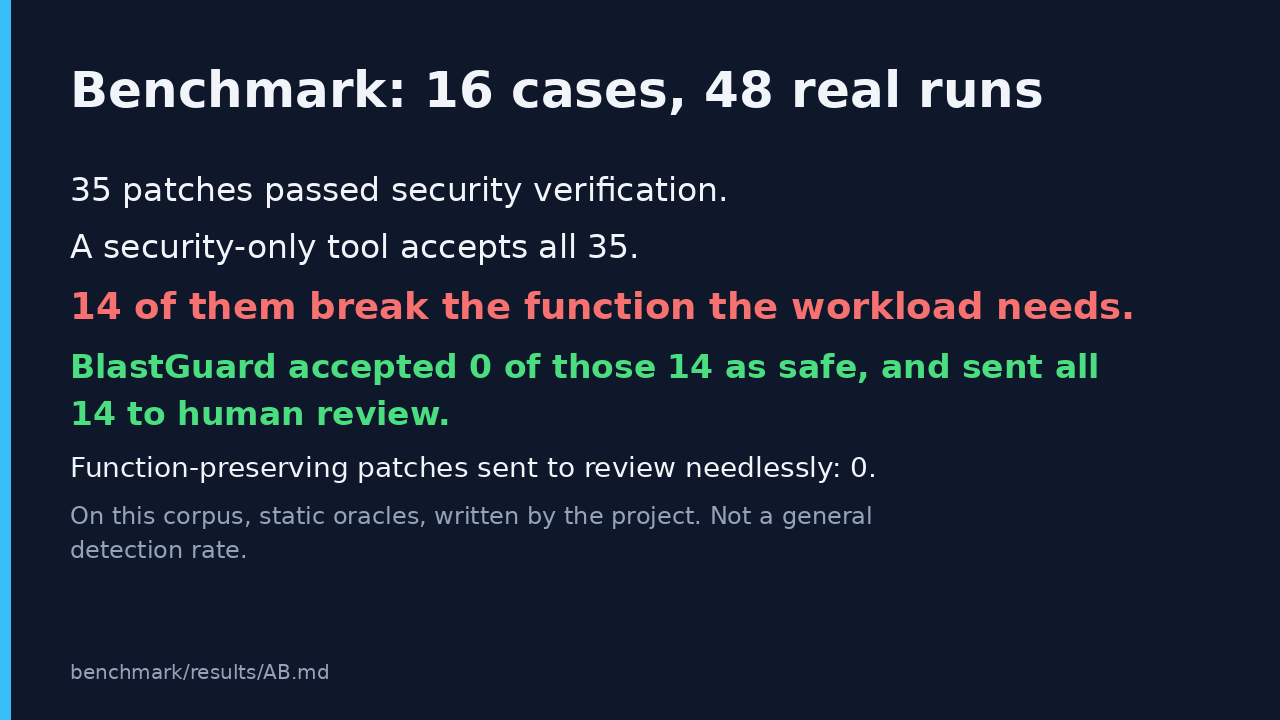
- Benchmark, 16 cases, 48 real runs: 35 patches passed security verification. A security-only tool would accept all 35, and 14 of them break the function the workload needs (for example
hostPathturned intoemptyDir). BlastGuard accepted 0 of those 14 as safe and sent them to review; it sent 0 function-preserving patches to review. Already-clean manifests (6 of 6) need no change, invalid inputs (6 of 6) are rejected before any model call, and a prompt injection inside a manifest was ignored in 3 of 3 runs. Static oracles, small corpus, written by the project. - Runtime proof (real kind cluster, GitHub Actions): a synthetic collector reads a marker file from a node
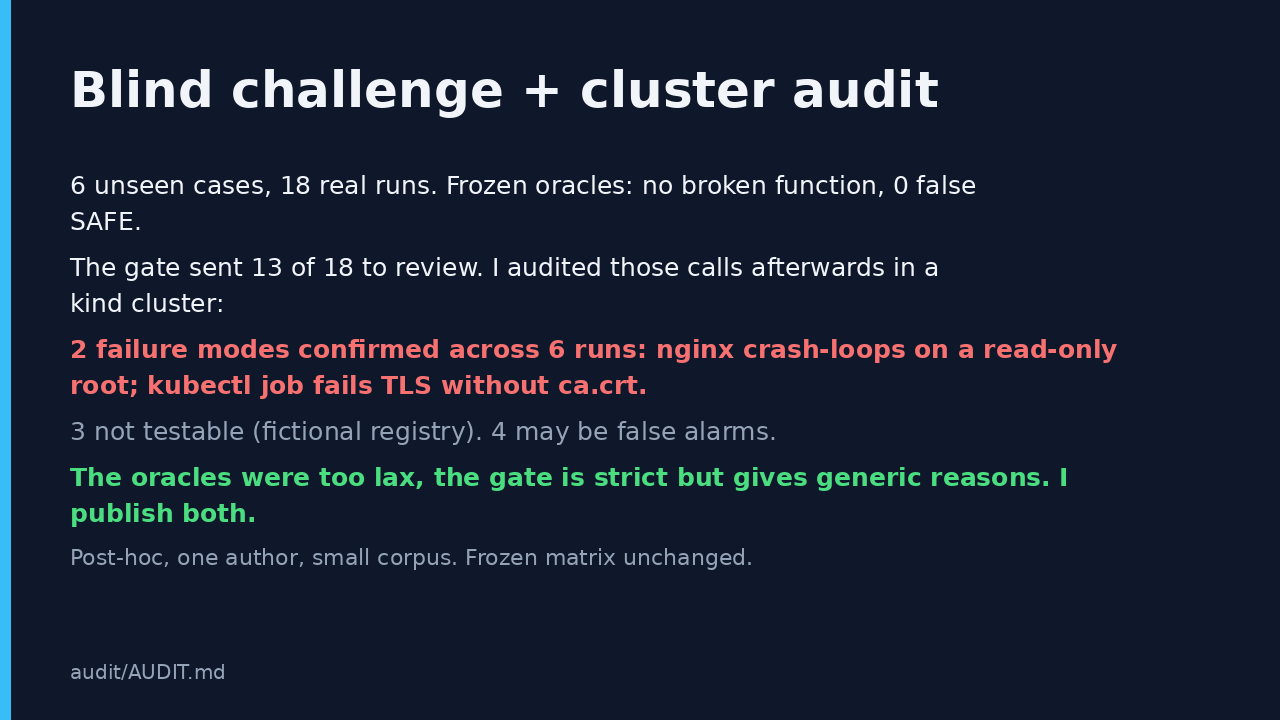
hostPath. The original reports COLLECTED; Nemotron's patch passes every security check and reports NOTHING_TO_COLLECT. The recorded run shows the real loop: attempt 1 failed (kept the hostPath), attempt 2 passed security, and the gate returned REVIEW_REQUIRED. - Blind challenge, 6 unseen cases, 18 real runs: the frozen oracles found no broken function (0 false SAFE), and the gate sent 13 of 18 to review. I audited those calls afterwards in kind: 2 failure modes confirmed across 6 runs (nginx crash-loops on a read-only root; a kubectl CronJob fails TLS verification without
ca.crt), 3 could not be tested, and 4 may be false alarms. So the oracles were too lax; the gate is strict but its reasons are generic. I publish this as is.
What I learned
What I am not claiming: VERIFIED means "passed these checks", not "works in your cluster". The app never touches a cluster. Corpora are small and hand-written by one author; oracles are static and conceptually overlap the gate; the runtime proof is one synthetic case.
What existed before / what is new: the original BlastGuard (Go, a CVE blast-radius engine) existed before the Submission Period and is not integrated here. Everything in blastguard-ai was built during the Submission Period: loop, rules, identity guard, Intent Preservation Gate, validator integration, Nemotron client, evidence reports, Streamlit UI, benchmark, blind suite, runtime proof and audit.
What's next for BlastGuard AI
Behaviour-preserving prompts and a minimal-diff mode, named failure reasons from the gate (for example "nginx needs a writable /tmp"), Helm and Kustomize rendering, a GitHub PR mode and an admission-webhook dry-run mode.
Built with
Python, Streamlit, PyYAML, openai SDK, NVIDIA Nemotron (nemotron-3-super-120b-a12b), Nebius Token Factory, kubeconform, kube-linter, GitHub Actions, kind.
Built With
- github-actions
- kind
- kube-linter
- kubeconform
- nebius-token-factory
- nvidia-nemotron
- openai-sdk
- python
- pyyaml
- streamlit

Log in or sign up for Devpost to join the conversation.