Inspiration
Every data engineer has done this: you drop one column, and three days later someone asks why the executive dashboard has been blank since Tuesday. The change looked local. It wasn't.
DataHub already answers "what is downstream of this?" — its Impact Analysis is a shipped feature, and we're not claiming to have invented it. What it doesn't do is act on that answer. It won't write the migration, it won't check whether the migration actually worked, and it won't remember the verdict for the next person who touches that table.
So we set out to build the layer that acts: an agent that reads DataHub, works out exactly what a proposed schema change breaks, writes the fix, and — the part we didn't expect to become the whole project — proves its own fix before anything is allowed to be written.
What it does
Given drop order_entry.orders.promotion_id, the agent:
- reads schema, lineage, ownership, query history and downstream SQL over the DataHub MCP server;
- classifies every consumer BREAKS / DEGRADES / SAFE / UNKNOWN using a
sqlglotcolumn-usage engine over the real SQL — including columns referenced only inWHERE/JOIN/GROUP BY, which DataHub's own parser documents that it excludes; - generates a mechanical dbt migration fix as a clean git diff;
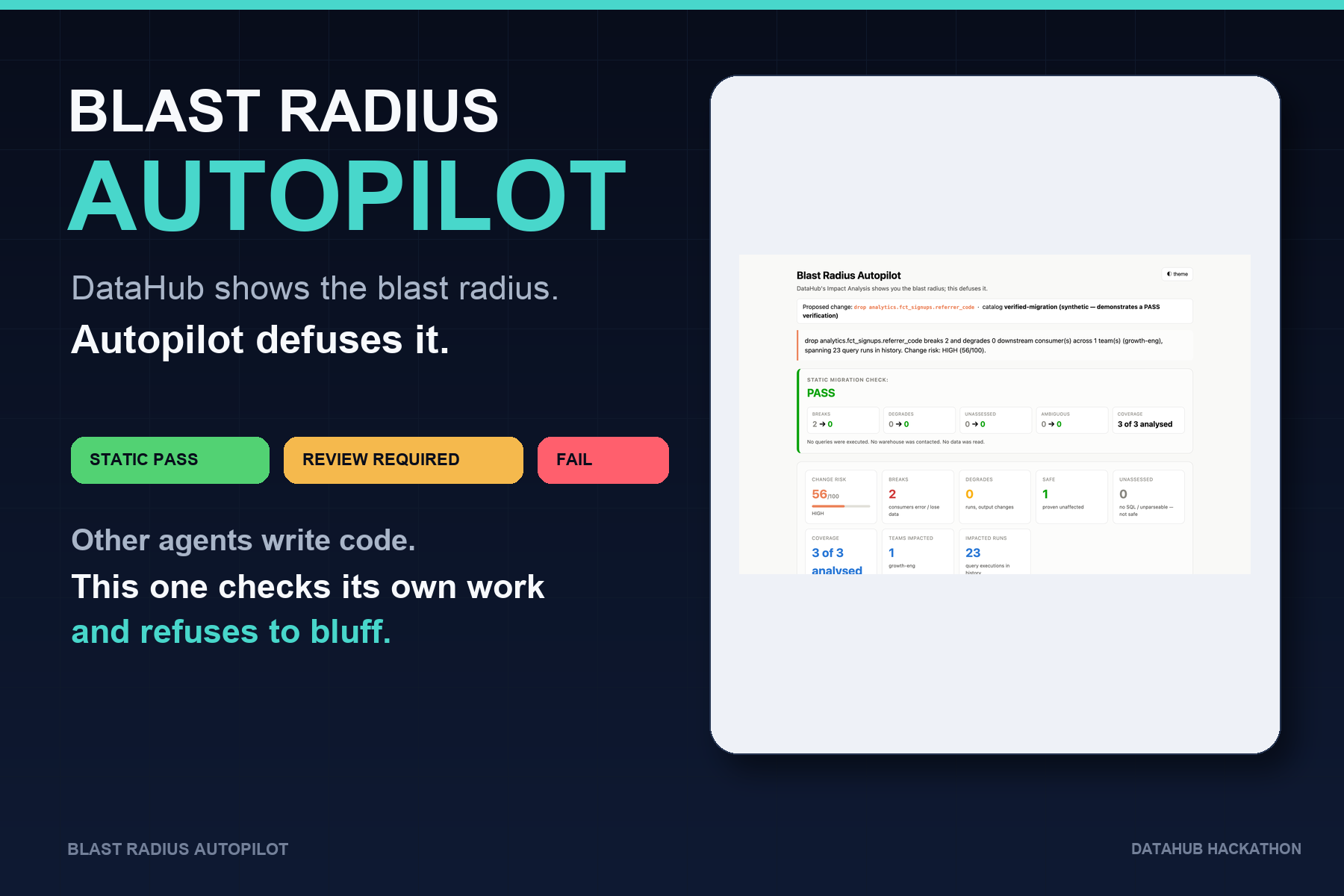
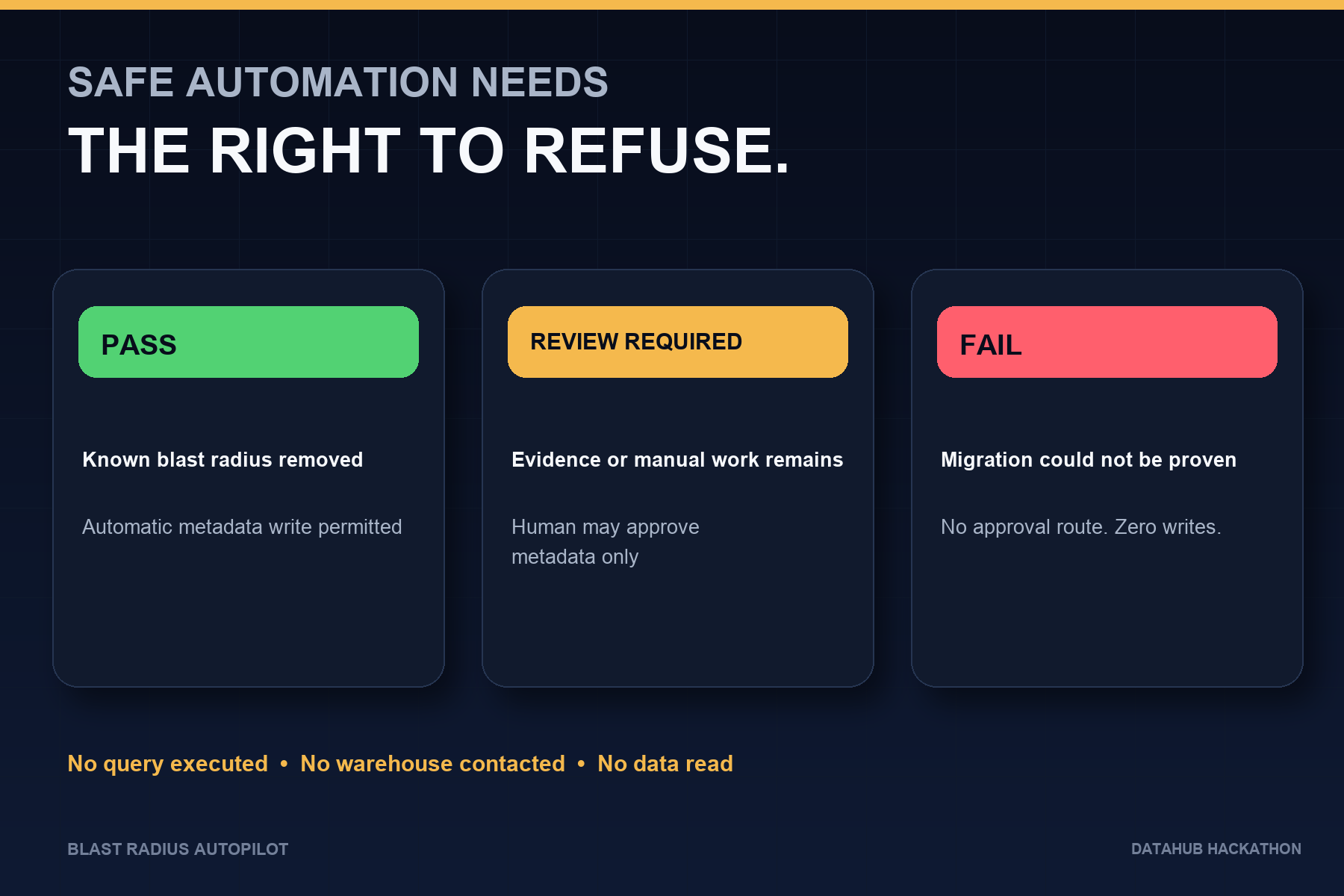
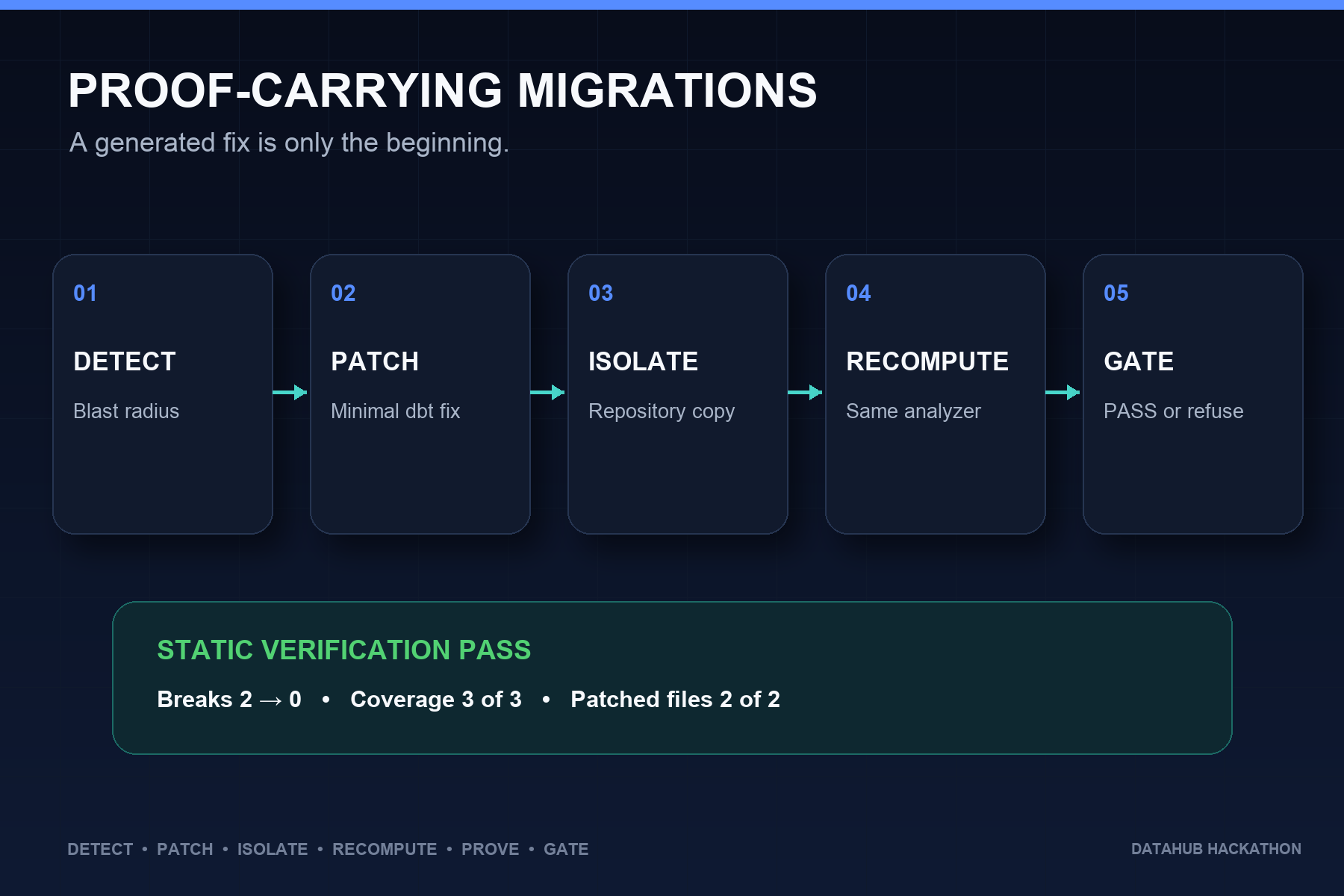
- verifies that fix: applies it in an isolated copy, re-parses every patched file, recomputes impact on the patched corpus, and issues PASS / REVIEW_REQUIRED / FAIL over a sixteen-clause conjunction;
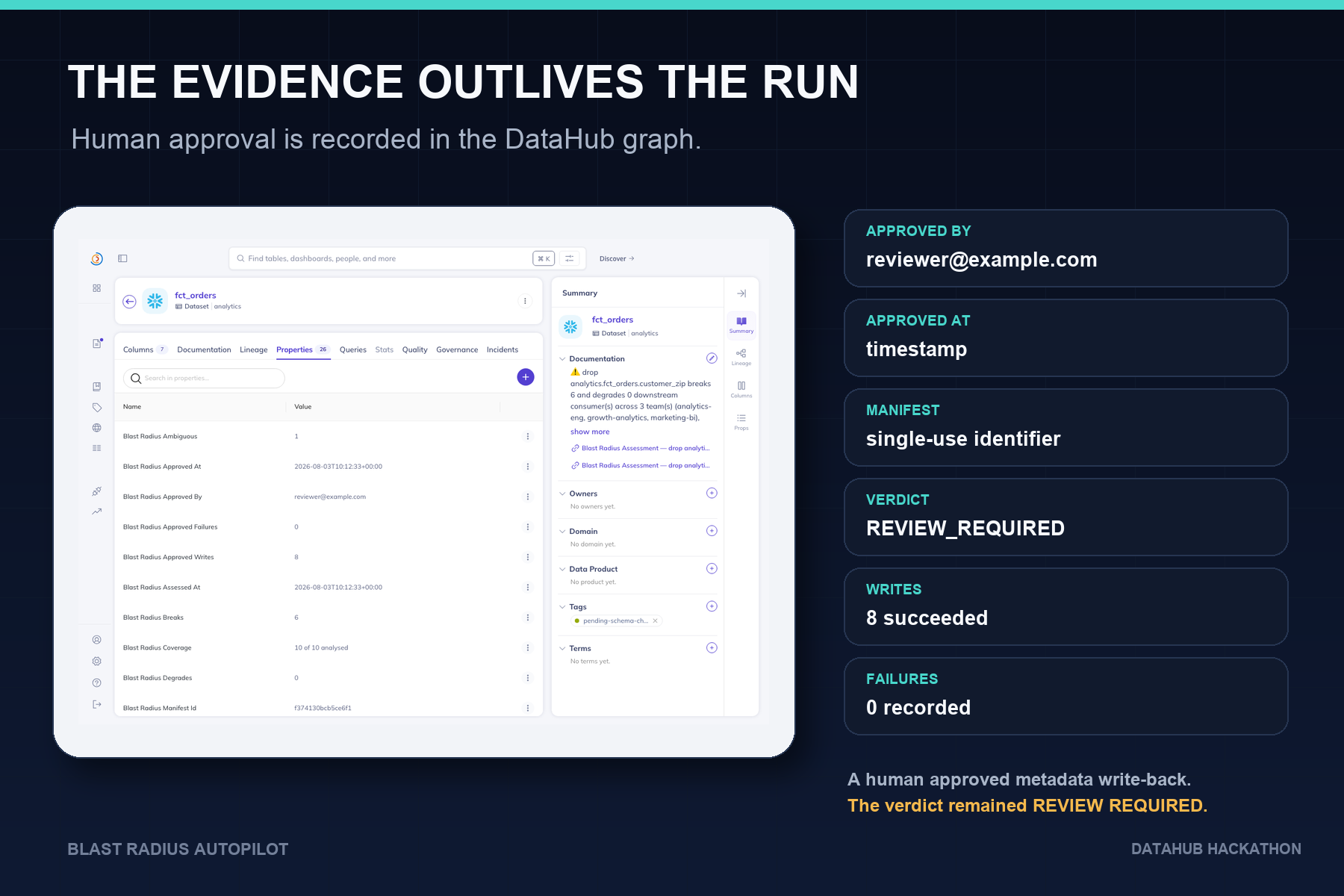
- gates every catalog write on that verdict — no PASS, no automatic write; a human can approve a REVIEW_REQUIRED via a single-use manifest; a FAIL can never be approved;
- writes the assessment, the impact tags, the risk properties and the human-approval audit trail back into DataHub, where the next engineer inherits them;
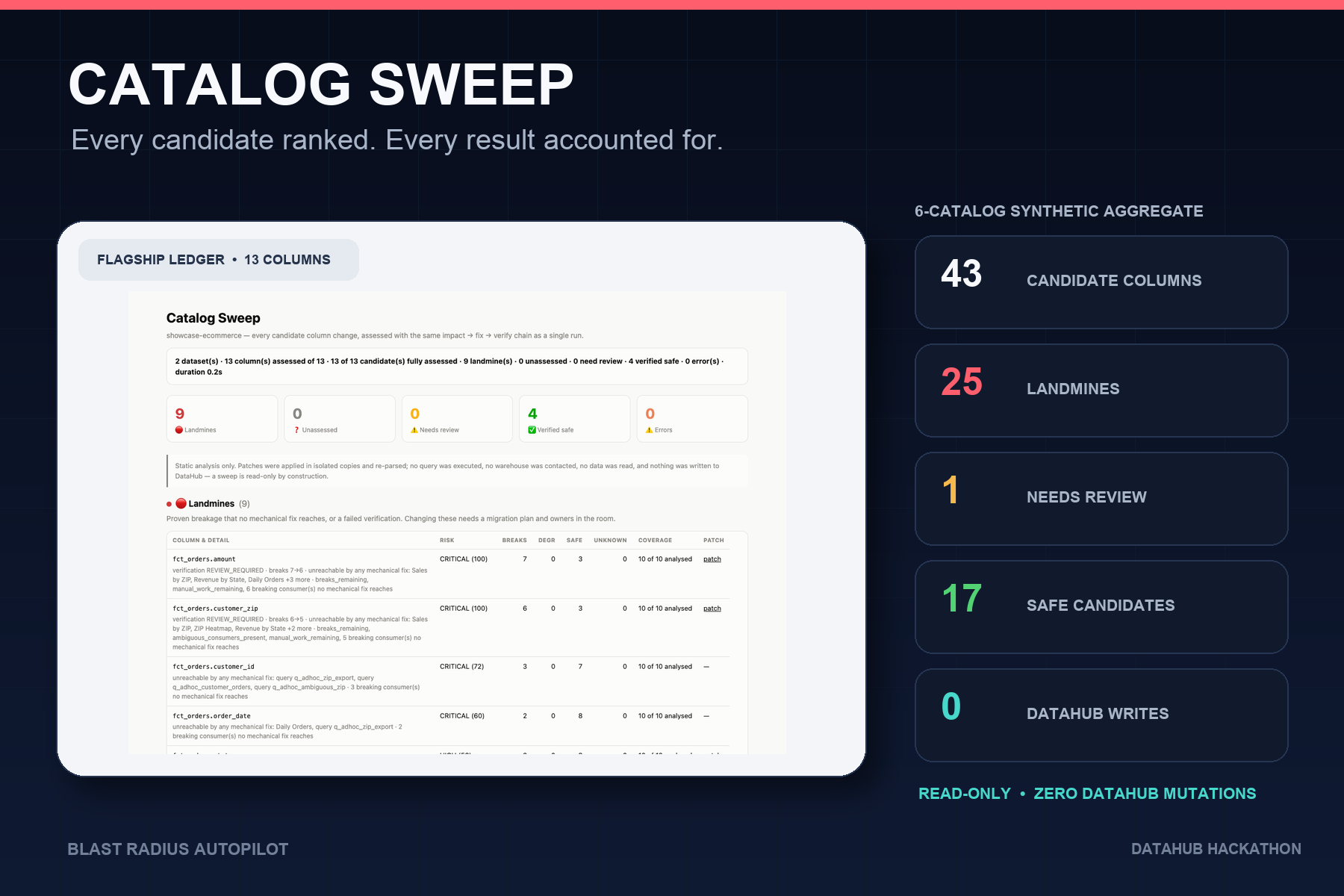
- runs that same chain unattended across the whole catalog — a read-only Catalog Sweep enumerates every candidate column change, scores each one, and emits a ranked ledger: verified-safe (with the patch attached), needs-review, landmine, or unassessed. Across six synthetic catalogs it assessed 43 candidate columns in 0.65 seconds. The sweep never writes to DataHub — it proposes a ledger; a human picks. ## How we built it
Python, sqlglot for the column-usage engine (the same parser generation behind DataHub's own
parse_sql_lineage()), the official mcp-server-datahub for reads, the DataHub Python SDK +
GraphQL for the write-back, and a local datahub docker quickstart loaded with the official
showcase-ecommerce datapack for live testing.
Two architectural decisions carried the whole build:
Offline-first. Every capability runs against JSON fixtures that mirror the MCP read surface, so the entire test suite (now 198 tests) executes with no DataHub instance at all. A live instance became a stronger evidence path, never a prerequisite. That decision saved the project on the day Docker wasn't running.
Metadata-only. The agent never reads a single row of data — only schemas, lineage, query text and ownership. A 6 TB table and a 6 MB table look identical to it. On the live run, the MCP pull took ~11.5 s and the entire column analysis took 14 ms. That is also why the catalog-wide sweep is viable at all: 43 candidate columns, each assessed and verified, in 0.65 seconds — the cost scales with metadata, not with data.
We also built it under a discipline that turned out to matter more than any feature: every fix was written as a failing test first, and nothing was recorded as done without either a passing test or a captured run.
Challenges we ran into
The tool was lying to us — twice
The live MCP run against the real datapack is what exposed it. Our analyzer reported the ADDRESSES
table as LOW risk. It wasn't. A Jinja-templated dbt model failed to parse, and the failure was
being scored as SAFE with confidence high — while that model joined addresses and referenced
the target column four times. A parse failure had been quietly promoted into a clean bill of
health.
The second was subtler. A dropped column referenced only in a WHERE clause was graded DEGRADES.
But dropping a column that a WHERE names doesn't degrade the query — it makes it error.
Both were fixed test-first, and they reshaped the project around one rule:
Missing evidence must never read as proof of safety.
Parse failures became a distinct fourth verdict, UNKNOWN — never counted safe, never inflated into
a break, and it blocks any PASS. Coverage became its own reported dimension
("CRITICAL among assessed · 6 of 24 analysed") instead of being folded into a reassuring score.
Then the verifier had the same disease
Once we had a verifier issuing PASS, we went looking for ways it could say PASS while real impact was
still unresolved. We found several, each reproduced as a failing test before it was fixed: an
ambiguous column reference surviving into a PASS; a pre-existing DEGRADES surviving into a PASS; a
patched file that mapped to no query in the corpus (so its effect was never actually recomputed); a
diff that deleted a consumer's SQL file, which made the consumer's references vanish and earned it
a clean verdict; a target dataset that didn't exist, producing a confident PASS over zero consumers.
The PASS conjunction ended up with sixteen named clauses, all of which must hold, in a single place in the code — because we learned that a verdict synthesised in two places will eventually disagree with itself.
And once more in the sweep — caught before shipping this time
The catalog sweep wanted to report a single "verified safe" count. Two different claims were about to
share that label: columns where a fix was generated, applied in isolation and re-checked
(verified_patch), and columns where nothing that parses referenced them at all, so no patch was
needed and nothing was verified (no_references). Both are safe to change — but only one involved
verifying anything, and letting the second borrow the first's credibility would have been this
project's characteristic error in miniature. The ledger reports the basis of every row:
8 verified_patch, 9 no_references. We also check unassessed before every other bucket, because
everything below it is a statement about a corpus we could actually read.
The catalog couldn't store what we claimed
We had been saying the full Impact Assessment was written into DataHub. We probed the actual aspect
rather than trusting the claim: open-source DataHub's InstitutionalMemoryMetadata is
{url, description, createStamp, updateStamp, settings} — there is no field that can hold a
document body. We had been building the content and dropping it.
We didn't fake it and we didn't smuggle the markdown into the description field. The body is persisted to a file, the catalog stores the link and title, and every surface now says exactly which is which — enforced by a test that fails the build on any wording claiming otherwise.
The honest result wasn't the flattering one
The datapack ships no query history (get_dataset_queries returns 0), and only 6 of 24
downstream consumers expose parseable SQL — PowerBI measures and Looker views can't be assessed by a
SQL parser at all. We report those 18 as unassessed, not safe.
And on the live target, verification returns FAIL: two Tableau consumers use the column in
WHERE and GROUP BY, which our fix generation deliberately refuses to rewrite. A tool that only
demoed green would have been more impressive and less true. We ship all three verdicts on real runs.
Accomplishments we're proud of
- 198 passing tests, every safety property written failing-first.
- A live DataHub round-trip verified by independent GraphQL read-back — including the approval audit trail (who approved, when, against which verdict, under which manifest).
- All three verdicts on real runs: a PASS (breaks 2 → 0, every gate independently satisfied), a REVIEW_REQUIRED (breaks 6 → 5), and a FAIL that correctly refuses to certify an incomplete fix.
- A read-only Catalog Sweep that generalises the whole chain to every column in the catalog and emits a ranked ledger — with the read-only guarantee enforced structurally (the module never imports the write layer), not by convention.
- The same code path across five very different dataset types, with the regulated examples (healthcare, finance) routing every write to human review.
- A
LIMITATIONS.mdthat documents our own residual risks rather than leaving them to be found. ## What we learned
That the hard part of an agent that writes to your catalog isn't the writing — it's earning the right to write. Most of our engineering went into the difference between "I found no problem" and "there is no problem." Those are not the same sentence, and a tool that conflates them is worse than no tool, because it launders uncertainty into confidence.
We also learned to distrust our own green checkmarks. Every one of the defects above was found by running against real metadata and then asking "how could this verdict be wrong?" — never by the test suite passing.
What's next
Per-mutation payload hashing so a reviewer's rendering is cryptographically identical to what executes; retry manifests for partial failures; atomic state and idempotency keys for the multi-operator case; a CI mode that posts the blast radius on any PR touching a schema and fails the check on CRITICAL; and pre-rendering dbt Jinja so templated models become analysable instead of UNKNOWN.
And the boundary we won't blur: verification here is static. The patch applies, the SQL parses, impact is recomputed. No query is executed — no warehouse is contacted, no data is read, no dbt build runs. It is evidence about SQL text, not runtime behaviour. Saying so plainly is the point.

Log in or sign up for Devpost to join the conversation.