-
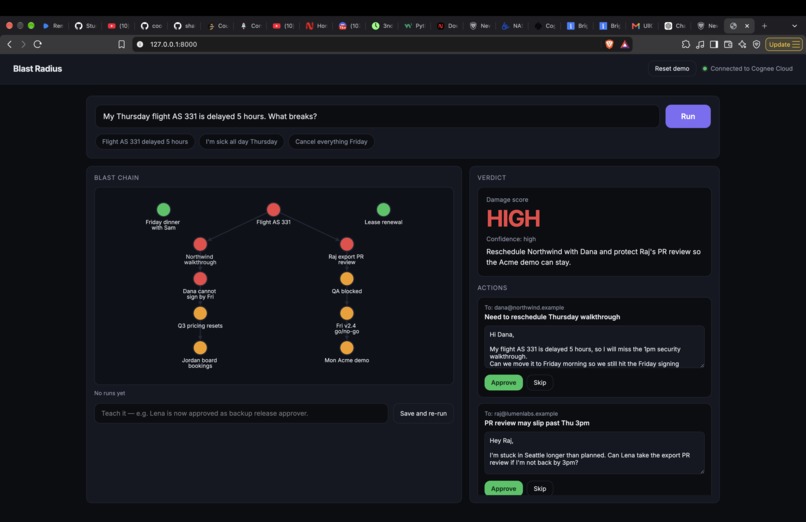
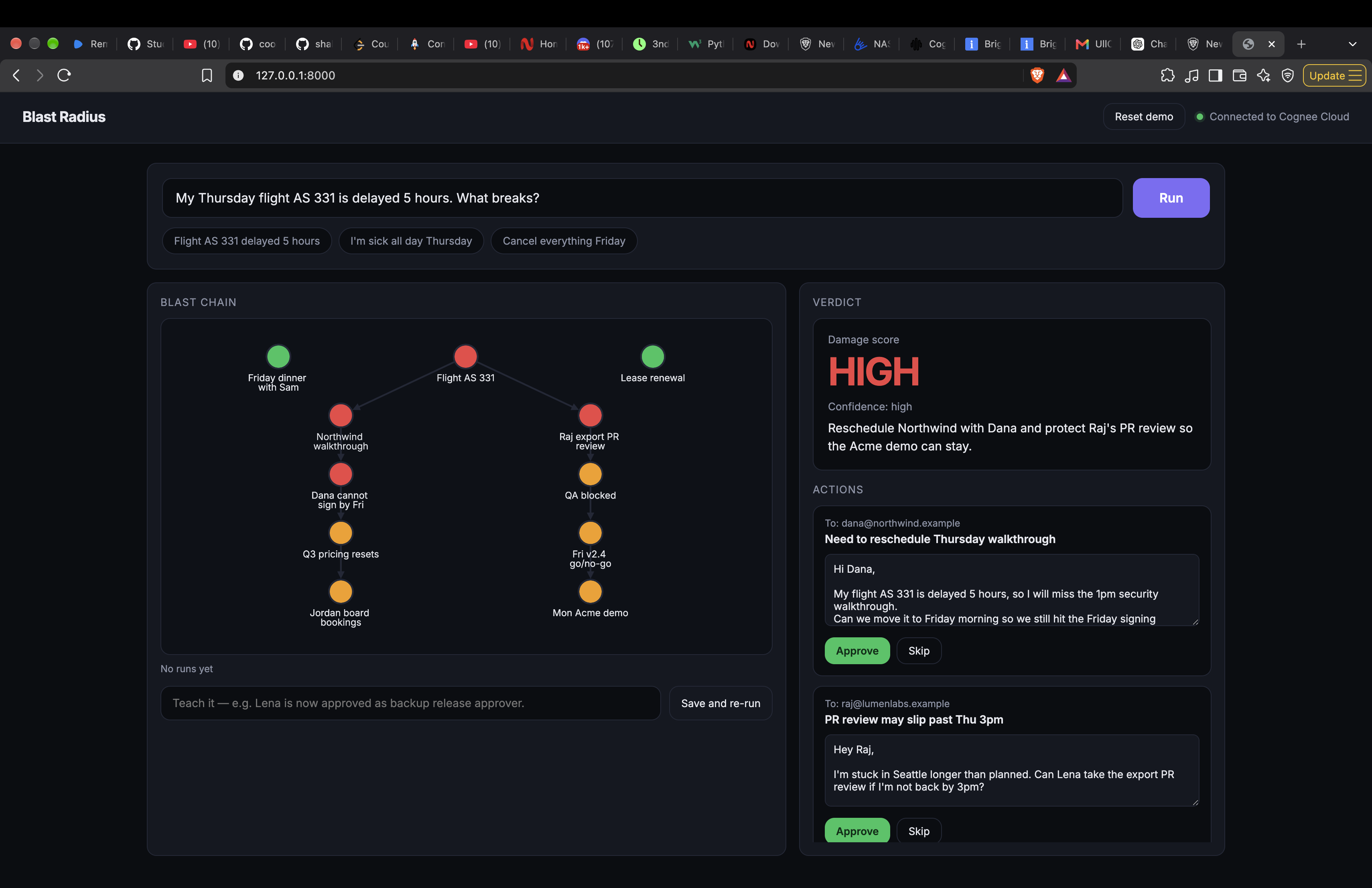
Demo UI
-
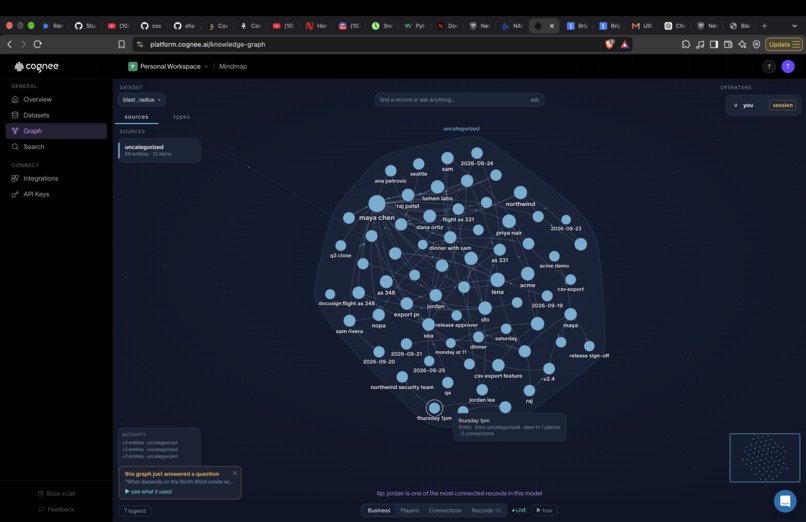
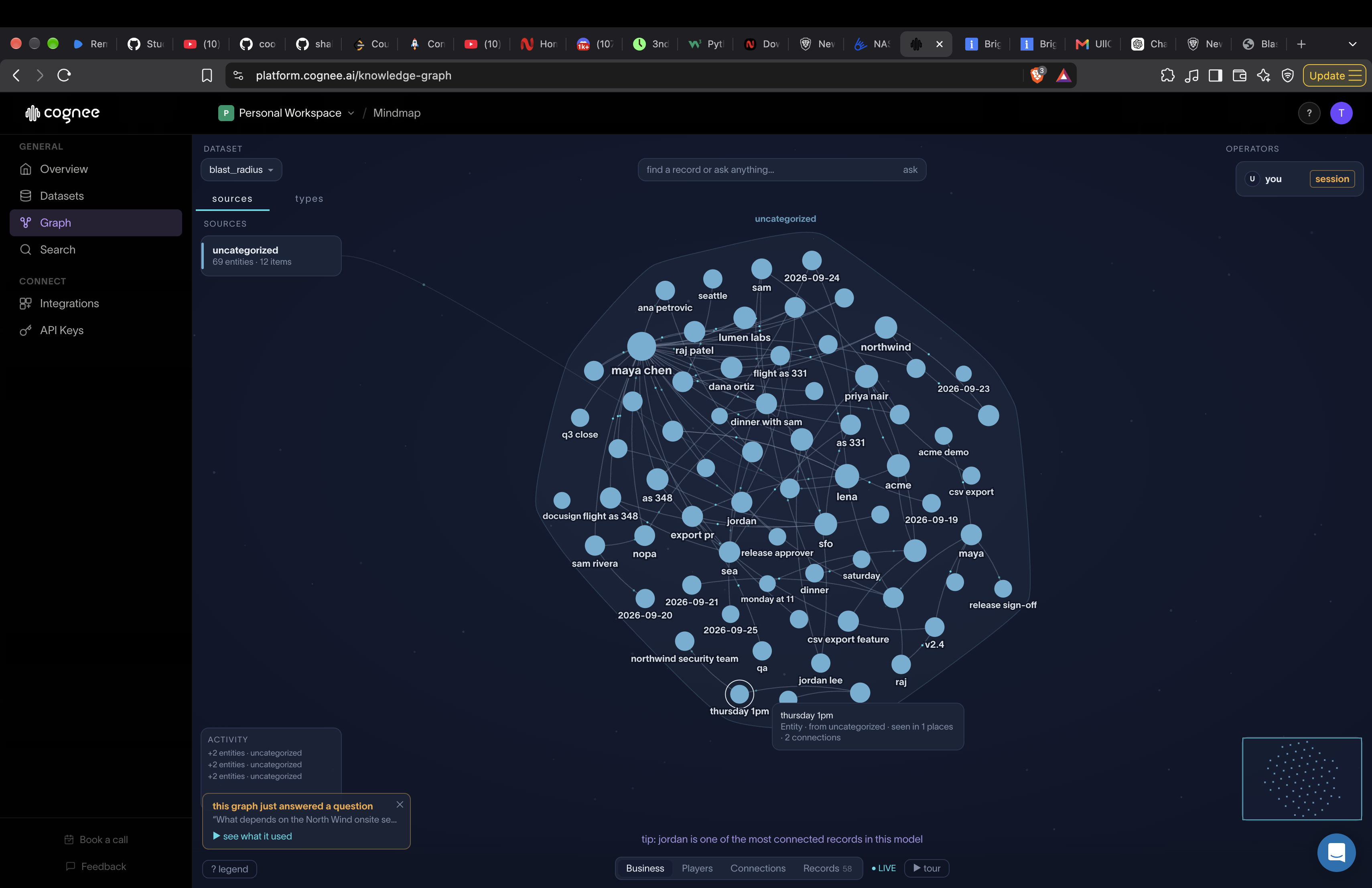
Cognee Knowledge Graph
Inspiration
Engineers ask "what's the blast radius?" before they change anything in production. Nobody does that for their own life.
You cancel one meeting, or your flight gets delayed, and three things quietly break a week later. A contract doesn't get signed. A teammate is blocked. A client demo has to move. The information to see this coming is already in your calendar, email, and chats. It's just spread across too many places for one person to connect.
I wanted a personal agent that connects it for you, before it's too late.
What it does
You tell Blast Radius what changed, like "My Thursday flight is delayed 5 hours."
It then:
Checks live public data, like the real flight status, using Bright Data. Walks your personal knowledge graph in Cognee, hop by hop, asking "what depends on this?" Finds every chain of things that break, and labels each item Broken, At risk, or Fine. Scores the damage and gives a confidence level based on the evidence. A deadline written in an email counts more than a vague chat message. Shows the source of every link, so you can check its reasoning. Drafts the emails to fix it, which you can edit and approve.
It also learns. When you correct it, like "Lena is now approved as backup release approver," the fact is saved to Cognee memory. The agent updates only the items that fact affects, and the UI shows exactly what changed. An unrelated fact changes nothing.
In My demo, one flight delay sets off two chains:
Money: missed client walkthrough, contract not signed by Friday, Q3 pricing resets, and the CEO's board number breaks. Product: a missed code review blocks QA, the Friday release fails, and Monday's client demo has to move. The lease signing and a Friday dinner are correctly marked as not affected.
How I built it
Cognee Cloud is the brain. I load calendar events, emails, Slack messages, and meeting notes, and Cognee turns them into a knowledge graph of people, events, and deadlines. I use remember and recall for memory, and save user corrections back into the graph. AWS Strands Agents runs the agent loop. The agent has tools for recalling memory, checking flights, saving corrections, patching the graph, drafting emails, and saving reports. It decides for itself when to keep digging and when a chain has ended. Bright Data provides the live public data trigger, starting with flight status. FastAPI serves a web UI styled like an incident console, built with Cytoscape.js. It shows a live investigation feed while the agent works, an interactive graph, a verdict card, and an action queue for the drafted emails. The model is Claude. [If you switched to Bedrock, write: "Claude on Amazon Bedrock."]
Corrections are applied as a patch in code, not by asking the model to rebuild the graph. The agent only reports which nodes change, and the server merges those changes. That keeps every unaffected item exactly where it was.
Challenges I ran into
Our first version only followed the most obvious chain. It found the missed contract, but not the blocked code review happening the same day. I fixed this by having the agent look at everything scheduled around the trigger, not only things that depend on it directly. Corrections at first rebuilt the whole graph, because I asked the model to redo the analysis and keep old items the same. It didn't always listen. I moved the merge into code so only affected items can change. Saved corrections stay in memory, which is the point, but it meant our test runs affected later runs. I added a full memory reset so every demo starts clean. Accomplishments that I am proud of The agent connects facts that no single document states. No email says "a flight delay breaks the board meeting." That only appears when you link an airline email, a calendar entry, a client's email, and the CEO's email. Every conclusion points back to its source, so the output is checkable, not a black box. The learning loop is visible. You teach it one fact and see exactly which items change. I built on a gap in the sponsor's own product. Cognee already offers commitment review and follow-ups. Blast Radius adds the next step: what happens when a commitment breaks.
What I learned
A knowledge graph lets an agent reason across sources in a way that plain document search can't. Anything that must be reliable, like merging corrections, should be done in code. The model should decide what changes, not rewrite everything. A live progress feed makes waiting on an agent feel like watching it think. What's next for Blast Radius Connect real accounts through Cognee Cloud connectors like Google Calendar, Gmail, and Slack. More triggers from public data: weather alerts, transit outages, and event changes. "Should I go?" mode: weigh what you lose by skipping something against what you gain by attending something else, using public event and speaker data. Actually send approved emails and move calendar events, with the user's approval. Note on data
The demo uses a synthetic week of data for one person, so no real inbox is shown on screen.
Built With
- aws-strands-agents
- bright-data
- chatgpt
- claude
- cognee
- cytoscape.js
- fastapi
- python

Log in or sign up for Devpost to join the conversation.