-
-
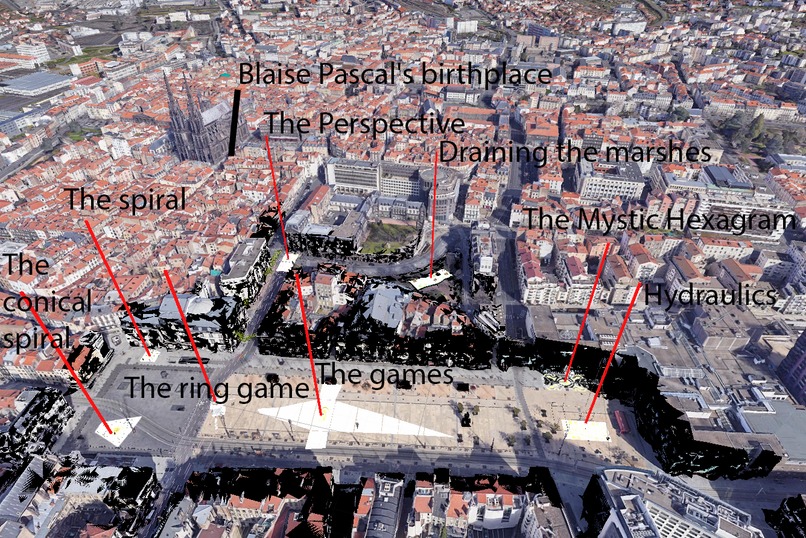
View of Clermont-Ferrand in Unity
-
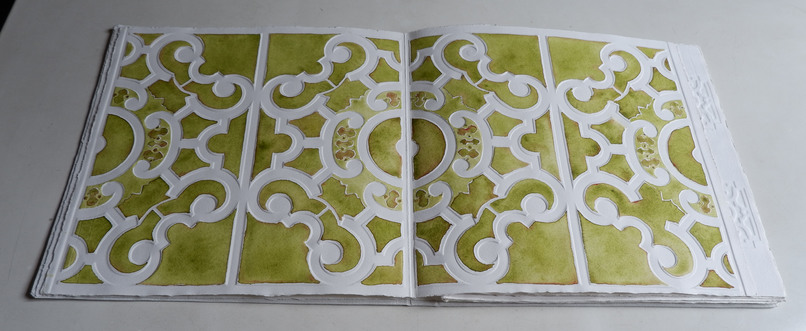
Sheets on hydraulics
-
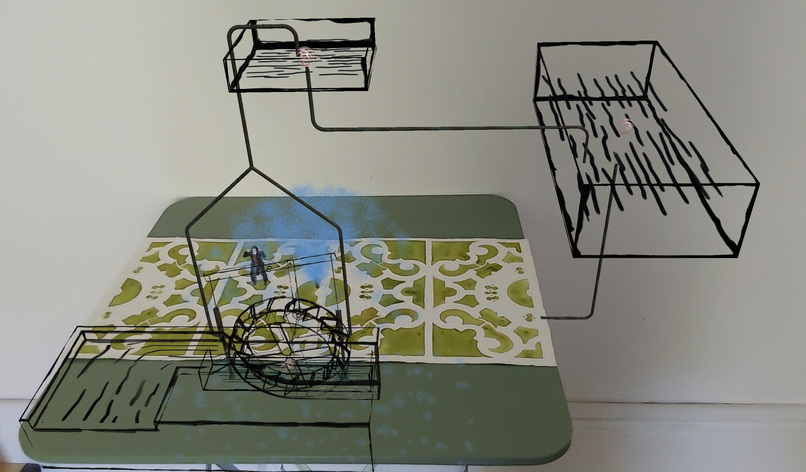
Hydraulics in augmented reality
-
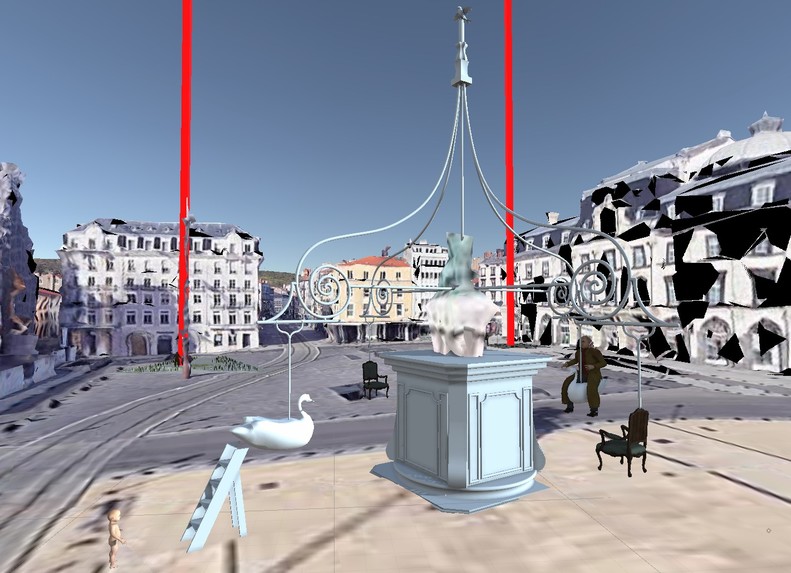
Ring game
-
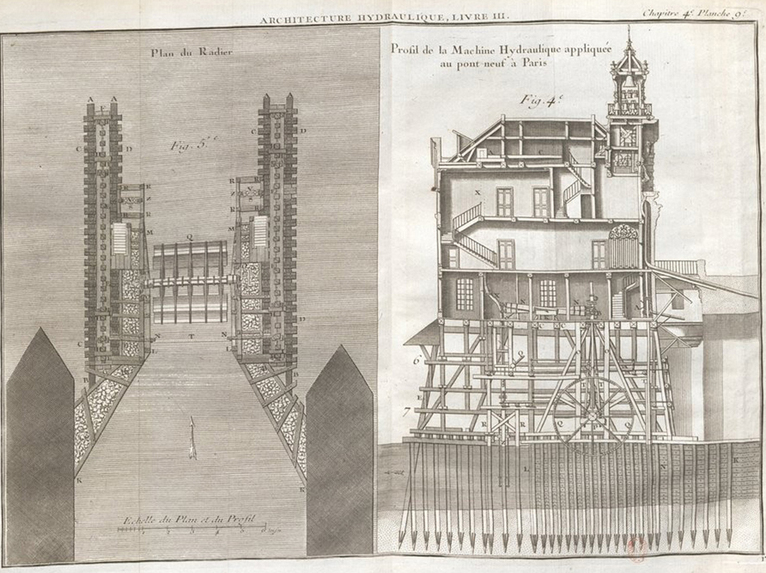
Samaritaine pump
-
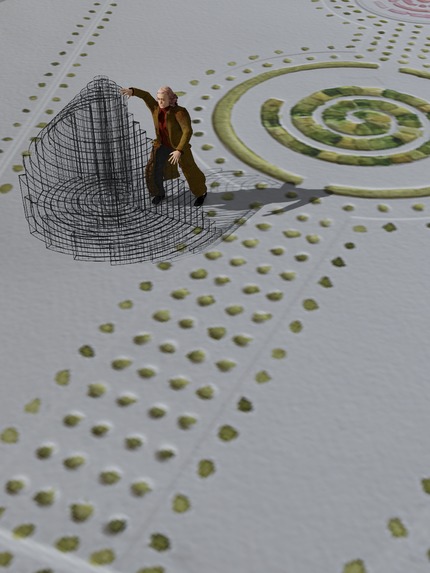
Calculating the volume of a conical spiral.
Inspiration
This year, Clermont-Ferrand celebrates Blaise Pascal's 400th birthday. Videoformes link asked my wife Annie to work on the links between Blaise Pascal's work and gardens. She produced an artist's book of embossed and water colored sheets depicting gardens.

With AR Foundation, I've added interactive animations illustrating the work of our French genius.

An exhibition with Videoformes took place in the Chapelle des Cordeliers in Clermont-Ferrand in June 2023, and we wanted to find a way of showing this work to a wider public, in a space closer in size to a garden, and above all without the support of an artist's book, which by its fragility can only be presented in an enclosed space.

What it does
There are 7 plates in the artist's book, so there are 7 places to visit, visualized by large red columns, around the Place de Jaude in Clermont-Ferrand. At each location, as in the augmented reality version, an animation is launched, with Blaise Pascal moving around, drawing arcs with a compass, performing experiments such as the one on vacuum, and dying of malaria in the marshes. An interaction also takes place that depended on the position and orientation of the augmented reality camera, which I've started to replace with the user's geolocated position. An eighth location was added in relation to the book, depicting Blaise Pascal as a baby riding the ring game, which is the one present in the garden of the Château de Chantilly. Another, older Blaise Pascal stands in front of him as the game rotates.

The ring game is placed exactly on the statue of Vercingetorix.
How we built it
We created all the elements between us, Annie for the artistic aspects and with her extensive knowledge of gardens, and I with my scientific background in the work of Blaise Pascal for the modeling and animation of the objects. All models are based on period plans. The illustration below shows the Samaritaine pump, which was installed on the Pont neuf in Paris as early as 1600 and remained in operation for over 100 years. Blaise Pascal used to walk past this pump when he lived in Paris.

The aim of our modeling work was twofold: to represent as clearly as possible how the systems worked, while remaining graphically consistent with Annie's drawings. 3D objects should be represented with pencil lines in space, as in the conical spiral volume calculation below.

Challenges we ran into
The first difficulty was to find the right location, as a long avenue seemed essential for the perspective board. Secondly, this technique can be dangerous if the area is not pedestrianized, so Place Jaude was the right destination. The second difficulty was our distance from a place where the VPS works: we live in Saint-Nectaire, 40 km from Clermont-Ferrand. So it's not possible to test modifications more than once a week. The final problem is the transition from our augmented reality version to this geolocated version. There's a mix-up between the x, y, z coordinates and the longitude, latitude, altitude approach. I think I can solve this problem, but as things stand, I still need to improve things.
Accomplishments that we're proud of
The Gorillaz concert, using geospatialization, was a great motivator for us, but it lacked the touch of interaction in the field of contemporary art. Even if the current version isn't perfect, I know that it's possible, without wasting too much time, to switch from an augmented reality version to a geolocalized one, even with interaction. For the occlusion with the buildings, in a first test, I reconstructed plans close to the buildings. This operation is time-consuming and imprecise, so this time I managed to use the tiles visible in Unity. I saved them in FBX and modified them in Blender. For example, I don't want to occlude at ground level, since in some cases 3D objects are below it.
What we learned
Above all, we've realized that contemporary art can be taken out of museums and galleries without requiring any more effort than virtual reality or augmented reality animation. Contemporary art needs to understand that emotions don't just pass through the brain, but first and foremost through the body, just as when you take a walk in a garden; it also needs to be interactive, so that visitors feel involved in the visit; it also needs to be situated in time and geographically. We've found all these points in this technology, although we regret that VPS isn't yet available everywhere.
What's next for Blaise Pascal and Gardens
In December, we'll find out whether Clermont-Ferrand will be the European Capital of Culture in 2028. To achieve this, we need to demonstrate our ability to bring art within everyone's reach, and it's by proposing developments like ours that we'll be able to do just that. The version with book and virtual reality is already presented in libraries for the artist's book aspect, but we will also be presenting the geolocated version at the Clermont-Ferrand 2024 short film festival and Videoformes 2024 festival.

Log in or sign up for Devpost to join the conversation.