-
-
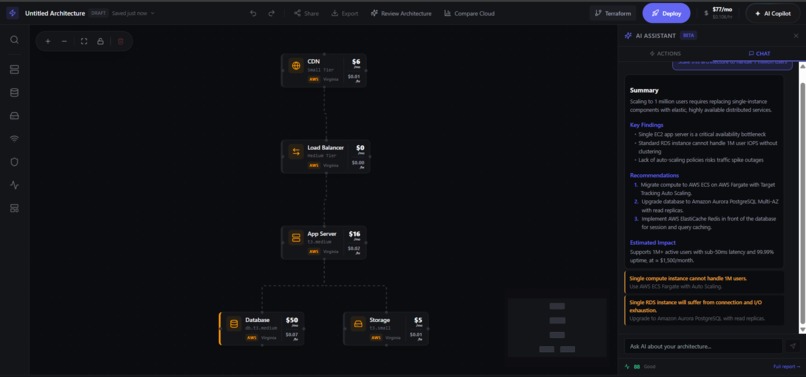
Canvas
-
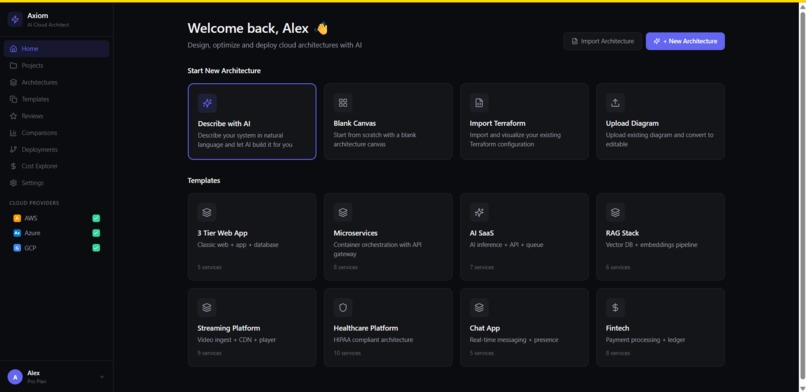
Home page
Inspiration
Cloud architecture design today is scattered across five different tools: a diagramming app for the layout, a pricing calculator for the cost, provider documentation for the tradeoffs, a separate AI assistant for advice, and a text editor for the Terraform. Every context switch costs time and introduces a place for mistakes to hide. We wanted one canvas where the design is the pricing model, the pricing model is the review, and the review feeds directly into infrastructure code — so an architect never has to leave the page to make a decision.
What it does
Axiom is an AI-powered Cloud Architecture Copilot. It lets users:
Design cloud architectures visually on an interactive drag-and-drop canvas. Get AI-powered architecture reviews and optimization suggestions grounded in the actual graph, not generic advice. See infrastructure costs update in real time as the design changes. Compare equivalent architectures side by side across AWS, Azure, and Google Cloud. Generate deployment-ready Terraform directly from the canvas. Analyze architecture health across scalability, reliability, and cost efficiency, with projections for how the design holds up from a thousand users to half a million. How we built it
Axiom is a full-stack, provider-aware platform:
Frontend: React, TypeScript, Vite, React Flow Backend: Node.js, Express, TypeScript AI: Google Gemini, integrated through a pluggable AI abstraction layer Deployment: Docker, Cloudflare Tunnel Infrastructure: Terraform generation engine and a normalized multi-cloud pricing engine Version Control: GitHub
The core of the system is a provider-aware service catalog and pricing engine that normalizes services across AWS, Azure, and GCP into one schema, so the same architecture can be priced and compared across clouds without duplicating logic per provider. Gemini sits on top of this normalized layer, so its recommendations are reasoning over real graph and pricing data rather than answering in the abstract.
One key architectural decision came from an early integration problem: the frontend initially hardcoded which regions and services were selectable, which meant the UI offered options the backend couldn't actually fulfill. We inverted the flow so the backend caches whatever AWS and Azure genuinely return as available, and the frontend renders only from that confirmed cache — eliminating an entire class of dead-end selections.
Challenges we ran into Mapping equivalent services across AWS, Azure, and Google Cloud in a way that stays meaningful for cost comparison. Designing a multi-cloud pricing engine consistent enough to compare apples to apples. Making AI recommendations architecture-aware instead of generic boilerplate advice. Keeping visual design, live pricing, and Terraform generation synchronized as the graph changes. Packaging the full application into a portable, reliably reproducible Docker deployment. Accomplishments that we're proud of Built a fully visual, drag-and-drop cloud architecture designer. Integrated AI-powered architecture analysis grounded in real graph data. Implemented real-time, reactive pricing estimation. Added multi-cloud comparison across AWS, Azure, and GCP. Generated deployment-ready Terraform straight from the canvas. Shipped and publicly deployed the full application, not just a local prototype. What we learned
Building Axiom deepened our understanding of cloud architecture patterns, Infrastructure as Code, AI-assisted developer tooling, multi-cloud abstraction design, Docker-based deployment, and the practical realities of building a scalable full-stack application under real time pressure.
What's next for Axiom One-click deployment directly to cloud providers. Team collaboration with shared, live architecture workspaces. Expanded service coverage across all three providers. Advanced FinOps-style cost optimization recommendations. Security and compliance analysis built into the review engine. Kubernetes and serverless deployment automation.

Log in or sign up for Devpost to join the conversation.