-
-
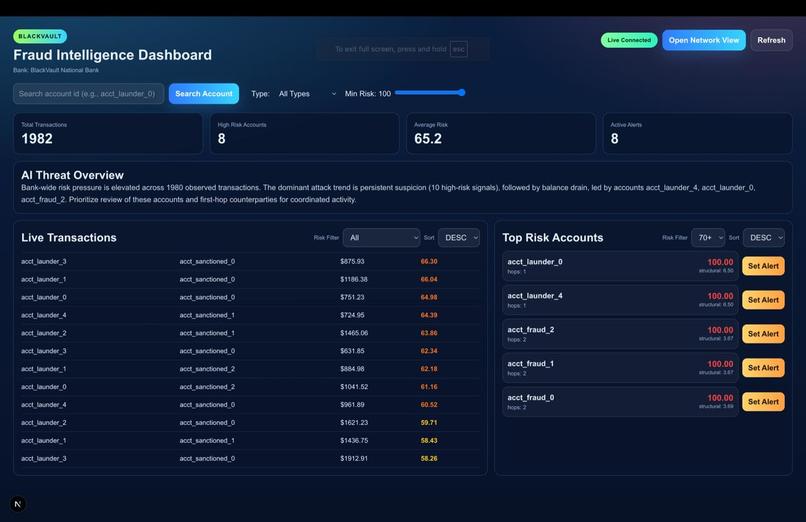
BlackVault Dashboard
🛡️ BlackVault
Real-Time, Graph-Powered Fraud Detection for Modern Banking
## Inspiration
Financial fraud is no longer isolated — it is networked.
Modern fraud rings operate through mule accounts, layered transfers, circular transactions, and distributed low-value activity designed to evade traditional rule-based systems. Most legacy monitoring platforms analyze accounts independently and rely heavily on static thresholds or batch processing.
We were inspired by a fundamental shift in perspective:
Instead of analyzing accounts individually, what if we modeled the financial ecosystem as a network?
Fraud spreads through connections. Risk should be modeled the same way.
That insight became the foundation of BlackVault — a real-time, graph-based risk intelligence platform designed to detect malicious accounts before fraud propagates across the system.
## What it does
BlackVault is a real-time fraud detection engine built for banks.
It:
- Ingests live transaction streams
- Models accounts as nodes in a directed transaction graph
- Assigns dynamic risk scores
- Propagates risk across connected accounts
- Flags suspicious entities instantly
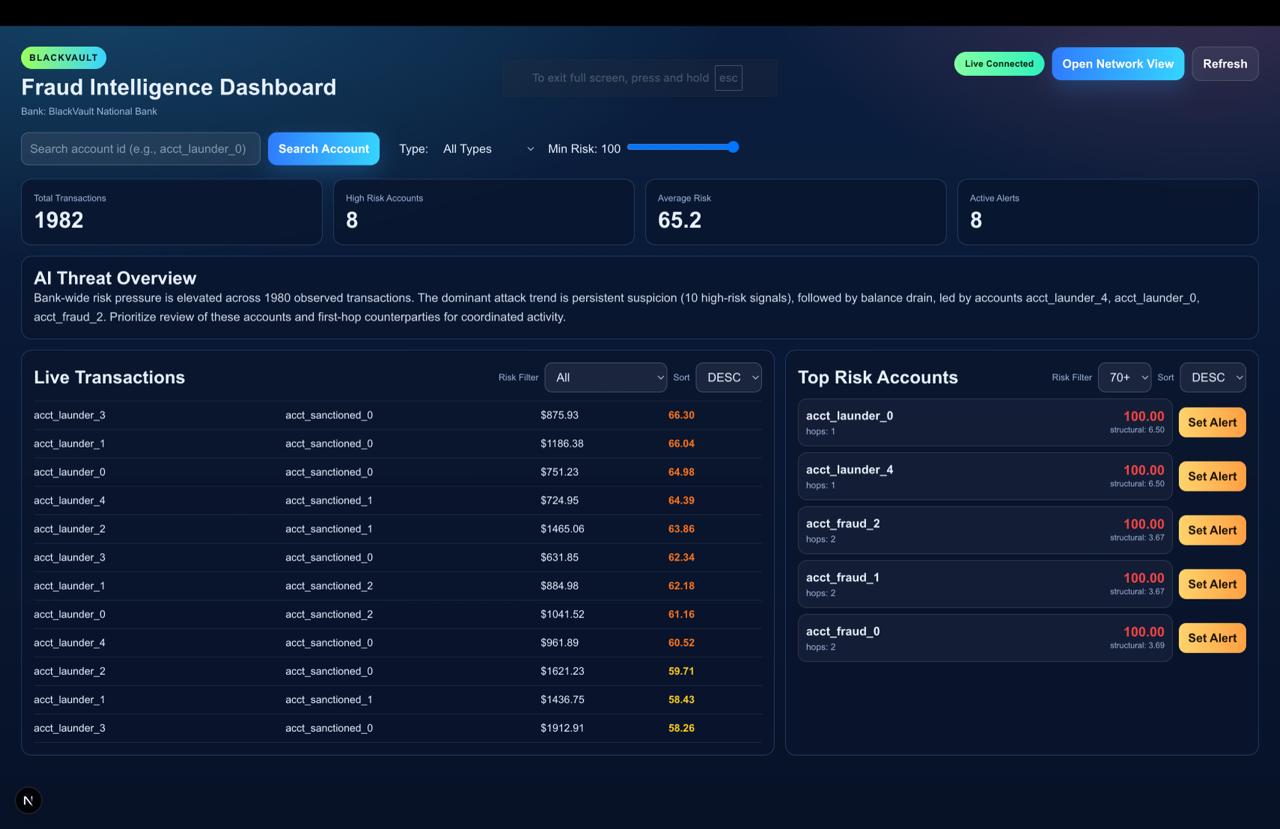
- Visualizes risk through a live dashboard
We represent the transaction ecosystem as:
[ G = (V, E) ]
Where:
- ( V ) = accounts
- ( E ) = transactions
Each account maintains a risk score:
[ R_i(t) = \alpha B_i + \beta V_i + \gamma P_i ]
Where:
- ( B_i ) = behavioral anomaly component
- ( V_i ) = transaction velocity deviation
- ( P_i ) = propagated network risk
- ( \alpha, \beta, \gamma ) = tunable weights
Risk propagates through connected nodes with time decay:
[ P_j = \sum_{i \in N(j)} R_i \cdot e^{-\lambda \Delta t} ]
This enables detection of coordinated fraud rings, not just isolated anomalies.
## How we built it
Backend
We built the backend using FastAPI (Python) for:
- Asynchronous transaction ingestion
- Real-time risk computation
- Deterministic state updates
- REST APIs powering the dashboard
FastAPI allowed us to handle concurrent transaction streams efficiently.
In-Memory Store
We used Valkey as our real-time datastore for:
- Account state
- Risk scores
- Graph adjacency mappings
- Transaction metadata
Valkey provided:
- Sub-millisecond read/write latency
- Atomic updates for consistency
- Concurrency-safe state mutation
This was critical for maintaining deterministic risk scoring under load.
Graph-Based Core Engine
Accounts are modeled as nodes; transactions as directed edges.
We maintain:
- Adjacency mappings
- Edge weights (amount, recency, frequency)
- Node-level behavioral metrics
When a node’s risk increases, connected nodes receive proportional risk adjustments with decay, preventing hidden mule networks from escaping detection.
Transaction Simulator
To test the system, we built a simulator that generates:
- High-velocity transfers
- Circular transaction loops
- Sudden balance spikes
- Structuring patterns
This allowed us to validate risk propagation and stress-test concurrency behavior.
Dashboard
We built a live dashboard displaying:
- Flagged accounts
- Risk score trends
- Live transaction feeds
- Behavioral breakdowns per account
This transforms raw analytics into actionable compliance intelligence.
## Challenges we ran into
1️⃣ Concurrency & State Consistency
Simultaneous transactions caused race conditions during risk updates.
We resolved this by:
- Using atomic operations in Valkey
- Designing deterministic update flows
- Avoiding partial state writes
2️⃣ Risk Over-Propagation
Early propagation models caused risk to spread too aggressively across loosely connected nodes.
We refined this using:
- Time decay functions
- Edge-weight scaling
- Threshold-based propagation limits
This significantly reduced false positives.
3️⃣ Balancing Precision vs Sensitivity
Overly sensitive scoring increased alerts; overly strict scoring missed fraud.
We tuned weight parameters and propagation decay constants to maintain equilibrium between detection accuracy and noise reduction.
## Accomplishments that we're proud of
- Built a fully functional graph-based fraud detection engine
- Achieved real-time risk updates with sub-millisecond state storage
- Implemented risk propagation with decay modeling
- Designed a live monitoring dashboard
- Created a realistic transaction simulator for stress testing
- Demonstrated network-aware fraud detection rather than rule-only evaluation
Most importantly, we built a system that thinks in relationships, not just transactions.
## What we learned
- Fraud detection is fundamentally a network problem
- Real-time systems demand deterministic state management
- Graph modeling significantly improves detection depth
- Explainability is critical in financial risk systems
- In-memory datastores like Valkey are powerful for streaming workloads
We learned that infrastructure design directly impacts detection capability.
## What's next for BlackVault
- Machine learning–based anomaly detection
- Graph clustering for mule network identification
- Multi-institution risk intelligence sharing
- Blockchain transaction ingestion
- Automated AML reporting generation
- Advanced visualization of fraud clusters
Our long-term vision is to evolve BlackVault into a scalable, production-grade fraud intelligence infrastructure for modern financial institutions.
Built With
- docker
- fastapi
- javascript
- python
- typescript
- valkey


Log in or sign up for Devpost to join the conversation.